
Gem and mineral shows are among the most exciting events in the rockhounding world — tables piled with crystals, fossils, rough gemstones, and lapidary work stretching as far as you can see, prices ranging from a few dollars to tens of thousands. They are also, bluntly, the easiest place to accidentally buy something that is not what it appears to be.
This is not always fraud. Many small-scale dealers buy their stock wholesale and resell without the gemological training to independently verify what they are selling. The malachite on their table may genuinely be resin composite — they just don't know that because their supplier didn't tell them. The "real Czech moldavite" may be green glass — and the seller may believe it is genuine. The turquoise bracelet may be dyed howlite — labeled turquoise because that is what the importer called it.
Some sellers do know. Most do not. The result is the same either way: you go home with something that isn't what you paid for.
This guide was written for the gem show floor, not the gemological laboratory. Every test here can be performed at a table in under five minutes, with tools that fit in a jacket pocket. The per-mineral guides cover the 15 minerals most commonly misrepresented at shows, with the specific tests that expose each fake.
Watch first: Our video guide walks through these tests visually, with real specimens and real comparisons.
Watch: How to spot fake gems at a mineral show — field tests demonstrated with real specimens.
Understanding What "Fake" Actually Means
Before testing anything, you need to know what you are testing for. The gemstone market has four categories of "not what it appears to be" — and they are not equally serious.
The four categories of misrepresentation
| Category | Definition | Example | Seriousness |
|---|---|---|---|
| Glass / plastic imitation | Completely different material sold as a gemstone | Glass sold as amethyst, resin sold as amber | Serious — fraud if knowing |
| Natural look-alike substitute | A different but genuine mineral sold as a more valuable one | Dyed howlite sold as turquoise; garnet sold as ruby | Serious — requires disclosure |
| Synthetic / lab-grown | Same chemistry as natural, grown in laboratory | Lab sapphire sold as natural sapphire | Requires disclosure; not fraud if disclosed |
| Treated natural | Genuine mineral enhanced by heat, dye, filling, or coating | Heat-treated amethyst sold as citrine; oiled emerald | Requires disclosure; acceptable if disclosed |
The key principle: Natural, untreated gemstones command the highest prices. Each category above generally reduces value relative to natural, untreated material. Any representation that moves a stone up this hierarchy without disclosure — selling a synthetic as natural, or treated as untreated — is misrepresentation.
What is always acceptable (if disclosed)
Many treatments and enhancements are standard industry practice and are acceptable when disclosed:
- Heat treatment of corundum (ruby and sapphire) — improves color and clarity; used on 90%+ of commercial ruby and sapphire
- Heat treatment of amethyst to produce citrine — this is how most commercial citrine is made
- Oiling / resin treatment of emerald — accepted practice; must be disclosed; significantly reduces value if heavy
- Stabilization of turquoise — hardening with resin to allow use in jewelry; common and accepted; must be disclosed
What is never acceptable is selling treated material as untreated, or one material as another entirely.
What to Bring to a Gem Show — Your Testing Kit
These five items fit in a small pouch, cost under $100 total, and cover the vast majority of faking methods you will encounter at any gem show.
1. 10x Jeweler's Loupe — $10–$30
The single most important tool in your kit. A 10x loupe allows you to examine inclusions, surface texture, and internal structure with enough magnification to identify glass bubbles, dye concentration, and the fibrous structures of natural minerals. The standard jeweler's loupe (triplet, 10x, achromatic lens) is the same tool used by GIA-trained gemologists as their first line of examination.
What to look for:
- Round or elongated gas bubbles = glass
- Curved swirl lines = glass or melt-grown synthetic
- Dye concentrated in cracks and fractures = dyed stone
- Organic, irregular inclusions = natural mineral
- Too-perfect uniformity, zero inclusions = likely synthetic or glass
2. UV Flashlight (Shortwave 254nm + Longwave 365nm) — $20–$50
Many natural minerals have characteristic fluorescence responses that their impostors do not share. A dual-wavelength UV flashlight covers both the shortwave and longwave responses.
Key uses:
- Amber vs. copal vs. plastic (amber fluoresces blue-green; copal fluoresces white/yellow)
- Glass fakes vs. natural gems (glass usually shows no or anomalous fluorescence)
- Calcite vs. look-alikes (calcite fluoresces red-orange reliably)
- Detecting glass-filled fractures in rubies (filled areas show orange flash)
3. Small Strong Neodymium Magnet — $5–$10
Used primarily for two purposes: testing for magnetic minerals (magnetite, pyrrhotite, meteorites containing iron-nickel) and detecting magnetic fillings or coatings in composite stones.
Key uses:
- Distinguishing true meteorites from slag and industrial waste
- Testing gold and silver (neither is magnetic; gold-plated base metal may react)
- Some filled rubies react slightly to magnets
4. Glass Scratch Plate (Small Glass Tile) — $2–$5
A small piece of window glass (or a glass tile from a hardware store) serves as a hardness reference at Mohs 5.5. Any genuine gemstone harder than 5.5 will scratch glass; any imitation softer than 5.5 will not.
How to use: Drag the specimen firmly across the glass tile with steady pressure. A groove that cannot be wiped away means the specimen is harder than glass (Mohs 5.5+). A smear that wipes away means the specimen is the same hardness or softer than glass.
Caution: Do not scratch test valuable faceted specimens — the test creates permanent damage. Reserve it for rough or tumbled material where a small scratch is inconsequential.
5. Cotton Ball + Small Bottle of Nail Polish Remover (Acetone) — $2
Acetone dissolves most commercial stone dyes. Rubbing an acetone-soaked cotton ball on a suspected dyed stone reveals color transfer within seconds. This is the single most reliable field test for dyed turquoise, dyed agate, and reconstituted color-treated minerals.
Carry it in: A small, tightly-sealed glass jar or dedicated acetone-safe container. Store separately from the loupe and electronics.
The Universal 5-Test System — Applicable to Any Specimen
Apply these five tests in sequence whenever you are evaluating an unknown or suspicious specimen. No single test is conclusive; three or more agreeing tests provide strong confidence.
Test 1 — Visual Inspection Under the Loupe
Pick up the specimen and examine it under your 10x loupe. Systematically look at the interior (under direct light, looking through the stone if translucent or transparent), the surface (facet edges, polish quality, surface texture), and any cracks or inclusions you can see.
Glass signatures:
- Spherical or sub-spherical gas bubbles — the most reliable indicator of glass. Natural inclusions are irregular; glass bubbles are round.
- Flow lines or swirl marks (best seen in transmitted light with the loupe)
- Rounded facet junctions — glass and soft plastics cannot hold sharp corners as long as genuine hard gems
Dye signatures:
- Color concentrated in cracks, fractures, and grain boundaries
- Color sitting on the surface rather than distributed throughout the stone
- Unnatural uniformity of color — no zones, no variation, no natural gradation
Synthetic signatures:
- Curved growth lines (best seen in corundum fakes — curved banding rather than angular, natural inclusions)
- Gas bubbles from the melt-growth process
- Chevron patterns in flux-grown ruby and sapphire (require more experience to identify)
What natural looks like: Natural inclusions are random, organic, and diverse — crystals of other minerals, liquid-filled cavities (fingerprints), healed fractures (feathers), silky needle inclusions (rutile in sapphire, amphibole in quartz). They look chaotic because they formed chaotically. Synthetics and glass fakes are either too clean or show systematic patterns that look manufactured.
Test 2 — Temperature Against Your Skin
Press the specimen firmly against your inner wrist or cheek for 10 seconds. Count.
- Natural stone: Feels distinctly cool on contact. Remains cool for 10+ seconds. Warms noticeably slower than air temperature would suggest.
- Glass: Warms faster than natural stone. Usually noticeably warmer than genuine mineral within 5–8 seconds.
- Plastic or resin: Warms almost immediately — within 2–3 seconds it feels like room temperature.
This test is particularly reliable for distinguishing acrylic crystal balls and spheres (which feel almost instantly warm) from genuine quartz spheres (which stay distinctly cool). It is also useful for identifying resin-cast composites and plastic moldavite fakes.
Test 3 — Weight and Density
Hold the specimen in your open palm and feel its weight. Compare mentally to what you would expect from a similar-sized piece of quartz or glass.
Dense minerals feel heavier than expected:
- Hematite (SG 5.3) and galena (SG 7.6) feel dramatically heavy
- Garnet (SG 3.5–4.3) feels noticeably heavier than quartz
- Pyrite (SG 5.0) and malachite (SG 3.9) feel denser than glass
Glass and resin feel lighter than expected:
- Glass SG ≈ 2.5 (similar to quartz at 2.65 — less useful for quartz-family minerals)
- Plastic and acrylic SG ≈ 1.1–1.4 — dramatically lighter than any genuine stone
Most useful for: identifying hollow-cast resin spheres and towers (feel surprisingly light), distinguishing glass hematite from real hematite (glass "hematite" is extremely common — shiny dark spheres — and dramatically lighter than genuine hematite), and spotting plastic moldavite (moldavite has SG ~2.35 — genuinely light, but plastic is even lighter).
Test 4 — Hardness Against Glass
Set your glass tile on a flat surface. Take the specimen and drag a corner or edge firmly across the glass with deliberate pressure.
- Scratch in glass (cannot be wiped away): Specimen is harder than 5.5 on the Mohs scale — consistent with most genuine gemstones.
- Smear that wipes away: Specimen is the same hardness as glass or softer — eliminates most genuine hard gemstones from consideration.
- Critical caution: Glass itself can leave a convincing-looking smear on glass — wipe the mark with a finger before concluding. A true scratch has a groove; a smear disappears.
- Limitations: This test cannot distinguish between different minerals that are all harder than glass. It eliminates soft impostors (dyed howlite for turquoise — howlite is Mohs 3.5 and is easily scratched) but cannot tell you what the harder mineral actually is.
Test 5 — Dye Test with Acetone
For any specimen where dye is suspected, soak a cotton ball in acetone and rub firmly against the back or base of the specimen.
- Color transfers to cotton: Dyed stone — the color is a surface or fracture-applied coating that dissolves in acetone.
- No transfer: Color is either natural (internal) or a permanent sintered glaze. Note that some permanent dye treatments are acetone-resistant — a negative result does not guarantee natural color, but a positive result definitively identifies dye.
Most useful for: turquoise vs. dyed howlite or magnesite, dyed agate slabs, dyed quartz geodes, and malachite composites with dyed filler.
15 Specific Mineral Fakes Exposed
These are the minerals most commonly misrepresented at gem and mineral shows, in rough order of how frequently the issue is encountered.
1. Moldavite — The Most Faked Mineral in the Current Market

What it is: A tektite — natural glass formed approximately 15 million years ago when a large meteorite struck what is now the Czech Republic. The impact melted rock and soil and threw it into the atmosphere; it fell back as glass droplets. Genuine moldavite is found only in a defined strewn field across parts of the Czech Republic, Austria, and Germany.
Why it is so frequently faked: The moldavite market exploded with the rise of crystal healing culture. Demand dramatically outstripped the finite Czech supply, and the price rose to $15–$50+ per gram for quality pieces. Green glass is inexpensive to produce and visually similar. Estimates suggest that up to 80–90% of "moldavite" currently circulating in the retail market is glass.
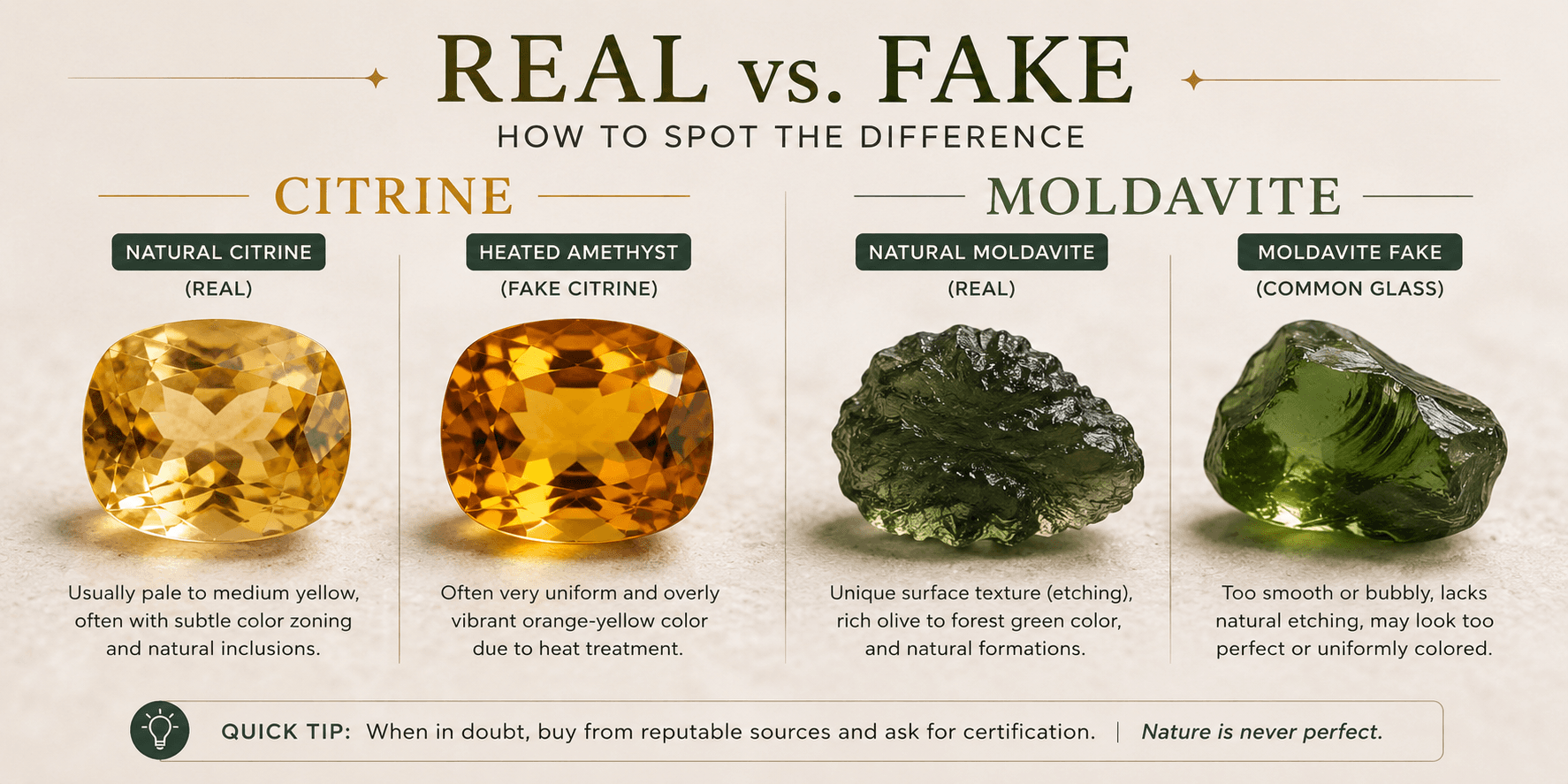
How genuine moldavite looks: Olive-green to forest-green, occasionally brownish-green or pale green, with a distinctive surface texture — deeply pitted, wrinkled, and sculpted from aerodynamic forces during its flight through the atmosphere and subsequent chemical etching over millions of years. This surface sculpture (called lechatelierite texture) is irregular and three-dimensional, not a uniform pattern.
Tests:
- Under the loupe: Natural moldavite contains flow structures, lechatelierite inclusions (silica glass rods from melted quartz grains), and occasional bubble elongations — all from the violent thermal event of its formation. Glass fakes often contain spherical gas bubbles — the most common telltale sign. Some sophisticated glass fakes are deliberately etched to simulate the surface texture; genuine etching looks organic, artificial etching looks repetitive and mechanical.
- Weight: Moldavite has a specific gravity of approximately 2.35 — notably light for its size, lighter than quartz (2.65). If a "moldavite" piece feels like quartz or heavier, it is suspect.
- Temperature: Like any glass (which moldavite technically is), genuine moldavite is not dramatically cool to the touch. This test is most useful for identifying plastic fakes.
- Provenance: Buy only from dealers who can document specific Czech mine provenance. The Czech Moldavite Association provides certification.
The bottom line: Do not buy moldavite from any vendor who cannot provide documented Czech provenance. The market is saturated with glass fakes at every price point.
2. Turquoise — Dyed Howlite, Magnesite, and Stabilized Composites

What it is: Genuine turquoise is a hydrated copper aluminum phosphate mineral with a distinctive blue-green color from copper. High-quality natural turquoise is genuinely scarce and valuable. Most inexpensive "turquoise" sold at gem shows is something else entirely.
Common substitutes:
- Dyed howlite: White, gray-veined howlite takes dye readily and becomes almost indistinguishable from turquoise to the naked eye. This is by far the most common substitute.
- Dyed magnesite: Similar to howlite substitution — white magnesite dyed blue or green.
- Stabilized turquoise: Real but low-grade, chalky turquoise hardened with resin so it can be cut and polished. Standard practice; must be disclosed.
- Reconstituted turquoise: Powdered turquoise (or howlite) mixed with resin binder and pressed into blocks. Very common in inexpensive jewelry.
- Plastic imitation: Simple plastic molded and colored to look like turquoise.
Tests:
- Acetone test: The most reliable single test. Rub an acetone-soaked cotton ball firmly on the back of the specimen for 10 seconds. Dyed howlite transfers a vivid blue-green color to the cotton immediately. Natural turquoise transfers nothing.
- Hardness test: Natural turquoise is Mohs 5–6 (cannot be scratched easily by a knife blade). Dyed howlite is Mohs 3–3.5 (scratched easily by a knife blade and even a fingernail).
- Visual under loupe: Natural turquoise has a characteristic matrix of brown to black veining that runs through the stone organically, with the turquoise color occurring in the mineral itself. Dyed stones often show the opposite pattern — vivid color concentrated in the veins (where the dye seeps in) with the base mineral remaining lighter colored at the surface.
- Matrix appearance: Natural turquoise matrix is typically black (iron pyrite or manganese oxide) or brown (iron oxide) — natural-looking, irregular veins. Plastic and reconstituted material often has artificially uniform or too-symmetric "veining."
3. Amber — Copal, Plastic, and Glass Fakes

What it is: Amber is fossilized tree resin, typically 25–50+ million years old. Prized for its warm golden-orange color, its frequent insect and plant inclusions, and its ancient provenance. Major sources include the Baltic region, the Dominican Republic, and Myanmar.
Common substitutes:
- Copal: Young, non-fossilized resin — sometimes hundreds, sometimes thousands of years old, but not millions. Chemically similar to amber but not fully polymerized. Often contains insect inclusions that are sometimes artificially inserted.
- Plastic (Bakelite, polystyrene, celluloid): Various plastics have been sold as amber for over a century. Modern plastics are particularly convincing in color but fail simple tests.
- Glass: Rare now but occasionally encountered.
Tests:
- Salt water test (most reliable for plastic and copal): Dissolve 2 heaped tablespoons of table salt in a cup of water and stir thoroughly. Place the suspected amber in the salt water. Real amber and copal float (SG ~1.0–1.1 for both; salt water SG ~1.13). Most plastics float too, though some heavier plastics may sink. Glass sinks (SG ~2.5). This test cannot distinguish amber from copal — both float — so use the tests below to differentiate.
- UV fluorescence test: Under shortwave UV light, real amber fluoresces vivid blue to blue-green; copal fluoresces white, pale yellow, or shows a much weaker blue response; plastic typically shows no fluorescence, or an unusual color.
- Hot needle test (use with care — destructive on a small scale): Heat a metal needle until hot (not glowing) and touch it to a hidden spot on the specimen. Amber produces a fragrant, resinous smoke with a characteristic piney/sweet smell and resists the needle. Copal melts more easily with a similar but more acetone-like smell. Plastic gives off an acrid, chemical smell and melts readily. Glass cannot be pierced and produces no smoke.
- Surface feel and look: Old amber has a slightly different surface quality than copal — more resinous, more patinated. Copal often looks slightly too fresh or too perfect. Under the loupe, genuine Baltic amber often shows natural surface cracks (crazing) from age.
- Inclusions (insect): Real insect inclusions in amber are extremely rare and valuable. Many inclusions sold in "amber" are actually in copal or are completely faked (plastic with an insect glued inside, then cast). Authentic inclusions show the insect in a death position consistent with getting trapped in resin — wings often spread or partially extended, struggling posture. Faked inclusions often show the insect in too-perfect position.
4. Opal — Doublets, Triplets, and Glass Imitations

What it is: Precious opal is amorphous silica displaying a spectacular play of spectral colors (fire) from diffraction of light by a regular internal structure of silica spheres. Genuine precious opal is valuable — especially black opal, which can reach $10,000+ per carat for top grade. Many common "opals" at shows are assembled fakes.
Common substitutes:
- Opal doublet: A thin slice of natural precious opal cemented to a dark backing material (usually black potch opal, onyx, or plastic) to enhance the play-of-color. The opal is real but thin; the backing is artificial. Worth far less than a comparable solid opal, though at face value it can be visually stunning.
- Opal triplet: Like a doublet but with a quartz dome cemented on top for protection and magnification of the fire. Even less valuable than doublets; frequently sold without disclosure.
- Glass imitation: Several glass compositions can simulate opal's fire. Most are obviously glass under a loupe — too perfect, wrong color distribution.
- Synthetic opal (Gilson, Kyocera): Lab-created opal with genuine play-of-color. Distinctly different internal structure under magnification — more "reptile skin" or "chicken wire" pattern compared to the broader, more irregular color patches in natural opal.
Tests:
- Side-view inspection: View the opal from the side, not just the top. A doublet shows a distinct dark bottom layer with a sharp horizontal join line — often visible with the naked eye if you look directly at the side of the stone in good light. Solid natural opal shows a consistent internal appearance throughout.
- Water immersion: Submerging a doublet or triplet in water often causes the cemented layers to separate at the seam, or reveals the join clearly.
- Under the loupe: Natural opal shows irregular, three-dimensional play-of-color of varying patch sizes with some cloudiness and no visible layers. Doublets/triplets show a visible seam line and dark backing from the side. Synthetic Gilson opal shows a regular "columnar" structure. Glass shows uniform color, possibly gas bubbles, and no depth to the fire.
- Back surface: Natural opal has a consistent opal matrix or potch on its back. Doublets and triplets have an artificial black or dark backing — often plastic, resin, or black potch in a flat, uniform layer. Run your fingernail across the back — natural opal matrix feels consistent; artificially applied backings may have a slightly different texture or a slight raised edge at the seam.
5. Amethyst — Heat-Treated Fakes and Dyed Glass

What it is: Amethyst is purple quartz — the color comes from irradiation of trace iron impurities. Large crystals and geodes are widely available. Most "amethyst" at shows is genuine; the main issues are:
- Glass sold as amethyst: Purple glass, often with deliberate bubbles or inclusions, sold as natural amethyst crystal. Easy to spot under a loupe — glass bubbles are perfectly spherical; natural quartz inclusions are irregular.
- Dyed glass or dyed clear quartz: Purple dye applied to clear quartz or glass. The acetone test reveals color transfer.
- Synthetic amethyst sold as natural: Lab-grown amethyst with identical chemistry to natural. Identified under magnification by curved growth lines (as opposed to angular growth zones in natural amethyst) and sometimes by chevron patterns. Requires experience or professional examination for certain identification.
- "Heat-treated amethyst" sold as citrine: Most commercial "citrine" (yellow quartz) is actually amethyst heated to 470–750°C, converting the purple iron-color center to yellow or brownish-orange. Natural citrine is rare and typically pale yellow to lemon-yellow; commercial citrine that is deep yellow-orange or brownish is almost certainly heat-treated amethyst. This is a treatment that reputable sellers disclose — though many do not.
Tests:
- Under the loupe: Natural amethyst often shows color zoning (purple and white/clear zones in angular patterns parallel to crystal faces), natural fractures, and irregular inclusions. Glass fakes show spherical bubbles and too-uniform color. Dyed stones show color concentrated in cracks and a positive acetone test.
- Citrine vs. heat-treated amethyst: Hold the stone up to light. Heat-treated amethyst typically has an orange-brown tone concentrated particularly at the tip of the crystal and fading toward the base. Natural citrine is a pale, more uniform yellow throughout. Brazil's mines produce virtually all commercial citrine, and most of it is heat-treated amethyst — even from reputable Brazilian dealers.
6. Dyed Howlite — Sold as Turquoise, Lapis, and Red Coral

What it is: Howlite is a white to gray boron silicate mineral with distinctive gray veining. Its soft, porous nature makes it ideal for absorbing dye. It is routinely dyed to imitate turquoise (blue-green), lapis lazuli (deep blue), and red coral (red-orange).
Why it matters beyond turquoise: Many gem show visitors know to watch for howlite passed off as turquoise. Fewer know that the same material, dyed deep blue, is sold as lapis lazuli at many shows. Real lapis lazuli (a metamorphic rock rich in lazurite mineral) contains pyrite flecks — if the "lapis" has no pyrite sparkle and dye transfers with acetone, it is dyed howlite.
Tests:
- Acetone test: immediate blue, green, or red color transfer on cotton
- Hardness: Mohs 3–3.5 (easily scratched by a knife blade)
- Weight: lighter than genuine lapis (SG 2.7–2.9 vs. howlite SG ~2.5)
- Under UV: howlite fluoresces blue-white under UV; genuine turquoise typically does not fluoresce (or shows a weak response)
7. Glass "Hematite" — One of the Most Common Fakes at Any Show

What it is: Genuine hematite is an iron oxide mineral (Fe₂O₃) with a specific gravity of 5.3 — dramatically heavy for its size, with a distinctive reddish-brown streak. The most common form sold at gem shows as "hematite" — shiny, dark metallic spheres, tumbled stones, and beads — is actually glass or synthetic material.
The tell: weight. Genuine hematite feels shockingly heavy. A hematite sphere the size of a marble feels like it should be the size of a pool ball. "Hematite" that feels ordinary — similar to a plastic bead or quartz stone of the same size — is not genuine hematite.
The common synthetic material sold as hematite is actually a manufactured iron-containing glass called "hemalyke" or "magnetic hematite" — often agglomerated iron powder in a resin matrix, sometimes slightly magnetic (natural hematite is not strongly magnetic). The label "magnetic hematite" should be treated as a warning that what you are buying may not be natural mineral hematite.
Tests:
- Weight: genuine hematite (SG 5.3) should feel dramatically heavy
- Streak: genuine hematite leaves a red to red-brown streak; most fakes leave a dark gray or no streak
- Magnet: natural hematite is only weakly magnetic or non-magnetic; strong magnetism in "hematite" is a red flag
8. Malachite Composites and Resin Fakes

What it is: Genuine malachite is a vivid green copper carbonate mineral with characteristic banded patterns, produced by concentric growth zones. Collectible slabs, cabochons, and polished specimens are popular.
Common fakes:
- Powdered malachite mixed with resin binder, pressed into blocks — produced primarily in China; looks convincing but has different weight and surface quality
- Dyed green stones sold as malachite (chrysocolla-colored plastic, dyed calcite)
- Resin with malachite-like green dye and printed pattern
Tests:
- Acid test (dilute HCl or vinegar): Genuine malachite fizzes vigorously in dilute acid (it is a carbonate mineral — same acid reaction as calcite). Resin composites and glass fakes do not fizz.
- Weight: Natural malachite has SG ~3.9 — noticeably heavy. Resin composites are significantly lighter (SG ~1.5–2.5 depending on mineral content).
- Under loupe: Natural malachite banding is three-dimensional and penetrates the full thickness of the specimen. Printed or surface-applied patterns appear flat and can show pixelation or too-regular repeat.
- Temperature: Resin composites warm noticeably faster than genuine dense mineral material.
9. Citrine — Almost Universally Heat-Treated

The disclosure issue: Approximately 90–95% of commercial citrine is heat-treated amethyst. This is widely known in the trade and widely undisclosed at retail level. Genuine natural citrine is pale yellow to lemon-yellow; deep orange-yellow to brownish "Madeira" citrine is virtually always heat-treated amethyst from Brazil.
What to ask: Ask the seller directly, "Is this heat-treated amethyst or natural citrine?" A knowledgeable and honest seller will tell you. Natural citrine commands a premium; heat-treated is more common and less valuable — but the material itself is genuine quartz either way.
How to identify heat-treated amethyst: Under the loupe, look at the crystal tip. Heat-treated amethyst often shows an orangey-brown color concentration toward the termination, fading to paler yellow or clear toward the base. Natural citrine tends to have a more uniform pale lemon-yellow throughout. The characteristic brownish undertone of most commercial citrine is essentially diagnostic of heat treatment.
10. "Lava Stone" Beads — Usually Basalt, But Check

The issue: "Lava stone" is a legitimate, if informal, name for porous basaltic volcanic rock used in bead jewelry. Genuine basalt lava beads are real volcanic rock and are inexpensive — there is no meaningful monetary motivation to fake them. However, some beads sold as "lava stone" or "volcanic rock" are actually porous resin molded to look like the porous texture of basalt.
Test: Weight and temperature. Genuine basalt (SG ~3.0) is noticeably heavier than resin beads of the same size. Resin warms immediately to skin temperature; basalt stays cool longer.
11. Larimar — Caribbean Blue Pectolite (Only from the Dominican Republic)
What it is: Larimar is a rare blue variety of pectolite found only in one limited area in the Dominican Republic (Los Chupaderos mine, Barahona Province). Its distinctive sky-blue to turquoise color and soft, wavy texture patterns make it a popular collector mineral.
Common fakes:
- Blue-dyed howlite or magnesite (same as the turquoise substitutes)
- Blue calcite sold as larimar
- Resin composites
Tests:
- Hardness: genuine larimar is Mohs 4.5–5 — slightly harder than howlite (3–3.5)
- Pattern under loupe: natural larimar shows a distinctive radiating or swirling "volcanic" pattern of white and blue zones; howlite substitutes show a different veining character
- Acetone test: blue dye transfers on howlite or magnesite fakes
- Weight: larimar (SG ~2.7–2.9) is somewhat heavier than typical howlite
- Origin documentation: reputable dealers source from the Dominican Republic and can often provide provenance information
12. Meteorite — Slag, Iron Ore, and "Meteor-Wrongs"
What it is: Genuine meteorites are extraordinarily rare and valuable — fragments of asteroids, the Moon, and Mars that survived atmospheric entry. Iron-nickel meteorites, stony meteorites, and stony-irons are all encountered at gem shows; prices range from $1 to $10,000+ per gram depending on type and classification.
The "meteor-wrong" problem: The vast majority of rocks offered as meteorites at shows are terrestrial — magnetite-rich iron ore, industrial slag, iron-rich sandstone concretions, welding slag — all mistaken for or deliberately mislabeled as meteorites.
Genuine meteorite characteristics:
- Widmanstätten pattern: Genuine iron-nickel meteorites (octahedrites) show a distinctive crystalline pattern of interlocking nickel-iron bands when cut, polished, and acid-etched. This pattern takes millions of years to form and cannot be faked.
- Fusion crust: Fresh meteorites have a thin, black, glassy fusion crust — the melted exterior from atmospheric entry. Older meteorites may have weathered crust.
- Regmaglypts: Thumbprint-like surface depressions on iron and some stony meteorites, formed by ablation during atmospheric entry.
- The magnet test: Most genuine meteorites are strongly attracted to a magnet — iron-nickel meteorites very strongly; most stony meteorites contain sufficient metallic mineral to show some attraction. Industrial slag may also attract magnets, so this test confirms probable meteorite material but does not eliminate all terrestrials.
- Streak: Iron meteorite leaves a dark gray to black metallic streak; iron ore and slag may leave similar streaks, so this test is not definitive on its own.
- Weight: Genuine iron meteorites (SG 7.5–8) are extremely dense — much heavier than their size suggests.
The responsible approach: Any meteorite purchase of significant value should come with a classification number (assigned by the Meteoritical Society's Meteoritical Bulletin) or documentation from a recognized meteoritics laboratory.
13. Kyanite — Occasionally Confused with Iolite and Aquamarine
What it is: Kyanite is a blue aluminosilicate mineral notable for its unusual property of variable hardness — approximately Mohs 5.5 parallel to the crystal length but Mohs 7 perpendicular to it. This anisotropy is diagnostic: if a blade scratches the blue mineral along its length easily but not across its width, it is almost certainly kyanite.
The issue: Kyanite's vivid blue color and bladed crystal habit make it a popular collector mineral. It is sometimes confused with iolite or sold as "blue sapphire matrix." Kyanite is genuine and has legitimate value as a collector mineral and occasionally as a gem; the concern is misidentification, not typically deliberate fraud.
Tests: The directional hardness test is definitive. Kyanite is also distinctly bladed (flat, elongated crystals) rather than the hexagonal prisms of sapphire.
14. Selenite and Desert Rose Gypsum — Dyed "Rare" Varieties
The issue: Genuine selenite (clear crystalline gypsum) and desert rose gypsum are common and inexpensive. Dyed versions — blue, purple, black — are sold at premium prices as "rare colored selenite," "black moonstone," or other creative names that obscure their true identity.
Tests:
- Hardness: gypsum is Mohs 2 — scratched easily by a fingernail. Any "crystal" scratched by your fingernail is likely gypsum or a similar soft mineral.
- Acetone test: dye transfers on dyed specimens
- UV: natural selenite fluoresces under UV; check the consistency of fluorescence across a dyed specimen (dye may block or change fluorescence in treated areas)
Naming alert: "Black kyanite" (a legitimate mineral), "black selenite," and "black moonstone" — when these names appear on dyed white gypsum, the naming is the misrepresentation. Ask to scratch it with your fingernail.
15. Pyrite and Chalcopyrite — Sold as Gold
What it is: Pyrite (iron sulfide, "fool's gold") and chalcopyrite (copper iron sulfide, often iridescent gold-yellow) are commonly sold as gold nuggets, gold-in-quartz specimens, or gold ore by sellers who may genuinely not know the difference.
This one matters: Gold is worth ~$60–80 per gram. Pyrite is worth essentially nothing monetarily. A "gold nugget" that is actually pyrite has a profound value difference.
Tests:
- Malleability: gold dents under a pin; pyrite shatters
- Streak: gold leaves a gold-yellow streak; pyrite leaves greenish-black
- Specific gravity: gold (SG 19.3) is about 4x heavier than pyrite (SG 5.0)
- Hardness: pyrite is Mohs 6–6.5 and scratches glass; gold is soft (Mohs 2.5–3) and does not
See the full gold identification guide in our gold prospecting article.
Red Flag Behaviors — When the Seller Is the Warning Sign
Beyond testing the stones themselves, knowing what seller behavior to watch for protects you at shows before a single test is run.
Behavioral red flags
- Vague or evasive answers to direct questions. Any straightforward question — "Is this heat-treated?" "Is this natural or lab-grown?" "Where was this sourced?" — should get a direct answer. "I'm not sure" is acceptable from a small dealer. "All our stones are natural" followed by an immediate change of subject is a red flag.
- Resistance to physical inspection. A genuine seller of genuine material has no reason to object to you examining a stone under your loupe, testing its temperature, or using your glass plate. Any objection to non-destructive testing — beyond reasonable concern about dropping an expensive piece — warrants caution.
- Resistance to the acetone test. This one is specific and significant. An acetone test on the back of a turquoise piece, a malachite slab, or a dyed stone takes ten seconds and harms nothing. If a seller objects strongly to this test, they know the dye will transfer.
- "Too good to be true" pricing. Fine natural gemstone material has a floor price set by rarity. A large, flawless natural amethyst cluster at $5 is fine — amethyst is common. A large, vivid paraíba tourmaline at $20 is not — genuine paraíba starts at $500/carat retail. A 50-carat "natural ruby" for $30 is impossible. If you do not know typical market prices for a gem, look it up before the show — or before you spend significantly.
-
Names that obscure identity. The gem trade has a long history of marketing names that inflate perceived value:
- "Mexican jade" → Green dyed onyx or calcite (not jade)
- "African turquoise" → Jasper (not turquoise)
- "Swiss lapis" → Dyed jasper (not lapis)
- "Siberian jade" → Green nephrite (potentially real jade — but the regional modifier inflates price)
- "Volcano citrine" or "Madeira citrine" → Almost certainly heat-treated amethyst
- "Magnetic hematite" → Likely synthetic agglomerate, not natural hematite
- "Swarovski crystal" → Lead glass (not natural crystal) — but Swarovski is a legitimate brand; the issue is calling it "crystal" to imply quartz
- Rushed or pressured selling. "This is the last one." "Someone else is looking at this." "Today only." "I'll give you a deal if you decide right now." Pressure tactics are designed to prevent you from thinking clearly, asking questions, or running tests. Walk away and come back — if the stone is genuinely still there when you return, it will still be there after you test it.
- Inflated provenance claims without documentation. "This is from the original Tucson find." "This came from a closed mine." "This is from a private collection of a famous mineralogist." These claims may be true — or they may be decoration. Ask for documentation, the name of the collection, the mine, the provenance paper. Legitimate provenance has documentation; fabricated provenance usually dissolves into vagueness when pressed.
The Right Questions to Ask at Any Table
These specific questions, asked directly, separate knowledgeable sellers from evasive ones and elicit the information you need.
Questions about identity
- "What is the mineralogical name of this?" (Not the trade name — the mineral species name)
- "What is the chemical composition?" (A knowledgeable seller knows their minerals)
- "Is this natural, synthetic, or treated?"
- "Is this solid material or a composite (doublet, triplet, backed, filled)?"
Questions about treatment
- "Has this been heat-treated?"
- "Has it been oiled, resin-filled, or wax-coated?"
- "Is the color natural or dyed/enhanced?"
- "Is this stabilized or reconstituted?" (For turquoise especially)
Questions about provenance
- "Where was this mined?" (Country of origin — not just "South America" or "Africa")
- "Do you have any documentation for this?"
- "For moldavite: do you have Czech certification?"
- "For meteorite: does this have a classification number?"
Questions about testing
- "May I examine this under my loupe?" (Any reputable dealer says yes)
- "Can I do a quick temperature test?" (Any reputable dealer says yes)
- "Can I do an acetone test on the back?" (Reputable dealers of natural unstained material say yes; sellers of dyed stones may object)
A Word About Honest, Unknowing Sellers
The majority of gem show sellers who have fakes or misrepresented material on their tables did not set out to deceive anyone. They bought their stock from a wholesale supplier, were told it was what it is, and are passing on that identification in good faith. This is not an excuse for misrepresentation — the seller is responsible for verifying what they sell — but it does mean that when you identify a potential problem with something on a table, a calm, factual conversation is the right approach.
"I think this might be dyed — can I try an acetone test?" is always more productive than an accusation. Most sellers who genuinely believed their stock was authentic respond to a positive dye test with curiosity and concern, not hostility. They have been deceived too.
The confrontational response — objection, hostility, refusal to test — is the one that should cause you to walk away.
When to Seek Professional Certification
Field tests eliminate most fakes and misrepresentations. For high-value purchases, they are not sufficient on their own. When should you invest in professional gemological certification?
When the value justifies it: Any colored gemstone purchase over $500, any diamond over 0.5 carat, any rare mineral specimen priced over $1,000. GIA reports run $50–$200 depending on stone type; AGL, Gübelin, and GRS are preferred for high-value colored stones.
For treatment disclosure: If you are specifically paying a premium for an untreated ruby, sapphire, or emerald, only a gemological laboratory report can confirm treatment status definitively. The methods for detecting heat treatment in corundum (UV-Vis spectroscopy, infrared spectroscopy) require laboratory equipment.
Major gemological laboratories:
- GIA (Gemological Institute of America): Most recognized worldwide
- AGL (American Gemological Laboratories): Excellent for colored stone origin determination
- Gübelin Gem Lab: Top tier for sapphire and ruby origin determination
- GRS (Gem Research SwissLab): Widely used for ruby and sapphire
An important note: Bring the stone to the laboratory yourself if possible, or ship insured. Never accept a certificate that was not issued for the specific stone you are buying — a fraudulent practice exists where genuine certificates from other stones are presented with impostors.
Building Your Eye — Developing Long-Term Fake Detection Skills
No guide substitutes for experience with genuine specimens. The fastest way to develop reliable identification skills is deliberate exposure to known authentic material.
Visit natural history museum mineral collections. The Smithsonian's mineral collection, the Denver Museum of Nature & Science, and the American Museum of Natural History all display documented, authenticated specimens of virtually every mineral you will encounter at shows. Examining labeled genuine material sets your mental baseline.
Buy low-cost reference specimens of common minerals. Spend $50–100 at a reputable mineral dealer on small, documented specimens of the minerals most commonly faked: genuine turquoise (labeled and sourced), real amber (with provenance), genuine moldavite (with Czech documentation), and natural amethyst. These become your physical comparison standards.
Handle as much material as possible. Weight, temperature, surface feel, and luster are properties learned through repeated handling. The more genuine specimens you handle, the more immediately you notice when something does not feel right.
Join a mineral club. Experienced club members are the fastest source of practical identification knowledge. The identification sessions at club meetings — where members bring unknown specimens and the group identifies them together — are an ideal learning environment. Club members have also encountered the same fakes you will see at shows and know what to watch for locally.
→ Find a rockhounding club near you
The Pre-Show Checklist
Print or bookmark this checklist before your next gem show.
Pack
- 10x jeweler's loupe
- Dual-wavelength UV flashlight (shortwave + longwave)
- Small neodymium magnet
- Small glass tile (hardness reference)
- Cotton balls + small sealed jar of nail polish remover (acetone)
- Phone with mineral pricing apps or bookmarks
- This guide bookmarked on your phone
At the show
- Handle before you buy — weight, temperature, look
- Ask the mineralogical name for every item you are seriously considering
- Ask treatment status directly: "Is this natural and untreated?"
- Loupe any gemstone over $20 before buying
- Acetone test turquoise, malachite, howlite, and brightly colored specimens
- Magnet test any "hematite" or "meteorite"
- Walk away from pressure tactics
- Compare prices across multiple vendors before buying anything significant
Before paying significant money
- Research current market prices for the specific mineral and quality
- Ask for documentation (moldavite, meteorites, high-value gems)
- Consider whether the price reflects what the stone actually is
- For purchases over $500, consider professional certification
Frequently Asked Questions
How can you tell if a gemstone is real or fake?
Five field tests catch most fakes: (1) Visual inspection under a 10x loupe — look for air bubbles (glass), dye in cracks (treated), or too-perfect uniformity (synthetic); (2) Temperature test — real stone stays cool against skin for 10+ seconds; plastic warms in 2–3 seconds; (3) Weight — natural stones are generally denser than glass or plastic of the same size; (4) Hardness against glass — real gems are usually harder than glass (Mohs 5.5); (5) Acetone dye test — dyed stones transfer color to acetone-soaked cotton. No single test is conclusive — use at least three together.
What are the most commonly faked gems at mineral shows?
The most frequently misrepresented minerals are: moldavite (rampant glass fakes — assume fake until proven otherwise with Czech provenance), turquoise (dyed howlite or magnesite is the norm at low price points), amber (copal or plastic), opal (doublets and triplets sold as solid natural opal), malachite (resin composites), glass "hematite" spheres (dramatically lighter than genuine hematite), and meteorites (slag and iron ore sold as space rocks).
How do I know if my turquoise is real?
Three tests: (1) Acetone test — dye transfers from dyed howlite/magnesite; natural turquoise transfers nothing; (2) Hardness — natural turquoise Mohs 5–6; dyed howlite Mohs 3–3.5 (easily scratched); (3) Matrix observation under loupe — natural turquoise has a three-dimensional matrix where the turquoise color is in the mineral itself; dyed stones show color concentrated in surface cracks.
How can I tell if moldavite is real?
Moldavite is the most faked mineral currently sold at gem shows. Look for: (1) Characteristic surface sculpture — deeply pitted and wrinkled from chemical weathering over 15 million years; a too-smooth surface is a red flag; (2) Under loupe — natural moldavite shows flow structures and lechatelierite rods; glass fakes show spherical gas bubbles; (3) Documented Czech provenance — buy only from dealers with supplier documentation. Assume any "moldavite" without provenance is glass.
How do I spot fake amber?
Three reliable tests: (1) Salt water float test — real amber floats in saturated salt water; glass sinks; (2) UV fluorescence — genuine amber fluoresces blue-green; copal fluoresces white/yellow; plastic shows no significant fluorescence; (3) Hot needle test — real amber produces piney, resinous smoke; plastic produces an acrid chemical smell.
What tools should I bring to a gem and mineral show?
A five-item kit: 10x loupe ($10–30), UV flashlight ($20–50), small neodymium magnet ($5), glass scratch tile ($2–5), and cotton balls with nail polish remover/acetone ($2). Total cost under $100. These five tools address the most common faking methods at any gem show.
Is it legal to sell fake gemstones at gem shows?
Selling misrepresented stones constitutes fraud when done knowingly. FTC guidelines require disclosure of synthetic status, treatments, and imitations. In practice, enforcement is rare at individual show level. Many sellers genuinely do not know their stock's true identity. Your best protection is knowing how to test material yourself.
Related Guides on Rockhounding.org
- 50 Most Valuable Gemstones & Minerals in the U.S. — Locations & Values
- What Rocks Are Worth Money? — Identify & Value Your Finds
- Mohs Hardness Scale — Complete Chart, 60+ Minerals & Field Testing Guide
- How to Identify Minerals and Rocks — Complete Field Guide
- 7 Best Rock Identification Apps 2026 — Tested & Ranked
- Tiger's Eye — Geology, Identification & How to Tell If It's Real
- Find Gold Near You — How to Tell Real Gold from Fool's Gold
- Rockhounding Clubs in the USA — Find Your Local Community
Article published July 2026. Gemstone market conditions, pricing, and fraud patterns evolve — return to this guide periodically for updates. If you encounter a specific mineral misrepresentation pattern at a show that is not covered here, let us know through our community forum, and we will add it to the next update.