
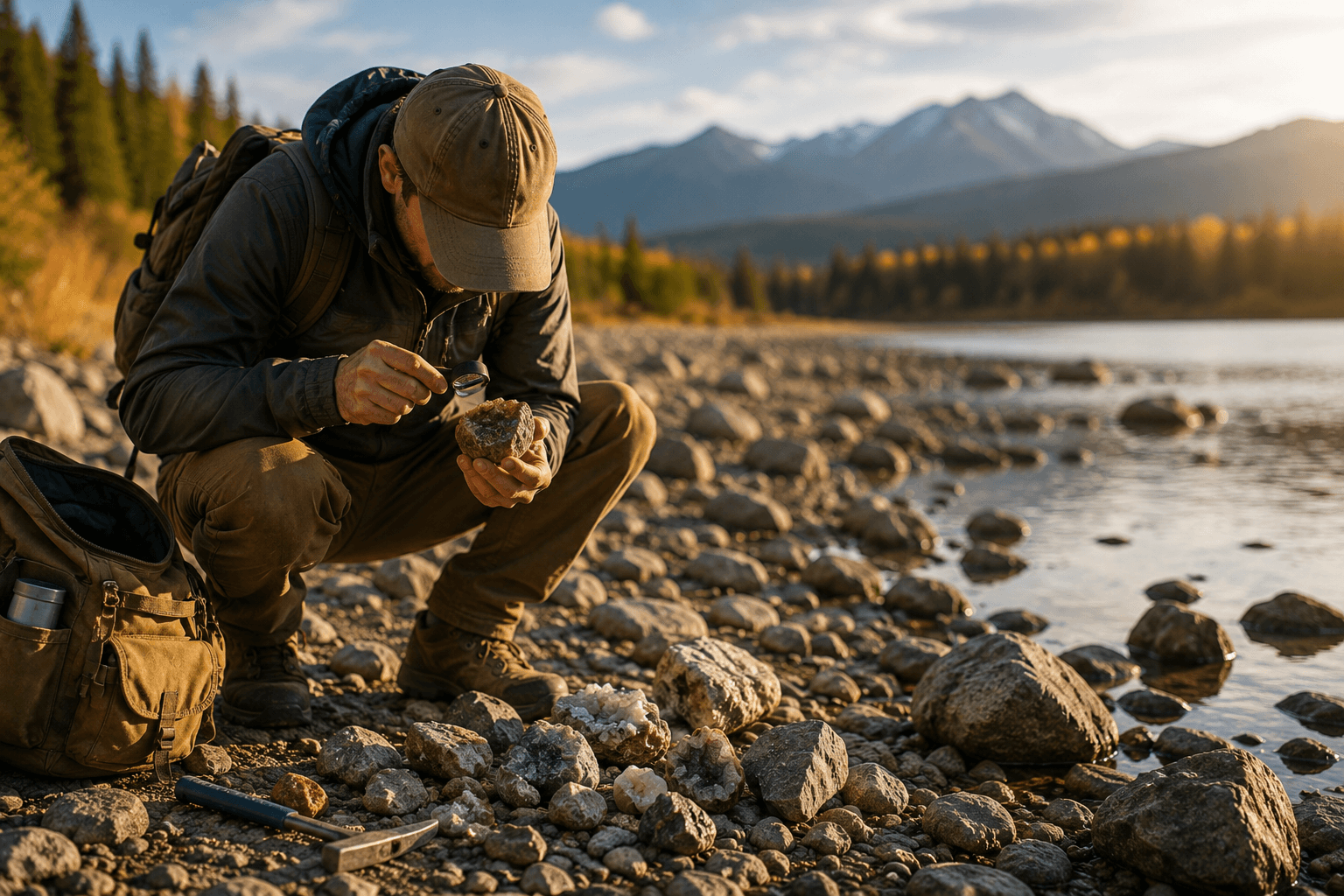
You've found the perfect spot. Jasper in the wash, agate in the roadcut, maybe a geode bed marked on your map. One question stands between you and your bucket: is it actually legal to collect here?
The short answer: rockhounding is legal on most BLM and National Forest land for personal use, illegal in every National Park, hit-or-miss on state land, and permission-only on private property. The long answer is what keeps beginners out of trouble — because "public land" is not one thing, and the difference between a great day in the field and a federal citation can be a single invisible boundary line.
This guide covers exactly where you can collect, how much you can take, what you can never touch, and how to verify a site before you dig. Once you know the rules, put them to use with our interactive rockhounding map of 1,000+ GPS-verified, legally collectable locations.
Quick Answer: Where Can You Legally Collect Rocks?
| Land Type | Can You Collect? | Notes |
|---|---|---|
| BLM land | Yes, generally | Reasonable amounts, personal use, hand tools only |
| National Forest (USFS) | Yes, generally | Rules vary by district; some require a free permit |
| National Park (NPS) | No | Prohibited everywhere; criminal penalties apply |
| National Monument | Usually no | Check the specific monument's rules |
| Wilderness Area | Restricted | Surface collection at most; often prohibited |
| Wildlife Refuge (USFWS) | No | Managed for ecology, not recreation |
| Bureau of Reclamation | No | Scientific permits only |
| State parks | Varies by state | Many prohibit it; a few allow or even encourage it |
| State trust land | Varies by state | Often requires a permit or lease |
| Tribal land | Permission required | Not public land; ask the tribe or landowner |
| Private land | Permission required | Collecting without permission is trespassing (or theft) |
| Beaches & rivers | Depends who manages them | Follow the managing agency's rules |
If you remember nothing else: the agency that manages the land decides the rules — not the state you're standing in.

The Three Questions That Decide Legality
Every "can I collect here?" question comes down to three things:
- Who manages the land? BLM, Forest Service, Park Service, a state agency, a tribe, or a private owner — each has different rules, and boundaries are rarely marked on the ground.
- What are you collecting? Common rocks and minerals are treated very differently from petrified wood, vertebrate fossils, artifacts, and gold.
- How much, and with what? Personal-use quantities collected with hand tools are broadly tolerated. Commercial quantities, motorized equipment, or ground disturbance change the legal picture entirely.
Answer those three questions before every trip and you'll stay on the right side of the law essentially everywhere.
Federal Land, Agency by Agency
Roughly a third of the United States is federally managed — but by six different agencies with six different attitudes toward your rock hammer.
BLM Land: The Rockhound's Best Friend
The Bureau of Land Management manages over 245 million acres, mostly across the West, and its rules are the most collector-friendly in the federal system.
Under BLM regulations (43 CFR 8365.1-5), you may collect reasonable amounts of rocks, mineral specimens, semiprecious gemstones, common invertebrate fossils, and petrified wood for personal, noncommercial use — no permit, no fee.
The widely applied benchmark for "reasonable amounts" is:
- Up to 25 pounds per day, plus one piece
- Up to 250 pounds per calendar year
Petrified wood has its own explicit federal limit at those same numbers (25 lbs + one piece daily, 250 lbs annually), and it may not be collected for sale.
The conditions that come with it:
- Hand tools only. Shovels, picks, and rock hammers are fine. Motorized or mechanical equipment, heavy machinery, and explosives are not.
- Stay out of developed recreation sites (campgrounds, picnic areas, trailheads) unless the BLM has specifically designated the area for rockhounding.
- Respect withdrawn and specially designated areas. Research natural areas, outstanding natural areas, national historic sites, and similar designations are closed to collecting.
- Respect mining claims. Active claims cover the minerals on that ground. Collecting on someone's claim without consent is effectively taking their property (more on this below).
- Noncommercial means noncommercial. The moment you're collecting to sell, you need a different authorization entirely.
National Forests (USFS): Generally Open, Locally Variable
The U.S. Forest Service manages about 190 million acres, and recreational rockhounding is allowed on most of it. National Forest ground is also some of the best public land for panning — see our guide to finding gold near you for site-specific rules. But the Forest Service delegates far more discretion to individual forests and ranger districts than the BLM does, so the rules genuinely vary by forest.
What's consistent:
- Personal-use collecting of rocks and minerals is allowed in most districts. Some districts require a permit, which is typically free.
- No digging sluices or dams in any National Forest.
- Commercial fossil collecting is prohibited.
- Sensitive watersheds and habitat areas may be closed to collecting.
The practical rule: call the ranger district before you go. A five-minute phone call has saved more rockhounds from citations than any other habit in this hobby.
National Parks: An Absolute No
This is the rule that surprises the most beginners. The National Park Service prohibits collecting rocks, minerals, and paleontological specimens — recreational or educational — in every unit of the National Park System. That includes national parks, most national monuments run by NPS, national seashores, national recreation areas under NPS management, and national historic sites.
Violations carry criminal penalties, and rangers do enforce it. That pretty piece of petrified wood in Petrified Forest National Park? Leaving with it is a federal offense. The park famously receives "conscience letters" every year from visitors returning stolen pieces.
If a map says "National Park" or "National Monument (NPS)," the answer is no. Full stop.
The Overlay Designations: Where Good Trips Go Wrong
The trickiest violations happen on land that would be open — BLM or Forest Service ground — but carries an extra designation on top:
- Wilderness Areas — At most, hand collection of loose surface material for personal use, with no ground disturbance and no motorized tools; many wilderness areas prohibit collecting entirely. Rules differ between BLM wilderness and Forest Service wilderness, and between individual units.
- National Monuments — Most prohibit collecting regardless of which agency manages them. Check the monument's specific proclamation and rules.
- Wild & Scenic Rivers — Generally follows the managing agency: BLM- and USFS-managed segments often allow it; NPS- and USFWS-managed segments don't.
- National Conservation Areas and similar — Site-specific rules; some ban metal detectors and collecting outright.
The land looks identical on the ground. The legal status doesn't. This is why checking the designation, not just the agency, matters.
The Hard No's: Reclamation, Fish & Wildlife, Military
- Bureau of Reclamation land (around reservoirs and water projects): rockhounding prohibited; collection allowed only under scientific permits.
- U.S. Fish & Wildlife Service refuges: generally prohibited — these lands are managed for wildlife, not recreation.
- Department of Defense land: closed, for reasons that should be obvious.
Tribal Land: Not Public Land
Tribal lands are sovereign — they are not public land, even where federal agencies are involved in their administration. Collecting requires permission from the tribe or the individual landowner. Never assume access.
What You Can Never Collect (Anywhere on Federal Land)
Some materials are off-limits regardless of agency, quantity, or good intentions. Collecting these can escalate from a citation to a felony:
- Native American artifacts — arrowheads, flakes, pottery and potsherds, rock art, mats, dwellings, and human remains are protected under the Archaeological Resources Protection Act. This includes that arrowhead sitting loose on the surface.
- Vertebrate fossils — dinosaurs, fish, mammals, reptiles: anything with a backbone requires a scientific permit. Common invertebrate fossils (shells, corals, trilobites in most areas) and plant fossils are generally collectable in reasonable amounts on BLM land.
- Historic artifacts — old bottles, mining equipment, and structures over 50 years old are typically protected too.
- Petrified wood beyond the limits — legal in small amounts on BLM land, but strictly capped and never for commercial sale from public land.
- Anything from an active mining claim — the locatable minerals belong to the claimant.
When in doubt: photograph it, GPS it, and leave it. Not sure what you're looking at in the first place? Our guide to the best rock identification apps can help you tell a common jasper from a protected fossil before you decide whether to pick it up.
State Land, State Parks, and Beaches
Here's where it gets genuinely messy. There is no national rule for state land — all 50 states set their own policies, and they range from "welcome, here's a designated dig site" to "removing a pebble is a misdemeanor."
The general pattern
- State parks: The majority of states prohibit collecting in state parks, treating rocks as protected natural resources alongside plants and wildlife. A minority allow limited hobby collecting, and a handful have parks built for collectors.
- State trust land: Many western states manage "school trust" land (often checkerboarded with BLM land) where collecting typically requires a permit or lease from the state land office — Arizona and Utah are classic examples.
- State forests, wildlife areas, and beaches: Entirely state-specific. Never assume a beach or riverbed is fair game; check who manages it.
Notable states every rockhound should know
| State | State-Land Snapshot |
|---|---|
| New Mexico | Home of Rockhound State Park — one of the few parks in America where collecting is actively encouraged (with a take-home limit). See our geodes near you guide for dig sites. |
| Oregon | One of the most rockhound-friendly states; generous access on public land, famous sunstone and thunderegg areas, and clear published rules. |
| Utah | Excellent collecting on BLM land (Topaz Mountain, geode beds), but state parks prohibit removal of natural resources without written authorization, and trust lands require a permit. Great territory for our find quartz near you map layer. |
| Arizona | Superb BLM collecting; state trust land requires a recreational permit. |
| Texas | Very little public land — most of the state is private, and collecting anything in Texas state parks is prohibited. Landowner permission is the name of the game. |
| Colorado | State parks generally prohibit collecting, with a notable exception for recreational gold panning in the Arkansas Headwaters Recreation Area (where posted rules allow). |
| Vermont | Unusually reasonable: personal hobby collection of small stones is exempt from the permit requirement, unless fossils or historically significant material are involved. |
| Connecticut | Collecting on state land is not allowed, but a limited number of mineral localities open on a permit basis for educational collecting. |
| New York | Among the more restrictive states for collecting on state land. |
(We're building out full state-by-state law guides linked from this page — each covering state parks, trust land, and the best legal collecting sites in that state.)
The takeaway: your home state's rules tell you nothing about the next state over. Check every state's land-management agency before crossing a border with a rock hammer.
Private Land and Mining Claims
Private land
Some of the best collecting in America is on private ground — quarries, ranches, old mine dumps. The rule is simple: written permission first. Without it, you're trespassing, and pocketing material can compound that into theft. With it, private land often beats public land: no quantity limits, no tool restrictions beyond what the owner sets, and sites that haven't been picked over.
Fee-dig operations (pay-to-dig mines and quarries) are the easiest fully legal collecting there is — you pay, you dig, you keep what the operation's rules allow.
Mining claims: the invisible tripwire
This is the most common accidental violation in rockhounding. Public land that's otherwise open to collecting can carry active mining claims, which give the claimant rights to the locatable minerals on that ground. The land often looks completely unremarkable — no fences, sometimes just a weathered corner post or nothing at all.
Collecting on someone's active claim without consent isn't a gray area; you're removing minerals that legally belong to someone else.
How to check for claims before you dig:
- Search the BLM's Mineral & Land Records System (MLRS) for active claims by township and range.
- Use land-status apps and mapping tools that overlay claim data.
- Ask the local BLM field office — they can tell you the status of a specific area.
- Join a local club through our rockhounding club directory — experienced members almost always know which nearby ground is claimed.
Your Pre-Trip Legality Checklist
Five minutes of checking beats a fine every time. Before any new site:
- Identify the managing agency. Use a land-ownership map layer — boundaries between BLM, Forest Service, state, and private land are almost never marked in the field.
- Check for overlay designations. Wilderness, monument, conservation area, wild & scenic corridor.
- Check for active mining claims in the BLM records for that area.
- Confirm what you plan to collect is allowed — rocks and minerals, yes; artifacts and vertebrate fossils, never.
- Know your limits — 25 lbs/day + one piece and 250 lbs/year is the safe benchmark on BLM land; hand tools only.
- When any doubt remains, call the field office or ranger district. They will tell you, for free, exactly what's allowed.
Every location in our GPS-verified site database lists the managing agency and land status, so you can run this checklist in seconds instead of an evening.
Click here to check land status on our interactive mapThe Bottom Line
Rockhounding is legal across enormous swaths of America — hundreds of millions of acres of BLM and National Forest land are open to you right now, no permit required. The rockhounds who get in trouble are almost never bad actors; they're people who didn't know that the pretty canyon was a national monument, the wash was under claim, or the state park treated a pocketed agate like a poached deer.
Learn the land, check before you dig, take reasonable amounts, and leave artifacts and bones where they lie — and the law will never be the thing standing between you and a full bucket.
Related Reading
- Interactive Rockhounding Map: 12,000+ GPS-Verified Locations
- Best Rock Identification Apps
- Find Quartz Near You
- Find Gold Near You
- Geodes Near Me
- Most Valuable Gemstones You Can Find
- Mohs Hardness Scale Explained
- Rockhounding Club Directory
This guide is for general information only and is not legal advice. Land designations, agency rules, and state laws change; always verify current regulations with the managing agency before collecting. Found something out of date? Let us know and we'll fix it.