
Quick-Reference Facts
| Property | Value |
|---|---|
| Mineral class | Chalcedony (microcrystalline quartz) — pseudomorph after crocidolite |
| Chemical formula | SiO₂ with Fe₂O₃ (iron oxide inclusions) |
| Hardness (Mohs) | 7 |
| Luster | Silky to waxy; vitreous on fresh break |
| Chatoyancy | Yes — "cat's eye" effect from parallel fiber structure |
| Color | Golden-yellow, honey-brown, reddish-brown (golden variety) |
| Streak | White |
| Fracture | Fibrous; conchoidal on massive surfaces |
| Transparency | Opaque |
| Specific gravity | 2.64–2.71 |
| Primary source | Northern Cape, South Africa; Hamersley Range, Western Australia |
| Crystal system | Trigonal (inherits from quartz; no visible crystal faces — always massive) |
What Is Tiger's Eye?
Tiger's eye is one of the most visually distinctive minerals in existence — a golden-brown, silky stone that displays a mesmerizing band of reflected light that glides across its surface as it is rotated, mimicking the narrow vertical pupil of a predator's eye. This optical effect, called chatoyancy, is what drives its popularity in jewelry, collecting, and metaphysical practice worldwide.
Mineralogically, tiger's eye is a chalcedony — a microcrystalline variety of quartz — that formed through a geological process called pseudomorphism. It did not crystallize directly from silica-bearing fluids. Instead, it inherited the structure of a completely different mineral — crocidolite, a fibrous blue asbestos — which was progressively and completely replaced by silica over millions of years. The fibers of crocidolite were preserved in quartz, creating a stone with quartz's hardness and durability but with an internal fibrous architecture that belongs to an entirely different mineral family. That preserved architecture is the source of the chatoyancy.
Tiger's eye belongs to the larger family of "eye minerals" — chatoyant stones whose silky, moving optical effect resembles an animal's eye. It is the most widely available and commercially significant member of this family, with its primary deposits concentrated in South Africa and Western Australia.
How Tiger's Eye Forms — The Geology of Pseudomorphism
Understanding how tiger's eye forms is understanding one of the most elegant geological processes in mineralogy. The process is called pseudomorphism — from the Greek for "false form" — and it describes a mineral that adopts the external shape or internal structure of a completely different mineral that it has replaced.
Stage 1 — The original mineral: crocidolite
Everything begins with crocidolite — a fibrous amphibole mineral also known as blue asbestos. Crocidolite forms as long, parallel, microscopically thin fibers in metamorphic rocks subjected to moderate pressure and temperature. In the regions of South Africa that produce tiger's eye, crocidolite was deposited in the Precambrian Asbestos Hills formation in the Northern Cape Province — a banded iron formation approximately 2.6 billion years old. The fibers grew parallel to each other, aligned by the stress directions in the rock, creating a perfectly organized internal architecture.
Stage 2 — The silica replacement
As the geological environment changed — specifically as silica-bearing groundwater or metamorphic fluids permeated the rock — silicon dioxide began to replace the crocidolite fibers. This happened atom by atom, fiber by fiber, over an extraordinarily long period. Crucially, the replacement was pseudomorphic rather than destructive: the silica did not dissolve the crocidolite and precipitate in a new form. It replaced the crocidolite while preserving the arrangement of the fibers. The fibrous structure — the parallel alignment, the spacing, the orientation — was carried over into the new quartz material.
Stage 3 — Iron oxidation and the golden color
Crocidolite contains iron — specifically, ferrous iron (Fe²⁺) that gives it its distinctive blue color. As silica replacement proceeded, this iron was oxidized from ferrous (Fe²⁺) to ferric (Fe³⁺) form. Ferric iron produces limonite and goethite — the iron oxide minerals responsible for the warm golden-yellow to brown colors of tiger's eye. The progression of this oxidation is what separates tiger's eye from its blue precursor, hawk's eye (more on this in the varieties section).
Stage 4 — The finished product
The result of complete pseudomorphic replacement is a massive quartz mineral that has inherited two things from its crocidolite ancestor: the parallel fibrous microstructure and the iron that has since oxidized to produce color. The fibrous structure — now made entirely of silica — is what creates the chatoyancy. The iron oxides distributed along those fibers — limonite and goethite — are what create the golden-brown coloration. Tiger's eye is, in essence, organized iron-stained silica in the shape of asbestos.
Why tiger's eye does not pose an asbestos hazard
This is a common concern — and a reasonable one, given the crocidolite origin. The answer is that once pseudomorphic replacement is complete, no crocidolite remains in the stone. The fibrous structure is now quartz, not asbestos. Handling polished tiger's eye poses no asbestos exposure risk. The concern is more applicable to cutting and grinding unfinished material in lapidary work, where fine silica dust — not asbestos fibers — is the relevant health consideration (and one that applies to all silica-containing minerals, not tiger's eye specifically).

What Causes the Chatoyant "Cat's Eye" Effect?
Chatoyancy — from the French œil de chat, meaning "cat's eye" — is one of the most distinctive optical phenomena in mineralogy. In tiger's eye, it is caused entirely by the parallel fibrous microstructure inherited from the crocidolite replacement.
The physics
When light enters a polished cabochon of tiger's eye, it encounters millions of parallel silica fibers oriented in the same direction. Each fiber acts as a tiny reflector. Because the fibers are parallel — all aligned on the same axis — the light they reflect converges into a single, narrow band perpendicular to the fiber direction. This band of concentrated reflected light is what you see moving across the stone as you rotate it.
The effect is analogous to how a silk fabric shimmers — individual threads reflect light as a coordinated group rather than as random scatterers, producing a directional shine. In tiger's eye, the "threads" are silica fibers locked inside stone.
Why cabochon cut is essential
Chatoyancy is only visible when the stone is cut as a cabochon — a smooth, domed, unfaceted shape. The dome acts as a lens that focuses the reflected band into a sharp line. Flat cuts (slabs, facets) do not concentrate the reflection and show no eye effect. The fiber direction must also be oriented perpendicular to the length of the cabochon — a skilled lapidary aligns the cut so the eye runs across the width of the stone, centered on the dome.
This is why evaluating chatoyancy is essential when buying tiger's eye cabochons: poorly oriented cuts show the eye at the edge of the stone rather than centered, dramatically reducing the effect's visual impact.
Chatoyancy quality as a value determinant
The quality of the chatoyant band varies significantly between specimens:
- Strong eye: A narrow, sharp, highly mobile band that moves dramatically with slight rotation — the most prized
- Moderate eye: A visible but broader, softer band — very common in standard commercial material
- Weak eye: A diffuse sheen with no distinct band — lowest quality; many tumbled stones fall here
- No eye (fibrous failure): Fiber orientation is disrupted, producing no distinct band; sometimes the result of cutting against the fiber grain
How to Tell If Tiger's Eye Is Real — 5-Step Identification Guide
The global demand for tiger's eye has created a significant market for imitations, dyed material, and mislabeled stones. The most common substitutes are: glass (produced to mimic the appearance), dyed agate or chalcedony (genuine quartz but artificially colored), serpentine (sold under misleading names), and synthetic material (resin or plastic). Here is how to distinguish genuine tiger's eye from all of them.
Step 1 — The chatoyancy test: does the band move smoothly?
Hold the specimen under a single-point light source — a flashlight or a desk lamp works best. Diffuse overhead lighting makes chatoyancy almost invisible. Slowly rotate the stone.
Genuine tiger's eye: Displays a distinct, smooth band of reflected light that moves fluidly and continuously across the surface as the stone rotates. The band is broad and slightly soft-edged, sometimes with subtle variations that reflect the slight waviness of the original fibers.
Fakes and imitations: Glass and plastic show a static reflection — bright at one angle, gone at another — rather than a mobile band. Painted or printed fakes show a visible line that does not move with rotation. Dyed chalcedony without a fibrous structure shows a general sheen but no distinct eye. This single test eliminates most imitations.
Step 2 — The hardness test: scratch glass
Drag a corner or edge of the specimen firmly across a glass surface (the side of a glass bottle works well). Apply firm, deliberate pressure.
Genuine tiger's eye (Mohs 7): Easily scratches glass (hardness 5.5) and leaves a permanent groove. The scratch cannot be wiped away.
Glass imitation (Mohs 5.5): Does not scratch glass — same hardness. May leave a powder smear that wipes off, not a groove.
Plastic (Mohs 2–3): Cannot scratch glass. Can itself be scratched by glass, a coin, or even a fingernail.
Serpentine (Mohs 3–5): Cannot scratch glass. Its softer surface may show scratches from the glass edge rather than leaving marks on the glass.
Wipe away any powder residue and confirm a physical groove remains in the glass.
Step 3 — The temperature test: stone stays cool
Press the specimen firmly against the inside of your wrist or your cheek for 10 seconds.
Genuine stone (any mineral): Feels distinctly cool and warms slowly. Stone is a better thermal conductor than air, drawing heat away from skin efficiently. Even after prolonged contact, it takes noticeably longer to reach skin temperature than organic or synthetic materials.
Glass: Warms faster than stone but still slower than plastic. Generally acceptable for confirming stone vs. plastic but not ideal for separating glass from mineral.
Plastic and resin: Warm almost immediately to skin temperature — within 2–3 seconds of contact. If it feels warm as soon as you touch it, it is almost certainly not a mineral.
This is a supportive test — most useful for ruling out plastic and resin imitations.
Step 4 — The fiber structure test: examine under magnification
Examine the surface and, where possible, the interior of the specimen under a 10x hand lens or loupe.
Genuine tiger's eye: Shows fine, parallel, slightly undulating fibrous lines running in a consistent direction throughout the stone. These lines are subtle but unmistakable under magnification — they look like tightly packed, slightly wavy threads. The color variation between golden and darker brown bands follows the fiber pattern.
Glass: Completely featureless under magnification. No internal structure, no lines, no parallel organization. The color is uniform and glassy throughout.
Dyed material: May show a fibrous structure (if it is dyed genuine chalcedony or agate) but the color distribution will be unnatural — either too uniform or concentrated in cracks and grain boundaries.
Plastic: Shows tool marks, flow lines, or surface texture from molding. No natural fibrous structure.
Step 5 — The dye detection test: check cracks and fractures
Examine any natural cracks, fractures, pits, or surface irregularities under a loupe.
Natural golden tiger's eye: The golden-brown coloration is uniformly distributed throughout the fibrous structure. Color in cracks is the same intensity as surrounding material because the color comes from iron oxide distributed during geological formation — not applied to the surface.
Dyed tiger's eye: Color concentrates visibly in cracks and fractures because liquid dye seeps in through any opening. The color in cracks appears more intense or slightly different in hue compared to the surrounding stone face. In transmitted light (hold up to a lamp), dyed specimens often show color concentrations along structural irregularities.
Note on red tiger's eye: Red tiger's eye is conventionally produced by gently heat-treating golden tiger's eye to oxidize iron compounds further. This is an accepted and widely disclosed practice in the gemstone trade. Heat-treated red tiger's eye is still genuine tiger's eye — the treatment alters the iron chemistry but not the fundamental mineral identity or chatoyancy. It should, however, be disclosed at point of sale.
Tiger's Eye Varieties — Complete Guide
Tiger's eye is not a single stone but a family of related chatoyant minerals that form through variations of the same pseudomorphic replacement process.
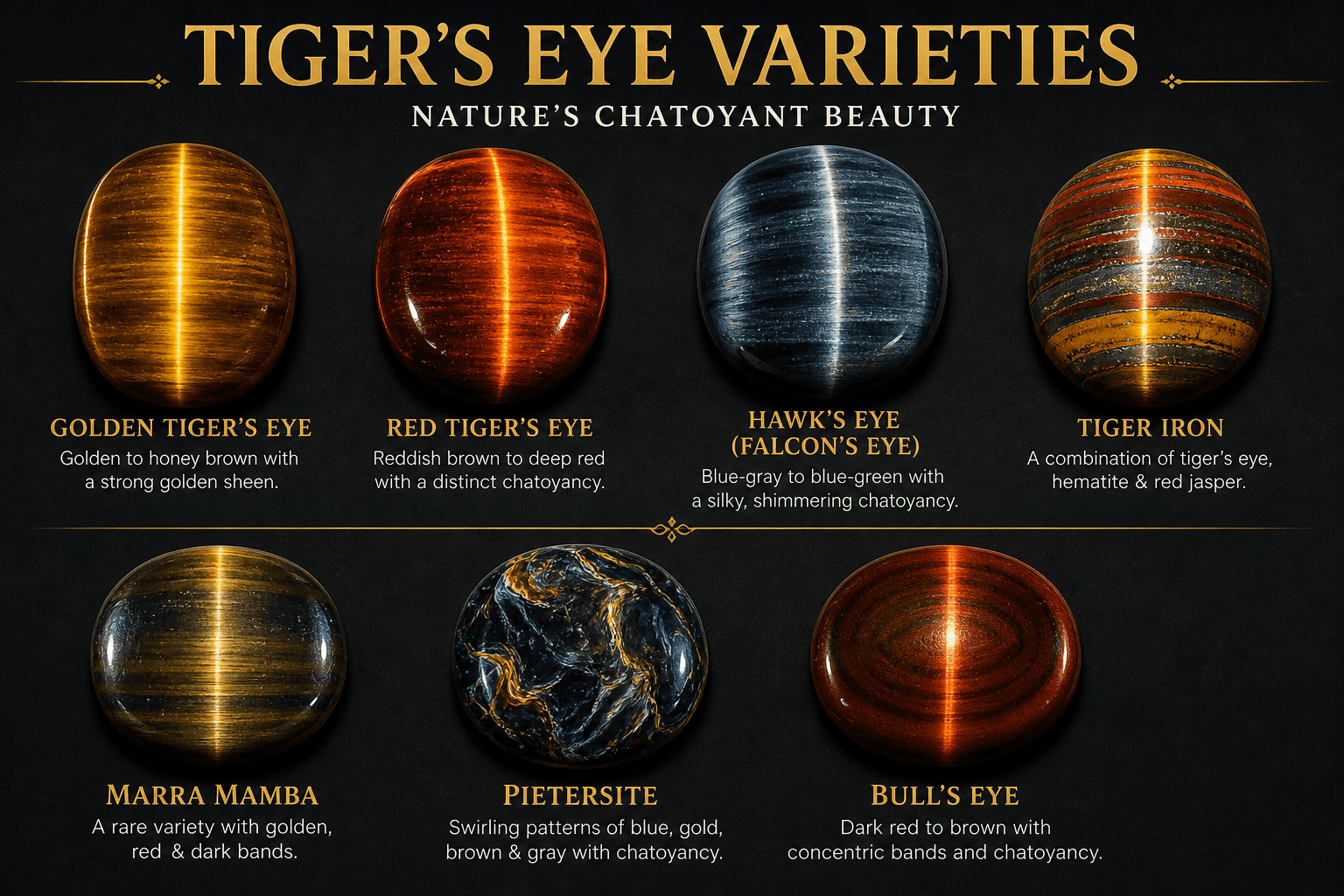
Varieties at a glance
| Variety | Color | Formation | Rarity | Typical retail price | Key characteristic |
|---|---|---|---|---|---|
| Golden tiger's eye | Honey-gold to brown | Complete pseudomorphism + full iron oxidation | Common | $1–30 depending on grade | The classic; most widely collected |
| Red tiger's eye | Reddish-brown | Heat treatment of golden variety | Common | Similar to golden | Warmer, richer tones; often used in jewelry |
| Hawk's eye (falcon's eye) | Blue-gray to blue-green | Incomplete pseudomorphism; iron not yet oxidized | Uncommon | $5–50 | Retains original crocidolite blue |
| Tiger iron | Gold, red, black banded | Interlayered tiger's eye, hematite, red jasper | Uncommon | $5–40 | Bold graphic banding; popular in cabochons |
| Marra Mamba | Green, red, blue, gold | Western Australian variety; unique multi-mineral banding | Rare | $50–500+ | Most prized; multiple colors in single stone |
| Pietersite | Blue-gold-red swirling | Brecciated tiger's eye + hawk's eye; fractured and healed | Rare | $30–200+ | Chaotic swirling patterns; Namibia and China |
| Bull's eye | Deep red-brown | Heavily heat-treated; sometimes called red tiger's eye | Common | Similar to red | Deeper, more uniform red than standard red |
Golden Tiger's Eye

The classic and most familiar form. Complete replacement of crocidolite by silica combined with thorough iron oxidation produces the warm honey-gold to chocolate-brown colors and strong chatoyancy. South Africa's Northern Cape Province produces the majority of the world's commercial supply. Golden tiger's eye is the standard against which other varieties are measured — accessible, durable, and beautiful in cabochon form.
Best chatoyancy: Look for specimens with a narrow, sharply defined band that moves across the full width of the stone. Strong chatoyancy significantly increases value.
Red Tiger's Eye (Bull's Eye)
Golden tiger's eye subjected to controlled heat treatment undergoes further iron oxidation, converting the limonite and goethite (yellow-brown iron oxides) to hematite (red iron oxide). The result is a warm reddish-brown stone with the same chatoyancy as the golden variety. The color is natural in the sense that it results from iron chemistry, but the treatment is artificial — the heat accelerates a process that would occur naturally only over geological timescales. Red tiger's eye at its most deeply colored is sometimes marketed as "bull's eye."
Disclosure note: Reputable sellers disclose heat treatment. When buying, ask specifically whether the red color is natural (rarely) or heat-treated (usually).
Hawk's Eye (Falcon's Eye, Blue Tiger's Eye)
When pseudomorphic replacement of crocidolite by silica is incomplete — when iron oxidation has not proceeded to the point of producing golden-brown colors — the resulting mineral retains the blue-gray to blue-green color of the original crocidolite fibers. This is hawk's eye. The stone has the same fibrous structure and chatoyancy as tiger's eye, but its color comes from partially unreacted iron in the crocidolite rather than iron oxides.
Hawk's eye and tiger's eye often occur together in the same formation, with transitional zones between them — a single specimen can show blue-gray hawk's eye grading into golden tiger's eye as the degree of iron oxidation changes across the stone. These transitional specimens are among the most scientifically interesting and collectable in the tiger's eye family.
Practical identification: Hawk's eye scratches glass (same Mohs 7 hardness), shows chatoyancy under point lighting, and feels cool. The blue color combined with chatoyancy distinguishes it from virtually all other common minerals.
Tiger Iron
Tiger iron is a naturally banded rock — not a single mineral — composed of alternating layers of golden tiger's eye, hematite (silver-black metalite), and red jasper (opaque red chalcedony). It forms in Precambrian banded iron formations where the iron-rich sedimentary layers host both the tiger's eye formation process and iron oxide/silica precipitation. The result is a dramatically graphic rock with bold parallel bands of gold, black, and red.
Tiger iron is particularly popular in lapidary work — its graphic banding makes every cabochon unique. It comes primarily from the Hamersley Range of Western Australia (the same geological province that produces Marra Mamba) and from South Africa.
Note: Tiger iron is not a gemstone variety in the traditional sense — it is a decorative rock that contains tiger's eye as a component. Its chatoyancy comes from the tiger's eye layers, which stand out against the opaque hematite and jasper bands.
Marra Mamba Tiger's Eye
The rarest and most prized variety in the tiger's eye family. Marra Mamba forms in the Hamersley Range of Western Australia and is geologically distinct from the South African deposits. It displays multiple colors — green, red, gold, and blue — often in the same specimen, resulting from a combination of different mineral phases and varying degrees of oxidation within the stone. Some Marra Mamba specimens show all four colors in distinct zones across a single cabochon.
Marra Mamba's rarity is genuine — the deposits are limited in extent and the accessible high-quality material has been largely exhausted. Authentic Marra Mamba commands a significant premium over standard tiger's eye: quality specimens range from $50 to several hundred dollars per piece depending on color display and chatoyancy quality. It is frequently imitated using dyed or heat-treated South African material, making provenance documentation important when buying.
Pietersite
Pietersite occupies a unique position in the tiger's eye family — it is a breccia. The original tiger's eye and hawk's eye were fractured by geological stress and then "healed" by further silica and iron oxide deposition. The fracturing disrupts the parallel fiber alignment, creating chaotic swirling patterns of gold, blue, and red in which the chatoyancy no longer forms a single band but instead creates complex, shifting light effects across the stone's surface.
Pietersite is found primarily in Namibia (where it was first described) and in Hunan Province, China. Namibian pietersite tends toward blue and gold; Chinese pietersite leans toward red-brown and gold. It is named after Sid Pieters, a Namibian farmer who first noticed the unusual stone on his land in 1962. Quality pietersite commands prices similar to Marra Mamba — rarity and dramatic appearance drive the premium.
Physical Properties in Detail
Hardness and durability
Tiger's eye has a Mohs hardness of 7 — the same as all quartz-family minerals. This makes it suitable for virtually all jewelry applications including rings, which experience the most abrasive wear of any jewelry type. It is significantly harder than most gemstones in the 5–6 range (opal, turquoise, feldspar) and matches or exceeds most colored gemstones used in everyday jewelry. At hardness 7, it scratches glass, steel files, and most pocket knife blades, and is not scratched by any of them.
Luster and surface character
Freshly cut or polished tiger's eye has a silky to waxy luster — distinct from the vitreous (glassy) luster of clear quartz. The silkiness comes from the fibrous microstructure scattering light slightly rather than reflecting it as a clean mirror surface. This silky quality is most prominent in high-quality specimens with tight, uniform fiber packing.
Streak
White. The streak of tiger's eye (the color of its powder when dragged across an unglazed porcelain streak plate) is white, consistent with its quartz composition. The iron oxide colorants are dilute enough not to affect the streak color.
Specific gravity
2.64–2.71 — slightly higher than pure quartz (2.65) due to the iron oxide content distributed through the fibrous structure. In practice, the specific gravity of tiger's eye matches quartz closely enough that this distinction is useful only in laboratory settings.
Optical properties
Tiger's eye is opaque. No light passes through even thin sections. The silky luster and chatoyancy are entirely surface optical phenomena. It is uniaxial positive under a polarizing microscope, consistent with its quartz mineralogy, and shows no fluorescence under standard UV wavelengths.
Where Tiger's Eye Is Found — Global Localities
South Africa — the world's primary source
The Northern Cape Province of South Africa, particularly the region around Griquatown in the Asbestos Hills, is the source of the overwhelming majority of commercial tiger's eye. The stone forms in the Precambrian Asbestos Hills formation — a banded iron formation approximately 2.6 billion years old that was subjected to greenschist-facies metamorphism. Crocidolite deposits in this formation were progressively silicified to produce the extensive tiger's eye deposits that have supplied the global market for over a century. The town of Griquatown itself has a geological museum dedicated to the local mineralogy.
Collector access: South Africa's tiger's eye deposits are largely on private mining claims and farmland. Direct collector access is limited — most material enters the market through commercial channels. Some specimens are available as rough at the Griquatown market.
Western Australia — Hamersley Range
The Hamersley Range in the Pilbara region of Western Australia hosts a geologically distinct tiger's eye occurrence, producing both standard golden tiger's eye and the rare, highly prized Marra Mamba variety. The host formation — also a Precambrian banded iron formation — is older than the South African deposits (approximately 2.7–3.0 billion years) and produces more mineralogically complex material. Tiger iron (tiger's eye + hematite + jasper) comes primarily from this region.
Collector access: The Hamersley Range is extremely remote. Most material is accessed by commercial mining operations. Occasional gem fossicking (the Australian term for rockhounding) is permitted on certain pastoral properties with landowner permission.
Brazil
Brazil is a significant secondary source of commercial tiger's eye, producing primarily standard golden material from metamorphic terrains in Bahia and Minas Gerais states. Brazilian material is generally comparable in quality to South African material but tends to be less consistently golden in color. Brazil also produces tiger iron.
Namibia and China
Namibia is the primary source of pietersite, which forms in metamorphic rocks of the Damara fold belt. China's Hunan Province also produces pietersite, generally with redder tones than Namibian material. Both countries contribute material to the global collector market, primarily through commercial channels.
United States — occurrences and collecting
Tiger's eye does not occur in the economically significant quantities found in South Africa or Australia. However, chatoyant quartz minerals associated with iron-rich metamorphic rocks have been reported in scattered localities in California (particularly in the Coast Ranges and parts of the Sierra Nevada foothills where serpentinite belts contain various iron silicate minerals) and Nevada. These U.S. occurrences are scientifically interesting but not commercially significant.
For collectors in the United States, tiger's eye is most practically obtained through gem shows, mineral dealers, and the many fee-dig and purchase operations that stock South African and Australian material. The Tucson Gem and Mineral Show (held each February) and the Denver Gem and Mineral Showcase are the best North American venues for acquiring exceptional tiger's eye specimens.
→ Use our interactive specimen maps to find mineral collecting sites near you
India and Myanmar
India's Rajasthan state produces limited quantities of tiger's eye, primarily used in domestic lapidary work and carving. Myanmar (Burma) has reported occasional tiger's eye from metamorphic belt localities, but production is minimal.
Tiger's Eye Value — What It's Worth

Tiger's eye is one of the most accessible semi-precious stones commercially, but its value varies enormously across grades and varieties.
Golden tiger's eye — price by grade
| Grade | Description | Typical retail price |
|---|---|---|
| Tumbled stones (low) | Mass-produced, weak chatoyancy | $1–3 each |
| Tumbled stones (quality) | Good chatoyancy, nice banding | $3–8 each |
| Raw/rough specimen | Collector-quality rough | $5–25 per piece |
| Cabochon (commercial) | Standard chatoyancy, jewelry grade | $5–20 per cab |
| Cabochon (high quality) | Strong, narrow, well-centered eye | $20–80 per cab |
| Large carved object/sphere | Quality material, skilled lapidary | $50–300+ |
| Exceptional specimen | Museum-quality chatoyancy, large size | $200–500+ |
What drives the price
Chatoyancy strength is the primary value factor. A narrow, sharply defined eye band that moves dramatically with slight rotation is significantly more valuable than a diffuse sheen with no distinct band. The eye should ideally be centered on the dome of the cabochon, not at the edge.
Color saturation matters for the golden variety — the richest, most uniform honey-gold color commands a premium over pale, inconsistent, or grayish material.
Size scales value significantly. Large, single-piece cabochons over 20 carats with strong chatoyancy are genuinely rare and priced accordingly.
Origin and variety produce the largest price differentials:
- South African golden: the price benchmark
- Red tiger's eye (heat-treated): comparable to golden
- Hawk's eye: slight premium over golden for quality specimens — less abundant
- Tiger iron: similar to golden; bold banding increases decorative appeal
- Australian tiger iron: slight premium for Hamersley provenance
- Marra Mamba: 10–50x the price of standard material; authentic provenance matters
- Pietersite: 5–20x the price of standard; Namibian commands more than Chinese
Market watch — where to buy reliably
The most reliable venues for quality tiger's eye are established gem and mineral shows where material can be examined in person, reputable online lapidary dealers with detailed photography and return policies, and specialist mineral dealers at rockhounding club events. Avoid buying from sources that cannot specify origin or that cannot confirm whether red material is natural or heat-treated.
Tiger's Eye in History and Culture
Ancient Egypt
The ancient Egyptians incorporated tiger's eye into the eye sockets of deity statues — most notably into figures of Ra, the sun god, and Geb, the god of the earth. The reflective, animated quality of the chatoyant band made it a fitting representation of divine vision: the eye that sees everything, the presence that watches and protects. Tiger's eye amulets were worn for protection and associated with the power of Ra's all-seeing gaze. The stone's warm golden color aligned with Egyptian solar symbolism.
Ancient Rome
Roman soldiers were documented to have carried engraved tiger's eye amulets into battle, believing the stone provided protection, courage, and keen awareness. The association with the predator's eye — alert, watchful, confident — made it a natural talisman for warriors. Roman legions frequently carried stones and amulets from the territories they had conquered or traded with; tiger's eye from North Africa entered Roman culture through Mediterranean trade networks.
Chinese tradition
In Chinese cultural tradition, the tiger is one of the most revered animals — a guardian and symbol of strength, courage, and protection. Stones bearing the tiger's name and visual characteristics were correspondingly valued as protective talismans, worn to ward off misfortune and embody the tiger's strength. Tiger's eye has been incorporated into Chinese amulet and jewelry traditions for centuries.
Scientific recognition
Tiger's eye was first formally recorded in European scientific literature by French ornithologist François Levaillant in 1784 during his travels in southern Africa. German naturalist Martin Hinrich Lichtenstein made further descriptions in 1803 during his surveys of the Cape Colony. The formal geological and mineralogical description of the pseudomorphic replacement process came significantly later, as the science of mineralogy matured in the nineteenth and twentieth centuries. The German chemist Martin Heinrich Klaproth gave tiger's eye its first systematic chemical analysis in 1811.
Uses of Tiger's Eye
Lapidary and jewelry
Tiger's eye is primarily used as a cabochon gemstone in all categories of jewelry — rings, pendants, bracelets, earrings, and men's cufflinks and tie pins. Its warm earth tones pair well with yellow gold, rose gold, and copper settings. It is durable enough for daily wear at Mohs 7 but should be protected from sharp impacts that could cause chipping along the fibrous grain direction.
Beads of tiger's eye — drilled through the fiber direction to create a ball or cylinder — show chatoyancy on the outer surface when rolled on a strand. Stretch bracelets of tiger's eye beads are among the most commonly produced crystal jewelry in the market.
Carved tiger's eye — spheres, pyramids, animal figures, and free-form shapes — is popular in both the collector and metaphysical markets. Larger carving pieces (those producing spheres over 60mm) from quality material are increasingly scarce and valuable.
Crystal and metaphysical practice
Tiger's eye is one of the most widely used stones in crystal healing and metaphysical practice. It is primarily associated with the solar plexus chakra (Manipura), the energy center governing personal power, confidence, and willpower. Practitioners use it to:
- Build courage and confidence before challenging situations
- Sharpen focus and support clear decision-making
- Balance the extremes of risk-taking and caution
- Provide grounding and stability during periods of change
It is also used in feng shui practice, placed in home or work spaces to promote clarity and protective energy. Tiger's eye is considered a stone that combines the fiery energy of the sun with the grounding stability of the earth — an integration of opposites that is a recurring theme across the cultural traditions that have historically valued it.
Note: All metaphysical properties described represent traditional and cultural beliefs associated with this stone. Rockhounding.org presents these perspectives as culturally significant information. Crystal properties are not scientifically validated medical or psychological treatments.
Zodiac associations
Tiger's eye is most frequently associated with Capricorn (December 22 – January 19) and Gemini (May 21 – June 20) in Western astrological traditions. It is considered the traditional gemstone for 9th and 18th wedding anniversaries. It also appears as a spiritual birthstone for June in alternative birthstone traditions.
Industrial history
Silicified banded iron formations — the geological unit that produces tiger's eye — have been important iron ore sources historically. The banded iron formations of both South Africa and Western Australia are among the richest iron ore resources on Earth. Tiger's eye is essentially the gem-quality byproduct of iron ore geology; the same rock that supplies hematite and magnetite to steel production hosts the silicified zones that produce collectable specimens.
Care and Cleaning of Tiger's Eye
Tiger's eye is one of the lower-maintenance gemstones available:
Cleaning: Warm water with a small amount of mild dish soap and a soft cloth is all that is needed. Rinse thoroughly and dry with a lint-free cloth. A soft toothbrush can help clean settings and crevices in jewelry.
What to avoid:
- Ultrasonic cleaners: Generally safe, but caution is warranted — ultrasonic vibration can stress the fibrous internal structure over repeated use
- Steam cleaning: Not recommended — rapid temperature changes can cause micro-fractures along fiber planes
- Bleach and ammonia: Harsh chemicals can attack the iron oxide components that give tiger's eye its color, potentially bleaching or altering the appearance over time
- Prolonged direct sunlight: Extended UV exposure may slowly fade the golden color — not a concern for jewelry worn normally, but relevant for display specimens in sunny windows
Storage: Store tiger's eye jewelry separately from harder gemstones (sapphire, ruby, diamond, topaz) that could scratch its Mohs-7 surface. A soft cloth pouch or a fabric-lined jewelry box compartment is ideal.
Frequently Asked Questions
What is tiger's eye made of? ▾
Tiger's eye is a pseudomorphic quartz mineral — specifically a fibrous chalcedony that formed when silica progressively replaced the fibrous mineral crocidolite (blue asbestos) while retaining its fibrous structure. Iron oxides deposited during this replacement create the characteristic golden-brown color. The preserved parallel fiber structure creates the chatoyant "cat's eye" optical effect.
How can you tell if tiger's eye is real? ▾
Five tests identify genuine tiger's eye: (1) Chatoyancy test — genuine specimens show a smooth, mobile band under a single light source; (2) Hardness test — Mohs 7 means it scratches glass easily; (3) Temperature test — real stone feels distinctly cool and warms slowly; (4) Fiber structure — under a 10x loupe, genuine specimens show fine, parallel fibrous lines; (5) Dye detection — examine cracks; dyed material concentrates color in fractures. See the full identification guide above.
What is the difference between tiger's eye and hawk's eye? ▾
Hawk's eye is an earlier stage in the same pseudomorphic replacement process. In hawk's eye, replacement is incomplete and iron oxidation has not yet converted the original crocidolite iron to golden-brown oxides — the blue-gray color of the original crocidolite fibers is partially retained. Tiger's eye has undergone complete iron oxidation to limonite and goethite, producing the golden-brown color. They are mineralogically the same process at different stages.
Where does tiger's eye come from? ▾
The world's primary source is the Northern Cape Province of South Africa, particularly around Griquatown. Western Australia's Hamersley Range produces the rare Marra Mamba variety. Brazil, Namibia, India, China, and minor deposits in the United States (California, Nevada) also contribute to the global market.
What is tiger's eye worth? ▾
Standard golden tiger's eye is widely available — tumbled specimens cost $1–8, quality jewelry cabochons $5–80 depending on chatoyancy. Exceptional carved pieces reach $200–500+. The rare Marra Mamba variety commands 10–50x the price of standard material. Pietersite is similarly premium-priced at 5–20x standard.
What chakra is tiger's eye associated with? ▾
In crystal healing traditions, tiger's eye is primarily associated with the solar plexus chakra (Manipura) — the energy center governing personal power, confidence, and willpower. Some traditions also connect it to the sacral chakra. It is used to promote grounded confidence, focus, and clarity of intention.
What are the main varieties of tiger's eye? ▾
The main varieties are: golden tiger's eye (classic, most common), red tiger's eye (heat-treated), hawk's eye/falcon's eye (blue-gray, incomplete pseudomorphism), tiger iron (tiger's eye + hematite + red jasper), Marra Mamba (rare Australian multi-colored variety), and pietersite (brecciated, swirling patterns from Namibia and China).
Is tiger's eye the same as cat's eye? ▾
No. Cat's eye gemstone (chrysoberyl cat's eye) is a completely different mineral — chrysoberyl (Mohs 8.5), significantly harder, rarer, and more expensive. Both show chatoyancy, but chrysoberyl produces a sharper, more intense single band. Tiger's eye belongs to the quartz family (Mohs 7). The term "cat's eye quartz" is sometimes applied to tiger's eye informally, but true cat's eye in gemology refers to chrysoberyl unless otherwise specified.
Related Guides on Rockhounding.org
- Mohs Hardness Scale — Complete Chart, 60+ Minerals & Field Testing Guide
- How to Identify Minerals and Rocks — Complete Field Guide
- Find Quartz Near You — Interactive Map, 202 Locations & State Guide
- 7 Best Rock Identification Apps 2026 — Tested & Ranked
- Rockhounding Maps — Browse 1,000+ U.S. Locations
- Siltstone — Field Tests, Properties & Rockhounding Guide
Article last reviewed and updated April 2026. Geological formation data sourced from USGS and peer-reviewed mineralogy literature. Pricing figures reflect typical retail ranges observed at gem shows and specialist dealers as of April 2026; market prices fluctuate. Metaphysical properties represent traditional cultural beliefs and are not scientifically validated.