
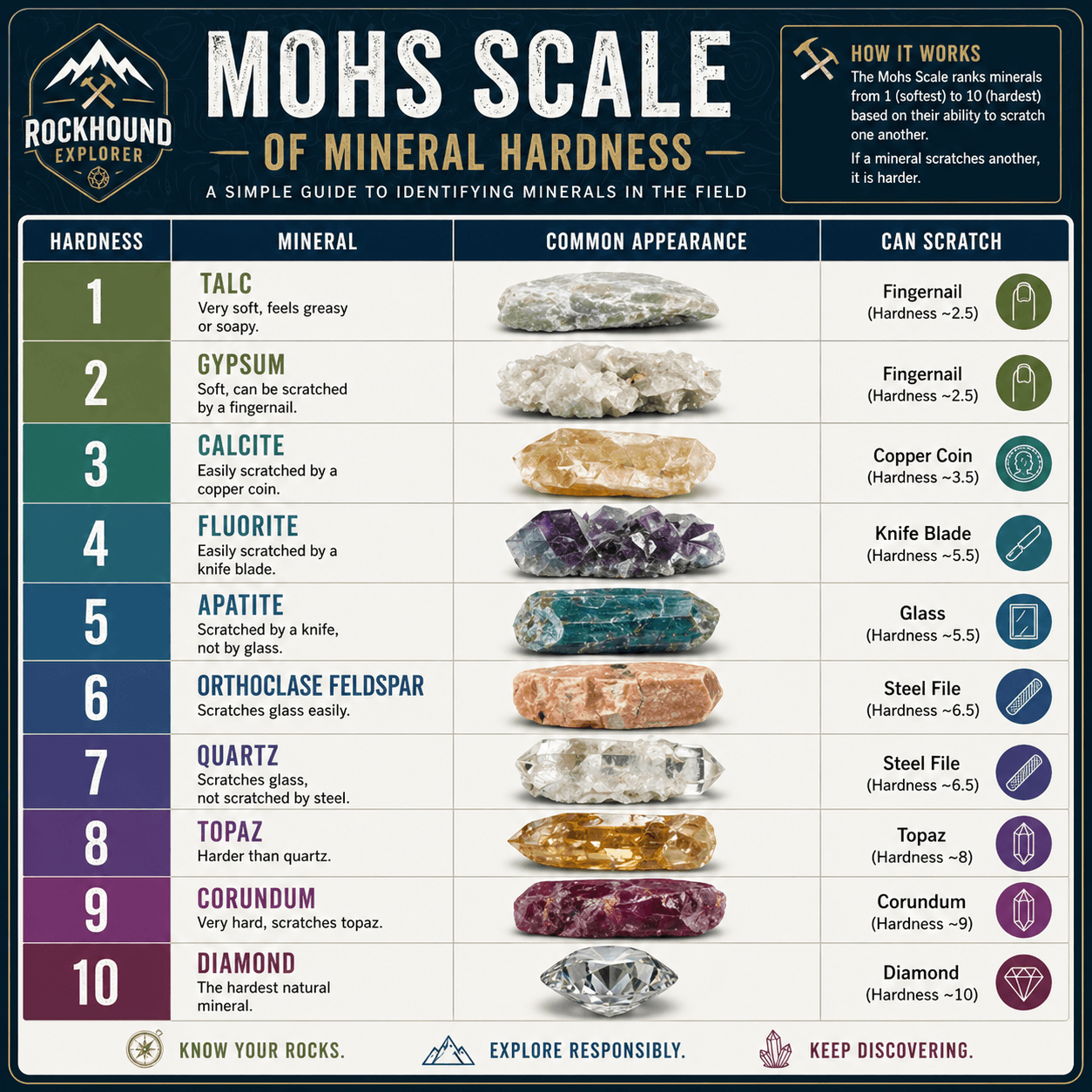
The Mohs hardness scale is the most practical tool in a mineral collector's kit — a simple, consistent way to narrow down what you've found using nothing more than a steel nail and your own fingernail. Developed by German mineralogist Friedrich Mohs in 1812, it ranks minerals from 1 (softest) to 10 (hardest) based on one principle: a harder mineral will scratch a softer one, but not the reverse.
This guide gives you everything you need to use the scale in the field — the standard 10-mineral reference chart, a complete list of 60+ minerals by hardness, a household objects testing guide for when you don't have a kit, and a step-by-step testing procedure. All in one printable, downloadable reference.
⬇ Download the free printable Mohs hardness scale chart (PDF)
Download Chart PDF →
A clean, print-ready reference card — 10 reference minerals, common objects, and 30 key specimens. Letter and A4 sizes included.
The Standard Mohs Hardness Scale — The 10 Reference Minerals
These are the ten minerals Friedrich Mohs selected to define the scale in 1812. Each is used as a reference point — if your specimen is scratched by fluorite (4) but scratches calcite (3), its hardness is between 3 and 4.
| Hardness | Mineral | Chemical Formula | Notes for Rockhounds |
|---|---|---|---|
| 1 | Talc | Mg₃Si₄O₁₀(OH)₂ | Feels soapy; leaves a mark on paper; scratched by fingernail |
| 2 | Gypsum | CaSO₄·2H₂O | Includes selenite, satin spar, alabaster; scratched by fingernail |
| 3 | Calcite | CaCO₃ | Rhombohedral cleavage; fizzes in dilute acid; scratched by a copper penny |
| 4 | Fluorite | CaF₂ | Cubic cleavage; wide color range; scratched easily with a knife |
| 5 | Apatite | Ca₅(PO₄)₃(F,Cl,OH) | Barely scratched by a knife; common in igneous and metamorphic rock |
| 6 | Orthoclase feldspar | KAlSi₃O₈ | Common rock-forming mineral; scratches glass with effort |
| 7 | Quartz | SiO₂ | The most common and useful field reference; scratches glass and steel easily |
| 8 | Topaz | Al₂SiO₄(F,OH)₂ | Perfect basal cleavage; gem variety common in pegmatites |
| 9 | Corundum | Al₂O₃ | Includes ruby and sapphire; extremely hard — scratches almost everything |
| 10 | Diamond | C | Hardest natural substance; scratches all other minerals; not scratched by anything |
Important: The Mohs scale is not linear. The jump from 9 (corundum) to 10 (diamond) in absolute hardness is far greater than any other step on the scale — diamond is approximately four times harder than corundum in absolute terms, even though the scale shows them just one number apart.
Test Minerals with Household Objects — No Kit Required
You do not need a commercial Mohs hardness kit to get a useful field identification. The following common objects have known approximate hardness values and can substitute effectively for the reference minerals.
| Household Object | Approx. Mohs Hardness | What it can scratch | What scratches it |
|---|---|---|---|
| Fingernail | 2.5 | Talc (1), Gypsum (2) | Calcite (3) and harder |
| Copper penny (post-1982 US cent) | 3.5 | Calcite (3) and softer | Fluorite (4) and harder |
| Iron nail | 4.0 | Fluorite (4) and softer | Apatite (5) and harder |
| Knife blade / steel pocket knife | 5.5 | Apatite (5) and softer | Orthoclase (6) and harder |
| Glass plate (window glass) | 5.5 | Apatite (5) and softer | Orthoclase (6) and harder |
| Hardened steel file | 6.5 | Orthoclase (6) and softer | Quartz (7) and harder |
| Porcelain streak plate (unglazed) | 6.5–7 | Most minerals below quartz | Quartz and harder |
| Quartz crystal or quartz sand | 7.0 | Everything below quartz | Topaz (8) and harder |
| Masonry drill bit (tungsten carbide tip) | 8.5–9 | Quartz (7), topaz (8), and softer | Diamond only |
How to use this table in the field
Start in the middle. Begin with your knife blade (5.5). If the knife scratches your specimen, the specimen is softer than 5.5. Then try a copper penny (3.5). If the penny doesn't scratch it, you're between 3.5 and 5.5. Keep narrowing.
Distinguish a scratch from a smear. A soft reference material dragged across a harder specimen leaves a smear of powder — not a groove. Wipe the surface with your finger. If the mark disappears, it was a smear, not a scratch. A true scratch is a permanent groove in the surface.
Test on a fresh surface. Weathered or dirty surfaces give false readings. Break or clean a fresh area of the specimen before testing.
Use the reverse test to confirm. If you think the specimen scratches glass (5.5), drag the specimen across a glass surface. If it leaves a groove in the glass, it is harder than 5.5. If it leaves only a powder smear, it is softer.
How to Perform a Mohs Hardness Test — Step by Step
What you need
- The specimen you want to test
- One or more reference minerals or household objects from the table above
- A streak plate (unglazed porcelain) — optional but useful
- A hand lens or loupe — optional for examining the scratch
The procedure
Step 1 — Prepare a fresh surface. Weathered rock surfaces are softer than the rock's true hardness. Find a fresh, clean area of your specimen — break a corner if needed. Wipe away any dust or loose particles.
Step 2 — Choose a starting reference point. Begin in the middle of the range you expect. If the rock looks hard and glassy, start with quartz (7) or a hardened steel file (6.5). If it looks soft and dull, start with a copper penny (3.5). Starting in the middle halves the number of tests you need to make.
Step 3 — Perform the scratch. Hold your specimen firmly on a flat surface. Press the point or edge of your reference material against the specimen's surface. Apply firm, steady pressure and drag the reference material across a short distance (1–2 cm). Always drag away from your fingers.
Step 4 — Examine the result. Brush away any powder with your finger. Look closely at the surface:
- A groove = the reference is harder than your specimen
- A smear that wipes away = your specimen is harder (the reference left powder, not a cut)
- Nothing = they are approximately equal in hardness
Step 5 — Narrow the range. Based on step 4, test with a harder or softer reference. If quartz (7) scratched your specimen, try a steel file (6.5). If the file doesn't scratch it, your specimen is between 6.5 and 7. Record the result as approximately 6.5–7.
Step 6 — Test multiple spots. Hardness can vary across a specimen due to different minerals or weathering. Test at least two or three spots and use the consistent result. Anomalously high or low readings at a single spot are usually inclusions or weathering, not the true hardness of the rock.
Step 7 — Cross-reference with other properties. Hardness narrows the list of possibilities but rarely gives a definitive identification on its own. Combine with streak color, luster, cleavage or fracture, and crystal form for a confident ID. See our complete mineral identification guide.
Common mistakes and how to avoid them
Smear vs scratch confusion. The most common error. Always wipe the surface and look for a physical groove before concluding a scratch occurred.
Testing on a weathered surface. Outer surfaces are almost always softer. A rock that tests at hardness 3 on its outside may be hardness 6 on a fresh break. Always test fresh.
Using a dull reference material. A blunt nail or worn penny may not scratch even softer minerals. Use a sharp point or fresh edge.
Confusing hardness with resistance to breaking. A mineral might shatter before being scratched (highly brittle minerals like fluorite). Hardness is specifically scratch resistance, not strength.
Complete Minerals List by Mohs Hardness — 60+ Minerals
This table covers minerals and gemstones commonly encountered by rockhounds, students, and collectors. Organized by hardness value from softest to hardest.
| Mohs Hardness | Mineral / Material | Notes |
|---|---|---|
| 1 | Talc | Softest mineral; soapy feel; used in talcum powder |
| 1 | Molybdenite | Lead-gray, metallic; leaves gray mark on paper |
| 1–2 | Graphite | Gray-black; slippery feel; marks paper |
| 2 | Gypsum | Includes selenite (clear), satin spar (fibrous), alabaster (massive) |
| 2 | Halite (rock salt) | Cubic crystals; dissolves in water; salty taste |
| 2 | Muscovite mica | Splits into thin flexible sheets; pearly luster |
| 2 | Biotite mica | Dark brown-black; flexible sheets; common in granite |
| 2 | Lepidolite | Lilac to pink mica; found in pegmatites |
| 2–2.5 | Chlorite | Green; flexible but not elastic sheets |
| 2–3 | Silver (native) | Metallic; tarnishes black; sectile (cuts with knife) |
| 2–3 | Gold (native) | Metallic yellow; sectile; does not tarnish |
| 2–3 | Sulfur | Bright yellow; brittle; distinctive smell |
| 2.5 | Fingernail | Common field reference |
| 2.5–3 | Galena | Heavy; gray metallic; cubic cleavage; lead ore |
| 3 | Calcite | Most common carbonate; rhombohedral cleavage; fizzes in acid |
| 3 | Aragonite | Same chemistry as calcite but different crystal structure |
| 3 | Anhydrite | White to gray; no reaction to acid unlike calcite |
| 3–3.5 | Cerussite | White; heavy; lead carbonate; found in oxidized lead deposits |
| 3.5 | Copper penny | Common field reference |
| 3.5–4 | Malachite | Vivid green; banded; copper ore; common in oxidized copper deposits |
| 3.5–4 | Azurite | Deep blue; copper carbonate; often with malachite |
| 3.5–4 | Siderite | Brown; iron carbonate; found in sedimentary iron formations |
| 4 | Fluorite | Perfect cubic cleavage; wide color range; UV fluorescence common |
| 4 | Dolomite | Similar to calcite but fizzes only in powdered form |
| 4–4.5 | Rhodochrosite | Pink to red; manganese carbonate; banded varieties collectable |
| 4.5 | Smithsonite | White to tan; zinc carbonate; sometimes blue-green |
| 5 | Apatite | Often green, brown, or blue; hexagonal crystals; found in igneous rocks |
| 5 | Stibnite | Lead-gray; metallic; prismatic crystals; antimony ore |
| 5 | Wollastonite | White; silky luster; found in metamorphic rocks |
| 5–5.5 | Obsidian | Volcanic glass; conchoidal fracture; black, mahogany, rainbow varieties |
| 5–5.5 | Turquoise | Blue-green; phosphate mineral; waxy luster; popular gem |
| 5–5.5 | Goethite | Brown to yellow; iron oxyhydroxide; forms botryoidal masses |
| 5–6 | Opal | Amorphous silica; play of color in precious opal; many varieties |
| 5.5 | Knife blade / glass | Common field reference |
| 5.5–6 | Chrysocolla | Blue-green; copper silicate; often with malachite |
| 5.5–6 | Columbite-Tantalite | Black; metallic; found in granitic pegmatites |
| 6 | Orthoclase feldspar | Cream to pink; two cleavage directions at ~90°; common in granite |
| 6 | Labradorite | Gray; spectacular blue-green iridescence (labradorescence) |
| 6 | Rhodonite | Pink to rose-red; manganese silicate; black veining; lapidary use |
| 6 | Pyrite | Pale brass-yellow; cubic crystals; "fool's gold"; iron sulfide |
| 6 | Marcasite | Same formula as pyrite but different crystal form; unstable |
| 6–6.5 | Moonstone | Orthoclase variety; blue adularescence; gem quality |
| 6–6.5 | Sunstone | Labradorite variety; copper inclusions; Oregon state gem |
| 6–6.5 | Nephrite jade | Green to black; extremely tough; not easily broken |
| 6.5 | Hardened steel file | Common field reference |
| 6.5–7 | Jadeite | Green; pyroxene; more valuable variety of jade than nephrite |
| 6.5–7 | Olivine / Peridot | Olive green; found in volcanic basalt; gem variety is peridot |
| 6.5–7 | Cassiterite | Brown to black; tin ore; found in granitic pegmatites |
| 7 | Quartz | Most useful field reference; includes all varieties below |
| 7 | Amethyst | Purple quartz variety; common in geodes and druzy pockets |
| 7 | Citrine | Yellow to orange quartz variety |
| 7 | Rose quartz | Pink; massive habit; common in pegmatites |
| 7 | Smoky quartz | Gray to black quartz; often in vugs and pegmatites |
| 7 | Rock crystal | Clear, colorless quartz; large crystals in hydrothermal veins |
| 7 | Agate | Banded chalcedony quartz; conchoidal fracture; very collectable |
| 7 | Jasper | Opaque chalcedony; wide color range; conchoidal fracture |
| 7 | Chert / Flint | Microcrystalline quartz; sharp conchoidal fracture; dark varieties = flint |
| 7 | Tiger's eye | Fibrous quartz pseudomorph after crocidolite; chatoyant |
| 7 | Carnelian | Red-orange chalcedony; translucent |
| 7 | Aventurine | Quartz with sparkling inclusions (usually fuchsite) |
| 7–7.5 | Tourmaline | Black, green, pink, watermelon; found in pegmatites; many gem varieties |
| 7–7.5 | Garnet (almandine) | Red to brownish-red; most common garnet; found in metamorphic rock |
| 7–7.5 | Garnet (pyrope) | Deep red; found in peridotite and kimberlite |
| 7–7.5 | Garnet (spessartine) | Orange to red-orange; found in pegmatites and granites |
| 7–7.5 | Garnet (grossular) | Green, yellow, or orange; found in metamorphic calcium-rich rocks |
| 7–7.5 | Garnet (andradite) | Yellow to dark green; includes demantoid variety |
| 7–7.5 | Iolite | Blue-violet; pleochroic; found in metamorphic rocks |
| 7.5 | Zircon | Brown, red, or colorless; very dense; found in igneous rock |
| 7.5–8 | Beryl (aquamarine) | Blue-green beryl; found in granite pegmatites |
| 7.5–8 | Beryl (emerald) | Green beryl; chromium-colored; found in schists and veins |
| 7.5–8 | Beryl (morganite) | Pink beryl; found in lithium pegmatites |
| 7.5–8 | Beryl (heliodor) | Yellow beryl; found in granitic pegmatites |
| 7.5–8 | Spinel | Red, blue, black; found in metamorphic limestone and alluvial gravels |
| 8 | Topaz | Colorless, blue, yellow, pink; perfect basal cleavage; found in pegmatites |
| 8–8.5 | Alexandrite / Chrysoberyl | Color-change variety; found in metamorphic and igneous rocks |
| 8.5 | Masonry drill bit | Common field reference (tungsten carbide) |
| 9 | Corundum | Includes ruby (red) and sapphire (all other colors) |
| 9 | Ruby | Red corundum; found in marble and metamorphic rocks |
| 9 | Sapphire | All non-red corundum; blue, yellow, pink, green varieties |
| 9.5 | Silicon carbide (moissanite) | Rare natural occurrence; common as synthetic gem substitute |
| 10 | Diamond | Hardest natural substance; found in kimberlite and alluvial deposits |
Using the Mohs Scale for Rockhounding — A Field Guide
The Mohs scale is most valuable when you are standing in a creek bed or on a hillside with something in your hand and no reference books nearby. Here is how to use it practically as a collector.
Build a $5 field hardness kit
A complete field hardness kit does not require expensive equipment:
- Copper penny (pre-1982 solid copper is ideal, but modern zinc pennies coated in copper work adequately for a 3.5 reference)
- Steel nail or pocket knife (5.5)
- Small piece of glass — a glass tile chip from a hardware store, or an old microscope slide (5.5)
- Hardened steel file — small triangular file from any hardware store (6.5)
- Small piece of unglazed porcelain — the back of a ceramic tile, broken from the corner (6.5–7; useful as a streak plate too)
- Small quartz crystal or quartz gravel — pick up any milky quartz pebble from a stream, confirm it scratches glass, and keep it as your hardness-7 reference
Total cost: under $5 if you already have a penknife. With this kit, you can bracket any specimen from hardness 1 to 7.5 in the field.
What common rockhounding finds test at each hardness level
Hardness 1–2 (fingernail scratches it easily): Talc, gypsum, selenite, satin spar, halite, graphite, mica flakes. If a fingernail scratches it, it is a soft mineral — often a secondary or evaporite mineral. Soft, soapy, or slippery feel = probably talc. Clear, flat cleavage planes = probably selenite or gypsum.
Hardness 2.5–3.5 (copper penny scratches it): Calcite, aragonite, malachite, azurite, cerussite, native gold, native silver. This range includes the most common secondary copper minerals (malachite's vivid green, azurite's deep blue) and many carbonate minerals. Do the acid test: calcite fizzes vigorously, dolomite fizzes only when powdered.
Hardness 4–5 (knife scratches it easily): Fluorite, dolomite, rhodochrosite, turquoise, apatite, many phosphate minerals, obsidian. Fluorite's perfect cubic cleavage (three directions at 90°) and wide color range (purple, green, yellow, clear) are diagnostic. Turquoise (5–5.5) has a waxy luster and distinctive blue-green color.
Hardness 5.5–6.5 (knife barely scratches it or cannot): Feldspar family, pyrite, moonstone, labradorite, nephrite jade, chrysocolla, rhodonite, olivine. Pyrite's brassy-yellow color and cubic crystals are distinctive. Feldspar's two cleavage directions at ~90° distinguish it from quartz. If your specimen scratches glass and has a glassy luster but no obvious cleavage, suspect a feldspar variety.
Hardness 7 (scratches glass and steel easily; not scratched by steel file): Quartz and all its varieties — agate, jasper, chert, amethyst, citrine, rose quartz, smoky quartz, tiger's eye, aventurine, carnelian. This is the most important hardness level for rockhounds. If your specimen tests at exactly 7 and has a conchoidal fracture with glassy luster, it is almost certainly some form of quartz.
Hardness 7–8 (scratches steel file but not masonry bit): Garnet (all varieties), tourmaline, zircon, beryl (aquamarine, emerald, morganite), spinel, topaz. Garnets typically form 12- or 24-sided crystals and have no cleavage. Tourmaline forms elongated, striated prisms. Beryl forms hexagonal columns. If your specimen is this hard and forms clear crystals, you may have a gemstone-quality find.
Hardness 8.5–10 (scratches or resists the masonry bit): Corundum (ruby, sapphire), diamond. Specimens in this range are rare in a typical rockhounding context but occur in sapphire-bearing stream gravels (Montana, North Carolina, Idaho) and diamond-producing formations (Arkansas). If you have a clear, dense, extremely hard crystal, have it professionally evaluated.
The hardness decision tree
Use this quick decision path in the field when you find an unidentified specimen: