
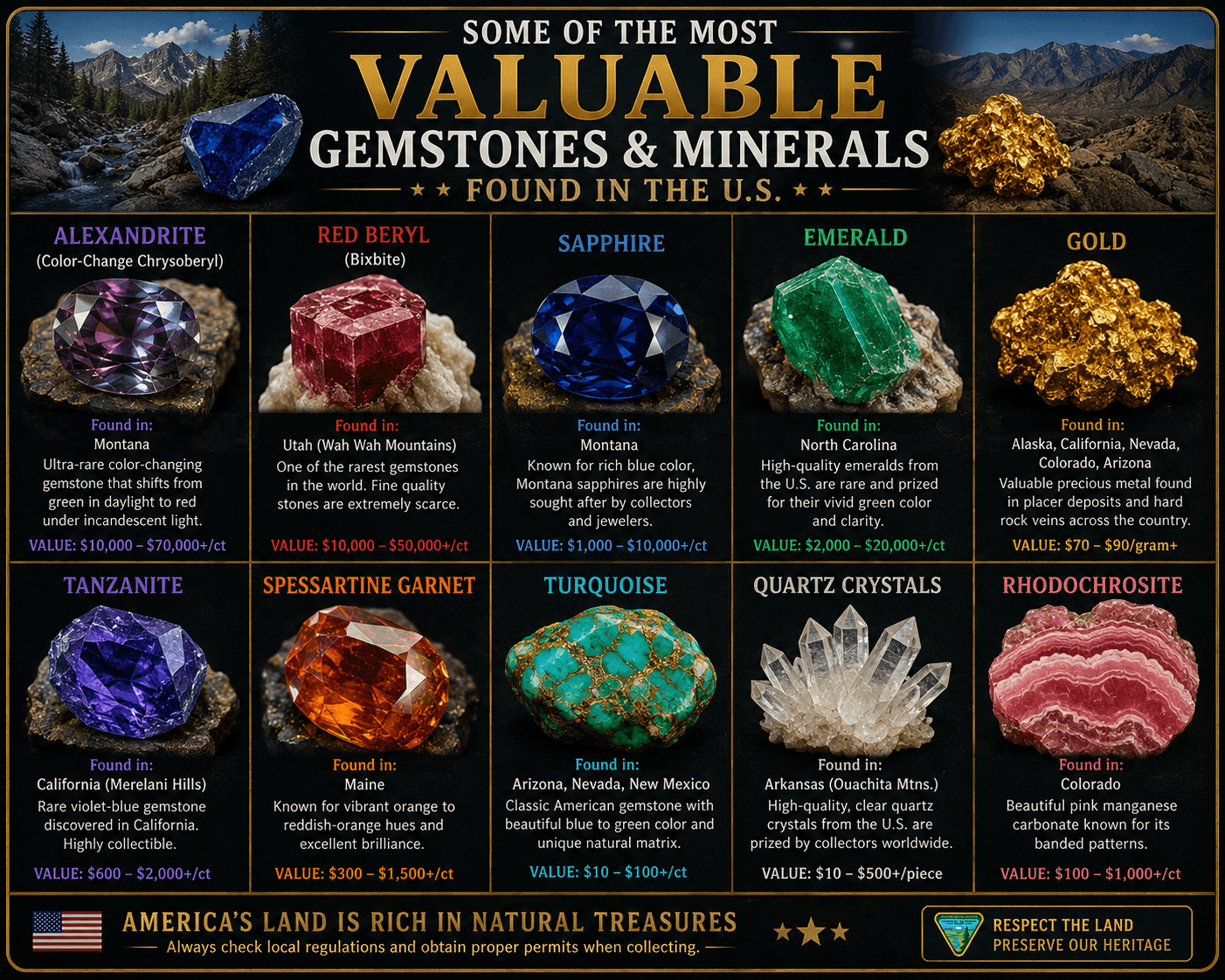
50 gemstones & minerals covered · 3-tier value ranges (rough to gem quality) · Field identification notes · GPS collecting site links · Accessibility ratings · Updated June 2026
The United States is one of the most mineralogically diverse countries on Earth — home to the world's only publicly accessible diamond mine, the rarest gemstone on the planet (red beryl, found only in Utah), the most celebrated double-terminated quartz crystals (Herkimer diamonds, New York), the finest teal sapphires in the world (Montana), and dozens of other gem and mineral finds that range from the modestly collectible to the extraordinarily valuable.
This guide covers 50 of the most valuable gemstones and minerals found in the U.S. — with practical field identification notes for each, three-tier value breakdowns (what rough material, collector specimens, and gem-quality pieces actually sell for), accessibility ratings (so you know what is genuinely achievable as a recreational collector), and direct links to the collecting locations in our GPS database.
How to use this guide:
- Looking for a specific gem? Use the quick-reference table below.
- Found something and want to identify and value it? See our companion guide: How to Identify Minerals & Rocks
- Ready to go collect? Use the interactive map to find verified locations near you.
How We Value Gemstones — Understanding the Three Tiers
Every gem entry in this guide uses a consistent three-tier value framework:
| Tier | What it means | Who buys at this level |
|---|---|---|
| Rough / Field grade | Uncut material as found — what a rockhound typically recovers | Lapidaries, dealers, other collectors; rough gem markets |
| Collector specimen | Quality piece valued for display as-is — matrix specimens, crystal formations, unusual habits | Mineral show dealers, auction houses, serious collectors |
| Gem quality | Facet-grade or top cabochon-grade material; cut stones | Jewelers, gem dealers, gem auctions (GIA-certified for top stones) |
Important caveat: Values listed are approximate retail ranges based on market observations as of May 2026. The actual value of any specific piece depends on exact color, clarity, size, treatment status, origin documentation, and market conditions. Use these figures as orientation, not appraisal.
Quick-Reference Table — All 50 Gems at a Glance
| # | Gemstone / Mineral | Best U.S. State | Field-grade rough | Accessibility |
|---|---|---|---|---|
| 1 | Diamond | Arkansas | $10–$500+/ct | 🟡 Fee-dig |
| 2 | Red Beryl | Utah | $500–$2,000+/ct | 🔴 Private only |
| 3 | Ruby | North Carolina, Montana | $50–$500+/ct | 🟡 Fee-dig |
| 4 | Alexandrite | North Carolina | $200–$1,000+/ct | 🟡 Fee-dig |
| 5 | Benitoite | California | $500–$2,000+/ct | 🔴 Closed to public |
| 6 | Montana Sapphire | Montana | $10–$50/ct | 🟡 Fee-dig |
| 7 | Emerald | North Carolina | $50–$300/ct | 🟡 Fee-dig |
| 8 | Demantoid Garnet | California, Arizona | $100–$500/ct | 🟡 Club access |
| 9 | Black Opal | Nevada | $20–$200/ct | 🟢 BLM / fee-dig |
| 10 | Herkimer Diamond | New York | $5–$100/crystal | 🟡 Fee-dig |
| 11 | Imperial Topaz | Utah | $5–$30/ct | 🟢 Free BLM |
| 12 | Aquamarine | Colorado, North Carolina | $5–$50/ct | 🟡 Fee-dig / forest |
| 13 | Rhodochrosite | Colorado | $20–$200+/specimen | 🟡 Mine dump / dealers |
| 14 | Oregon Sunstone | Oregon | $5–$50/ct | 🟢 BLM free |
| 15 | Native Gold (nugget) | Alaska, California | $80–$200+/gram | 🟢 BLM free |
| 16 | Tourmaline (Rubellite) | Maine, California | $20–$200/ct | 🟡 Fee-dig |
| 17 | Spessartine Garnet | Virginia, California | $5–$50/ct | 🟢 Free / club |
| 18 | Fire Opal | Oregon, Nevada | $10–$100/ct | 🟢 BLM free |
| 19 | Turquoise (high-grade) | Nevada, Arizona | $5–$100/ct | 🟡 Variable |
| 20 | Peridot (gem) | Arizona | $5–$30/ct | 🟡 Reservation permit |
| 21 | Rhodolite Garnet | North Carolina | $5–$50/ct | 🟡 Fee-dig |
| 22 | Star Sapphire | Montana, North Carolina | $20–$200/ct | 🟡 Fee-dig |
| 23 | Platinum Nugget | Alaska | $500–$1,000+/gram | 🟢 BLM panning |
| 24 | Hiddenite | North Carolina | $50–$500/ct | 🟡 Fee-dig |
| 25 | Amazonite | Colorado | $2–$20/specimen | 🟢 BLM / Forest |
| 26 | Pyrope Garnet (Anthill) | Arizona | $2–$30/ct | 🟢 BLM ant hills |
| 27 | Phenakite | Colorado | $50–$300/ct | 🟡 Mine areas |
| 28 | Scheelite | California, Nevada | $5–$50/specimen | 🟡 Mine areas |
| 29 | Georgia Tektite | Georgia | $5–$30/piece | 🟢 Surface hunt |
| 30 | Holley Blue Agate | Oregon | $2–$80/piece | 🟢 Free road cuts |
| 31 | Morganite | California, Maine | $10–$80/ct | 🟡 Pegmatite digging |
| 32 | Heliodor (Golden Beryl) | Maine, Connecticut | $5–$30/ct | 🟡 Pegmatite |
| 33 | Kunzite | California | $5–$50/ct | 🟡 Pegmatite |
| 34 | Idaho Star Garnet | Idaho | $5–$30/ct | 🟢 USFS fee-dig |
| 35 | Fire Agate | Arizona, California | $5–$50/piece | 🟢 BLM free |
| 36 | Native Silver | Michigan, Montana | $10–$100/specimen | 🟡 Mine dumps |
| 37 | Rhodonite | New Jersey, Montana | $2–$30/specimen | 🟢 Club / public |
| 38 | Fluorite (gem) | Illinois, New Mexico | $1–$20/specimen | 🟢 Free / fee |
| 39 | Apatite (gem) | Maine | $5–$40/ct | 🟡 Pegmatite |
| 40 | Danburite | New York | $5–$30/ct | 🟡 Collector markets |
| 41 | Scapolite | Maine, New York | $5–$25/ct | 🟡 Pegmatite |
| 42 | Precious Opal | Nevada, Oregon | $5–$80/ct | 🟢 BLM / fee |
| 43 | Iolite | Connecticut, Wyoming | $5–$30/ct | 🟡 Pegmatite / schist |
| 44 | Spodumene (Triphane) | North Carolina | $5–$30/ct | 🟡 Pegmatite |
| 45 | Epidote (gem) | Alaska, California | $5–$30/ct | 🟡 Variable |
| 46 | Sphene (Titanite) | Alaska, Nevada | $50–$300/ct | 🟡 Variable |
| 47 | Zircon (gem) | Limited U.S. | $20–$100/ct | 🔴 Rare gem quality |
| 48 | Tsavorite Garnet | Limited U.S. | $100–$500/ct | 🔴 Rare U.S. occurrence |
| 49 | Clinohumite | Utah | $200–$1,000/ct | 🔴 Very rare gem |
| 50 | Painite | Limited U.S. | Rare | 🔴 Essentially inaccessible |
Accessibility key: 🟢 Free public land · 🟡 Fee-dig, club access, or permit · 🔴 Limited or private — not regularly accessible to recreational collectors
Part One — Precious Gems: The Highest-Value Finds

1. Diamond
Mohs hardness: 10 — the hardest natural substance; scratches everything
Key field ID: Octahedral crystal habit (8-sided); adamantine (brilliant) luster; oil-repellent surface — water beads off; only material that scratches corundum
Accessibility: 🟡 Fee-dig — Crater of Diamonds State Park, Murfreesboro, Arkansas
Diamond is the hardest natural mineral on Earth and, in gem quality, one of the most valuable objects by weight that exists. In the United States, the only significant public collecting opportunity is Crater of Diamonds State Park in Murfreesboro, Arkansas — the world's only public diamond mine where visitors keep what they find. The park sits atop a lamproite volcanic pipe that erupted approximately 95 million years ago, bringing diamonds from the deep mantle to the surface. Over 75,000 diamonds have been recovered by visitors since the park opened.
Most Arkansas diamonds are white (colorless), yellow, or brown. The famous 40.23-carat "Uncle Sam" — the largest diamond ever found in North America — was discovered here in 1924.
| Value tier | Description | Approximate range |
|---|---|---|
| Rough / field | Typical Arkansas rough — small chips, off-color | $10–$100 per carat |
| Collector specimen | Well-formed crystal, visible form | $100–$500 per carat |
| Gem quality | Facet-grade, colorless, D–F clarity | $4,000–$15,000+ per carat |
→ Find diamond collecting sites on our map
2. Red Beryl
Mohs hardness: 7.5–8
Key field ID: Deep raspberry to scarlet red hexagonal crystals in rhyolite matrix; very small (typically <1 cm); extremely dense color
Accessibility: 🔴 Private mining claims only — not accessible to recreational collectors
Red beryl is arguably the rarest gem-quality mineral in the United States, occurring in significant gem quality in only one place on the planet — the Wah Wah Mountains of Beaver County, Utah. Roughly 8,000 times rarer than diamond by some estimates, it is the most uniquely American precious gemstone. The Ruby-Violet Claims are privately held with no recreational access.
| Value tier | Description | Approximate range |
|---|---|---|
| Rough / field | Small crystals in matrix, off-color | $500–$2,000 per carat |
| Collector specimen | Crystals in rhyolite matrix, good color | $1,000–$5,000+ per piece |
| Gem quality | Facet-grade, deep red, >0.5 carat | $2,000–$10,000+ per carat |
3. Ruby
Mohs hardness: 9 (corundum — second hardest natural mineral)
Key field ID: Deep red hexagonal barrel-shaped crystals; extreme hardness — scratches everything except diamond; no cleavage; adamantine luster; may show fluorescence under UV
Accessibility: 🟡 Fee-dig — multiple operations in Franklin/Cowee Valley area, North Carolina; Yogo Gulch vicinity, Montana (mostly private)
Ruby is red corundum, colored red by trace chromium. Fine rubies regularly outsell equivalent-quality diamonds by weight. The United States has two notable ruby-producing areas: North Carolina's Cowee Valley (Franklin area), where multiple fee-dig mines operate year-round; and Montana's Yogo Gulch. Fee-dig operations — Sheffield Mine, Mason Ruby & Sapphire Mine — provide sluicing access where visitors regularly find small corundum crystals.
| Value tier | Description | Approximate range |
|---|---|---|
| Rough / field | Small, fractured, pink-red corundum crystals | $50–$500 per carat |
| Collector specimen | Well-formed crystal, visible form | $200–$2,000 per carat |
| Gem quality | Facet-grade, deep red, good clarity | $100–$15,000+ per carat |
→ Find ruby collecting sites on our map
4. Alexandrite
Mohs hardness: 8.5 (chrysoberyl)
Key field ID: The color-change effect is diagnostic — appears bluish-green in daylight, purplish-red under incandescent light; tabular orthorhombic crystals; very hard (8.5)
Accessibility: 🟡 Rare — limited fee-dig access in North Carolina; primarily enters market through dealers
Alexandrite is the color-change variety of chrysoberyl — one of the rarest and most remarkable gemstones in existence. True gem-quality alexandrite is extraordinarily rare. U.S. occurrences are limited — North Carolina's Hiddenite area and associated pegmatites have produced occasional alexandrite, and the Emerald Hollow Mine in Hiddenite offers fee-dig access.
| Value tier | Description | Approximate range |
|---|---|---|
| Rough / field | Small crystals, weak to moderate color change | $200–$1,000 per carat |
| Collector specimen | Visible crystals, documented color change | $500–$3,000 per piece |
| Gem quality | Strong color change, good clarity, >1 carat | $5,000–$70,000+ per carat |
5. Benitoite
Mohs hardness: 6–6.5
Key field ID: Vivid sapphire-blue color; triangular (ditrigonal bipyramidal) crystals — the only common mineral with this specific form; intense blue fluorescence under shortwave UV light
Accessibility: 🔴 The Dallas Gem Mine in San Benito County, California is the only significant locality; access is extremely limited and irregular
Benitoite is California's state gemstone and one of the rarest minerals on Earth. It forms in blue schist in only one commercially significant locality in the world — the New Idria district of San Benito County, California. Its vivid sapphire-blue color, intense UV fluorescence, and extreme rarity make it one of the most sought-after collector minerals in the world.
| Value tier | Description | Approximate range |
|---|---|---|
| Rough / field | Small, fractured crystals | $500–$2,000 per carat |
| Collector specimen | Blue crystals on natrolite matrix (classic form) | $500–$10,000+ per piece |
| Gem quality | Facet-grade, vivid blue, good clarity | $3,000–$10,000+ per carat |
6. Montana Sapphire
Mohs hardness: 9 (corundum)
Key field ID: Barrel-shaped hexagonal crystals; extremely hard; wide color range (teal, blue, green, yellow, pink, parti-color); often water-worn in alluvial gravels
Accessibility: 🟡 Fee-dig — Gem Mountain Mine (Philipsburg), El Dorado Bar Mine, Spokane Bar Sapphire Mine; also BLM areas near Rock Creek
Montana is the only significant domestic source of sapphires in the United States. Montana sapphires have a unique color range not found in Asian or Australian deposits — particularly the teal and parti-color stones (showing multiple colors in a single crystal). Three main deposit areas: Yogo Gulch (finest cornflower-blue, mostly private); Rock Creek (fee-dig access); and Dry Cottonwood Creek near Philipsburg (Gem Mountain Mine — extremely beginner-friendly tourist operation with consistent sapphire recovery).
| Value tier | Description | Approximate range |
|---|---|---|
| Rough / field | Water-worn gravel crystals, mixed quality | $10–$50 per carat |
| Collector specimen | Well-formed crystals, good color | $50–$300 per carat |
| Gem quality | Facet-grade, vivid teal or blue, unheated | $200–$3,000 per carat |
→ Find sapphire collecting sites on our map
7. Emerald

Mohs hardness: 7.5–8 (beryl family)
Key field ID: Vivid green hexagonal prisms; color from chromium (finest) or vanadium; almost always contains inclusions ("jardin") — eye-clean emerald is rarer than eye-clean ruby; brittle
Accessibility: 🟡 Fee-dig — Emerald Hollow Mine (Hiddenite, NC) is the only U.S. emerald mine open to public
The United States has one significant emerald locality accessible to recreational collectors: the Emerald Hollow Mine in Hiddenite, Alexander County, North Carolina — the only emerald mine in the country open to public fee-dig collecting. Hiddenite emeralds are genuine chromium-colored emeralds, not just green beryl. Quality ranges widely: most finds are small, highly included crystals, but fine specimens and occasionally facetable material do occur. The mine also produces sapphires, garnets, and the rare lithium pyroxene hiddenite.
| Value tier | Description | Approximate range |
|---|---|---|
| Rough / field | Typical Hiddenite — small, included | $50–$300 per carat |
| Collector specimen | Crystal in matrix, visible emerald green | $100–$2,000 per piece |
| Gem quality | Facet-grade, vivid green, good clarity | $500–$20,000+ per carat |
→ Find emerald collecting sites on our map
8. Demantoid Garnet
Mohs hardness: 6.5–7 (andradite garnet species)
Key field ID: Vivid green to yellowish-green; distinctive "horsetail" fibrous asbestos inclusions are diagnostic for Russian material; adamantine luster higher than diamond in dispersion; dodecahedral crystals
Accessibility: 🟡 Club access / limited — scattered California and Arizona occurrences; primarily imported from Russia, Namibia, Italy
Demantoid is the most valuable garnet species, prized for a fire (dispersion) that exceeds even diamond — it throws more spectral color than any other gemstone. U.S. occurrences of gem-quality demantoid are limited. California's Tulare County and Sierra Nevada foothills have produced occasional green andradite garnet.
| Value tier | Description | Approximate range |
|---|---|---|
| Rough / field | U.S. material — green andradite, small | $20–$200 per carat |
| Collector specimen | Matrix crystals, good green color | $100–$500 per piece |
| Gem quality | Facet-grade (Russian/Namibian typically) | $1,000–$10,000+ per carat |
9. Black Opal
Mohs hardness: 5.5–6.5 (amorphous silica — not crystalline)
Key field ID: Play-of-color (flashes of spectral color) on dark body tone; waxy luster; no crystal form (amorphous); relatively soft; Nevada material is often fragile and prone to crazing when dried
Accessibility: 🟢 BLM land (Virgin Valley, Nevada) and fee-dig operations at Royal Peacock Mine and others
Black opal — with its dark body tone and vivid spectral play-of-color — is the most valuable opal variety. In the United States, Virgin Valley in Humboldt County, Nevada is the primary black opal producing area. Critical note: Virgin Valley opals contain significant water in their structure. When removed from the wet clay matrix and allowed to dry, they frequently crack (craze). Keeping them wet or in water-saturated media is essential.
| Value tier | Description | Approximate range |
|---|---|---|
| Rough / field | Virgin Valley material — often crazes | $5–$50 per carat |
| Collector specimen | Stable piece with visible play-of-color | $20–$200 per carat |
| Gem quality | Stable, vivid play-of-color on dark base | $500–$5,000+ per carat |
→ Find opal collecting sites on our map
10. Herkimer Diamond
Mohs hardness: 7 (quartz)
Key field ID: Naturally double-terminated (pointed at both ends) — the only common quartz crystal form with this habit; water-clear to slightly smoky; often contains fluid inclusions or anthraxolite inclusions; found suspended in Cambrian dolostone cavities
Accessibility: 🟡 Fee-dig — Herkimer Diamond Mines, Ace of Diamonds Mine, Crystal Grove (all in Herkimer County, NY); some road cuts accessible free
Herkimer diamonds are exceptionally clear, double-terminated quartz crystals that form in cavities within Cambrian-age dolostone of the Little Falls Formation in Herkimer County, New York. Unlike ordinary quartz crystals, which are attached to a matrix at their base, Herkimers are free-floating in their dolostone pockets and develop terminations at both ends. Finding a large, flawless double-terminated crystal with perfect faces commands serious collector prices.
| Value tier | Description | Approximate range |
|---|---|---|
| Rough / field | Small, typical crystals | $5–$30 per crystal |
| Collector specimen | Large (>2cm), perfect faces, double-terminated | $50–$500 per crystal |
| Gem quality | Exceptional clarity, large, water-clear, no chips | $100–$1,000+ per crystal |
→ Find Herkimer diamond locations on our map
Part Two — Semi-Precious Gems Worth Serious Collecting Effort
11. Imperial Topaz (Sherry Topaz)
Mohs hardness: 8
Key field ID: Sherry (orange-amber) to honey-yellow color at Topaz Mountain, Utah; perfect basal cleavage; orthorhombic crystals; found in gas cavities in rhyolite at Utah site; characteristic warm amber color distinguishes from citrine (softer quartz)
Accessibility: 🟢 Free BLM land — Topaz Mountain, Juab County, Utah (Thomas Range)
Topaz Mountain in the Thomas Range of Utah is one of the most reliable free rockhounding experiences in the western United States. The amber to sherry-orange topaz found here is in the "imperial topaz" color range. It fades to colorless with prolonged light exposure — the standard practice is to collect in the late afternoon and store in a dark container. Collectors regularly find gemstone-quality crystals large enough to facet. One of the best free gem-collecting destinations in the country.
| Value tier | Description | Approximate range |
|---|---|---|
| Rough / field | Utah material — small to medium sherry crystals | $5–$30 per carat |
| Collector specimen | Large, well-formed crystal, natural color | $20–$200 per piece |
| Gem quality | Facet-grade, vivid sherry/orange-amber | $100–$1,000+ per carat |
→ Find topaz collecting sites on our map
12. Aquamarine

Mohs hardness: 7.5–8 (beryl family)
Key field ID: Light blue to blue-green hexagonal prisms; vitreous luster; good clarity typical; found in granitic pegmatites with other beryl varieties, tourmaline, and feldspar
Accessibility: 🟡 Fee-dig / National Forest — Mount Antero, Colorado (strenuous high-altitude hike); North Carolina pegmatite areas; Maine Oxford County
Aquamarine is the blue to blue-green variety of beryl. Mount Antero in Chaffee County, Colorado (elevation 14,269 feet) is the highest gem-collecting site in North America and produces some of the finest gem-quality aquamarine crystals in the Western Hemisphere — water-clear to vivid blue hexagonal crystals found in high-altitude granite. The hike is strenuous and requires excellent physical fitness and alpine experience. The area is on San Isabel National Forest land where hand-tool collecting is permitted.
| Value tier | Description | Approximate range |
|---|---|---|
| Rough / field | Typical pegmatite material — pale blue, included | $5–$30 per carat |
| Collector specimen | Well-formed crystal, good blue color | $20–$300 per piece |
| Gem quality | Facet-grade, vivid blue, eye-clean | $20–$200+ per carat |
→ Find aquamarine collecting sites on our map
13. Rhodochrosite (Collector Grade)
Mohs hardness: 3.5–4
Key field ID: Deep cherry-red to rose-pink rhombohedral crystals; fizzes vigorously in dilute acid (carbonate mineral); perfect 3-direction cleavage (like calcite); softer than feldspar; found in hydrothermal veins associated with silver mines
Accessibility: 🟡 Mine area / dealers — Sweet Home Mine specimens enter market via dealers; mine dump collecting possible near Alma, Colorado
The Sweet Home Mine in Park County, Colorado (near Alma) has produced some of the finest mineral specimens in the Western Hemisphere. The deep cherry-red rhombohedral rhodochrosite crystals from this mine — often perched on pyrite or associated with white quartz — are among the most recognizable and coveted collector minerals in North America. Colorado has designated rhodochrosite as the state mineral.
| Value tier | Description | Approximate range |
|---|---|---|
| Rough / field | Massive rhodochrosite, minor crystals | $5–$50 per piece |
| Collector specimen | Small rhombohedral crystals, good color | $50–$2,000 per piece |
| Gem quality | Museum-quality Sweet Home crystals | $500–$50,000+ for exceptional pieces |
→ Find rhodochrosite locations near Alma, Colorado
14. Oregon Sunstone
Mohs hardness: 6–6.5 (labradorite feldspar)
Key field ID: Transparent to translucent; metallic copper "schiller" (adventurescence) in colored varieties; colors: colorless, yellow, orange, red, green, parti-color; found in basalt flows as phenocrysts
Accessibility: 🟢 Free BLM collecting areas — Sunstone Knoll, Rabbit Hills; also fee-dig at Spectrum Mine and others near Plush, Oregon
Oregon sunstone is the official state gemstone of Oregon and one of the most distinctive gemstones in the world. It is a copper-bearing labradorite feldspar that produces a characteristic metallic flash called schiller. The color range is extraordinary: colorless to yellow to orange to red, with rare green and bicolor (parti) stones. Multiple BLM collecting areas near Plush in Lake County, Oregon allow free collecting with hand tools — one of the best free gem experiences in the Pacific Northwest.
| Value tier | Description | Approximate range |
|---|---|---|
| Rough / field | Small to medium, colorless to pale yellow | $5–$20 per carat |
| Collector specimen | Strong schiller, good color, large crystal | $20–$200 per piece |
| Gem quality | Facet-grade, deep red or bicolor, >2 carat | $20–$200+ per carat |
→ Find Oregon sunstone locations on our map
15. Native Gold — Nuggets and Specimen Gold
Mohs hardness: 2.5–3
Key field ID: Dents under pin (does not shatter); gold-yellow streak (matches surface color); extremely heavy for size (SG 19.3); does not tarnish; non-magnetic
Accessibility: 🟢 Free BLM and National Forest land — Alaska, California, Colorado, Montana, Idaho, Oregon, Nevada, and more
Native gold in nugget or crystalline form is both the most culturally iconic mineral find in the United States and a legitimate collectible with real market value. Specimen gold — material with aesthetic crystal form or unusual shape — sells for 2–10x spot value to mineral collectors. The spot price of gold (approximately $2,000–$3,000 per troy ounce) provides a floor value for any gold find. Alaska produces more gold than any other state.
| Value tier | Description | Approximate range |
|---|---|---|
| Rough / field | Fine flour gold — standard panning result | $60–$80 per gram (near spot) |
| Collector specimen | Quality nugget >1 gram, or crystalline form | $100–$500 per gram |
| Gem quality | Exceptional crystalline gold on matrix | $200–$2,000+ per gram |
→ Find gold prospecting sites on our map · Full gold prospecting guide
16. Gem-Quality Tourmaline (Rubellite, Indicolite)
Mohs hardness: 7–7.5
Key field ID: Elongated prismatic crystals with triangular cross-section; strong vertical striations on prism faces; wide color range (black, green, pink, red, blue, multicolor); often zoned (watermelon tourmaline)
Accessibility: 🟡 Fee-dig / pegmatite — Maine (Oxford County), California (Pala District, San Diego County)
Tourmaline is the most color-diverse gemstone family. The most valuable varieties are rubellite (red to pink) and indicolite (blue). The United States has two premier tourmaline regions: Maine's Oxford County (Newry, Hebron, Paris Hill — pegmatites producing fine rubellite, watermelon, and multi-colored crystals) and California's Pala District in San Diego County (historical producer of world-class rubellite and blue tourmaline).
| Value tier | Description | Approximate range |
|---|---|---|
| Rough / field | Pegmatite tourmaline — common green, black | $5–$50 per carat |
| Collector specimen | Crystal cluster, good rubellite or multicolor | $50–$1,000 per piece |
| Gem quality | Facet-grade rubellite/indicolite, good clarity | $100–$2,000+ per carat |
→ Find tourmaline collecting sites on our map
Part Three — High-Value Placer Finds
23. Platinum Nugget
Mohs hardness: 4–4.5
Key field ID: Silver-white; does not tarnish; extremely dense (SG ~21); found in placer gravels associated with mafic and ultramafic rocks
Accessibility: 🟢 BLM panning — Alaska (primarily); some Oregon and California occurrences
Native platinum is one of the rarest precious metals and occurs in placer form in some of the same streams that produce gold in Alaska. The Goodnews Bay district in southwestern Alaska produced the most significant U.S. platinum. Platinum's current spot price (~$900–$1,100/troy ounce as of 2026) makes even small grains valuable.
Value range: Near spot: $900–$1,100 per troy ounce. Specimen platinum: 1.5–3x spot.
24. Hiddenite (Green Spodumene)
Mohs hardness: 6.5–7 (spodumene — pyroxene family)
Key field ID: Distinctive emerald-green color (from chromium impurities); prismatic crystals with prominent vertical striations; perfect 2-direction cleavage at ~87°; found almost exclusively in Alexander County, NC
Accessibility: 🟡 Fee-dig — Emerald Hollow Mine, Hiddenite, North Carolina
Hiddenite is a chromium-colored variety of spodumene found almost exclusively in Hiddenite, North Carolina — the locality for which it is named. Gem-quality hiddenite is extraordinarily rare; fine deep-green specimens approach emerald in appearance and value.
Value range: Pale green rough: $10–$50/ct. Medium quality: $50–$200/ct. Gem-quality deep green: $200–$3,000+/ct.
25. Amazonite
Mohs hardness: 6 (microcline feldspar)
Key field ID: Distinctive teal to bright green color (no other common feldspar is this color); vitreous to waxy luster; 2-direction cleavage at ~90°; found in granitic pegmatites alongside smoky quartz at Colorado localities
Accessibility: 🟢 Free BLM / Pike National Forest — Crystal Peak area, Teller County, Colorado
Crystal Peak near Lake George, Colorado produces some of the finest amazonite in the world — vivid teal to bright green microcline crystals. The amazonite and smoky quartz from this locality often occur together in the same miarolitic cavity, creating dramatic combination specimens.
Value range: Rough: $1–$10/specimen. Quality crystals: $10–$150/piece. Fine combination with smoky quartz: $50–$500+/piece.
Part Four — Underrated Finds Worth More Than You Think
26. Pyrope Garnet ("Anthill Garnets")
Mohs hardness: 7–7.5
Key field ID: Deep blood-red; dodecahedral crystals; found on ant mounds in Arizona desert (ants excavate them from surrounding soil) — one of the most distinctive field-collecting methods in rockhounding
Accessibility: 🟢 Free BLM — Garnet Ridge and adjacent BLM areas in Apache County, Arizona; also Four Corners region
Arizona's "anthill garnets" are pyrope garnets weathered from kimberlite and peridotite dikes. Ants excavating their mounds bring these small, gem-quality garnets to the surface and deposit them around the entrance — creating natural concentrations visible at the surface. The garnets are genuine gem quality — many are suitable for faceting into brilliant red stones.
Value range: Small anthill garnets: $1–$10 per stone. Facet-grade >5mm: $5–$50 per carat.
27. Phenakite
Mohs hardness: 7.5–8 (beryllium silicate)
Key field ID: Colorless to white; rhombohedral crystals (looks like quartz but harder and denser); very high refractive index produces diamond-like brilliance; found in granitic pegmatites and mica schists in Colorado
Accessibility: 🟡 Mine areas — Topaz Mountain area (Utah), Pikes Peak region (Colorado), Mt. Antero (Colorado)
Phenakite is a beryllium silicate that is rare, hard, and produces exceptional brilliance when faceted — it is occasionally used as a diamond simulant. Colorado's Mount Antero and the Pikes Peak granite region have produced gem-quality phenakite.
Value range: Small rough crystals: $20–$100/ct. Facet-grade: $100–$500/ct. Fine crystals: $200–$2,000+ per piece.
28. Scheelite
Mohs hardness: 4.5–5 (calcium tungstate)
Key field ID: White to yellow-orange; intense bright blue fluorescence under shortwave UV — the most diagnostic property; very high specific gravity (6.1) — feels very heavy; dipyramidal crystals
Accessibility: 🟡 Mine areas — California (San Bernardino, Inyo Counties), Nevada, Arizona tungsten districts
Scheelite is prized by fluorescent mineral collectors for its spectacular bright blue fluorescence under shortwave UV — one of the most dramatic fluorescence effects in mineralogy. In good light and under the right UV lamp, scheelite in a field of dark limestone glows like a beacon.
Value range: Common material: $5–$30/specimen. Excellent fluorescent display quality: $20–$150. Fine crystals: $50–$400+.
29. Georgia Tektite (Georgiaite)
Mohs hardness: 5.5–6 (glass)
Key field ID: Green to olive-green to greenish-yellow glass; aerodynamic shapes (button, dumbbell, teardrop); smooth, flow-sculpted exterior; found on the surface of Coastal Plain sediments in Georgia and South Carolina
Accessibility: 🟢 Free surface hunt — Coastal Plain agricultural fields in central Georgia; private farmland (permission required); some public land in the coastal plain
Georgiaites are natural glass formed by a large meteorite that struck the Chesapeake Bay area approximately 35 million years ago. The impact melted and vaporized rock, ejecting material into the atmosphere where it fell back molten across the southeastern U.S., solidifying as glass droplets. Finding them requires walking plowed agricultural fields — they are most visible after rain.
Value range: Small, abraded: $5–$20/piece. Well-formed, unweathered: $20–$150/piece. Exceptional aerodynamic form: $100–$500.
30. Oregon "Holley Blue" Agate
Mohs hardness: 7 (chalcedony)
Key field ID: Distinctive blue-lavender to cornflower blue color; translucent; conchoidal fracture; found as river cobbles and nodules in the Willamette Valley and surrounding areas
Accessibility: 🟢 Free — public road cuts and river gravel bars near Holley, Oregon
Holley blue agate is a naturally blue to blue-lavender chalcedony found near Holley, Oregon. The blue color is unusual for North American agate and results from specific trace element chemistry in the volcanic host.
Value range: Common material: $2–$15/piece. Rich blue, translucent: $10–$80/piece. Top-grade slabs: $30–$200.
How to Get Your Find Appraised or Sold
Found something you think might be valuable? Here is the realistic path to appraisal and sale.
Step 1 — Identify it first
Before seeking appraisal, be confident in the mineral identification. Use our field identification guide and the rock identification apps guide. Post to the Rockhounding.org community forum for peer identification help. Paying for a gemological appraisal before you know what you have is premature.
Step 2 — Understand treatment status
For colored gemstones (ruby, sapphire, emerald), whether the stone has been heat-treated or filled with resin/glass affects price substantially. GIA, AGL, and Gübelin are the major gemological labs that certify origin and treatment status for important stones.
Step 3 — Seek appropriate market venues
- Gem and mineral shows (Tucson, Denver, Springfield) — the best place to gauge realistic market value and meet buyers
- Mineral dealer networks — established dealers buy quality collector specimens; bring documentation of provenance when available
- Gem auction houses — for high-value cut stones or exceptional mineral specimens
- eBay, Etsy, Mineral Auctions — useful for moderate-value material; research comparable sold listings before pricing
- Local lapidary clubs — for rough gem material; members often buy quality local finds
Step 4 — Avoid common selling mistakes
- Do not sell to the first buyer without getting multiple offers on anything potentially valuable
- Do not rely on a retailer's appraisal for selling purposes — retailers appraise at retail value, not what they would pay
- Provenance documentation (where it was found, when) adds value — keep records of significant finds
Related Guides on Rockhounding.org
- What Rocks Are Worth Money? — Identify & Value Your Finds
- Find Gold Near You — 3,037 Locations & Field Guide
- Find Quartz Near You — 202 Locations & State Guide
- Mohs Hardness Scale — Complete Chart & 60+ Minerals
- How to Identify Minerals & Rocks — Complete Field Guide
- Public Gem Mining Sites in the U.S.
- Interactive Map — Browse All 1,000+ U.S. Rockhounding Locations
Article last reviewed and updated June 2026. Values represent approximate retail price ranges observed at gem shows, auction records, and dealer markets as of May 2026. Gemstone and mineral markets fluctuate — do not use these figures for insurance, estate, or legal appraisal purposes. Consulting a GIA-certified gemologist is recommended for formal appraisal of significant finds.