
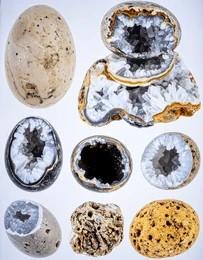
This guide covers everything you need to know: what thundereggs are, how they form step by step, what's hiding inside, what they look like in the field, and where to find them across the US and internationally.
Thundereggs

Thundereggs are spherical, nodular-like rocks formed inside rhyolitic volcanic ash, typically filled with agate, chalcedony, jasper, or opal, and surrounded by a lumpy rhyolite shell. The inside is well known to contain a star-shaped fracture pattern at the core of the thunderegg's geological fingerprint, found in no other type of rock.
The word "thunderegg" originated from Native Americans of central Oregon, who believed that thunder spirits lived on Mount Jefferson and Mount Hood, two rival volcanic peaks. When the spirits grew jealous or enraged, they hurled the round, agate-filled stones at each other across the sky during storms. The rocks were said to be the eggs of those thunder spirits, and the name stuck.
However, geologists believed that Thundereggs were formed in gas pockets, serving as molds, that were left in the lava flows of the Eocene Geological Age. The scientific term is lithophysae, gotten from the Greek word for "stone bubbles".
How do Thundereggs form?
In geological terms, thundereggs are associated with igneous rock processes, since they form within volcanic rhyolite. Igneous rocks originate when molten rock material called magma or lava cools and solidifies.
Thundereggs develop through a sequence of geological processes that begin with explosive volcanic eruptions producing silica-rich lava known as rhyolite. Because rhyolitic magma contains more than 70% silica (SiO₂), it is extremely viscous. Instead of flowing easily like basalt, it erupts violently, creating thick lava flows, ash clouds, and welded volcanic tuffs. As these materials cool, gases trapped in the molten rock form cavities, which are the starting point for thundereggs. Here are the stages that make up the formation of thundereggs:
- Cooling Lava and Crystal Growth: Here, rhyolite cools, and needle-like crystals of minerals such as cristobalite and feldspar radiate outward from central points. These structures, called spherulites, generate internal stress that fractures the surrounding rock. The result is a distinctive star-shaped crack pattern at the cavity's center, known as a lithophysa, a hallmark of thundereggs.
- Silica-Rich Fluids Fill the Cavities: Over time, hydrothermal fluids rich in dissolved silica seep into the cavities. Instead of leaving hollow spaces, the silica deposits minerals layer by layer. Chalcedony usually forms first, coating the walls; later deposits may include agate, jasper, opal, or quartz crystals. In some cases, silica gels harden into solid fills, creating banded or patterned interiors.
- Colors and Patterns Develop: The striking patterns seen inside thundereggs are created by trace elements and impurities within the silica-rich fluids. Small amounts of iron, manganese, and other elements influence the color of the minerals as they crystallize. For example Iron can create reds, yellows, and browns, and variations in silica concentration can create banded agate patterns. Because the mineral chemistry and conditions vary slightly within each cavity, no two thundereggs develop identical interiors. Interestingly, while thundereggs from the same deposit often look nearly identical on the outside, their internal patterns can be completely different.
- Exposure Through Erosion: Thundereggs remain buried in volcanic deposits for millions of years. Eventually, erosion and uplift expose them by stripping away softer rhyolitic ash. They often end up in streambeds, hillsides, or desert surfaces. While weathering may reveal part of the interior, their full beauty is only seen when cut and polished, exposing the intricate mineral patterns hidden within.
The final result of these geological processes is a rock that looks ordinary on the outside but hides intricate mineral formations inside.
What's Inside a Thunderegg?

What is inside a thunderegg is where the surprise of finding one lies. Here is what you might find inside a thunderegg:
- Chalcedony: Most thundereggs are filled with chalcedony, a microcrystalline form of quartz that forms a smooth, waxy surface. Chalcedony ranges from white to pale blue to blue-gray, and at its best, it has an almost translucent quality that makes the interior glow when held to light. Oregon's Priday Ranch Blue Bed is world-famous for producing thundereggs with a distinctive powder-blue chalcedony interior unlike anything found elsewhere.
- Agate: Agate, also known as banded chalcedony, is the most prized and most varied interior type. You could find them in multiple colors, from rings of white and red, or brown and cream, or gray and orange, each layer representing a different period of mineral deposition. Agate thundereggs can also contain moss agate (with fern-like inclusions), plume agate (with feathery red or orange plumes), and sagenite agate (with needle-like crystal inclusions that look like straw caught in glass).
- Jasper: Jasper fills some thundereggs with solid, opaque color, red, yellow, green, or brown, and makes for striking display pieces. Baker Ranch in New Mexico is unique in producing multicolored jasper thundereggs with vivid reds, yellows, and greens layered together in patterns not found at any other site in the world.
- Opal: Opal is the rarest and most exciting interior type. Most thunderegg opal is common opal pale, waxy, lacking the color play of precious opal, but certain Oregon and Idaho localities produce thundereggs with genuine precious opal inside. Opal Butte in Morrow County, Oregon, is the most famous of these sites, producing thundereggs whose interiors contain gem-quality precious opal with the full spectral play of color.
Quartz and amethyst crystals occasionally appear in thundereggs that have a small hollow center. The silica fluids only partially filled the cavity, leaving a crystal-lined void that makes the specimen technically a geode as well as a thunderegg.
Read More: Where to Find Opal in the US: Locations & Collecting Guide
What Does a Thunderegg Look Like on the Outside?
On the surface, a thunderegg doesn't look spectacular. Its outer shell is rhyolite, the volcanic host rock, which weathers to shades of reddish-brown, gray, or dull tan. The texture is lumpy, irregular, and often nodular or warty. There are no visible crystals, no sparkle, and nothing flashy to catch the eye, the kind of rock you might walk past without noticing if you didn't know what to look for.
Most thundereggs are about the size of a baseball (2–6 inches across). However, they can range from smaller than a golf ball to massive specimens several feet wide. The largest known thunderegg weighs 1.75 tons and is displayed at the Rice Northwest Museum of Rocks and Minerals in Hillsboro, Oregon. A key field clue is their density; thundereggs feel heavy and solid compared to hollow geodes of similar size.
In the field, thundereggs are usually embedded in soft volcanic clay, often lie close to the surface, and in productive collecting areas, they can be surprisingly common.
When you pick a thunderegg, feel if the rock feels dense, round, and heavy for its size, with a reddish-brown, knobby surface, and you're in volcanic terrain, chances are good you've found a thunderegg. In contrast, a hollow geode of similar size will feel noticeably lighter.
Watch this video to see what the exterior of a thunderegg looks like.
Cutting and Polishing the Most Beautiful THUNDEREGGS!
Where to Find Thundereggs
Thundereggs form wherever ancient rhyolitic volcanic activity occurred, which means they're tied almost entirely to the volcanic geology of the western United States and a handful of international locations. Here's where to go to find thundereggs:
Oregon
Oregon is the most productive thunderegg state in the country by a significant margin. The volcanic terrain of central and eastern Oregon has produced more named collecting localities than anywhere else on Earth.
- Priday Ranch (Jefferson County) is the most famous thunderegg site in the world. Located near Madras, the ranch operates as a fee-dig site and is best known for its Blue Bed, a specific rhyolite layer that produces the distinctive powder-blue chalcedony thundereggs that collectors travel internationally to find.
- Richardson's Rock Ranch (Wheeler County) near Fossil is another major fee-dig operation producing thundereggs in a wide variety of interior types: agate, chalcedony, and occasional opal. The ranch has been operating for decades and is one of the most established collecting destinations in the Pacific Northwest.
- Ochoco National Forest (Crook County) near Prineville is public land where collecting for personal use is permitted without a fee. The Whistler Springs area within the forest is a well-known collecting locality that has produced thundereggs for generations of Oregon rockhounds. Check with the Ochoco National Forest ranger district for current rules and any permit requirements before visiting.
- Opal Butte (Morrow County) is in a category of its own. The rhyolite here produces thundereggs with genuine precious opal inside, some of gem quality with full spectral color play. Access has historically been through organized club trips and guided digs; contact local gem and mineral clubs for current access information before planning a visit.
- Hampton Butte and Glass Butte (Lake County) produce thundereggs alongside the obsidian flows that Glass Butte is more famous for. The area is on BLM land and open to casual collecting.
Idaho
Idaho, with its volcanic Snake River Plain and surrounding rhyolitic terrain make it the second most productive thunderegg state in the US.
- Graveyard Point (Owyhee County) near the Oregon-Idaho border is one of the most accessible and well-documented thunderegg sites in Idaho, producing thundereggs with agate and chalcedony interiors in a striking desert landscape. The site is on BLM land and free to collect on for personal use.
- Spencer Opal Mines (Clark County) in northeastern Idaho is best known for precious opal but also produces thundereggs and opal-bearing nodules from rhyolitic volcanic flows. The site operates as a fee-dig and is open to the public seasonally. Check their website for current operating dates before making the trip.
- The Challis Volcanic Group (Custer County) in central Idaho covers a broad area of rhyolitic terrain that has produced thundereggs across multiple collecting localities. Less developed and less documented than the Oregon sites, which means lower collector pressure and the possibility of genuinely untouched ground for those willing to do the research.
Other notable locations in the US to find thundereggs include:
- Washington: Washington is known for its eastern volcanic terrain, shaped largely by the Columbia River Basalt Group, which produces thundereggs and agate nodules in several accessible locations. Walker Valley (Skagit County) in northwestern Washington is a well-known collecting locality producing thundereggs and agates from basaltic volcanic flows. The Saddle Mountains and Vantage Area (Grant and Kittitas Counties) in central Washington are also worth visiting for thundereggs.
- Nevada: In Nevada, the Virgin Valley (Humboldt County, Nevada) is primarily known for precious opal, but the surrounding rhyolitic terrain produces thundereggs as well. Several fee-dig operations in the valley allow public collecting.
- New Mexico: In New Mexico, The Baker Ranch, Catron County, deserves special mention for its multicolored jasper thundereggs with vivid reds, yellows, and greens layered together in patterns not found at any other site in the world. Access is through the ranch directly.
- Texas: Woodward Ranch, Brewster County, Texas, near Alpine, produces thundereggs alongside the agate deposits the Big Bend region is known for. The ranch operates as a fee-dig and is the most accessible thunderegg destination in the southwestern US for collectors based in Texas or nearby states.
Thundereggs are not exclusively American, though the US has the highest concentration of known sites. The Thuringian Forest and Rhineland-Palatinate in Germany have produced thundereggs for over a century. In Australia, the Flinders Ranges and Queensland both have rhyolitic volcanic terrains that produce thundereggs, some with opal interiors.
Read More: Most Valuable Gemstones & Minerals You Can Find in the US (2026)
Tips for Finding Thundereggs in the Field
Finding thundereggs on the ground requires a different skill set. Here are some tips that can help your search:
- Look for the clay: Thundereggs form in rhyolitic ash that weathers over time to a soft, pale clay. When you're standing in the right terrain, the ground underfoot often has a distinctive pale gray or cream-colored clay component, the decomposed tuff that once hosted the thundereggs. Productive ground looks and feels different from ordinary dirt once you've experienced it.
- Search after rain: Rain washes surface clay away and exposes thundereggs that were buried just below the surface. Early morning after a recent shower at a known site is close to ideal conditions.
- Learn the size and weight: Most thundereggs are baseball-sized and feel dense, heavier than a hollow rock of the same diameter would be. Once you've held a few, your hands learn to recognize the combination of size, weight, and shape automatically.
- Join a club before your first trip: Oregon and Idaho gem and mineral clubs run organized field trips to known thunderegg localities, including private ranch sites that aren't publicly accessible on your own. For a first-time thunderegg hunter, a club trip removes the guesswork entirely and puts you on proven ground with experienced collectors who can show you exactly what you're looking for.
- Use the best tools: A sturdy rock hammer, chisel, and small shovel are essential for loosening thundereggs from clay or tuff. A bucket or backpack helps carry your finds, and gloves protect your hands from sharp edges.
Conclusion
A thunderegg is a geological surprise where, from the outside, it looks ordinary, but the inside tells a lot about the volcanic history of the region where it formed, and the chemistry of ancient groundwater that moved through cooling rhyolite millions of years ago.
With thundereggs, finding and cutting one open is the best way to experience their beautiful intricacies. It's the reason Oregon ranches have been hosting rockhounds for over a century, and the reason collectors who've opened hundreds of thundereggs still feel the pull of one more.
If you are planning to rockhound this season, start with a club trip to a known Oregon or Idaho site, or visit one of the fee-dig ranches covered in the locations section above to experience the beauty of discovering thundereggs.
Read More: Thunderegg or Geode? How to Tell Them Apart
Frequently Asked Questions
It depends on where you are. Globally, thundereggs are uncommon as they only form in regions with rhyolitic volcanic geology, which limits where they occur. But at known collecting sites in Oregon and Idaho, they can be found in significant concentrations.
Most field-collected thundereggs with attractive agate or chalcedony interiors sell as cut and polished slabs for $5 to $50, depending on size and visual appeal. Thundereggs with unusual or exceptional interiors, like strong color or inclusions, can reach $100 to several hundred dollars. Specimens with gem-quality precious opal from Opal Butte or the Owyhee River can sell for significantly more.
Lithophysa (plural: lithophysae), from the Greek for "stone bubble." The term is used in geological literature and museum labels.
With a diamond-tipped rock saw, ideally with water cooling the blade to prevent cracking. Mark a cut line around the equator, cut slowly, and polish the face afterward. A hammer will not work as thundereggs are solid and dense, and a hammer strike will shatter the interior rather than revealing it. If you don't have access to a rock saw, most gem and mineral clubs have one available to members.