
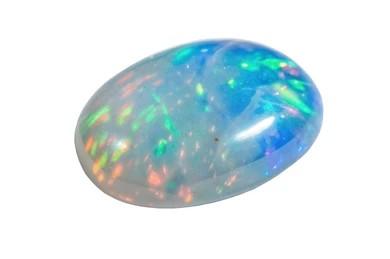
Opal: Silica, Water, and Light
Opal (SiO2 nH2O) is hydrated amorphous silica — it has no crystal structure, which makes it unique among gemstones. While quartz, feldspar, and garnet organize their atoms into neat repeating lattices, opal is a solidified gel: billions of tiny silica spheres packed together with water trapped between them. When those spheres are uniform in size (roughly 150 to 400 nanometers in diameter) and stacked in regular three-dimensional arrays, they diffract light into spectral colors — the play-of-color that defines precious opal. Shift the stone in the light and the colors change: red, green, blue, orange, dancing across the surface. This effect is not caused by pigments or chemical impurities but by the physical structure of the silica itself.
Common opal — opal without play-of-color — forms when the silica spheres are irregular in size or randomly packed. It can be milky white, yellow, orange (fire opal), blue, green, or colorless, and it has its own appeal as a mineral specimen even without the spectral fire.
The United States has produced some exceptional opal specimens, particularly from Nevada's Virgin Valley, which has yielded black opals rivaling the finest Australian material. Several other localities across the West produce collectible opal ranging from precious gem-grade material to attractive common opal.
How Opal Forms: The Geology
Opal forms when silica-rich groundwater percolates through volcanic rock or sediments and deposits amorphous silica in voids, fractures, and as replacements of organic material. The process requires three things: a source of dissolved silica (typically volcanic ash or rhyolite), water to transport it, and a void or permeable material to deposit it in.
In Nevada's Virgin Valley, the opal formed as a replacement of buried wood in volcanic ash (bentonite) deposits. Silica-bearing groundwater infiltrated organic-rich lake sediments and replaced the woody tissue cell by cell, preserving the wood grain while converting it to opal. The result is opalized wood — specimens that show the structure of the original tree but are now composed entirely of opal. Some of this opalized wood displays world-class play-of-color against a dark body color, producing black opal of extraordinary beauty.
In Oregon and Idaho, opal occurs in rhyolitic volcanic rock. Silica-bearing fluids deposited opal in vesicles (gas cavities), fractures, and along cooling joints in the rhyolite. The opal here includes transparent hyalite opal, precious fire opal with play-of-color, and common opal in white, blue, and pink.
In Louisiana, silica replaced buried palm wood in Oligocene-age sediments. The silica source was likely volcanic ash from distant eruptions that drifted into the Gulf Coast region and weathered, releasing dissolved silica into the groundwater. The result is opalized palm wood — the state gem of Louisiana — which shows the distinctive fibrous structure of palm trunks in opal.
Where to Find Opal in the United States
1. Virgin Valley, Nevada — Humboldt County
Virgin Valley is the most famous opal locality in North America and one of the finest in the world. The valley sits in the remote high desert of northwestern Nevada, about 35 miles west of Denio Junction. Three fee-dig operations provide public access to the opal-bearing bentonite clay deposits: Rainbow Ridge Opal Mine, Royal Peacock Opal Mine, and Bonanza Opal Mine.
The opal here occurs as replacements of wood in Miocene-age volcanic ash that settled into an ancient lake. Specimens range from common white opal with no play-of-color to spectacular black opal with vivid red, green, and blue fire. Virgin Valley has produced some of the largest and finest black opals ever found, including the Roebling Opal (now in the Smithsonian).
- GPS: Approximately 41.83°N, 118.77°W (Virgin Valley, Humboldt County, NV)
- Land Status: The fee-dig mines sit on patented mining claims within the Sheldon National Wildlife Refuge. Access is through the mine operators. Each mine charges daily or multi-day fees. The season runs approximately May through October, depending on weather and operator schedules.
- Vehicle: High-clearance vehicle strongly recommended. The access road from Denio Junction is approximately 35 miles of unpaved road that can be rough, muddy, or washboarded depending on conditions. Sedan access is possible in dry conditions on the main road, but not comfortable or reliable.
- What to Expect: You dig through bentonite clay with hand tools (pick, trowel, small shovel) looking for opal that formed as wood replacements. The clay is soft and workable when damp. Opal pieces range from fingernail-sized fragments to occasionally large limb casts several inches long. Most opal found is common (no play-of-color). Precious opal with play-of-color is the minority but does occur every day — persistence pays off. The mine operators provide instruction on digging technique and where to work.
Critical warning about Virgin Valley opal: This opal is notorious for crazing — developing fine cracks after it dries out. The opal forms with high water content (up to 20%) in wet clay, and when it dries in open air, differential water loss causes internal stresses that crack the stone. Some specimens craze within hours of removal; others take weeks or months; some never craze at all. There is no reliable way to predict which specimens will survive. To minimize crazing:
- Wrap freshly dug opal immediately in damp cloth or paper towels
- Place wrapped specimens in sealed zip-lock bags
- Some collectors store Virgin Valley opal permanently in water or baby oil
- Allow drying to occur extremely slowly — weeks to months — in a sealed container with gradually decreasing humidity
- Accept that a percentage of specimens will craze regardless of your precautions
2. Opal Butte, Oregon — Morrow County
Opal Butte in the Blue Mountains of northeastern Oregon produces transparent hyalite opal, precious fire opal with play-of-color, and contra luz opal (transparent opal that shows play-of-color when light passes through it from behind). The opal occurs in rhyolite and is associated with Miocene-age volcanic activity.
- GPS: Approximately 44.85°N, 119.15°W (Opal Butte area, Morrow County, OR)
- Land Status: Mix of BLM land and private mining claims. The primary producing claims are privately held. Some BLM land in the area may yield opal. Check with the BLM Prineville District Office for current land status and access information.
- Vehicle: High-clearance vehicle recommended. Forest and ranch roads in the area are rough and may be muddy in spring.
- What to Expect: Transparent to translucent opal in rhyolite matrix. Hyalite opal (clear, glass-like) sometimes fluoresces bright green under UV light. Precious opal with play-of-color is uncommon but does occur. Access to the best-known claims may require contacting the claim holders for permission or purchasing material through dealers.
3. Spencer Opal Mine, Idaho — Clark County
The Spencer Opal Mine near the small town of Spencer in eastern Idaho is a fee-dig operation that produces common opal and occasional precious opal in rhyolite. The mine has been open to the public for decades and is a well-established collecting destination.
- GPS: Approximately 44.36°N, 112.18°W (Spencer Opal Mine, Clark County, ID)
- Land Status: Private fee-dig operation. Open during summer months (typically Memorial Day through Labor Day). Admission fee required. The mine provides collecting areas where visitors screen through opal-bearing overburden.
- Vehicle: Sedan accessible. Spencer is on I-15 between Idaho Falls and Dillon, MT. The mine is reached via a short paved and gravel road from town.
- What to Expect: Common white to milky opal is the most frequent find. Translucent material with hints of play-of-color turns up regularly. Fully precious opal with strong play-of-color is uncommon but possible. The mine provides screening equipment and basic instruction. This is a family-friendly operation — good for introducing kids to mineral collecting.
4. Central and Northern Louisiana — Opalized Palm Wood
Louisiana's state gem is opalized palm wood — silicified palm trunk material where the original cellular structure of the palm is preserved in opal. The opalized wood occurs in Oligocene-age gravel deposits across central and northern Louisiana, particularly in the Leesville area of Vernon Parish and in gravel pits and stream beds throughout the region.
- GPS: Approximately 31.14°N, 93.26°W (Leesville area, Vernon Parish, LA); opalized wood occurrences are widespread across central and northern Louisiana.
- Land Status: Gravel pits on private land require landowner permission. Stream gravel deposits on public rights-of-way (road ditches, bridge approaches) may be collectible, but check local regulations. Some gravel pit operators allow collecting; others do not.
- Vehicle: Sedan accessible to most collecting areas. The terrain is flat coastal-plain geology — no mountain roads or desert tracks.
- What to Expect: Rounded to angular pieces of opalized palm wood in gravel beds. The palm structure — radial fibrous pattern in cross-section, longitudinal fibers in side view — is diagnostic. Color ranges from brown to cream to occasionally blue or red. Some specimens show translucency or faint play-of-color, but most are common opal. Quality material polishes well and displays the palm grain beautifully.
5. Denio Junction Area, Nevada — Humboldt County
Beyond Virgin Valley, the Denio Junction area in northwestern Nevada produces common opal and occasional precious opal in volcanic terrain. Several old prospects and collecting areas on BLM land in the region yield opal in rhyolite and volcanic ash deposits.
- GPS: Approximately 41.20°N, 118.63°W (Denio Junction area, Humboldt County, NV)
- Land Status: BLM land. Personal-use collecting is permitted. Check with the BLM Winnemucca District Office for current access information.
- Vehicle: High-clearance vehicle required. Remote desert terrain with unimproved roads.
- What to Expect: Common opal in volcanic host rock. Quality and availability are less consistent than Virgin Valley. This is exploratory collecting — bring patience and low expectations.
6. Lakeview Area, Oregon — Lake County (Spencer Opal Mine of Oregon)
The area around Lakeview in south-central Oregon produces opal in volcanic terrain. The old Juniper Ridge area and surrounding BLM land have produced common opal and occasional fire opal. Several collecting areas are accessible on public land.
- GPS: Approximately 42.19°N, 120.35°W (Lakeview area, Lake County, OR)
- Land Status: Mix of BLM land and private land. BLM land permits personal-use collecting. Check current access with the BLM Lakeview District Office.
- Vehicle: High-clearance vehicle recommended for backcountry access.
- What to Expect: Common opal and occasional fire opal in rhyolite. Less productive than Virgin Valley or Spencer but accessible and on public land.
Opal Specimen Varieties
| Variety | Body Color | Play-of-Color | Best US Source | Crazing Risk |
|---|---|---|---|---|
| Black opal | Dark gray to black | Vivid spectral fire | Virgin Valley, NV | High |
| White / light opal | White to cream | Moderate to weak | Spencer, ID; Virgin Valley, NV | Moderate |
| Fire opal | Orange to red | Variable (may or may not show) | Opal Butte, OR | Low to moderate |
| Hyalite opal | Colorless (glass-like) | None (UV fluorescent) | Opal Butte, OR | Low |
| Common opal | White, milky, blue, green | None | All US localities | Low |
| Opalized palm wood | Brown, cream, blue | Rare (occasional faint) | Louisiana | Very low (stable) |
| Opalized wood (not palm) | Variable | Variable — sometimes spectacular | Virgin Valley, NV | High |
| Contra luz opal | Transparent | Visible only in transmitted light | Opal Butte, OR | Low |
Field Identification: How to Confirm Opal and Avoid Look-Alikes
| Property | Value |
|---|---|
| Hardness | 5.5 to 6.5 (Mohs) — softer than quartz |
| Color | White, black, orange, colorless, blue (with or without play-of-color) |
| Luster | Vitreous to waxy to resinous |
| Streak | White |
| Fracture | Conchoidal |
| Specific Gravity | 1.98 to 2.25 — lighter than quartz (2.65) |
| Water Content | 3 to 20% by weight |
Opal's field identification depends on the variety. Precious opal is easy — play-of-color (spectral flashes that shift when you rotate the stone) is diagnostic and no other natural material produces it. Common opal is trickier and requires more attention.
The key field indicators for common opal are: a waxy to resinous luster (different from the vitreous luster of quartz), a conchoidal fracture that often shows a slightly waxy surface, lower hardness than quartz (opal can be scratched by quartz but not vice versa), and a lighter feel than quartz of the same size (lower specific gravity). Wetting a suspect piece often reveals the waxy character more clearly.
In Virgin Valley, freshly dug opal in bentonite clay has a distinctly different look from the surrounding clay — it appears glassy, often with a dark body color, and may show play-of-color immediately when wet. In rhyolite-hosted deposits (Oregon, Idaho), opal fills vesicles and appears as glassy patches or blobs in the gray to white rhyolite matrix.
Common Look-Alikes
- Chalcedony / agate: Both are SiO2 but chalcedony is crystalline (microcrystalline quartz), while opal is amorphous. Chalcedony is harder (7 vs. 5.5-6.5), heavier, and has a more vitreous luster. Chalcedony never shows play-of-color.
- Potch (common opal without play-of-color): Not really a look-alike since it IS opal — just not precious opal. Worth collecting as a mineral specimen.
- Moonstone (feldspar): Shows adularescence (a floating blue-white glow) that can be confused with opal play-of-color. But moonstone has feldspar cleavage, is harder (6-6.5), and the optical effect is a single color glow rather than spectral flashes.
- Synthetic or simulated opal: Too uniform, too perfect. Not encountered in the field, but common at gem shows.
Tools and Equipment for Opal Collecting
- Small pick and trowel: The primary tools for Virgin Valley and other clay-hosted deposits. You are digging through soft bentonite, not breaking hard rock. A small, pointed pick (like a military entrenching tool or a small garden pick) works best.
- Spray bottle: Wetting a freshly exposed surface reveals play-of-color immediately. Carry at least a quart of water dedicated to spraying specimens.
- Zip-lock bags and damp paper towels: Wrap each opal specimen in damp paper towel and seal in a zip-lock bag immediately after extraction. This is not optional for Virgin Valley opal — it is critical for preventing crazing.
- UV flashlight: Hyalite opal fluoresces bright green under shortwave UV. A UV light can identify opal in rhyolite that you might otherwise miss in visible light.
- Small containers with padding: Opal is softer and more fragile than most gemstones. Cushion every specimen.
- Sun protection: Virgin Valley, Spencer, and most western opal sites are in exposed terrain with no shade. Hat, sunscreen, long sleeves, and plenty of drinking water are mandatory.
- Knee pads: You will spend hours on your knees digging through clay at Virgin Valley. Good knee pads are worth their weight in opal.
- Eye protection: When working with pick or hammer in any rock.
Legal Considerations
- Fee-dig operations (Virgin Valley, NV; Spencer, ID): Pay the fee, follow the operator's rules, and keep what you find. The simplest legal framework for opal collecting.
- BLM land: Personal-use collecting of reasonable quantities is permitted on BLM-managed public land. This applies to opal found on BLM land in Nevada, Oregon, and other western states.
- National Wildlife Refuges: The Sheldon NWR surrounds Virgin Valley. The fee-dig mines operate on patented claims within the refuge. Do not collect on NWR land outside the patented claims — mineral collecting on NWR land is generally prohibited.
- Private land (Louisiana, Oregon): Get landowner permission before collecting. Gravel pit operators may or may not allow collecting — ask first.
- Mining claims: Many opal occurrences in Oregon and Nevada are covered by mining claims. Check claim status before collecting on any ground that is not clearly designated as public or fee-dig.
Explore the Interactive Opal Map
Use our interactive opal location map to find collecting sites with GPS coordinates, access information, and land status details.