
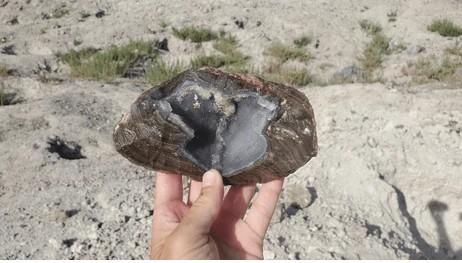
Thundereggs and Geodes are usually confused with one another; they are both round and lumpy rocks with beautiful crystals hidden inside. But they are contradictory in some ways; while geodes are hollow, thundereggs are solid, and thundereggs only form in volcanic rock. There are thundereggs with hollow centers, and some geodes are filled in.
This article explains the distinction between thundereggs and geodes, what each one is, how each one forms, what's inside, how to identify them in the field, and where the classification gets complicated. By the end, you'll know exactly what you're holding and how to tell them apart.
Geodes
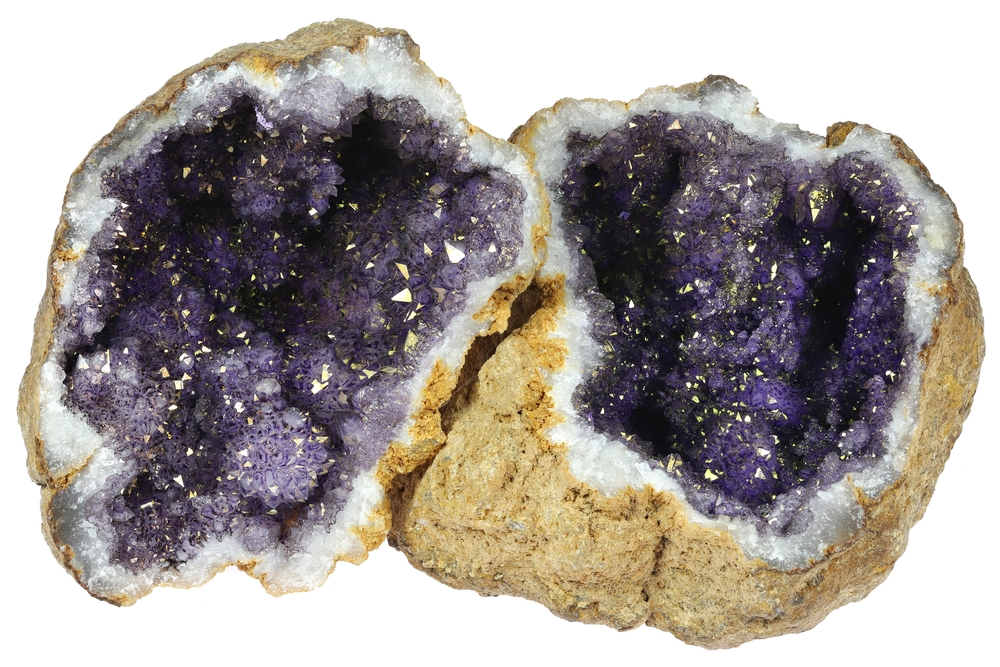
A geode is a roughly spherical rock with a hollow interior lined with crystals. Geodes form around a void when groundwater dissolves out a cavity and then slowly deposits minerals inward from the walls, growing crystals toward the center over thousands to millions of years.
Geodes can form in two main geological settings. In sedimentary rocks such as limestone, dolomite, and shale, cavities develop that later become lined with crystals. In volcanic rocks, especially basalt, geodes originate inside gas bubbles (vesicles) left behind as lava cools.
Over time, mineral-rich groundwater seeps into these hollow spaces, depositing crystals and creating the sparkling interiors we see today. The interior can contain a remarkable variety of minerals depending on the chemistry of the groundwater: quartz (the most common), amethyst, calcite, celestite, barite, and fluorite. The outer shell is typically chalcedony, a microcrystalline quartz, and ranges from pure white to dark gray.
Geodes can be as small as a marble or over a meter across, but the most important defining feature is the hollow center with inward-pointing crystals. That void space is what makes a geode a geode.
Classic geode locations in the US are numerous but popularly include the Keokuk region on the Iowa-Missouri-Illinois border, the Green River drainage in Kentucky, Wolf Creek Pass in Colorado, and the Hauser Geode Beds in the California desert, amongst many other notable locations, which you can assess here.
Geodes are also found worldwide, with notable occurrences in Mexico, Uruguay, and Brazil producing large amethyst-lined specimens.
Thunderegg

A thunderegg is a nodule-like rock formed within rhyolitic volcanic ash layers. Externally, they look similar to geodes: round, rough, brownish, and easy to overlook. But cut one open, and you'll find something quite different: a solid interior of chalcedony or agate, often showing dramatic banding, and frequently featuring a distinctive star-shaped fracture pattern at the core that is unique to thundereggs and found in no other rock type.
They form inside cavities in rhyolitic ash flows, bubbles and voids created as volcanic gases escaped during eruption. As the ash cooled and hardened into rhyolite, hydrothermal fluids rich in silica seeped into these cavities and slowly deposited chalcedony, agate, jasper, or opal inward from the walls.
Unlike geodes, which leave a hollow center, thundereggs typically fill completely. The star pattern forms from shrinkage fractures as the silica deposits cooled and contracted, creating a characteristic six-pointed or irregular star shape at the core that is the surest way to confirm you have a thunderegg rather than something else.
Thundereggs range from just over a centimeter to over a meter across, though most are roughly baseball-sized. Their rhyolitic exterior tends to be reddish-brown and distinctly knobby rather than the smoother gray of a typical geode exterior. Each one is unique in its interior pattern, color, and design; two thundereggs from the same deposit can look completely different once cut.
Thundereggs are predominantly a western US phenomenon, tied to the volcanic geology of the region. Here are the locations you can find thundereggs in the US:
- Oregon: Oregon is the heartland of thunderegg collecting, so much so that the state designated the thunderegg as its official state rock in 1965, the first state in the country to adopt a state rock. Key Oregon sites include the Priday Ranch near Madras, the Ochoco National Forest near Prineville, and Richardson's Rock Ranch.
- Idaho: Excellent thundereggs are also found in Idaho. Idaho's volcanic landscape, particularly across the Snake River Plain, produces thundereggs, opal-bearing nodules, and quartz geodes formed within ancient rhyolite flows and volcanic tuffs. These silica-filled cavities developed millions of years ago in gas pockets within cooling volcanic rock. Popular collecting locations include Graveyard Point in Owyhee County, near the Oregon–Idaho border, the Spencer Opal Mines in Clark County, and the Challis Volcanic Group region around Custer County.
- Washington: Washington's volcanic terrain, particularly in the eastern part of the state, produces thundereggs, agate nodules, and basalt-hosted geodes formed within ancient lava flows of the Columbia River Basalt Group. Many of these specimens developed in gas pockets within cooling volcanic rock, later filling with silica minerals such as agate, chalcedony, and quartz. Notable collecting areas include Walker Valley in Skagit County, the Saddle Mountains region spanning Grant and Kittitas counties, and the nearby Vantage area, which is known among collectors for occasional finds of the rare Ellensburg Blue agate.
Other locations include Nevada, New Mexico, and Texas, as well as internationally in Germany, Romania, and Australia.
Read More: Where to Find Geodes Near Me: Interactive Map & Locations by State
Key Differences: Geode vs. Thunderegg
| Feature | Geode | Thunderegg |
|---|---|---|
| Interior | Hollow cavity lined with inward-pointing crystals | Solid fill of agate, chalcedony, jasper, or opal |
| Host rock | Limestone, dolomite, shale, or basalt | Rhyolitic volcanic ash only |
| Exterior | Gray or tan chalcedony, smooth to slightly bumpy | Reddish-brown rhyolite, distinctly knobby |
| Formation | Dissolution cavities in sedimentary rock or gas bubbles in basalt, later filled with crystals | Gas bubble in rhyolite filled solidly with silica from hydrothermal fluids |
| Where found | Worldwide (esp. Midwest US, Mexico, Uruguay, Brazil) | Western US (Oregon, Idaho, Nevada, NM, TX), Germany, Australia |
| Similarities | Some geodes are solid. If groundwater completely fills the cavity, the result is a solid nodule rather than a true geode. By strict definition, a geode must retain a void space. | Some thundereggs are hollow. If silica-rich fluids only partially filled the cavity, a thunderegg may have a small hollow lined with crystals — technically making it a geode as well. These hybrids are fairly common in Oregon and Germany. |
| What's Inside | Quartz crystals (clear, smoky, or amethyst), Calcite, celestite, fluorite, barite, millerite, pyrite, depending on locality Regional specialties: Keokuk geodes (calcite + quartz), Kentucky Green River geodes (celestite + millerite) | Chalcedony (smooth, waxy quartz), Banded agate in vivid colors, Jasper (solid red, yellow, green), Opal (rare, found in Oregon and New Mexico) Famous localities: Priday Ranch (blue-gray chalcedony), Opal Butte (precious opal) |
To tell them apart, you will notice that the exterior of a thunderegg will present as reddish-brown, while the geode will present as a gray/tan/white color, and smoother. You can wet the surface, which helps reveal texture.
Another way to tell them apart is to do the "shake test". Hollow geodes may rattle from loose crystals, but thundereggs never rattle. Hollow geodes feel lighter than expected, while thundereggs feel dense and heavy.
After cutting them open, a geode will have a hollow cavity with inward-pointing crystals. But thundereggs have a solid interior with star-shaped fractures.
Read More: 6 Best Ways to Open a Geode Without Ruining the Crystals
Are Thundereggs or Geodes More Valuable?
Neither category is inherently more valuable than the other, and value depends almost entirely on what's inside and how well it's presented. For geodes, the most valuable specimens are large amethyst-lined pieces, which can sell for hundreds to thousands of dollars. North American geodes from the Keokuk region or Kentucky's Green River typically sell for a few dollars to a few dozen dollars, depending on size and crystal quality. Geodes with unusual minerals (celestite, fluorite) command a premium.
For thundereggs, a standard field find with attractive agate banding might sell for $5 to $50 as a cut and polished slab. Thundereggs with gem-quality opal interiors from Opal Butte in Oregon are in a different category entirely, while exceptional specimens can sell for hundreds of dollars. Named-locality thundereggs from famous sites like Priday Ranch command collector premiums beyond their intrinsic mineral value.
In both cases, the best value play is finding and cutting your own. A thunderegg or geode you collect yourself, cut on a rock saw, and polish to a smooth face is worth more to you than any specimen you buy, and the experience of not knowing what's inside until the saw comes through is something you can't purchase.
Final Thoughts
At first glance, thundereggs and geodes look almost identical; both appear as round, rough rocks hiding something beautiful inside. But once you understand their geology, the distinction becomes clearer. Geodes are defined by their hollow interior lined with crystals, while thundereggs are typically solid nodules filled with agate, chalcedony, or other silica minerals formed in rhyolitic volcanic rock.
The outer appearance can often provide the first clue. Thundereggs usually have a reddish-brown, knobby rhyolite exterior, whereas geodes tend to have a smoother gray or tan chalcedony shell. When opened, the difference becomes unmistakable: geodes reveal a crystal-lined cavity, while thundereggs display solid, often beautifully banded interiors with distinctive star-like fracture patterns.
However, nature rarely fits perfectly into neat categories. Some geodes can become completely filled, turning solid, and some thundereggs develop small hollow pockets lined with crystals. These exceptions blur the line between the two and are part of what makes rock collecting so fascinating. In the end, whether you find a geode or a thunderegg, you can only truly tell them apart when you cut or crack them open and discover what is inside.
Read More: How to Start a Rock Collection: Beginner Guide (2026)
Frequently Asked Questions
Technically, yes, in two ways. First, some thundereggs have a small hollow center lined with crystals, making them fit the broad definition of a geode as well. Second, under the broadest definition of a geode (any mineral-filled cavity in a rock), all thundereggs qualify. But under the stricter definition (requires a void space), most thundereggs do not. In practice, if it has a rhyolitic exterior and a solid agate interior, call it a thunderegg.
The world's largest known thunderegg weighs 1.75 tons and is housed at the Rice Northwest Museum of Rocks and Minerals in Hillsboro, Oregon, an appropriate home given Oregon's relationship with the rock. The museum's collection also includes a wide range of cut and polished thunderegg specimens that give an excellent sense of the variety of interiors possible.
For thundereggs, a diamond-tipped rock saw is the only right answer. Thundereggs are solid and dense and will not crack cleanly with a hammer. Mark a cut line around the equator with a marker, and cut slowly with water cooling the blade. For geodes, a hammer and chisel work if you score around the circumference first, though a rock saw gives a much cleaner and more display-worthy result.