
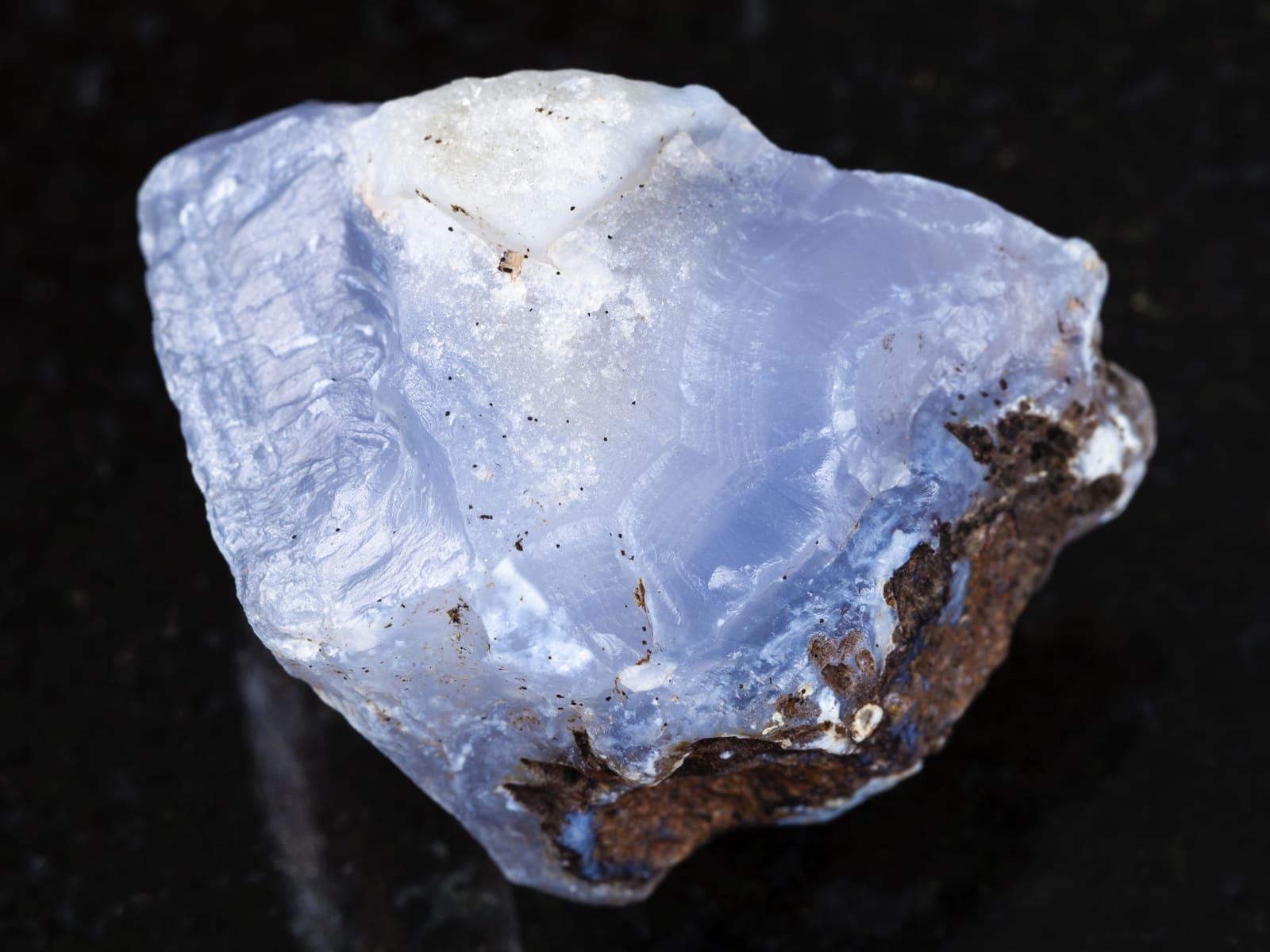
Chalcedony is the microcrystalline variety of quartz (SiO₂) — the parent material behind agate, jasper, carnelian, chrysoprase, and many other collectible stones that fill rock shops and lapidary benches. In its pure form, chalcedony ranges from translucent white to soft gray to pale blue. The "blue chalcedony" variety (sometimes sold under trade names like "Ellensburg Blue" or "Holly Blue Agate") commands premium prices because truly saturated blue material is scarce. Chalcedony forms when silica-rich fluids precipitate inside volcanic vesicles, fractures, and dissolution cavities. The individual quartz crystals are too small to see without magnification — typically 100 nanometers to a few microns — which gives chalcedony its waxy texture and distinguishes it from macrocrystalline quartz (rock crystal, amethyst, citrine).
The geology is straightforward: you need a silica source, a void to fill, and time. Volcanic terrains — especially basalt flows with gas cavities and rhyolitic tuffs with dissolved-out lithic fragments — are the primary production environments. That means the western US is chalcedony country. Oregon, California, Nevada, Arizona, and Washington all produce collectible material on public land. East of the Rockies, chalcedony still turns up in gravels and as secondary deposits in limestone, but the western volcanic belt is where field collectors concentrate their effort.
Chalcedony Geology: How and Where It Forms
Chalcedony precipitates from aqueous silica solutions at temperatures below about 200°C. In basalt flows, dissolved volcanic gas creates vesicles (round holes) that later fill with silica carried by groundwater. These are the agates and thundereggs collectors target. In rhyolite and welded tuff, chalcedony fills fractures and breccia zones, producing vein chalcedony and agatized wood where silica replaces buried organic material.
The blue color in chalcedony comes from Rayleigh scattering — the same optical effect that makes the sky blue. Sub-microscopic particles and pore spaces within the silica scatter shorter (blue) wavelengths of light preferentially. This effect is structural, not chemical, which is why blue chalcedony does not fade in sunlight the way amethyst can. Iron impurities push the color toward gray or brown; manganese can add pink to lavender tones (as in Holly Blue Agate).
When you are scouting a new volcanic area, look for vesicular basalt — the dark rock full of small round holes. If even one of those holes contains a translucent white or blue filling, the rest of the flow is worth exploring. Chalcedony weathers harder than its host rock, so nodules, rosettes, and agate chunks accumulate in the soil and gravel downslope from their source formation.
Top Chalcedony Collecting Locations in the United States
Oregon — Ochoco Mountains (Crook County)
Land Status: Ochoco National Forest (USDA Forest Service). Open to personal-use collecting.
Location: East of Prineville, OR. General area around 44.350°N, 120.100°W. Elevation 4,500–6,000 ft.
Access: Forest roads. AWD or high-clearance vehicle recommended. Roads are gravel and can be rough in spring.
Vehicle: AWD/high-clearance. Sedan possible on main forest roads in summer.
Specimens: The Ochoco Mountains are one of the most productive chalcedony-producing regions in Oregon. The volcanic host rock here is Cenozoic rhyolite and basalt. You will find white to pale blue chalcedony in vesicles and veins, plus thundereggs and plume agate. Chalcedony nodules and float are scattered in the soil across large areas. The most collectible pieces are translucent blue-gray specimens with good backlight glow. Check along road cuts and erosion gullies where material has weathered out of the host rock.
Oregon — Holly Blue Agate Site (Linn County)
Land Status: Private land. Fee collecting available seasonally through the property owner.
Location: Near the town of Holley, approx. 44.370°N, 122.750°W.
Access: Sedan OK to the property. Check local gem and mineral clubs for current access schedules.
Fee: Varies by operator. Typically $20–$40/day when open.
Specimens: Holly Blue Agate is a translucent lavender-blue chalcedony with trace manganese that gives it a distinctive purple tint. This is a highly collectible variety found at very few localities worldwide. Pieces range from small nodules to vein sections several inches across. The best material has uniform color and strong translucency. This site produces limited quantities and is not always open — contact ahead.
Oregon — Madras Area (Jefferson County)
Land Status: BLM land (Prineville District). Open to personal-use collecting.
Location: East and south of Madras, approx. 44.580°N, 121.050°W.
Access: Gravel and dirt roads. High-clearance vehicle recommended.
Vehicle: High-clearance. 4x4 helpful after rain.
Specimens: The Madras area is famous for thundereggs and agate, but it also produces excellent chalcedony roses — botryoidal (grape-like) chalcedony formations that grow as rounded, bulging masses. These are visually striking specimens even without cutting. You will also find blue and white vein chalcedony and small agate nodules. Surface collecting on BLM land is the primary method. Walk washes and desert pavement slowly, scanning for the waxy sheen of chalcedony among volcanic gravel.
Washington — Ellensburg (Kittitas County)
Land Status: Mostly private land. Some BLM land in surrounding areas.
Location: Gravel deposits around Ellensburg, approx. 46.997°N, 120.548°W.
Access: Sedan OK on paved roads. Off-road access to collecting areas varies.
Vehicle: Depends on specific site. Some gravel areas require AWD.
Specimens: Ellensburg Blue agate is one of the rarest and most expensive chalcedony varieties in North America. It is a transparent to translucent blue chalcedony found in Miocene gravel deposits derived from the erosion of Columbia River Basalt flows. The material formed originally in gas cavities within the basalt and was later transported and deposited in ancient river gravels. Most known deposits are on private ranch land and are not open to public collecting. Material occasionally turns up in plowed fields and construction excavations. The Saddle Mountains and surrounding Columbia Basin on BLM land produce more common white and gray chalcedony varieties. If you find genuine Ellensburg Blue, you are looking at $50–$200 per carat for gem-grade cabochon material.
California — Hauser Geode Beds (Imperial County)
Land Status: BLM land (El Centro Field Office). Open to personal-use collecting.
Location: Approximately 32.980°N, 115.140°W. Chocolate Mountains area.
Access: Dirt roads from Wiley Well Road off I-10. High-clearance vehicle required.
Vehicle: High-clearance 4x4 recommended. Soft sand in some areas.
Specimens: The Hauser Geode Beds produce chalcedony-filled geodes in volcanic ash beds. Crack a geode open and you may find banded agate, druzy quartz, or solid chalcedony filling. Some geodes contain blue-gray chalcedony centers. Surface collecting and light digging are permitted on BLM land. Bring a rock hammer and crack tool, plus safety glasses — geode opening throws sharp fragments. This is a desert site: summer temperatures routinely exceed 110°F. Best collecting season is October through April.
California — Wiley Well / Chuckwalla Mountains (Riverside County)
Land Status: BLM land (Palm Springs-South Coast Field Office). Open to personal-use collecting.
Location: Approx. 33.530°N, 115.120°W. South of I-10 near Desert Center.
Access: Dirt roads. High-clearance vehicle required.
Vehicle: High-clearance 4x4. Desert terrain with sandy washes.
Specimens: Blue and white chalcedony, agate nodules, and jasper occur across a large area of desert pavement and volcanic gravel. The chalcedony here tends toward pale blue-gray and white with good translucency. It occurs as nodules weathering from volcanic host rock and as loose float on the surface. Some vein chalcedony in place can be chiseled from exposed rock faces. This area also produces fire agate (an iridescent chalcedony variety) at some localities.
Arizona / Nevada — Black Mountains & Searchlight Area
Land Status: BLM land (Kingman Field Office, AZ / Las Vegas Field Office, NV). Open to personal-use collecting.
Location: Black Mountains, Mohave County, AZ: approx. 35.300°N, 114.500°W. Searchlight, NV area: approx. 35.460°N, 114.920°W.
Access: Dirt roads. High-clearance vehicle recommended.
Vehicle: High-clearance. 4x4 for more remote areas.
Specimens: Desert regions across the Southwest produce chalcedony roses (botryoidal formations), nodules, and vein chalcedony on BLM land. The Black Mountains and Searchlight area yield blue and white chalcedony in volcanic gravels. Surface collecting is the primary method — walk slowly across desert pavement, scanning for the telltale waxy luster. Chalcedony nodules here range from marble-size to fist-size. Some localities produce chalcedony with internal plume or moss inclusions that make excellent cabochon material.
Chalcedony Varieties and Specimen Types
| Variety | Color | Key Feature | US Sources |
|---|---|---|---|
| Blue Chalcedony | Pale to medium blue | Rayleigh scattering; translucent | OR, WA, CA, AZ, NV |
| Holly Blue Agate | Lavender-blue | Mn-tinted; distinctive purple hue | Holley, OR (private) |
| Ellensburg Blue | Blue (transparent-translucent) | Extremely rare; gem-grade cab material | Ellensburg, WA (mostly private) |
| Chalcedony Roses | White to gray to blue | Botryoidal (grape-like) habit | Madras OR, AZ/NV BLM |
| Agate (banded chalcedony) | Multicolored bands | Concentric or parallel banding | OR, CA, AZ, Great Lakes |
| Fire Agate | Brown with iridescence | Thin-layer interference colors | AZ, CA desert sites |
| Chrysoprase | Apple green | Ni-colored chalcedony; rare in US | Scattered AZ/CA occurrences |
How to Identify Chalcedony in the Field
| Property | Chalcedony | Look-Alike: Common Opal | Look-Alike: Jasper |
|---|---|---|---|
| Hardness | 6.5–7 (Mohs) — scratches glass easily | 5.5–6 — barely scratches glass | 6.5–7 — same as chalcedony |
| Transparency | Translucent — light passes through thin edges | Translucent to opaque | Opaque — no light transmission |
| Luster | Waxy to vitreous | Waxy to resinous | Dull to waxy |
| Fracture | Conchoidal (smooth, curved) | Conchoidal | Conchoidal to granular |
| Streak | White | White | White to colored |
| Key Test | Translucent on thin edges; waxy feel | Softer; may show play of color | Opaque even on thin edges |
The critical field distinction is translucency. Pick up a suspect piece and hold a thin edge toward the sun or shine a bright flashlight through it. Chalcedony transmits light with a soft, diffused glow — you can see the silhouette of your finger behind a thin piece. Jasper does not transmit light at all because it contains clay and iron oxide inclusions that block it. Common opal can look similar to chalcedony but is slightly softer and sometimes shows a milky play of color that chalcedony lacks.
The waxy surface feel is another strong indicator. Run your thumb across a fresh fracture surface — chalcedony has a smooth, almost soapy texture that macrocrystalline quartz lacks. The botryoidal (grape-like) growth habit is also diagnostic when present. Chalcedony often grows as rounded, bulging masses inside cavities rather than forming pointed crystals.
Wet the specimen with a spray bottle. Water dramatically reveals the translucency and color of chalcedony that appears dull and unremarkable when dry. Many experienced collectors keep a spray bottle on their belt specifically for this purpose.
Tools and Equipment for Chalcedony Collecting
- Spray bottle — wetting the surface is the single most useful field technique for chalcedony. It reveals translucency, color saturation, and banding that are invisible on dry specimens.
- Rock hammer (2–3 lb) — for extracting vein chalcedony from host rock. A pointed tip helps pry nodules from vesicles without shattering them.
- Cold chisels (1/2" and 3/4") — useful for working chalcedony out of basalt vesicles. Place the chisel at the contact between the chalcedony and the host rock and tap gently.
- Flashlight or headlamp — backlight thin edges to check translucency. This is the fastest way to separate chalcedony from jasper in mixed gravel.
- Safety glasses — mandatory when hammering. Chalcedony fractures conchoidally and throws razor-sharp flakes.
- Knee pads — surface collecting on desert pavement means hours of slow walking and kneeling. Save your knees.
- Bucket and padding — wrap individual specimens in newspaper or towels. Chalcedony is hard but brittle — nodules banging together in a bucket will chip edges and ruin botryoidal surfaces.
- GPS unit or phone with offline maps — BLM land in the desert lacks cell service. Download offline maps before your trip and mark productive spots.
Legal Information and Collecting Rules
On BLM land, personal-use mineral collecting is permitted under 43 CFR 8365 for "reasonable quantities" of common minerals and semiprecious gemstones. The standard guideline is up to 25 pounds per day plus one piece, not to exceed 250 pounds per year. You may not use mechanized equipment or explosives. On National Forest land, similar personal-use collecting is allowed under 36 CFR 228.62. No permit is needed for hand tools and small quantities.
Private land requires written permission from the landowner. The Holly Blue Agate site near Holley, OR, and the Ellensburg Blue areas in Washington are overwhelmingly on private land. Trespassing on ranch land to collect is illegal, damages the hobby's reputation, and can result in all collectors losing access to entire areas.
State lands, national parks, and national monuments are generally closed to mineral collecting. BLM Areas of Critical Environmental Concern (ACECs) and Wilderness Study Areas (WSAs) may also restrict collecting. Check the BLM or Forest Service field office for your target area before you go.
Interactive Chalcedony Location Map
Use our interactive chalcedony location map to find collecting sites with GPS coordinates, land status, and reported specimens. You can also browse all specimen maps or search by state.