
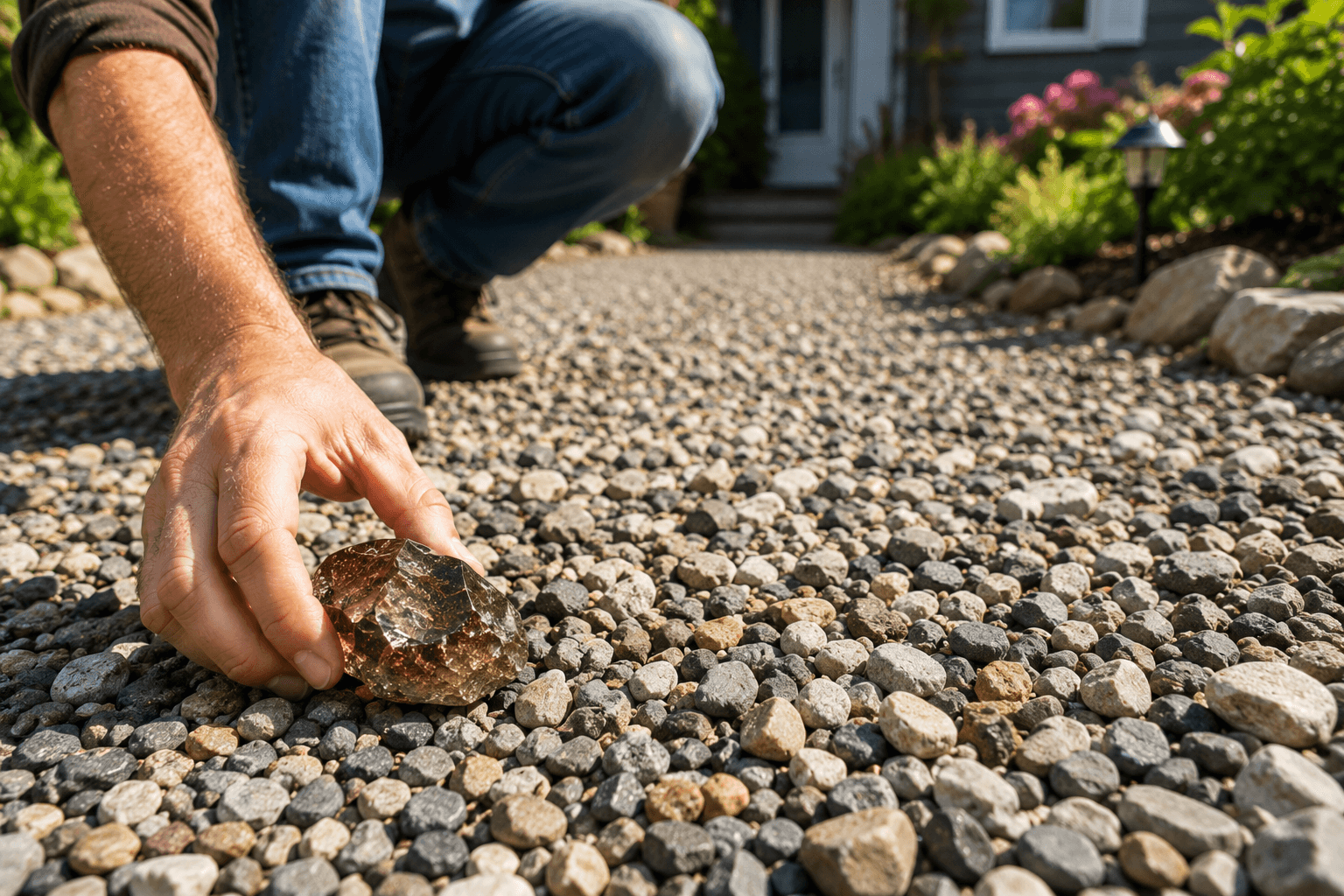
You don't have to drive to BLM land or book a fee-dig mine to start rockhounding. There's a good chance something worth a second look is sitting within fifty feet of your front door right now — in the landscaping rock along your walkway, the gravel in your driveway, a dusty box in the garage from a relative who "used to collect rocks." Most of it is ordinary. Some of it isn't. And almost nobody stops to check.
This guide walks through where to look on your own property, what's realistic to find, and how to tell the difference between "interesting" and "actually worth something" — no travel required.
Where "Hiding in Plain Sight" Actually Means
Rocks don't stay where they formed. Every one of these everyday sources moved material from somewhere geologically interesting to right where you're standing:
- Landscaping rock and decorative gravel — Bagged and bulk landscaping stone is trucked in from real quarries, and many quarries sit on genuinely productive deposits. A pallet of "river rock" or "pea gravel" can carry agate, jasper, or quartz mixed in with the filler.
- Driveway and road gravel — Crushed aggregate is sourced locally in most of the country. If your regional quarry cuts through a formation known for garnet, unakite, or petrified wood, trace amounts can end up under your tires.
- Garden beds and fill dirt — Topsoil and fill are frequently trucked from construction sites or excavation projects, which means whatever was in the ground there came with it.
- Old stone walls and foundations — Especially common in New England and parts of the Midwest, where early landowners built walls out of whatever fieldstone glacial till left behind — till that's known to carry garnet, agate, and quartz in exactly those regions.
- Fish tank and aquarium gravel — Occasionally sourced from natural deposits rather than pure manufactured aggregate; worth a second look if you've ever kept a tank.
- Inherited collections — The single highest-odds source on this whole list. A relative's old "rock box" in an attic or garage was curated by someone who thought each piece was worth keeping.
What to Actually Look For
Keep expectations realistic — the goal is "interesting and possibly worth something," not "found a diamond by the mailbox." These are the pieces worth a second look:
- Quartz points and clusters — Clear to milky, six-sided crystal faces, glassy luster.
- Agate and jasper — Banded or mottled coloring, waxy luster, noticeably heavier and harder than the gravel around it.
- Petrified wood — Retains wood grain or growth rings but has the weight and hardness of stone.
- Garnet — Small, reddish, glassy grains, often in sandy or gravelly deposits in glaciated regions.
- Pyrite — Brassy, metallic, cubic crystal faces ("fool's gold" — genuinely fun to find even though it isn't gold).
- Unakite — A distinctive pink-and-green speckled stone, common in river gravel sourced from the Blue Ridge region.
- Geodes — Round, unassuming on the outside; only cracking one open reveals the crystal lining, in aggregate sourced from geode-producing regions like the Midwest.
- Meteorites — By far the rarest possibility on this list, and worth flagging clearly: don't expect one, but it's not impossible. See the meteorite identification notes below before getting your hopes up.
Not sure which of these you're actually holding? Our best rock identification apps guide and the Mohs hardness scale are the fastest way to narrow it down — hardness alone rules out most lookalikes in under a minute.
Why This Actually Works
This isn't a "there's gold in your backyard" gimmick — there's a real geological reason ordinary gravel can hold interesting material. Aggregate and landscaping quarries pull from real formations, not manufactured stone, so whatever mineral character that formation has, some of it ends up in the load. In glaciated regions especially — New England, the Upper Midwest, the Great Lakes — glacial till naturally concentrated agates, garnets, and quartz from hundreds of miles away into the gravel and rock people now build walls and driveways out of. That's the same geological process that fills entire published site guides; it just also happens to run through residential supply yards.
If your region shows up as a productive area on our state rockhounding maps, your local gravel supply is more likely than average to be sourced from the same or nearby geology.
Realistic Expectations
Let's be direct about this, because it's the question most people actually have: is this too good to be true?
Mostly, yes — and that's fine. The honest odds:
- Most of what you'll find is common rock, not rare specimens. That's true of rockhounding everywhere, not just backyards.
- Value depends on quality and rarity, not just identity. A garnet the size of a grain of sand and a gem-grade garnet are the same mineral and wildly different worth.
- A "wow" find still needs real evaluation. Excitement is not the same as value — get a genuine identification before assuming anything is worth money.
- Meteorites are the exception that proves the rule. They're real, they do occasionally turn up in unexpected places, and they're also the single most over-claimed category in amateur geology — nearly everything suspected of being a meteorite turns out to be "meteorwrong" (usually slag, hematite, or magnetite). If you think you've found one, a magnet test and a streak test are the first checks, and our interactive meteorite map has documented finds for context on what's realistic in your area.
Setting expectations here isn't a downer — it's what makes an actual find feel earned instead of gimmicky.
How to Search Your Own Property
No special equipment required — this is a method, not a trip:
- Wet the rock. Color and pattern often disappear on dry stone and pop back into view wet — this is the single fastest way to spot something worth a closer look.
- Look for what doesn't belong. In a driveway or gravel bed, most material looks the same. The piece that stands out — different color, glassier surface, obviously heavier — is the one worth pulling.
- Keep a handful, not everything. Pull the two or three most promising pieces rather than hauling in a bucket. It's easier to actually identify a few candidates than to sort a pile.
- Use a hand lens. A $10 loupe reveals crystal faces and banding invisible to the naked eye — often the difference between "maybe" and "definitely."
- Don't start digging without knowing what's underneath. Landscaping rock is one thing; disturbing a garden bed, foundation, or yard feature is another. Stick to loose surface material unless you know exactly what's below it.
Turning a "Maybe" Into an Answer
Once you've pulled a few candidates, the next step is a real identification, not a guess:
- Run it through our rock identification apps guide for a fast first pass.
- Cross-check hardness against the Mohs scale — this alone eliminates most lookalikes.
- If it looks genuinely promising, compare it against entries on Mindat.org, the standard open mineral database used by collectors and geologists worldwide.
- Post it to a local rockhounding club or an active community like r/rockhounds — experienced collectors can usually confirm or rule out an ID from a couple of clear photos.
- If you think it might genuinely be a specimen of value, the most valuable gemstones and minerals guide covers what actually drives worth, beyond just "is it a real mineral."
The Legal Note
If it's on your own property, it's yours — no permits, no permission needed. But curiosity has a way of spreading past the driveway. The moment you're eyeing a neighbor's landscaping rock, a public median, or a nearby lot, different rules apply. Our full guide, Is Rockhounding Legal? Rock Collecting Laws by Land Type & State, covers exactly where you stand once you step off your own land.
The Bottom Line
You don't need a plane ticket or a BLM map to start rockhounding — you need about twenty minutes, a garden hose, and a willingness to actually look at the gravel you walk past every day. Most of what you find will be ordinary. Some of it might genuinely surprise you. Either way, it's the easiest rockhounding trip you'll ever take.
Once your own yard has given up what it's going to give up, the real deposits are waiting — explore 1,000+ GPS-verified rockhounding locations across all 50 states and plan your next trip.
This guide is for general information only. Material found on your own property belongs to you; always confirm ownership and boundaries before collecting anywhere else, and see our rockhounding laws guide for public and private land rules.