
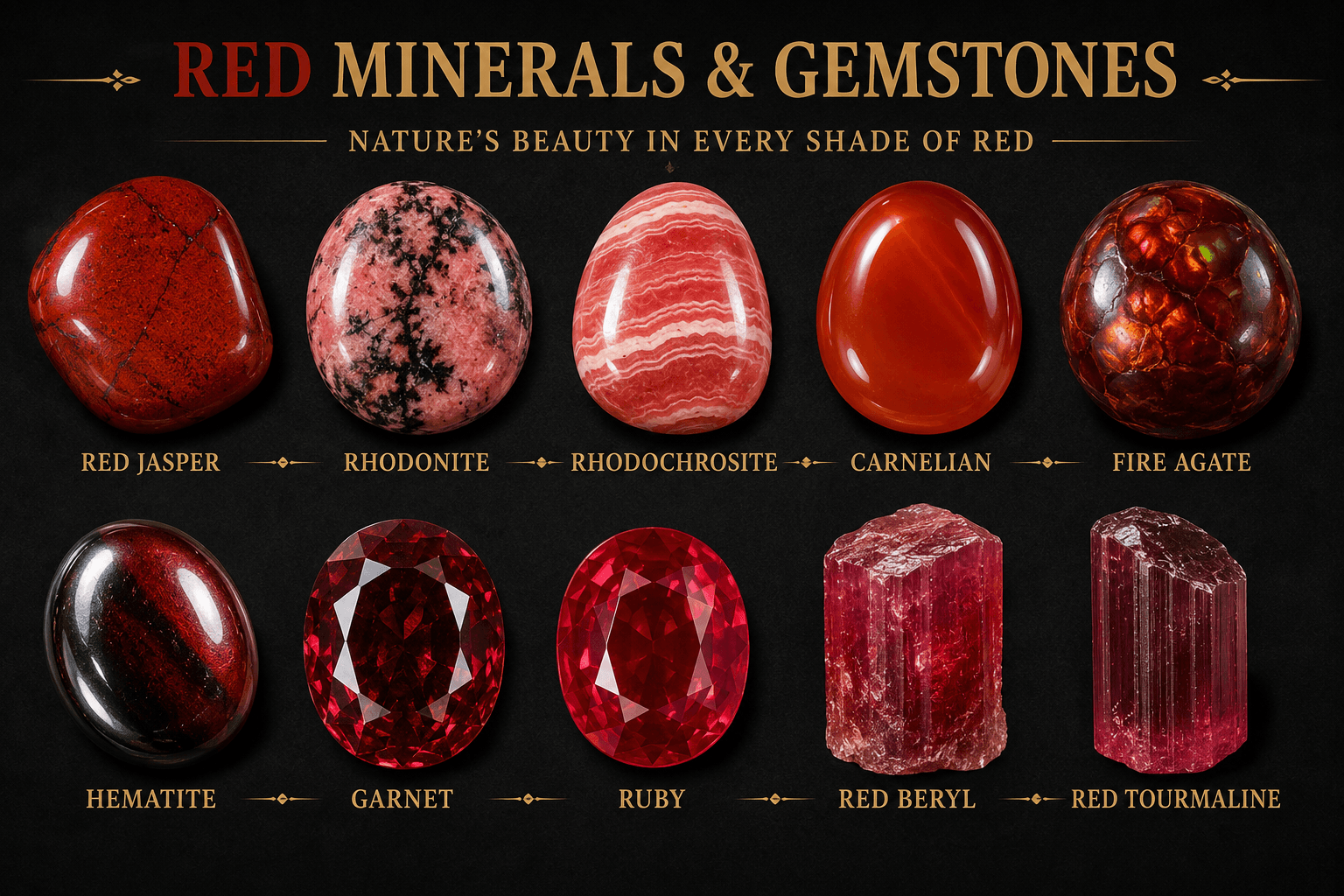
Red is one of the most dramatic colors in geology — from the towering vermillion walls of Zion Canyon to the blood-red flash of a fine ruby to the waxy, deep crimson of polished red jasper. But "red rock" covers an enormous range: landscape-scale geological formations painted red by iron oxide, individual collectable minerals worth your effort to seek out, and rare gemstones worth serious money. A red rock in your hand could be a piece of common red sandstone or it could be a garnet or rhodochrosite specimen that a collector would pay good money for.
This guide gives you what you actually need in the field: a step-by-step identification method, a full breakdown of every significant red rock type organized by what you're likely to do with it, and a state-by-state guide to finding the most collectible red minerals in the United States.
→ Looking for red rocks near you? Browse the Rockhounding.org interactive map — filter by mineral type and state
What Makes Rocks Red? — The Iron Chemistry
Almost every red rock on Earth owes its color to the same cause: iron oxide. Specifically, the mineral hematite (Fe₂O₃) — the same compound that makes rust red.
Iron is one of the most abundant elements in the Earth's crust, and it appears in many common minerals — biotite mica, olivine, pyroxene, amphibole, and countless others. When these iron-bearing minerals are exposed to oxygen and water — whether during weathering at the surface or during diagenesis (the chemical changes that turn sediment into rock) — the iron oxidizes. Iron gives up electrons to oxygen, forming iron oxide compounds that coat mineral grains and permeate rock fabric with a powerful red-orange pigment.
The critical fact is that almost no hematite is needed to produce a vivid red rock. As little as one percent of a rock's composition — a thin film of hematite coating individual sand grains — is enough to turn an otherwise white or tan sandstone deep red. Hematite is, gram for gram, one of the strongest pigments in nature.
The three iron oxide minerals that color red rocks
| Mineral | Formula | Color produced | Common setting |
|---|---|---|---|
| Hematite | Fe₂O₃ | Brilliant red to reddish-brown | Arid oxidizing environments; forms in well-aerated sediments |
| Goethite | FeO(OH) | Yellow to orange-brown | Wetter conditions; partial oxidation |
| Limonite | FeO(OH)·nH₂O | Yellow to yellow-brown | Hydrated weathering product; surface deposits |
When all three are present in varying proportions, you get the full range of red-orange-yellow-brown colors seen across the Colorado Plateau. When hematite is dominant and fresh, you get brilliant red. When goethite dominates, you get yellow and buff. When iron has been chemically reduced — removed from its oxidized state, for example by buried petroleum or reducing groundwater — the red disappears and you get pale gray or white bleached zones within otherwise red formations.
Red versus other colors — what the color tells you
- Brilliant red: Fresh, well-oxidized hematite — deposited in an arid, oxidizing environment (desert, floodplain, or continental setting with good air exposure)
- Orange: Mixture of hematite and goethite — partial oxidation or slightly wetter conditions
- Yellow to buff: Goethite dominant — wetter conditions during deposition or weathering
- White or pale gray within red rock: Bleached zone — reducing conditions (often petroleum or methane migration) stripped the iron after deposition
- Purple-red: Common in Permian red beds — slightly different iron oxide chemistry
The color of red sedimentary rock is essentially a record of the oxygen levels in the ancient environment where the sediment was deposited. Red = lots of oxygen. Gray = very little.
How to Identify Red Rocks in the Field — Step-by-Step
You are standing in a creek bed or road cut with a red rock in your hand. Here is how to narrow it down.
What you need
- Steel nail, pocket knife, or key (hardness ~5.5)
- Copper penny (hardness ~3.5)
- Glass plate or the side of a glass bottle (hardness ~5.5)
- Unglazed porcelain streak plate (the unglazed back of a bathroom tile works)
- Hand lens / loupe at 10x (optional but very helpful)
Step 1 — Check the streak
Drag the specimen firmly across your porcelain streak plate. This is often the fastest single test for red rocks.
Red to reddish-brown streak: Almost certainly hematite or a hematite-rich rock. This distinctive red streak is one of mineralogy's most reliable identification tests — hematite's streak is always red to reddish-brown regardless of whether the mineral's surface looks silver-metallic or earthy-red.
White or colorless streak: The red color is coming from trace iron oxide staining a fundamentally different mineral. This includes red jasper, chert, carnelian, garnet, ruby, rhodochrosite, and rhodonite — all of which leave a white streak despite their vivid red colors.
Bright scarlet streak: Cinnabar (mercury sulfide). Rare but distinctive. If your red mineral has a vivid scarlet streak and is unusually heavy, you may have cinnabar.
Step 2 — Test the hardness
After the streak test, hardness narrows the field dramatically.
Scratched by copper penny (hardness < 3.5): Soft minerals — gypsum (2), earthy hematite coatings (1–5.5 depending on form), or clay-rich red shale that crumbles easily.
Scratched by steel nail, NOT by copper penny (hardness ~3.5–5.5): Rhodochrosite (3.5–4), rhodonite (5.5–6 — just at this boundary), softer iron ore, or fine-grained volcanic rocks.
NOT scratched by steel nail, scratches glass easily (hardness 6–7): Orthoclase feldspar (6 — pink to salmon-red in granite), hematite proper (5.5–6.5), red jasper and chert (7 — quartz family).
Scratches hardened steel file, hardness ≥7: Garnet (6.5–7.5), red tourmaline (7–7.5), red quartz varieties, and ruby/corundum (9 — scratches virtually everything and is distinctive for its extreme hardness).
Step 3 — Examine grain size and texture
With your hand lens, look at the specimen surface closely.
Coarse, visible individual grains (sand to gravel sized): Sedimentary rock — red sandstone (quartz grains, gritty feel), or conglomerate (rounded pebbles in a red matrix).
Very fine grains, smooth but slightly rough feel: Red shale or siltstone — run a finger across the surface to feel the characteristic clay or silt texture.
No grain structure visible — smooth, waxy or glassy surface: Microcrystalline quartz — red jasper, carnelian, red chert, or red agate. All are silica minerals too fine-grained to see individual crystals without a microscope.
Well-formed individual crystals visible: If small crystals are embedded in a matrix, look at the crystal shape: 12-sided or 24-sided = garnet; hexagonal barrel or prism = ruby or red tourmaline; rhombohedral = rhodochrosite.
Mirror-like silver metallic sheen: Specular hematite — one of the most distinctive rocks in mineralogy. Nothing else looks quite like it.
Step 4 — Check fracture and cleavage
Conchoidal (shell-like curved) fracture — like broken glass: Red jasper, chert, carnelian, or any microcrystalline quartz variety. The fracture is smooth, curved, and produces sharp edges.
Perfect flat parallel fracture planes in multiple directions: Rhodochrosite (3 directions, like calcite — and like calcite, it fizzes in dilute acid); feldspar (2 directions at ~90°).
No cleavage, sub-conchoidal to irregular fracture: Garnet — no cleavage, breaks irregularly. Ruby (corundum) also has no cleavage but shows distinct partings (hexagonal planes of weakness).
Platy, micaceous fracture: Specular hematite — splits into thin, metallic plates.
Rough, granular fracture: Red sandstone, granite, or other coarse-grained rocks.
Step 5 — Check the luster
Mirror-bright metallic luster: Specular hematite — there is nothing else quite like it. Silver metallic on fresh surface despite having a red streak.
Earthy, dull luster: Earthy hematite, red ochre, red laterite, red shale. Non-reflective, like dried earth.
Vitreous (glassy) luster: Garnet crystals, quartz varieties (jasper can be slightly waxy), rhodochrosite on fresh cleavage.
Waxy to dull luster, polishes well: Red jasper, rhodonite — these are the lapidary collector's targets.
Adamantine (brilliant, high-brilliance) luster: Ruby/corundum — the very high refractive index gives exceptional brilliance.
Quick identification reference table
| Streak | Hardness | Texture | Fracture | Luster | Most likely identification |
|---|---|---|---|---|---|
| Red | 5.5–6.5 | Metallic plates or earthy | Platy or earthy | Metallic or earthy | Hematite |
| White | 7 | No grain structure, smooth | Conchoidal | Waxy to vitreous | Red jasper / chert / carnelian |
| White | 6.5–7.5 | Distinct crystals, 12-sided | No cleavage | Vitreous | Garnet |
| White | 3.5–4 | Rhombohedral crystals | Perfect 3-dir. cleavage | Vitreous | Rhodochrosite |
| White | 5.5–6 | Massive, no crystals | Uneven | Waxy to dull | Rhodonite |
| White | 9 | Hexagonal crystals | No cleavage, parting | Adamantine | Ruby (corundum) |
| White | 2 | Sandy, gritty | Granular | Dull | Red sandstone |
| White | 2 | Smooth, splits in layers | Fissile | Dull | Red shale |
| Scarlet | 2–2.5 | Heavy, granular | Uneven | Adamantine | Cinnabar |
Category 1 — Red Landscape Rocks

These are the bulk geological formations — the rocks that paint entire canyons, cliffs, and desert floors red. They are widespread, geologically significant, and often visually spectacular, but they are not typically what a rockhound collects for specimens. Their value lies in what they tell you about an area's geology — and occasionally, what other minerals might be found nearby.
Red Sandstone
What it is: Sandstone colored red by hematite — iron oxide coatings on individual quartz sand grains. The hematite was deposited during or after the sand was laid down, usually in arid or oxidizing continental environments such as ancient deserts, alluvial floodplains, or shallow marine settings with good oxygen exposure.
Hardness: 3–7 (highly variable — depends on cement type; silica-cemented red sandstone can reach 7, clay-cemented may be 3–4)
Streak: White (the quartz grains) with occasional reddish dust from the hematite coating
Field characteristics: Gritty feel when you scratch the surface. Visible sand grains. Often shows cross-bedding (internal layers at angles to the main bedding — a hallmark of ancient dune or river deposit). Weathers in bold, rounded cliff faces and spires in arid climates.
Where to see it: The Colorado Plateau — Utah, Arizona, Nevada, Colorado — hosts some of the most spectacular red sandstone terrain on Earth. Specific formations include the Navajo Sandstone (Zion National Park, The Wave), the Moenkopi Formation (Petrified Forest), the Entrada Sandstone (Arches), and the Aztec Sandstone (Red Rock Canyon, Nevada).
Collecting rules: Red sandstone is prohibited from collection in National Parks. On adjacent BLM land, personal-use quantities are permitted. Check local rules before collecting. Its value as a specimen is primarily aesthetic and geological — no significant monetary value.
→ See Utah rockhounding locations · Arizona
Red Shale
What it is: Fine-grained sedimentary rock composed of clay and silt minerals, colored red by hematite. Shale forms from clay-rich sediment deposited in quiet water environments — ancient lakes, river floodplains, and shallow marine shelves. Red shale, as opposed to gray or black shale, formed in an oxidizing environment — one with plenty of oxygen in the sediment or water.
Hardness: 2–4 (soft; fingernail often marks it)
Streak: Reddish-brown to brownish from clay minerals and hematite
Field characteristics: Splits into thin flat plates along bedding planes (fissility — the defining property of shale). Fine, smooth texture. No grit when rubbed with a finger (distinguishes it from siltstone). Often found interbedded with red sandstone in Permian, Triassic, and Jurassic continental sedimentary sequences.
Rockhound significance: Red shale itself is not a collector's target, but red shale formations frequently host fossils — fish scales, plant impressions, and trace fossils preserved in fine-grained muds. In some red bed sequences, green or gray reduction spots within the red shale indicate areas where fluids migrated, sometimes concentrating copper or uranium minerals.
Red Granite and Pink Feldspar Granite
What it is: Granite is a coarse-grained igneous rock. When the feldspar in granite is pink to salmon-red (potassium feldspar, specifically orthoclase or microcline with iron impurities or alteration), the whole rock takes on a distinctive pink to red color. True red granites — where the iron coloration is deep red rather than pink — occur where the feldspar has been more intensely stained by hematite.
Hardness: 6–7 (the feldspar and quartz components)
Field characteristics: Clearly visible individual mineral crystals — you can see the feldspar crystals (pink-red, blocky, rectangular), clear or gray quartz, and dark mica flakes. No banding or layers. Very coarse texture. Scratches glass easily.
Where to see it: The Pikes Peak Granite of Colorado (pink granite used in many historic U.S. government buildings), the Precambrian granites of the Black Hills (South Dakota), and the Llano Uplift of Texas all produce notable pink to red granites.
Red Volcanic Rock (Basalt, Scoria, Rhyolite)
What it is: Volcanic rocks are red for two different reasons. Ancient basalt flows are often brick-red on their oxidized upper surfaces — the vesicular (bubbly) tops of lava flows that were exposed to air while still partially molten. The iron in the basalt oxidized. More intense red coloration occurs in scoria — the frothy, vesicle-rich volcanic rock from erupting cinder cones. Rhyolite — silica-rich volcanic rock — can also be red from iron oxide in its glass or phenocrysts.
Field characteristics: Scoria: dark red to brick-red, extremely light (many gas bubbles), rough and irregular surface. Basalt: dark gray to black interior, red-orange on weathered surfaces. Rhyolite: fine-grained, glassy appearance, often pink to red.
Rockhound significance: Red volcanic terrain is important for chalcedony, agate, and jasper collectors — silica-rich hydrothermal fluids that follow volcanic systems fill gas pockets with these microcrystalline quartz minerals. Finding red volcanic rock often means agate and jasper are nearby.
Category 2 — Red Collectable Minerals
These are the minerals a rockhound actively targets — specimens with enough visual appeal, rarity, or lapidary quality to be worth collecting and trading.
Red Jasper
What it is: Red jasper is opaque microcrystalline quartz (chalcedony) colored red by hematite and iron oxide inclusions distributed throughout the silica matrix. It is one of the most abundant and widely distributed collectable minerals in the United States.
Hardness: 7 (pure quartz hardness — scratches glass easily, not scratched by a knife)
Streak: White
Luster: Waxy to dull; polishes to a bright, smooth surface
Fracture: Conchoidal
Transparency: Opaque
What sets it apart from red chert: Both are microcrystalline quartz. Jasper is the lapidary term for opaque, collectible, attractively colored chalcedony that takes a good polish. Chert and flint refer to the same mineral class when found as nodules in limestone or chalk, typically less colorful and used historically as tool material. The distinction is informal and based on use and appearance rather than mineralogy.
Field identification: Hardness 7 (scratches glass), white streak, conchoidal fracture, waxy surface, no visible grain structure. Often found as cobbles in creek gravels downstream from volcanic or iron-rich sedimentary terrain.
Varieties: Picture jasper (landscape patterns of tan, brown, red, and cream — highly collectible), Mookaite (multi-colored Australian jasper with vivid reds and yellows), Poppy jasper (red with rounded yellow spots), Brecciated jasper (angular red fragments cemented in beige or gray jasper matrix).
Value: Common red jasper: low monetary value but excellent for lapidary work. Picture jasper and specialty varieties: $2–30 per tumbled stone, $10–100+ for quality slabs. High-grade slabs for cabochon work from top localities: $20–150+ per slab.
Where to find it in the U.S.:
- Oregon High Desert (Lake and Harney Counties) — BLM land, free access, red and yellow jasper abundant
- California Coast Ranges — various BLM and National Forest areas
- Idaho — Snake River Plain volcanic terrain
- Montana — Missouri River Breaks red jasper on BLM land
- Wyoming and South Dakota — scattered BLM localities
→ Find red jasper collecting sites near you
Rhodonite
What it is: Rhodonite is a manganese inosilicate mineral — a manganese silicate that forms in metamorphic and metasomatic rocks associated with manganese ore deposits. Its name comes from the Greek for "rose." It is typically pink to rose-red with distinctive black veining from manganese oxide (MnO) that precipitates along cracks and grain boundaries, creating the graphic black-on-rose patterns that make fine specimens immediately recognizable.
Hardness: 5.5–6.5 (variable)
Streak: White
Luster: Vitreous to dull (fresh surface is glassy; weathered surface is dull)
Fracture: Uneven to sub-conchoidal
Transparency: Opaque
Specific gravity: 3.5–3.7 (notably heavier than quartz — pick up a piece and compare)
Field identification: Pink to deep rose-red with characteristic black veining. No fizz in acid (distinguishes it from rhodochrosite, which fizzes). Hardness around 6 (scratched by knife with effort but not easily). Black manganese oxide veining is nearly diagnostic on its own — very few other minerals produce this specific combination.
Don't confuse with: Rhodochrosite (softer at hardness 3.5–4, fizzes in acid, lighter pink, rhombohedral cleavage) and pink quartzite (no black veining, harder at 7, white streak).
Value: Quality rhodonite with bold black veining and deep rose color: $5–80 per specimen depending on size and quality. Gem-quality facetable rhodonite: $5–50 per carat.
Where to find it in the U.S.:
- Franklin, New Jersey — world's most famous rhodonite locality; Franklin Mineral Museum area
- Butte, Montana — manganese-bearing metamorphic terrain
- Massachusetts — Plainfield and Goshen area deposits
- Colorado — scattered metamorphic localities
Rhodochrosite
What it is: Rhodochrosite is a manganese carbonate mineral (MnCO₃) — the manganese equivalent of calcite. It forms in hydrothermal veins and metamorphic manganese deposits, often producing spectacular rhombohedral crystals or banded stalactitic masses. Its color ranges from pale pink to deep rose-red to cherry-red. The finest collector specimens — large, lustrous deep-red rhombohedral crystals — come from the Sweet Home Mine in Colorado and are among the most prized minerals in the world.
Hardness: 3.5–4 (softer than most collectable minerals — copper penny scratches it easily)
Streak: White
Luster: Vitreous on crystal faces, pearly on cleavage
Cleavage: Perfect rhombohedral (3 directions — exactly like calcite)
Acid test: Fizzes in dilute HCl (hydrochloric acid) or even cold vinegar — confirms carbonate mineralogy
Field identification: The combination of pink-red color + fizzes in acid + perfect rhombohedral cleavage + soft (penny scratches it) is diagnostic. If your red mineral fizzes in acid and is soft, rhodochrosite is the top candidate.
Don't confuse with: Rhodonite (doesn't fizz in acid, harder, has black veining). Calcite (same cleavage and acid reaction, but usually white or pale).
Value: Massive banded rhodochrosite (the stalactitic variety cut into decorative objects): $10–80+. Individual crystal specimens: $20–500+ depending on crystal perfection and depth of color. Museum-quality large deep-red crystals: $500–several thousand dollars. Colorado's Sweet Home Mine specimens are among the most valuable mineral specimens in the North American market.
Where to find it in the U.S.:
- Sweet Home Mine, Alma, Colorado — world-class specimens; private claim, specimens available through dealers
- Alma and Fairplay area, Colorado (Park County) — surrounding area has accessible specimens in mine dumps
- Montana — various silver-mining district hydrothermal veins
Carnelian (Red to Orange-Red Chalcedony)
What it is: Carnelian is a translucent to semi-transparent chalcedony (microcrystalline quartz) colored red to orange-red by iron oxide — specifically hematite and goethite. It is essentially a translucent version of red jasper with the same mineralogy but less iron oxide, allowing some light to pass through. Fine carnelian is translucent — hold it up to a lamp and light passes through the edges.
Hardness: 7
Streak: White
Luster: Vitreous to waxy
Transparency: Translucent to semi-transparent (key distinction from opaque jasper)
Field identification: Hold the specimen up to a bright light source. Carnelian transmits light through thin edges — you'll see a warm orange-red glow. Jasper transmits no light. Both have the same hardness (7) and conchoidal fracture.
Value: Quality carnelian with good translucency and saturated color: $2–20 per tumbled stone, $5–50 for cabochon-quality rough.
Where to find it in the U.S.:
- Oregon and Idaho — volcanic gravels and creek beds
- Montana — glacial gravels and stream beds downstream from volcanic terrain
- Lake Superior shorelines — glacially deposited agates often have carnelian-range orange-red zones
Fire Agate

What it is: Fire agate is a botryoidal (grape-cluster shaped) chalcedony with a distinctive iridescent play of color — red, orange, gold, green — produced by interference of light in thin layers of limonite (iron oxide) sandwiched within the silica structure. The layered structure is similar to the nacre of a pearl. Fire agate is found exclusively in the Basin and Range geologic province of the American Southwest and northwestern Mexico — nowhere else on Earth.
Hardness: 7 (chalcedony family)
Streak: White
Luster: Waxy; iridescent play of color distinguishes it from all other red rocks
Field identification: The iridescent "fire" — shifting red, orange, and gold colors that change angle with viewing direction — is completely distinctive. No other common mineral produces this effect in this context. Fire agate forms on the outside of host rocks as botryoidal coatings, not as veins or masses.
Value: Fire agate with strong fire and multiple colors: $10–150+ per piece, higher for exceptional display specimens or cut and polished "bubbles." A skilled lapidary can expose the fire by carefully removing the brown silica cap over the iridescent layers, increasing value dramatically.
Where to find it in the U.S.:
- Saddle Mountain, Tonopah, Arizona — BLM land, free access
- Deer Creek, Oatman, Arizona — BLM land
- Black Hills, Arizona — various BLM localities
- New Mexico — scattered Lordsburg and Silver City area localities
→ Find fire agate collecting sites near you
Hematite (Collectable Forms)
What it is: While hematite as a bulk mineral is the cause of most red rock coloration, the mineral itself occurs in several spectacular collectable forms that are worth seeking out as specimens.
Specular hematite (specularite): Mirror-bright metallic silver with a red streak — one of the most visually striking minerals in existence. The individual plates catch light and flash silver against a dark, metallic background. From the Upper Peninsula of Michigan (especially Marquette County iron ore formations) and from Brazil.
Kidney ore / botryoidal hematite: Smooth, rounded masses with a kidney or grape-cluster external form. The surface is dark metallic gray to red-brown. The interior is deep red. Found in hydrothermal iron ore deposits globally.
Red ochre / earthy hematite: The softest form — powdery, earthy, easily rubbed onto a surface. This is the red pigment used by prehistoric peoples worldwide for cave paintings and body decoration for over 40,000 years.
Value: Common massive hematite: low monetary value. Specular hematite with good mirror flash from Michigan: $5–40 per specimen. Museum-quality botryoidal and crystallized specimens from Brazil: $20–200+.
Category 3 — Red Gemstones
These are the red minerals that command significant monetary value — specimens where identification matters because the difference between garnet and ruby, or rhodonite and rhodochrosite, has real financial consequences.
Garnet — The Most Commonly Found Red Gemstone
What it is: Garnet is not a single mineral but a mineral group with multiple species sharing the same crystal structure (dodecahedral or trapezohedral form) and similar properties but different chemical compositions. Several garnet species produce red to reddish-orange colors:
| Garnet species | Color | Typical source environments |
|---|---|---|
| Almandine | Deep red to brownish-red | Most common; mica schists, metamorphic rocks |
| Pyrope | Deep blood-red | Peridotite, kimberlite; found with diamonds |
| Spessartine | Orange-red to red-orange | Granites, pegmatites |
| Andradite | Yellow to dark green (rarely red) | Metamorphic skarn deposits |
| Rhodolite | Rose-red (almandine + pyrope mix) | Metamorphic rocks |
Hardness: 6.5–7.5 (varies by species — almandine typically 7–7.5)
Streak: White
Luster: Vitreous — bright glassy reflections on crystal faces
Crystal form: 12-sided (dodecahedron) or 24-sided (trapezohedron) — the most diagnostic feature
Cleavage: None — breaks irregularly
Field identification: Well-formed garnet crystals are among the easiest minerals to identify — the 12-sided crystal form is nearly unique among common red minerals. Even in heavily weathered specimens, the remnant dodecahedral shape is visible. Hardness 7+ (scratches glass), white streak, no cleavage, vitreous luster. Often found as individual crystals embedded in gray to silver mica schist.
Value: Common almandine garnet: $1–10 for typical rough specimens; facetable gem quality: $10–80 per carat. Pyrope garnet: comparable pricing. Rhodolite garnet in gem quality: $20–150 per carat.
Where to find garnet in the U.S.:
- Erwin, North Carolina (ruby mines area) — almandine garnet in mica schist; multiple fee-dig operations
- Idaho — Star garnet (the state gem) in Latah and Benewah Counties; unique 4-rayed star inclusion
- Alaska — Wrangell (garnet on government property, young collectors especially welcome)
- Montana — metamorphic belts statewide; Tobacco Root Mountains
- Arizona and New Mexico — pyrope garnet in peridotite and volcanic deposits
- Connecticut, Massachusetts, Vermont — almandine in metamorphic schists throughout New England
→ Find garnet collecting sites on our map
Ruby — The Rarest Red Gemstone You Can Find in the U.S.
What it is: Ruby is red corundum — the mineral aluminum oxide (Al₂O₃) colored red by trace amounts of chromium replacing aluminum atoms in the crystal lattice. Chromium is what makes ruby red; without it, colorless corundum becomes sapphire in any other color. Ruby is the second hardest natural mineral (Mohs 9), surpassed only by diamond.
Hardness: 9 — scratches everything except diamond; almost nothing scratches it
Streak: White
Luster: Adamantine (very high brilliance)
Crystal form: Hexagonal barrel or tabular prism
Cleavage: None — but shows distinct basal and rhombohedral partings
Field identification: If your red mineral scratches a hardened steel file (Mohs 6.5) with ease and is scratched by nothing in your kit, corundum — ruby or sapphire — is your leading candidate. The combination of extreme hardness + hexagonal crystal shape + no cleavage + adamantine luster is diagnostic.
Don't confuse with: Red garnet (softer at 7–7.5, 12-sided crystal form, no parting), red spinel (also hard but softer at 8, cubic crystals, different luster).
Value: Commercial-quality ruby: $100–$1,000 per carat. High-quality ruby with good clarity and intense "pigeon blood" red color: $1,000–$15,000+ per carat. Even small, fractured, off-color ruby crystals from North Carolina fee-dig mines are worth keeping — they are genuinely corundum.
Where to find ruby in the U.S.:
- Franklin, North Carolina — the Cowee Valley ruby area is the premier U.S. ruby location. Multiple fee-dig operations including Sheffield Mine, Mason Ruby & Sapphire Mine, Mason Mountain Rhodolite & Ruby Mine. Rubies occur in gravel and saprolite (weathered marble and gneiss).
- Yogo Gulch, Montana — world-famous Yogo sapphires (blue) also occur with occasional red corundum; mostly private claims
- New England metamorphic belts — occasional corundum in marble and schist, rarely gem quality
Red Beryl — America's Rarest Gemstone
What it is: Red beryl is a beryllium aluminum silicate — the same mineral family as emerald and aquamarine — colored red by manganese impurities. It is found in only one commercially significant location on Earth: the Wah Wah Mountains of Beaver County, Utah. It was first described in 1904 and is still the only known locality for gem-quality red beryl.
Hardness: 7.5–8
Value: $2,000–$10,000+ per carat — among the most expensive gemstones in existence by weight. A single fine red beryl crystal the size of a grain of rice is worth more than a comparably sized ruby.
Field note: Red beryl is included here for geological interest and because Utah rockhounds ask about it constantly. There is no legal collector access to the Wah Wah Mountains red beryl deposits. Specimens enter the market only through the commercial mining operation. Do not attempt to collect in this area — it is private mining claim land.
Red Tourmaline (Rubellite)
What it is: Red to pink tourmaline is called rubellite. It belongs to the elbaite species of the tourmaline group, colored by manganese. Tourmaline forms elongated, striated prisms in granitic pegmatites — often alongside feldspar, quartz, mica, and other pegmatite minerals.
Hardness: 7–7.5
Streak: White
Luster: Vitreous
Crystal form: Elongated prismatic crystals with triangular cross-section and strong vertical striations
Cleavage: Poor; conchoidal fracture
Field identification: The triangular cross-section of tourmaline prisms is distinctive. Combined with the vertical striations on crystal faces and the elongated prism habit, tourmaline is one of the more recognizable crystal forms in pegmatites. Rubellite ranges from pale pink to deep red.
Value: Gem-quality rubellite: $100–$1,000+ per carat. Fine crystals in matrix with good color and integrity: $50–$500+ per specimen.
Where to find it in the U.S.:
- Maine — Oxford County pegmatites (Newry, Paris, Hebron) are the premier U.S. tourmaline locality; multiple colors including rubellite occur
- California — Pala District, San Diego County; multiple tourmaline mines, some with fee-dig access
- Connecticut and Massachusetts — various pegmatite localities
Where to Find Red Rocks & Minerals Near You — U.S. Collecting Guide
Utah and Arizona — Red Landscape Rock Central
The Colorado Plateau is the world's most spectacular red rock terrain. While the sandstone formations themselves are protected in National Parks, the surrounding BLM land provides legal access to geological exploration. The geology that produces the red sandstone also hosts jasper and agate in volcanic units, and occasional uranium-vanadium mineralization in reduction zones within the red beds creates secondary copper minerals (malachite, azurite) in the green and gray bleached spots.
Best for: Geological education, red landscape photography, occasionally finding jasper and agate nodules in volcanic intercalations within the sedimentary sequence.
→ Utah rockhounding map · Arizona
North Carolina — The Southeast's Gem Powerhouse
North Carolina is the most prolific gemstone state in the eastern United States. The Franklin and Spruce Pine areas host multiple fee-dig operations producing ruby, garnet (rhodolite, almandine), and other red minerals from Appalachian metamorphic terrain. The Cowee Valley ruby deposits have been producing gem-quality corundum for over a century.
Best for: Ruby (Cowee Valley fee-dig mines), rhodolite and almandine garnet, red tourmaline in pegmatites, star garnet.
→ North Carolina rockhounding map
Oregon High Desert — The Agate & Jasper Capital
Lake and Harney Counties of the Oregon High Desert contain vast BLM acreage producing red and yellow jasper, fire agate (in the southern portion near the California border), and various chalcedony forms — all free to collect with hand tools. The volcanic geology of the high desert is ideal for chalcedony and agate formation.
Best for: Red and yellow jasper (free BLM access), fire agate (Saddle Mountain area), red picture jasper, carnelian in stream gravels.
Colorado — Rhodochrosite and More
Colorado's mineral heritage is enormous. The Park County area (Alma, Fairplay) is the source of the world's finest rhodochrosite from the Sweet Home Mine — gem-quality crystals of deep cherry-red that are among the most prized mineral specimens in the world. While the mine itself is not open to collectors, the surrounding county has mine dumps and accessible terrain with rhodochrosite and other manganese minerals. Colorado also produces garnet, red tourmaline, and red beryl (though the beryl is in adjacent Utah).
Best for: Rhodochrosite (mine dump collecting near Alma), garnet (statewide in metamorphic terrain), red feldspar granite (Pikes Peak Granite).
Montana — Red Agate and More
Montana's Missouri River Breaks area produces excellent red, orange, and banded agate. The Yellowstone River gravels carry agate nodules eroded from upstream volcanic formations. Garnet occurs in metamorphic belts statewide. The state's diverse geology — from ancient Precambrian basement rocks to Cretaceous volcanic highlands — produces a wide range of red minerals.
Best for: Red and banded agate (Missouri River Breaks BLM), garnet (statewide metamorphic terrains), carnelian (Yellowstone River gravels).
Idaho — Garnet State
Idaho is one of the best garnet collecting states in the country. The Star garnet — Idaho's state gem — is a uniquely North American variety that displays a 4-rayed star (asterism) caused by rutile inclusions. Found primarily in Latah and Benewah Counties near Emerald Creek, the Emerald Creek Garnet Area is a Forest Service fee-dig site open to public collectors.
Best for: Star garnet (Emerald Creek Garnet Area, fee-dig), almandine garnet (statewide), red jasper (Snake River Plain volcanic terrain).
New Jersey — Rhodonite
The Franklin and Ogdensburg area of Sussex County, New Jersey is the world's foremost locality for fluorescent minerals — but rhodonite is equally significant here. The Franklin marble contains exceptional rhodonite with the characteristic black manganese oxide veining in quantities and quality not found elsewhere in the eastern United States. The Sterling Hill Mining Museum and the Franklin Mineral Museum both offer collecting opportunities.
Best for: Rhodonite (Franklin area, museum collecting), fluorescent minerals (same locality — see under UV light for an entirely different show).
→ Browse all red mineral collecting sites on the Rockhounding.org interactive map
Filter by: jasper · garnet · ruby · rhodonite · fire agate · hematite — with GPS coordinates and access status for every location.
Red Rocks and Their Value — What Is It Worth?
| Category | Mineral | Common grade value | Collector grade value | Gem grade value |
|---|---|---|---|---|
| Landscape rock | Red sandstone | Free (personal use) | Minimal | N/A |
| Landscape rock | Red shale | Free | Minimal | N/A |
| Collectable mineral | Red jasper | $1–5/piece | $5–50/slab | N/A (lapidary) |
| Collectable mineral | Carnelian | $1–5/piece | $5–20/cab | $10–40/cab |
| Collectable mineral | Fire agate | $5–20/piece | $20–100/display | $50–300+ cut |
| Collectable mineral | Rhodonite | $2–10/piece | $10–80/specimen | $5–30/carat |
| Collectable mineral | Rhodochrosite | $5–20/piece | $20–200/crystal | $20–200/carat |
| Collectable mineral | Hematite (specular) | $2–8/piece | $10–50/specimen | N/A |
| Red gemstone | Almandine garnet | $1–5/rough | $5–30/carat | $10–80/carat |
| Red gemstone | Red tourmaline | $5–20/rough | $20–200/specimen | $100–500+/carat |
| Red gemstone | Ruby | $10–50/rough | $100–1,000/carat | $1,000–15,000+/carat |
| Red gemstone | Red beryl | N/A (inaccessible) | $500–2,000+/specimen | $2,000–10,000+/carat |
Note: Values represent typical retail price ranges observed at gem shows and dealer markets as of April 2026. Market prices fluctuate. Quality, size, origin, and treatment status all affect actual value.
Red Rocks in History and Culture
Red has been the most symbolically powerful color in human culture for as long as humans have existed — and red minerals have been central to that history.
Ochre and prehistoric art
Red ochre — earthy, powdery hematite mixed with clay — is the oldest known pigment used by humans. Archaeological sites across Africa, Europe, Asia, and the Americas contain evidence of red ochre use dating back over 100,000 years. The cave paintings at Lascaux (France), Altamira (Spain), and hundreds of other sites were painted with hematite-based red ochre. Body decoration using red ochre — documented in burials worldwide — dates back at least 40,000 years. The red rock you pick up today is made of the same minerals that prehistoric people ground into pigment.
Red jasper in ancient Egypt
Red jasper was one of the most commonly used semiprecious stones in ancient Egypt, used for amulets, seals, and inlays in jewelry. It was associated with the blood of Isis and was believed to provide protection and strength. Egyptian craftspeople had access to jasper from the Eastern Desert and used it extensively from the Predynastic period onward.
Ruby — the king of gemstones
Ruby has been considered the most precious gemstone in many cultures — more valuable than diamonds in the Burmese tradition, associated with royalty and divine power across South and Southeast Asia. The Mogok Valley of Myanmar (Burma) has produced rubies for over 2,000 years. The finest rubies — "pigeon blood" red with strong fluorescence — remain among the most expensive objects on Earth by weight.
Red rock canyon formations and national identity
The red rock landscapes of the American Southwest have become deeply embedded in American cultural identity. Zion, Bryce, Monument Valley, Arches — these places defined the visual language of the American West in 20th-century art, photography, and cinema. The red sandstone walls of these parks are geological time made visible: layers of ancient dune fields, river deposits, and floodplains stacked by millions of years of deposition, all painted red by the iron that was there when the sand was alive.
Frequently Asked Questions
What makes rocks red? ▾
The red color in rocks is almost always caused by iron oxide minerals — primarily hematite (Fe₂O₃). When iron-bearing minerals oxidize (rust), they form hematite, which is an extraordinarily powerful pigment: as little as 1% hematite in a rock's composition is enough to turn it vivid red. The intensity depends on iron concentration and how completely it has oxidized. Red indicates an oxidizing, well-aerated ancient environment. Gray or black indicates reducing conditions with little oxygen.
How do I identify a red rock I found? ▾
Start with the streak test on an unglazed porcelain tile. Red streak = hematite. White streak = quartz family (jasper, chert, garnet, ruby) or carbonate (rhodochrosite). Then test hardness: soft (scratched by coin) = rhodochrosite, shale, soft minerals; medium (knife barely scratches) = rhodonite, feldspar; hard (scratches glass easily) = jasper, garnet, ruby. Combine with fracture (conchoidal = jasper; rhombohedral cleavage = rhodochrosite; no cleavage with 12-sided crystal = garnet) for a confident ID. See the full field identification guide above.
What red rocks are worth money? ▾
Ruby starts at $100+ per carat for gem quality. Red beryl (Utah) runs $2,000–$10,000+ per carat. Gem-quality garnet runs $10–80+ per carat depending on species and clarity. Rhodochrosite crystals from Colorado's Sweet Home Mine reach $500–several thousand for fine specimens. Fire agate with strong iridescence: $50–300+ for quality pieces. Common red jasper has minimal monetary value but is excellent lapidary material.
Where can I find red rocks to collect in the United States? ▾
North Carolina (ruby and garnet fee-dig mines in the Franklin area), Oregon High Desert BLM land (red jasper and fire agate, free access), Idaho (star garnet at Emerald Creek), Colorado (rhodochrosite near Alma), Montana (red agate in Missouri River Breaks), and New Jersey (rhodonite in the Franklin area) are all top destinations. Use the Rockhounding.org interactive map to find specific sites near you.
What is the difference between red jasper and red chert? ▾
Both are microcrystalline quartz (chalcedony) colored red by iron oxide. Jasper is the lapidary term for opaque, attractively colored chalcedony that takes a good polish and has collector value. Chert refers to the same mineral when found as nodules in limestone or chalk, typically less colorful and used historically as tool material. The boundary is informal — if it polishes beautifully and is attractive, collectors call it jasper; if it flakes sharply and resembles historical tool stone, it's chert.
What kind of rock is red and sparkles? ▾
A red rock with sparkle most commonly contains garnet crystals — deep red, 12-sided crystals that reflect light brightly when rotated. Garnet occurs in metamorphic schists, appearing as glittering red crystals embedded in silver-gray mica. A sparkly red rock can also be pink feldspar granite (the feldspar crystals catch light), or metamorphic rock with mica and iron staining. If the sparkle comes from distinct individual crystals rather than a general sheen, garnet is the most likely candidate.
Is red sandstone worth collecting? ▾
Red sandstone itself has minimal monetary value but significant geological interest. Unusual specimens — those with striking cross-bedding patterns, ripple marks, footprint fossils, or iron concretions — have real collector interest. Most National Park red sandstone cannot be collected legally. On BLM land in Utah and Arizona, personal-use collecting is permitted. Sandstone is also popularly used as paving and landscaping stone for its natural red coloration.
Related Guides on Rockhounding.org
- Mohs Hardness Scale — Complete Chart, 60+ Minerals & Field Testing Guide
- How to Identify Minerals and Rocks — Complete Field Guide
- Find Quartz Near You — Interactive Map, 202 Locations & State Guide
- Find Geodes Near You — 113 Verified U.S. Locations
- Tiger's Eye — Geology, Identification, Varieties & Where to Find It
- 7 Best Rock Identification Apps 2026 — Tested & Ranked
- Interactive Map — Browse All U.S. Rockhounding Locations
Article last reviewed and updated April 2026. Pricing figures reflect typical retail ranges observed at gem shows and specialist mineral dealers as of April 2026; market prices fluctuate. Collecting rules summarized from BLM, USFS, NPS, and state agency guidance — always verify current regulations before visiting any site.