
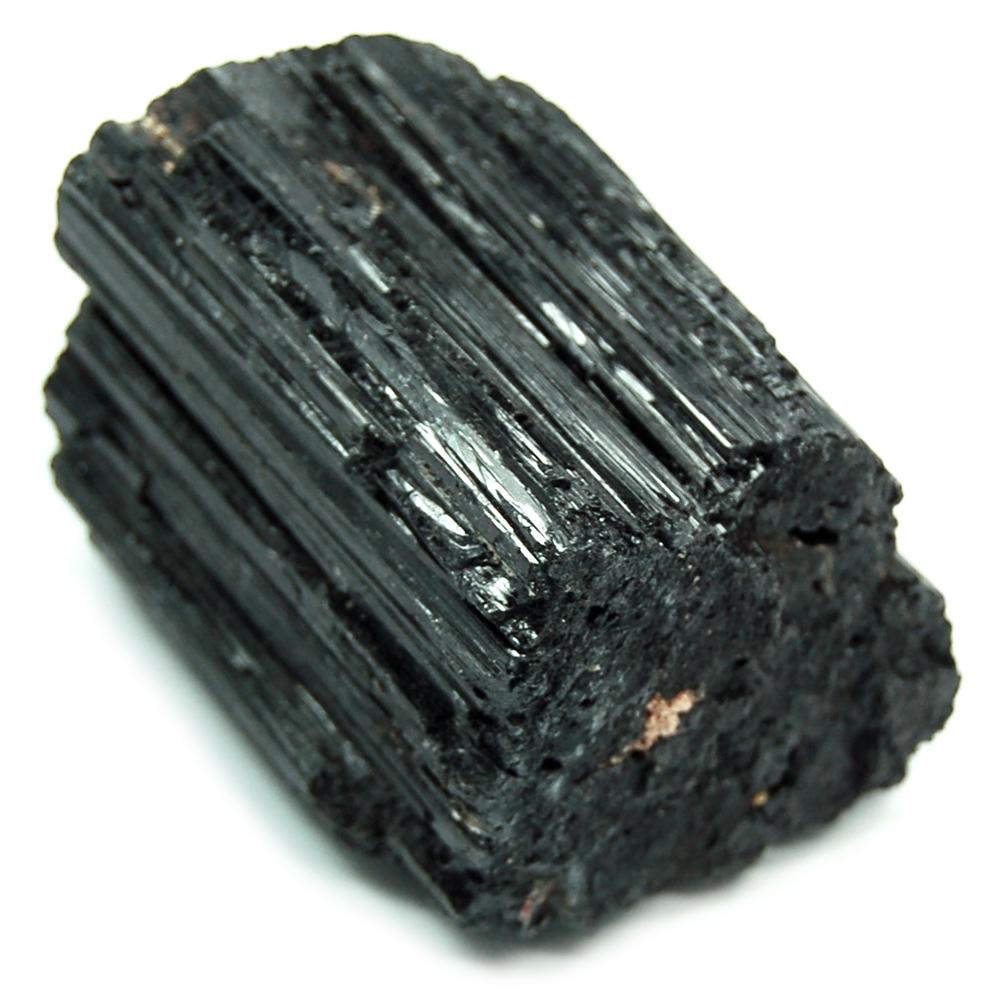
Tourmaline is a boron silicate mineral group with the general formula XY₃Z₆(T₆O₁₈)(BO₃)₃V₃W, where the X, Y, Z, T, V, and W sites accept a wide range of elements. That chemical flexibility is why tourmaline produces the widest color range of any mineral group: black (schorl), pink to red (rubellite), green (verdelite), blue (indicolite), brown (dravite), colorless (achroite), and the bicolored watermelon variety with a pink core and green rind. Single crystals can show multiple colors along their length or in concentric zones across their cross-section.
Tourmaline forms primarily in granitic pegmatites, where boron-rich fluids from the late stages of granite crystallization provide the boron needed for the tourmaline structure. Black tourmaline (schorl) is extremely common in pegmatites — it is the most abundant tourmaline species and turns up in nearly every beryl-bearing pegmatite. Finding colored tourmaline (elbaite, the lithium-bearing species) is the real prize. Gem-quality rubellite, indicolite, and watermelon tourmaline come from only a small fraction of the world's pegmatites, and the US has two regions with world-class production: San Diego County, California, and Oxford County, Maine.
Tourmaline Geology: Why Pegmatites and Why So Few?
The key element for tourmaline is boron. Boron concentrates in the residual fluids during granite crystallization because it does not fit well into the structures of common silicate minerals (quartz, feldspar, mica). As the granite body solidifies, boron accumulates in the remaining melt until it reaches concentrations high enough to stabilize tourmaline. This typically happens in the pegmatite phase — the coarse-grained, volatile-rich final stage of granite crystallization.
Black schorl (iron-rich tourmaline) forms early and in nearly all boron-bearing pegmatites. Colored elbaite (lithium-rich tourmaline) requires a more evolved, lithium-enriched pegmatite — one that has undergone extensive fractional crystallization to concentrate lithium, boron, and other rare elements. This is why colored tourmaline is so much rarer than schorl: the pegmatite must reach a high degree of chemical evolution.
Color in tourmaline is controlled by trace elements: manganese produces pink to red (rubellite), iron plus titanium produces green (verdelite), iron alone produces blue (indicolite), and chromium produces an intense green (chrome tourmaline, extremely rare). Watermelon tourmaline forms when the chemistry of the crystallizing fluid changes during growth — typically starting with manganese-rich (pink center) and shifting to iron-rich (green rim) as the pocket evolves.
In the field, schorl is your trailblazer mineral. If you find black tourmaline in a pegmatite, you know boron was present in the system. That does not guarantee colored tourmaline, but it puts you in the right geological neighborhood. Look for pegmatites with coarse muscovite, lepidolite (purple lithium mica), cleavelandite (platy albite feldspar), and cookeite (a lithium clay) — these indicate the highly evolved chemistry needed for elbaite.
Top Tourmaline Collecting Locations in the United States
California — Himalaya Mine, Mesa Grande (San Diego County)
Land Status: Private mining claim. Fee-dig operation open to the public.
Location: Near Mesa Grande, approx. 33.180°N, 116.790°W. Elevation ~3,400 ft.
Access: Sedan OK on paved and gravel roads. The mine is well-signed from Mesa Grande.
Fee: Varies. Check the Himalaya Mine website for current pricing. Typically $75+/day for mine dump screening.
Specimens: The Himalaya Mine has been producing gem tourmaline since 1898 and is one of the most famous tourmaline mines in the world. The pegmatite here has yielded enormous quantities of pink (rubellite), green (verdelite), blue (indicolite), and watermelon tourmaline, along with beryl, kunzite (pink spodumene), morganite (pink beryl), and dozens of other pegmatite minerals. The fee-dig operation lets visitors screen material from the mine tailings pile. You work with screens, picks, and shovels, sorting through broken pegmatite rock for tourmaline crystals and fragments. Colors found in the tailings include pink, green, black, and occasional watermelon sections.
What to expect: You will not be mining virgin rock — you are screening the waste material that has already passed through the mining operation. Gem-quality pieces are uncommon in the tailings but do turn up. Small pink and green crystals and fragments are more typical finds. The experience is worth the trip for the geology alone — the Himalaya pegmatite is one of the best-exposed gem pegmatites in North America, and staff are knowledgeable about the mineralogy.
California — Pala District / Stewart Mine / Tourmaline Queen (San Diego County)
Land Status: Private mining claims. Mostly not open to public collecting.
Location: Near Pala, approx. 33.360°N, 117.080°W.
Access: Limited. Some mines host occasional public collecting events. Contact mine operators directly.
Specimens: The Pala pegmatite district includes the Stewart Mine, Tourmaline Queen Mine, Pala Chief Mine, and others that have produced some of the finest rubellite and bicolored tourmaline in American history. Most of these mines are now private and not routinely open to the public. The Stewart Mine has produced spectacular rubellite crystals, and the Pala Chief has yielded kunzite alongside tourmaline. Occasional public collecting events or club-organized trips may provide access — check with the San Diego Mineral & Gem Society and the Fallbrook Gem & Mineral Society for scheduled events.
Maine — Oxford County Pegmatites
Land Status: Mix of town land, private quarries, and state land.
Location: Mount Mica, Paris: approx. 44.250°N, 70.490°W. Mount Apatite, Auburn: approx. 44.080°N, 70.280°W. Newry area: approx. 44.480°N, 70.790°W.
Access: Mount Apatite is town-owned land open to public collecting. Mount Mica is privately operated. Other quarries have varying access — check current status.
Vehicle: Sedan to most trailheads. Short hikes to quarry faces.
Specimens: Maine has produced some of the finest tourmaline in the world. Mount Mica near Paris, discovered in 1820, was the first tourmaline locality in the United States and has produced green, pink, and watermelon tourmaline for over 200 years. Mount Mica is now privately operated and not open to general public collecting. The nearby Newry quarries (including the famous Dunton Quarry) have produced spectacular watermelon and bicolored tourmaline but are also private.
For public collecting, Mount Apatite in Auburn is the most accessible site. This town-owned land contains multiple pegmatite quarries that have produced tourmaline (mostly black schorl, with occasional green and pink), aquamarine, apatite, garnet, and other pegmatite minerals. Collecting is by surface picking and light hand digging in the quarry walls and waste piles. The pegmatites are exposed in the quarry faces — look for black prismatic crystals with the distinctive triangular cross-section in the quartz-feldspar matrix.
Maine — Plumbago Mountain / Newry (Oxford County)
Land Status: Private claims. Access limited.
Location: Near Newry, approx. 44.480°N, 70.790°W.
Access: Contact mine operators or arrange access through local mineral clubs (Oxford County Mineral & Gem Club). Some organized collecting trips are offered.
Specimens: The Plumbago Mountain area and the Dunton Quarry have produced museum-quality watermelon tourmaline, mint-green verdelite, and large rubellite crystals. These are among the most important tourmaline localities in North America. Access is restricted because the operators are working active pegmatite veins and pockets. If you can arrange access through a club trip or organized event, the mineral diversity is extraordinary — tourmaline, beryl, apatite, columbite-tantalite, pollucite, and dozens of other species.
Connecticut — Portland / Strickland Quarry (Middlesex County)
Land Status: Private quarry. Periodic open collecting days.
Location: Portland, approx. 41.570°N, 72.630°W.
Access: Check with Connecticut mineral clubs for scheduled open collecting days. Not open for walk-in collecting.
Specimens: The Strickland Quarry in Portland is a well-known pegmatite collecting site that has produced black tourmaline (schorl), occasional green and pink tourmaline, beryl, garnet, and columbite. The pegmatite is exposed in the quarry walls, and collecting is from the quarry face and waste piles during organized events. Schorl is the most common tourmaline variety here, often as large prismatic crystals with well-developed triangular cross-sections. Green tourmaline is rare but has been found. Contact the New Haven Mineral Club or Mineralogical Society of Connecticut for access schedules.
Connecticut — Branchville (Fairfield County)
Land Status: Private land.
Location: Near Branchville, approx. 41.220°N, 73.450°W.
Access: Limited. Contact local rock clubs for current access information.
Specimens: The Branchville pegmatites have produced black tourmaline and occasional colored varieties alongside a suite of rare phosphate minerals. This is historically significant as a mineral locality but access is difficult. The pegmatites here are in the same New England pegmatite belt as the Connecticut and Maine localities.
North Carolina — Spruce Pine / Franklin Area (Mitchell, Avery & Macon Counties)
Land Status: Private fee-dig operations.
Location: Spruce Pine: approx. 35.910°N, 82.070°W. Franklin: approx. 35.180°N, 83.380°W.
Access: Sedan OK. Paved roads to fee-dig sites.
Fee: $20–$50/day or per-bucket pricing.
Specimens: The Spruce Pine pegmatite district produces dark-colored tourmaline — primarily schorl and occasionally dark green verdelite. While not as gem-rich as Maine or California, the region's pegmatites yield tourmaline along with feldspar, mica, quartz, garnet, and other pegmatite minerals. Fee-dig sites in the Franklin and Spruce Pine areas screen pegmatite gravel, and tourmaline crystals turn up mixed with other minerals. The Franklin area fee-digs are primarily oriented toward sapphire and ruby hunting, but tourmaline is a common secondary find.
Tourmaline Specimen Types
| Variety | Species | Color | US Sources |
|---|---|---|---|
| Schorl | Iron tourmaline | Black, opaque | Nearly all US pegmatites |
| Rubellite | Elbaite (Li) | Pink to deep red | CA (Himalaya, Pala), ME (Mount Mica, Newry) |
| Verdelite | Elbaite (Li) | Green (various shades) | CA, ME, CT |
| Indicolite | Elbaite (Li) | Blue (rare) | CA (Himalaya), ME (scattered) |
| Watermelon | Elbaite (Li) | Pink core, green rind | ME (Newry, Mount Mica), CA |
| Dravite | Mg tourmaline | Brown to dark brown | NY, NC metamorphic rocks |
| Bicolored | Elbaite (Li) | Multiple colors along c-axis | CA, ME |
How to Identify Tourmaline in the Field
| Property | Tourmaline | Look-Alike: Black Hornblende | Look-Alike: Black Augite |
|---|---|---|---|
| Hardness | 7–7.5 (Mohs) | 5–6 — scratched by tourmaline | 5–6 — scratched by tourmaline |
| Crystal Cross-Section | Rounded triangular (3-sided) | Diamond-shaped (2 cleavages at 56°/124°) | Square to rectangular (2 cleavages at ~87°) |
| Striations | Heavy lengthwise striations on prism | Absent to weak | Absent |
| Cleavage | None (conchoidal fracture) | Perfect in 2 directions | Good in 2 directions |
| Luster | Vitreous (glassy) | Vitreous to silky | Vitreous to dull |
| Key Test | Triangular cross-section + striations + no cleavage | Diamond cross-section + 2 cleavage planes | Square cross-section + 2 cleavage planes at ~90° |
Tourmaline has the most diagnostic crystal shape of any common mineral. Break a crystal perpendicular to its length and examine the cross-section: it is a rounded triangle with three sides. No other common mineral forms this shape. Hornblende (amphibole) has a diamond-shaped cross-section with two cleavage directions at about 56° and 124°. Augite (pyroxene) has a nearly square cross-section with two cleavage directions at about 87°. If you can see a triangular cross-section, you have tourmaline.
Lengthwise striations are the second diagnostic feature. Tourmaline prisms are heavily grooved parallel to the long axis — run your fingernail along the crystal and you will feel the ridges. These striations are much coarser and more prominent than those on quartz.
Tourmaline has no cleavage — it fractures conchoidally rather than splitting along flat planes. Hornblende and augite both cleave easily along their characteristic planes. Tap a suspect crystal gently with a hammer: tourmaline breaks with irregular, curved surfaces. Hornblende splits into elongated fragments along cleavage planes.
For colored tourmaline, hold the crystal up to light and rotate it. Many tourmaline crystals show strong pleochroism — the color visibly changes as you rotate the crystal along different axes. A green tourmaline may appear blue-green in one orientation and yellow-green in another. This pleochroism is a strong confirmation of tourmaline identity.
Tools and Equipment for Tourmaline Collecting
- Rock hammer (2–3 lb) and cold chisels (assorted) — pegmatite pocket mining requires careful chiseling along crystal-feldspar contacts. Use the chisel tip to pry crystals free rather than striking them directly.
- Pry bar — for opening sealed pockets in pegmatite. Work slowly — prying too hard can fracture the crystals inside.
- Classifying screens — for fee-dig operations where you screen mine dump material. 1/4" mesh is standard.
- 10x hand lens — examine cross-section shape, striations, and color zoning. Essential for confirming identity and evaluating quality.
- Safety glasses — mandatory when hammering. Pegmatite minerals fracture conchoidally and throw sharp fragments.
- Careful extraction technique — gem-quality tourmaline is brittle perpendicular to the c-axis. Crystals that survived millions of years in a pocket can snap from a single careless hammer blow. When you find a crystal, switch to the finest tools available and work the surrounding matrix away from the crystal, not the crystal away from the matrix.
- Wrapping material — individual wrapping is essential. Tourmaline crystals are brittle at the tips and along c-axis breaks. Newspaper, paper towels, or bubble wrap between each specimen.
- Camera — photograph crystals in situ before extraction. In-pocket photos document the find and help reconstruct the pocket geometry later.
Legal Information and Collecting Rules
Fee-dig mines (Himalaya, NC operations) are private businesses. You pay the fee and keep your finds. Check websites or call ahead for current hours, fees, and seasonal availability. Some operations close for weather or when material runs low.
Town-owned land (Mount Apatite, Auburn, ME) allows public collecting under local ordinances. No fee. Respect the land — fill holes, remove trash, do not disturb the quarry walls beyond light hand-tool work.
Private quarries and active mines require specific permission. Entering a posted mine property without authorization is trespassing. Club-organized trips typically arrange permission in advance — contact local mineral clubs for scheduled events.
On National Forest and BLM land where tourmaline-bearing pegmatites occur, personal-use collecting with hand tools is permitted under standard regulations (36 CFR 228.62 for NF; 43 CFR 8365 for BLM). Active mining claims on public land have exclusive mineral rights — check the BLM LR2000 database before collecting in pegmatite districts.
Interactive Tourmaline Location Map
Use our interactive tourmaline location map to find collecting sites with GPS coordinates, land status, and reported specimens. You can also browse all specimen maps or search by state.