
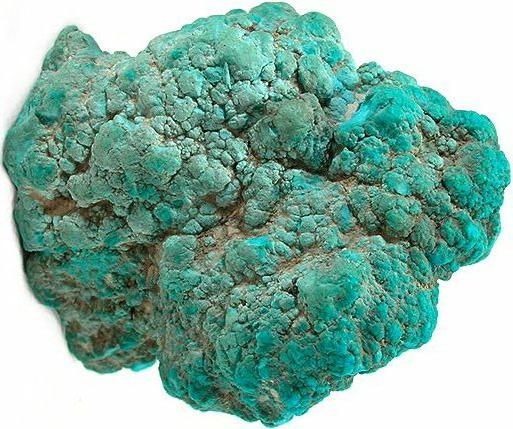
Turquoise (CuAl₆(PO₄)₄(OH)₈·4H₂O) is a copper aluminum phosphate that forms in arid environments where copper-rich groundwater percolates through aluminum-bearing rock — typically weathered volcanic tuff, rhyolite, or monzonite porphyry. The American Southwest has produced some of the world's finest turquoise for centuries. While many historic mines are on private claims or tribal land, there are still locations where collectors can legally find turquoise.
Where to Find Turquoise in the United States
Nevada — The Top Turquoise State
Nevada has more turquoise deposits than any other US state — over 120 named mines across the central and northern regions. The turquoise forms in copper-bearing volcanic rock within the Great Basin. Most active mines are on private mining claims and are not open to the public without permission.
Otteson Brothers' Turquoise Mine (Nye County)
Land Status: Private mining claim. Fee-dig access available.
Location: Near Tonopah, NV, approx. 38.069°N, 117.230°W.
Access: High-clearance 4x4 required for the last several miles. Desert terrain — no shade, no water, no cell service.
Fee: Contact the Otteson family directly for current rates and scheduling. They offer guided collecting experiences where you work the mine dump material.
Specimens: Blue to green turquoise in rhyolite host rock. Some material has spider-web matrix (dark veins through the turquoise caused by the host rock). Quality ranges from chalky to gem-grade. This is one of the few turquoise mines in the US that regularly allows public access.
Danger note: Summer temps exceed 100°F. Carry 1 gallon of water per person per day minimum. Rattlesnakes and abandoned mine shafts are present throughout the area. Stay on marked paths.
Battle Mountain BLM Land (Lander County)
Land Status: BLM (Bureau of Land Management). Open for casual surface collecting — BLM allows removal of reasonable quantities of rocks, minerals, and semiprecious gemstones for personal, non-commercial use (43 CFR 3622).
Location: Hillsides south and east of Battle Mountain, approx. 40.600°N, 116.900°W.
Access: AWD/4x4 recommended. BLM roads vary from graded gravel to unmaintained two-track.
Specimens: Small pieces of turquoise (typically pea-size to thumbnail) can occasionally be found as surface float in areas of copper mineralization. The turquoise weathers out of the host rock and sits on the surface. Look for blue-green staining on iron-stained brown rhyolite and monzonite.
What to expect: This is not a guaranteed find. You are prospecting on open BLM desert looking for small pieces of turquoise among many square miles of desert. Patience and sharp eyes are required. The area around the historic Carico Lake, Royston, and Broken Arrow mines (all privately claimed) has the right geology, but the specific claims are off-limits without permission. The surrounding BLM land is legal to surface collect.
Other Notable Nevada Turquoise Mines (Private — Not Open to Public)
| Mine | County | Known For | Status |
|---|---|---|---|
| Carico Lake | Lander | Bright green to blue, iridescent matrix | Private claim. No public access. |
| Royston | Nye | Green to blue with brown matrix | Private claim. Rough sold commercially. |
| Broken Arrow | Lander | High-grade blue with dark matrix | Private claim. |
| Number Eight | Eureka | Black spiderweb matrix, highly prized | Depleted. Material extremely rare. |
| Lone Mountain | Esmeralda | Robin's-egg blue, clean | Private claim. Limited production. |
| Blue Diamond | Lander | Bright blue, hard | Private claim. |
Arizona
Kingman Mine Area (Mohave County)
Land Status: Private mining claim. Limited public access — contact operator.
Location: Mineral Park district near Kingman, approx. 35.340°N, 114.070°W.
Access: AWD recommended. Desert roads.
Specimens: Kingman turquoise is known for its medium-blue color, often with a quartz matrix that makes it harder and more durable than many other sources. The mine has operated since the 1880s and has historically allowed some public collecting — contact the current operator for status and fees.
Mineral Park BLM Land (Mohave County)
Land Status: BLM. Open for casual surface collecting.
Location: Mineral Park district, approx. 35.350°N, 114.100°W.
Access: AWD recommended.
Specimens: Small turquoise nodules and staining can be found on BLM land in the surrounding Mineral Park district. The copper mineralization that produced the Kingman turquoise extends beyond the private claim boundaries. Surface float is legal to collect on BLM land. Always verify your exact position is not on a private claim — check with the BLM Kingman Field Office.
Sleeping Beauty Mine (Gila County)
Location: Near Globe, AZ, approx. 33.380°N, 110.800°W.
Status: Closed for turquoise mining in 2012 when the operation converted to copper mining. The mine produced the classic robin's-egg blue turquoise (minimal matrix) that is now extremely valuable. No public access. Sleeping Beauty turquoise on the market is old stock or from small remaining deposits — be cautious of imitations.
Bisbee (Cochise County)
Location: Bisbee, AZ, approx. 31.450°N, 109.930°W.
Status: Historic copper mining district that produced turquoise as a byproduct. The Lavender Pit and underground mines are closed. Bisbee turquoise (dark blue with chocolate-brown matrix) is highly collectible but no longer produced. Old mine dumps in the area are on private or restricted land.
New Mexico
Cerrillos Mining District (Santa Fe County)
Land Status: Mix of private claims and state park land.
Location: Cerrillos Hills, south of Santa Fe, approx. 35.440°N, 106.130°W.
Access: Sedan OK to the state park. Private claims require permission.
History: The Cerrillos district has been mined for turquoise since at least 900 AD by Ancestral Pueblo peoples. Mount Chalchihuitl (the turquoise mountain) is one of the oldest mines in North America. The Spanish mined it extensively in the 1600s–1700s.
Current collecting: Cerrillos Hills State Park allows hiking but not mineral collecting. Some private claims in the district offer fee-based collecting — check with the Cerrillos Turquoise Mining Museum in town for current access. The turquoise here ranges from pale green to medium blue and forms in altered monzonite porphyry.
Colorado
King Mine and Hall Mine (Conejos County)
Land Status: Private mining claims.
Location: San Luis Valley area, Conejos County, approx. 37.100°N, 106.100°W.
Access: 4x4 recommended. Mountain terrain at 8,000+ ft elevation. Check with operators for current access.
Specimens: Turquoise in a copper-mineralized zone within volcanic rock. The Colorado turquoise tends toward green (higher iron content). Some material is gem-grade.
San Luis Valley BLM Land
Land Status: BLM (Monte Vista Field Office).
Location: Various locations in the San Luis Valley, approx. 37.500°N, 105.900°W.
Access: AWD recommended. Contact the BLM Monte Vista Field Office (719-852-7074) for current collecting areas and road conditions.
Specimens: Surface prospecting for turquoise is permitted on BLM land. Casual collecting quantities only. The volcanic terrain of the San Juan Mountains has copper mineralization that can produce turquoise, but finds are uncommon and small.
How to Identify Turquoise in the Field
| Property | Turquoise | Chrysocolla (Look-Alike) | Dyed Howlite (Fake) |
|---|---|---|---|
| Hardness | 5–6 (Mohs) | 2–4 (much softer) | 3.5 (scratches easily) |
| Color | Sky blue to green (copper determines shade) | Blue-green, often brighter | Uniform dyed blue, too perfect |
| Luster | Waxy to dull | Vitreous to waxy | Dull, chalky |
| Streak | White to pale green | White | White (dye may transfer) |
| Key Test | Scratches glass with effort | Does NOT scratch glass | Acetone removes dye |
| Crystal System | Triclinic (rarely visible crystals) | Amorphous / cryptocrystalline | Monoclinic (howlite base) |
Field Identification Tips
Turquoise rarely forms visible crystals. It occurs as veins, nodules, coatings, and nuggets in weathered host rock. In the field, look for:
- Blue-green staining on iron-stained brown rock — this is the most common indicator of turquoise-bearing ground
- Spider-web matrix pattern — dark veins running through turquoise, caused by the host rock filling fractures. The matrix pattern is valued differently depending on the mine (black matrix from Number Eight is premium; brown matrix from Royston is distinctive)
- Waxy luster — gem-grade turquoise has a waxy sheen when broken fresh
- Copper oxides nearby — malachite (green), azurite (blue), and chrysocolla (blue-green) indicate copper mineralization in the area, which is a prerequisite for turquoise formation
Turquoise vs. Chrysocolla — The Critical Distinction
Chrysocolla (a copper silicate) looks similar to turquoise but is much softer (2–4 Mohs vs. 5–6). The scratch test is the simplest field method: if the blue-green mineral scratches a steel knife blade, it is likely turquoise. If the knife scratches the mineral, it is probably chrysocolla. Chrysocolla also tends to be more vitreous (glassy) than turquoise's waxy luster.
Gem-silica chrysocolla (chalcedony with chrysocolla inclusions) is an exception — it has hardness 6.5–7 and is valuable in its own right. It is typically more translucent than turquoise.
Tools and Collecting Tips
- Rock hammer (2–3 lb) and cold chisels — turquoise is embedded in hard host rock (rhyolite, monzonite porphyry). You need to break the host rock to extract turquoise veins.
- Brass chisel or wood wedge — turquoise is soft enough (5–6 Mohs) to be crushed by steel tools. Use brass or work carefully at the margins of the vein to avoid destroying specimens.
- Hand lens (10x) — examine matrix patterns and confirm waxy luster vs. glassy luster (chrysocolla)
- Spray bottle — wetting turquoise reveals the true color. Dry desert turquoise is often coated in dust and looks brown.
- Sun protection — hat, sunscreen, long sleeves. Most turquoise sites are in exposed desert terrain at elevation with intense UV.
- Water — carry at least 1 gallon per person per day in desert locations. No water sources at any turquoise collecting site listed above.
- GPS device or phone with offline maps — cell service is nonexistent at most Nevada and Arizona turquoise sites. Download offline maps before leaving town.
Stabilized vs. Natural Turquoise
Most turquoise on the commercial market is stabilized — treated with resin or epoxy to harden the stone and enhance color. Stabilization is standard practice and not considered fraudulent when disclosed. Natural, untreated, gem-grade turquoise is rare and commands high prices.
If you collect your own turquoise and it is chalky or soft, you can stabilize it yourself using thin cyanoacrylate (super glue) or commercial turquoise stabilizing compounds. Apply in a well-ventilated area and allow 24 hours to cure. Stabilization prevents the stone from absorbing oils and darkening over time.
Legal Considerations
- BLM land: Casual surface collecting of turquoise is legal for personal, non-commercial use under 43 CFR 3622. "Reasonable quantities" is generally interpreted as what you can carry by hand — no mechanized equipment.
- Private claims: The vast majority of known turquoise deposits are on private mining claims. Trespassing on a mining claim is illegal. Always verify land status before collecting.
- Tribal land: Many turquoise deposits in the Southwest are on tribal land (Navajo, Zuni, Pueblo). Collecting is prohibited without explicit tribal permission. Respect these boundaries.
- National Parks/Monuments: All mineral collecting is prohibited in National Parks and National Monuments.
Interactive Turquoise Location Map
Use our interactive turquoise location map to find collecting sites near you with GPS coordinates, land status, and access notes. You can also browse all specimen maps or search by state.