
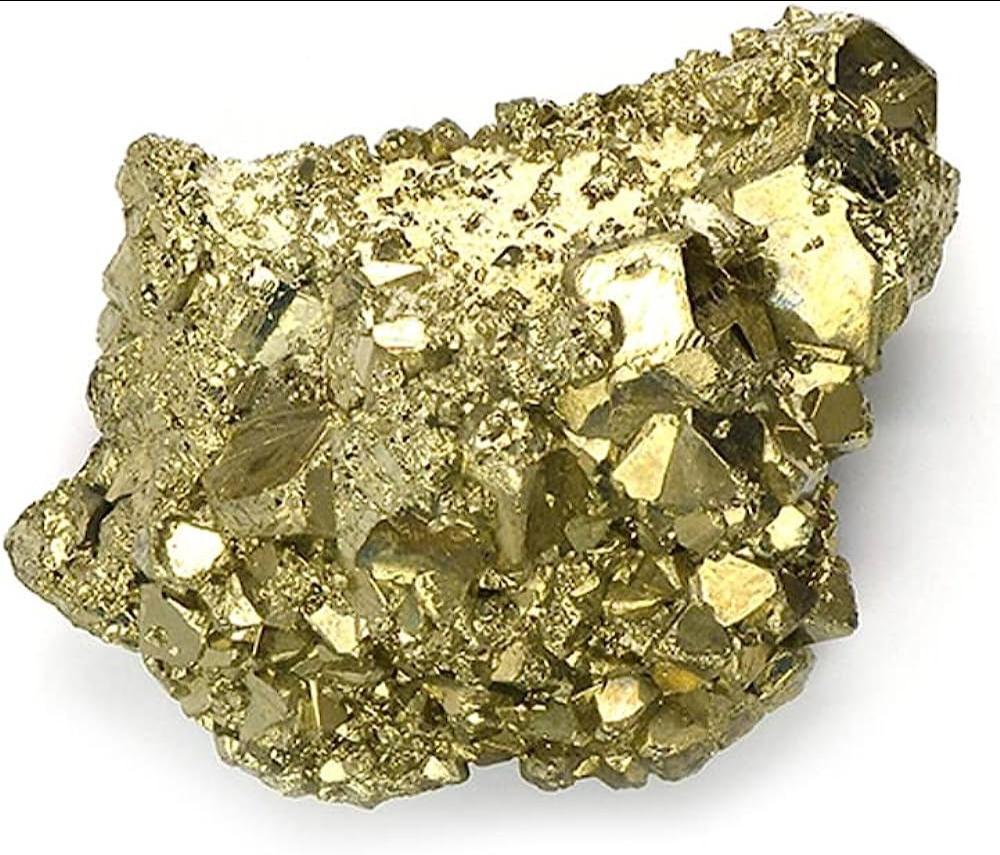
Pyrite (FeS₂) — iron disulfide, universally known as "fool's gold" — is the most abundant sulfide mineral on Earth. It forms in nearly every geological environment: sedimentary, igneous, metamorphic, and hydrothermal. You will find pyrite in coal beds, in gold-bearing quartz veins, in copper ore deposits, in black shale, in metamorphic schist, and even in some limestones. It is genuinely ubiquitous. But there is a massive difference between disseminated fine-grained pyrite (which is everywhere and not particularly collectible) and well-crystallized pyrite specimens — perfect cubes, pyritohedrons, octahedrons, and the bizarre flat "pyrite suns" from Illinois coal mines. Targeting the right localities for display-quality crystals is what separates a good specimen from a pile of brassy rubble.
Pyrite crystallizes in the isometric (cubic) crystal system, and its tendency to form perfect cubes is one of the most striking things in mineralogy. Natural pyrite cubes with mirror-flat faces and sharp 90-degree edges look engineered, not grown. The pyritohedral crystal form (12 pentagonal faces) is equally impressive and diagnostic — no other common mineral forms this shape. Collectors target localities that produce well-crystallized specimens with complete crystal faces, good luster, and intact edges.
Pyrite Geology: Where Perfect Crystals Form
The best pyrite specimens come from environments where crystals grew slowly in open spaces — vugs, veins, bedding-plane partings, and dissolution cavities. Rapid crystallization produces fine-grained, massive pyrite (the stuff that makes up ore deposits). Slow crystallization in void spaces produces the euhedral (well-formed) crystals collectors seek.
Three geological settings produce the best US pyrite specimens:
1. Hydrothermal veins in mining districts. Colorado, Nevada, and other western mining states have thousands of mineral veins where hot, metal-bearing fluids precipitated pyrite alongside gold, silver, copper, and other ore minerals. The mine dumps from 150 years of hard-rock mining contain discarded pyrite that the miners were not after. Some of this material has excellent crystal form — cubes and pyritohedrons sitting in quartz vein material.
2. Sedimentary environments — specifically coal measures. The Illinois coal basin produces a unique specimen type: pyrite suns (also called pyrite dollars). These are flat, radiating disks of pyrite that formed between layers of slate in coal seams. The disks grew radially outward along bedding planes, producing circular specimens up to 6–8 inches in diameter with radiating crystal structure. Pyrite suns are found nowhere else in the world at this quality and size.
3. Metamorphic rocks. Pyrite in schist, gneiss, and slate can form porphyroblasts — large, well-formed crystals that grew during metamorphism. The Piedmont region of Virginia and the Appalachian states produce pyrite cubes and pyritohedrons in metamorphic rocks, some exceeding 2 inches on edge.
Top Pyrite Collecting Locations in the United States
Colorado — Breckenridge Mining District (Summit County)
Land Status: Mix of National Forest (White River and Arapaho NF), BLM land, and private mining claims.
Location: Breckenridge area, approx. 39.480°N, 106.040°W. Elevation 9,600–12,000 ft.
Access: Forest roads. AWD/high-clearance recommended for mine dump access roads. Some dumps are along hiking trails.
Vehicle: AWD/high-clearance. Sedan possible for main roads but not to remote mine dumps.
Specimens: The Breckenridge Mining District produced gold from the 1860s onward, and the gold-bearing quartz veins carried abundant pyrite. Mine dumps scattered across the upper Blue River drainage and along French Gulch and other tributaries contain pyrite in quartz vein material. Crystal forms include cubes, pyritohedrons, and octahedrons, often in clusters on quartz matrix. Some specimens are partially oxidized to limonite (brown iron oxide), which can actually be attractive as a color contrast. Surface collecting on mine dumps is the primary method. Check claim status before collecting — some dumps are on active mining claims. The BLM LR2000 database and the Summit County Assessor's office can help determine claim status.
Colorado — Leadville Mining District (Lake County)
Land Status: Mix of BLM land, National Forest (San Isabel NF), and private mining claims.
Location: Near Leadville, approx. 39.250°N, 106.290°W. Elevation 10,000–12,000 ft.
Access: Forest roads. AWD recommended.
Vehicle: AWD/high-clearance.
Specimens: Leadville was one of the richest mining districts in Colorado, producing silver, gold, lead, zinc, and copper from hydrothermal replacement deposits in Paleozoic carbonate rocks. Pyrite was the dominant sulfide mineral in many of the ore bodies. Mine dumps in the district — particularly around Fryer Hill, Iron Hill, and Breece Hill — contain pyrite cubes and masses in limestone and dolomite matrix. Some specimens show pyrite crystals sitting in dissolved-out cavities in the carbonate rock, making for attractive matrix specimens. The same caution applies: verify claim status before collecting.
Colorado — Cripple Creek District (Teller County)
Land Status: Mix of private claims, city land, and BLM land.
Location: Near Cripple Creek, approx. 38.750°N, 105.180°W. Elevation ~9,500 ft.
Access: Paved and gravel roads. Some mine dumps accessible by sedan.
Vehicle: Sedan to town. AWD for remote dump access.
Specimens: The Cripple Creek district is a volcanic caldera that hosted one of the richest gold deposits in Colorado. The gold was intimately associated with pyrite in veins cutting through volcanic breccia and phonolite. Mine dumps in the district contain pyrite in vein quartz and altered volcanic rock. The Cripple Creek & Victor Gold Mine is an active open-pit operation — stay off active mine property. Historic dumps outside the active operation may be accessible on BLM or unclaimed ground, but the district is heavily claimed. Check status carefully.
Illinois — Southern Illinois Coal Country (Randolph, St. Clair & Perry Counties)
Land Status: Mostly private land. Active and abandoned coal mine properties.
Location: Sparta area: approx. 38.120°N, 89.700°W. General southern Illinois coal basin.
Access: Limited. Active coal mines are closed to the public. Some old strip mine areas may be accessible with landowner permission.
Vehicle: Sedan to most access points.
Specimens: Southern Illinois produces the world's finest pyrite suns — flat, radiating pyrite disks formed between layers of slate roof-rock above coal seams. These form when iron sulfide precipitates along bedding planes and grows radially outward, creating circular disks from 1 inch to over 6 inches in diameter. The radiating crystal structure is visible on broken surfaces. Pyrite suns are unique to the Illinois coal basin and are one of the most distinctive mineral specimens produced anywhere in the US.
Access reality: You cannot walk into an active underground coal mine. Most pyrite suns reach the market through miners who collect them during coal extraction and sell them to mineral dealers. Some old strip mine areas (reclaimed or abandoned) may have exposed coal measure outcrops where pyrite can be found. Contact local rock clubs and mineral dealers in the Sparta and Chester area for guidance on accessible locations and specimen availability. The Midwest Mineral Mining Symposium (held annually in the region) is a good networking opportunity.
Arizona — Bisbee District (Cochise County)
Land Status: Mix of private mining claims, Freeport-McMoRan property, and BLM land.
Location: Bisbee, approx. 31.440°N, 109.930°W.
Access: Limited. Active mining property is off-limits. Some old dumps may be accessible. The Lavender Pit viewpoint is public.
Vehicle: Sedan to town. AWD for surrounding roads.
Specimens: The Bisbee copper mining district has produced pyrite alongside copper minerals (malachite, azurite, chrysocolla, cuprite) for over a century. Pyrite here occurs in massive sulfide ore, in quartz veins, and as well-crystallized specimens in open cavities. Some Bisbee pyrite has a distinctive warm golden color and high metallic luster. The district also produces marcasite (FeS₂ in orthorhombic form — a different crystal structure from pyrite with a paler, more silvery color). Collecting in Bisbee is complicated by the active Freeport-McMoRan operation and extensive private claims. Old surface dumps on the outskirts of the district may be accessible on unclaimed BLM ground, but verify before collecting.
Arizona — Jerome District (Yavapai County)
Land Status: Mix of private claims, state land, and Prescott National Forest.
Location: Jerome, approx. 34.750°N, 112.110°W.
Access: Sedan to town. Mine dumps in the surrounding hills may require AWD.
Vehicle: Sedan for town; AWD for off-road dump access.
Specimens: Jerome was a major copper mining center, and the massive sulfide ore body (the United Verde deposit) was one of the richest in Arizona. Pyrite was the dominant sulfide mineral. Mine dumps in the district contain pyrite in massive sulfide, in quartz veins, and occasionally as well-formed crystals. The Jerome area also produces chalcopyrite (copper-iron sulfide) and various secondary copper minerals. Land status is complex — some dumps are on private claims, others on National Forest or state trust land. Check before collecting.
Virginia — Piedmont Region (Prince William & Fauquier Counties)
Land Status: Mostly private land. Some old prospects may be accessible.
Location: General area around 38.700°N, 77.500°W. Quantico area through Warrenton.
Access: Varies. Contact local rock clubs (Northern Virginia Mineral Club, Gem Cutters Guild of Baltimore) for current accessible sites.
Specimens: The Virginia Piedmont produces pyrite in metamorphic rocks — phyllite, schist, and gneiss — as porphyroblasts (large crystals that grew during metamorphism). Pyrite cubes and pyritohedrons up to 2+ inches on an edge have been collected from metamorphic exposures in Prince William County and the Quantico area. The pyrite grows within the foliated rock, and collecting involves breaking the schist to extract crystals. Some old prospects and road cuts are accessible; others are on private or military land (Quantico Marine Base — off-limits). The Virginia gold belt also produces pyrite in quartz veins, offering a second collecting opportunity in the same region.
Pennsylvania — Anthracite Coal Region (Schuylkill & Carbon Counties)
Land Status: Mostly private. Old coal mine dumps and strip mines.
Location: General area around 40.750°N, 76.200°W. Tamaqua, Minersville, Pottsville area.
Access: Varies. Some old dumps are accessible. Others are posted private or on active mine property. Contact the Schuylkill County Rock & Mineral Club for guidance.
Specimens: The Pennsylvania anthracite region produces pyrite cubes, pyrite on coal, and occasional pyrite suns in coal measure rocks. While not as famous as the Illinois pyrite suns, Pennsylvania coal deposits do yield interesting specimens. The pyrite here forms in both the coal itself and in associated slate and shale layers. Old mine dumps and strip mine highwalls expose coal measure rocks where pyrite can be found. The region has a long mining history, and mineral collecting on old dumps has been a tradition for generations.
Pyrite Specimen Types
| Type | Crystal Form | Setting | Best US Sources |
|---|---|---|---|
| Cubic pyrite | Perfect cubes with flat faces | Hydrothermal veins, metamorphic rocks | CO mining districts, VA Piedmont, Spain (imported) |
| Pyritohedral pyrite | 12 pentagonal faces | Hydrothermal veins | CO, AZ mining districts |
| Pyrite suns (dollars) | Flat radiating disks in slate | Coal measure bedding planes | Southern IL (unique worldwide) |
| Octahedral pyrite | 8 triangular faces | Hydrothermal veins | CO, less common |
| Massive pyrite | No distinct crystal faces | Sulfide ore bodies | AZ copper districts, CO |
| Pyrite on matrix | Cubes or clusters on quartz/host rock | Vein material | CO, AZ, PA mine dumps |
How to Identify Pyrite in the Field (and Not Confuse It with Gold)
| Property | Pyrite | Gold | Look-Alike: Chalcopyrite |
|---|---|---|---|
| Hardness | 6–6.5 (Mohs) — scratches glass | 2.5 — easily scratched by steel | 3.5–4 — scratched by steel knife |
| Color | Brass yellow with cool/pale tone | Rich warm yellow | Brassy yellow with greenish tint |
| Streak | Greenish-black to black | Golden yellow (same color as mineral) | Greenish-black |
| Crystal Form | Cubes, pyritohedrons, octahedrons | Nuggets, flakes, wire — never cubes | Tetrahedrons (wedge-shaped); commonly massive |
| Behavior When Struck | Shatters — sparks on steel | Deforms — gold is malleable | Shatters |
| Specific Gravity | 5.0 | 19.3 — extremely heavy | 4.1–4.3 |
| Key Test | Black streak + shatters + cubes | Gold streak + malleable + heavy | Greenish tint + scratched by knife |
The pyrite-vs-gold question has a simple answer: do the streak test. Scrape the specimen across an unglazed porcelain streak plate (the back of a bathroom tile works). Pyrite leaves a greenish-black to black streak. Gold leaves a golden-yellow streak that is the same color as the mineral itself. This single test is definitive and takes three seconds.
If you do not have a streak plate, use the hardness test. Try to scratch the specimen with a steel knife. Gold is soft (H=2.5) — the knife scratches it easily and the gold deforms. Pyrite is hard (H=6–6.5) — the knife will not scratch it. In fact, pyrite is hard enough to scratch glass and throw sparks when struck against steel (that is why it was used in flintlock firearms).
Chalcopyrite (CuFeS₂) is the other common confusion mineral. It has a similar brassy color but with a greenish tint, and it is much softer than pyrite (H=3.5–4). A steel knife easily scratches chalcopyrite but not pyrite. Chalcopyrite also tarnishes rapidly to iridescent purples and blues when exposed to air, while fresh pyrite maintains its pale brass color.
Crystal form is also diagnostic: gold never forms cubes or any angular crystal shape — it occurs as nuggets, flakes, wire, and amorphous masses. If your specimen has flat faces meeting at 90-degree angles, it is pyrite, period.
Tools and Equipment for Pyrite Collecting
- Rock hammer (2–3 lb) — for extracting specimens from host rock and breaking open vein material. A chisel-edge hammer works well for mine dump material.
- Cold chisels — for trimming matrix and extracting crystals from quartz veins without shattering them.
- Safety glasses — mandatory. Pyrite shatters when struck, and the angular fragments are sharp. Striking pyrite against steel also produces sparks.
- Padding and wrapping — pyrite cubes have sharp edges and flat faces that chip on impact. Wrap each specimen individually in newspaper or bubble wrap. A cube that chips at one corner is significantly less valuable as a display piece.
- Streak plate — carry an unglazed porcelain tile for positive identification. The streak test instantly separates pyrite from gold and from chalcopyrite.
- Silica gel desiccant packs — for storage. Pyrite deteriorates in humid conditions through a process called "pyrite disease" or "pyrite decay." The sulfide reacts with atmospheric moisture and oxygen to produce sulfuric acid, which damages the specimen surface and attacks any nearby labels, trays, or other specimens. Store pyrite in dry conditions with desiccant.
- Sealable plastic bags or containers — transport pyrite in airtight containers to minimize moisture exposure during the trip home.
- 10x hand lens — examine crystal faces for striations (fine parallel lines on cube faces are characteristic of pyrite) and confirm crystal form. Pyritohedral faces show distinctive striations that alternate direction on adjacent faces.
Pyrite Preservation and Storage
This section matters for pyrite more than for almost any other collected mineral. Pyrite decays. The iron sulfide reacts with water and oxygen through the reaction: 2FeS₂ + 7O₂ + 2H₂O → 2FeSO₄ + 2H₂SO₄. The sulfuric acid produced attacks the specimen surface, producing a white to yellow powder (iron sulfate) and an acidic, sulfurous smell. Specimens can literally disintegrate over years in a humid display case.
To prevent pyrite decay: store specimens in low-humidity environments (below 60% relative humidity). Include silica gel desiccant packs in display cases and storage boxes. Do not store pyrite in sealed containers with paper labels or cardboard trays — the acid will eat them. Coat high-value specimens with a thin layer of clear lacquer or Renaissance wax to create a moisture barrier. Check stored specimens periodically for signs of white or yellow powder on surfaces.
Legal Information and Collecting Rules
On National Forest and BLM land, personal-use mineral collecting with hand tools is permitted under standard regulations (36 CFR 228.62 for NF; 43 CFR 8365 for BLM). The standard BLM limit is 25 pounds per day plus one piece, not to exceed 250 pounds per year.
Mining districts are complicated. Many mine dumps sit on active mining claims — even old, abandoned-looking dumps may have a valid claim filed with the BLM. Collecting on someone else's active claim without permission is theft of mineral resources. Check the BLM LR2000 database for claim status before collecting on any mine dump in a mining district. When in doubt, contact the local BLM or Forest Service office.
Active mine property (coal mines in Illinois, open-pit operations in Arizona) is absolutely off-limits. These are dangerous industrial sites with open pits, unstable ground, and heavy equipment. Stay out.
Private land (Virginia Piedmont, Pennsylvania coal country) requires landowner permission. Contact local rock and mineral clubs for guidance on accessible sites — clubs often have established relationships with landowners.
Interactive Pyrite Location Map
Use our interactive pyrite location map to find collecting sites with GPS coordinates, land status, and reported specimens. You can also browse all specimen maps or search by state.