
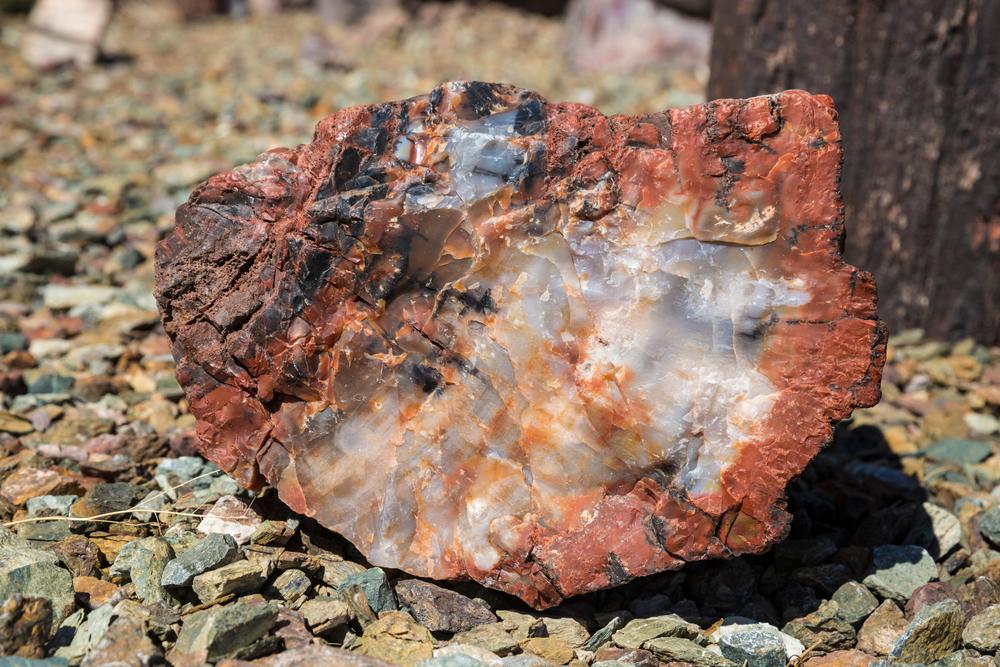
Petrified Wood Overview and Geology
Petrified wood is not wood at all — it is stone that has perfectly preserved the structure of wood. The process is called permineralization: mineral-laden groundwater percolates through buried wood, and silica (usually chalcedony, microcrystalline quartz, or opal) precipitates within the cell walls and cavities, molecule by molecule replacing the organic material while maintaining the original cellular architecture. Pick up a piece of petrified wood and you are holding something that was once a living tree, now converted entirely to rock, preserving bark texture, growth rings, and sometimes even individual cell structure visible under a hand lens.
The chemistry is dominated by SiO₂, but trace elements create the color range. Iron oxides produce reds, yellows, and browns. Manganese oxides give blacks and purples. Chromium contributes greens. Copper can produce blue-green tones. The best petrified wood deposits in the US formed during three main periods: the Late Triassic (~225 million years ago, responsible for Arizona's famous deposits), the Miocene (~15-20 million years ago, producing Washington and Oregon material), and the Eocene (~35-55 million years ago, creating Mississippi and some Texas material).
The typical preservation scenario requires rapid burial — usually by volcanic ash — that isolates the wood from oxygen and decay organisms while allowing silica-saturated groundwater to begin the replacement process. This is why the best petrified wood deposits cluster near ancient volcanic provinces.
Top US Locations for Petrified Wood
1. Holbrook / BLM Lands, Arizona (Navajo & Apache Counties)
GPS: 34.8800° N, 109.8600° W (general BLM collecting area east of Holbrook — NOT within the National Park)
Land Status: BLM land surrounding Petrified Forest National Park. Collecting within the National Park is a federal crime — fines up to $325 for first offense, potential felony charges for large amounts. BLM land outside park boundaries permits personal-use collecting: 25 pounds per day plus one piece, not to exceed 250 pounds per year.
Vehicle: High-clearance 2WD sufficient for most BLM roads. Some access routes benefit from 4WD, especially after rain when clay roads become slick.
The Chinle Formation — a Late Triassic unit roughly 225 million years old — is the source of Arizona's petrified wood. This formation extends well beyond the boundaries of Petrified Forest National Park, and it is the BLM-administered land outside the park where collecting is legal. The ancient trees were conifers (primarily Araucarioxylon arizonicum) that grew in a tropical floodplain environment. Volcanic eruptions from a nearby arc buried the forests in ash. Silica-rich groundwater did the rest.
The material here is spectacular. Colors range from deep reds and oranges (iron oxide) to purples and blacks (manganese) to rare blue-green (copper or chromium). Pieces range from small chips to entire logs several feet long. Surface collecting on BLM land is productive because ongoing erosion continuously exposes new material. The best strategy is to drive BLM roads east and south of Holbrook, park, and walk the badlands terrain scanning for exposed pieces. The Painted Desert extends across a wide area — the petrified wood is not confined to one small zone.
Do not set foot inside the National Park with collecting intentions. Rangers check vehicles at the exit, and the park takes enforcement seriously.
2. Ginkgo / Saddle Mountain, Washington (Kittitas & Grant Counties)
GPS: 46.9490° N, 120.0500° W (Saddle Mountain BLM area)
Land Status: Ginkgo Petrified Forest State Park — no collecting. BLM land in the Saddle Mountain area and central Washington Columbia Basin — collecting permitted under BLM casual-use rules.
Vehicle: High-clearance 4WD recommended for BLM access roads. Basalt terrain is rough on tires.
Washington's petrified wood formed during the Miocene when the Columbia River Basalt Group — one of the largest flood basalt events in Earth's history — buried forests across what is now the Columbia Basin. Successive lava flows entombed entire forests, and silica-rich groundwater fossilized the wood within the basalt. The Ginkgo Petrified Forest is notable because it preserves over 50 species of fossil trees, including the rare ginkgo — a "living fossil" tree genus that has barely changed in 200 million years.
The state park near Vantage is strictly a viewing and interpretive site. For collecting, head to BLM land in the Saddle Mountain area south of Vantage and areas around Ellensburg. Petrified wood here tends toward darker tones — blacks, browns, and dark reds — reflecting the basaltic groundwater chemistry. Some pieces show excellent cellular preservation and take a beautiful polish. Look for wood eroding out of the basalt or lying loose on desert pavement surfaces.
3. Hampton Buttes / Mitchell Area, Oregon (Deschutes & Wheeler Counties)
GPS: 43.8600° N, 120.3300° W (Hampton Buttes BLM area)
Land Status: BLM land — open for personal-use collecting (25 lbs/day rule). John Day Fossil Beds National Monument — all collecting prohibited.
Vehicle: High-clearance 4WD for Hampton Buttes area. Standard 2WD can access some areas near Mitchell.
Central Oregon's volcanic history produced multiple petrified wood deposits in Miocene-age ash and tuff. The Hampton Buttes area on BLM land southwest of Burns is one of the more productive sites. The wood here is often opalized or agatized, meaning the replacement mineral is common opal or banded chalcedony rather than plain microcrystalline quartz. Opalized wood can show play-of-color in rare cases, and agatized wood displays the banding patterns typical of agate.
The Mitchell area in Wheeler County produces petrified wood in stream gravels and eroding ash beds. The Blue Basin area within John Day Fossil Beds National Monument contains petrified wood, but collecting is prohibited inside the monument. Stay on BLM land — check boundary maps carefully, as the monument and BLM parcels are interspersed.
4. Washington County, Texas (Gulf Coastal Plain)
GPS: 30.3200° N, 96.3500° W (general Washington County area)
Land Status: Primarily private land. Collecting on public road rights-of-way and with landowner permission. Creek beds on public land are accessible.
Vehicle: Standard 2WD for most sites. Some creek access may require short hikes.
Texas petrified palm wood is the official state stone, and for good reason — the Gulf Coastal Plain from Houston north to Dallas produces abundant petrified palmwood in Eocene and Oligocene-age gravel deposits. The diagnostic feature is the cross-section pattern: palm trees lack growth rings (they are monocots, not dicots) and instead show a distinctive dot pattern created by fossilized vascular bundles. In cross-section, it looks like someone drilled hundreds of tiny holes in the wood.
Washington County and adjacent counties are the classic collecting area. Creek beds after high-water events expose petrified wood in gravel bars. Road cuts through the Whitsett and Manning Formations produce pieces ranging from small fragments to log sections. Most productive land is private — always ask permission. Some landowners are very accommodating, especially if you explain what you are looking for.
5. Mississippi Petrified Forest, Flora, Mississippi (Madison County)
GPS: 32.5450° N, 90.3100° W (Mississippi Petrified Forest — private attraction)
Land Status: The Mississippi Petrified Forest itself is a private tourist attraction — no collecting on their property. Surrounding areas on private land with permission and public road cuts yield specimens.
Vehicle: Standard 2WD.
The Mississippi Petrified Forest near Flora preserves logs from a Miocene-age forest buried by sediment from the ancestral Mississippi River. The attraction is worth visiting for the interpretive trail, but collecting happens outside the property on surrounding land. The Catahoula Formation throughout central Mississippi produces petrified wood — much of it is palm wood similar to the Texas material. Stream gravels and eroding bluffs along smaller creeks in Madison, Hinds, and Rankin Counties are productive. The material is typically tan, brown, or gray and takes a good polish.
6. Virgin Valley, Nevada (Humboldt County)
GPS: 41.1800° N, 118.7500° W (general Virgin Valley area)
Land Status: Mix of BLM land and private claims. The Royal Peacock Opal Mine and Bonanza Opal Mine are fee-dig operations. BLM land allows casual collecting.
Vehicle: High-clearance 4WD required. Remote desert — carry extra water, fuel, and a spare tire.
Virgin Valley is famous for precious opal, but it also produces opalized petrified wood — logs and branches where the replacement mineral is opal, sometimes with play-of-color. This is Miocene-age material (~15 million years old) buried in volcanic ash. The fee-dig opal mines occasionally produce stunning opalized wood specimens. Be warned: Virgin Valley opals (and opalized wood) are notoriously unstable and prone to crazing (cracking) when they dry out. Store specimens in water or in sealed containers with damp cotton.
7. Gallatin Valley, Montana (Gallatin County)
GPS: 45.0600° N, 111.0500° W (general Gallatin petrified forest area)
Land Status: Gallatin National Forest (now Custer Gallatin National Forest). Some collecting permitted on Forest Service land outside designated wilderness areas. Check with the local Ranger District.
Vehicle: High-clearance 4WD. Forest roads are rough and seasonal.
The Gallatin Petrified Forest in the Absaroka Range preserves Eocene-age trees (~50 million years old) buried by volcanic mudflows (lahars) from the Absaroka Volcanic Province. Some standing petrified stumps are still in growth position — these are scientifically significant and should not be disturbed. Loose petrified wood in stream gravels below the fossil forests can be collected in limited quantities on non-wilderness Forest Service land.
Petrified Wood Specimen Types
| Type | Replacement Mineral | Typical Colors | Key Locations | Collector Notes |
|---|---|---|---|---|
| Chalcedony-replaced | Microcrystalline quartz (chalcedony) | Red, orange, brown, yellow | AZ, WA, OR | Most common type; takes excellent polish |
| Opalized wood | Common opal or precious opal | White, tan, black; may show play-of-color | NV (Virgin Valley), OR | Precious opal varieties are rare and valuable; may craze |
| Agatized wood | Banded chalcedony (agate) | Banded reds, whites, clear | AZ, OR, MT | Shows agate banding within wood structure |
| Petrified palm wood | Chalcedony | Tan, brown, gray, black | TX, MS, LA | Distinctive dot pattern in cross-section; state stone of TX |
| Jet (bituminous wood) | Carbon-rich (not silicified) | Black | UT, CO | Organic preservation, not mineral replacement; lightweight |
Field Identification: Petrified Wood vs. Look-Alikes
| Property | Petrified Wood | Chert/Flint Nodules | Sandstone | Ironstone Concretions |
|---|---|---|---|---|
| Weight | Heavy (SG 2.5–2.8) | Heavy (SG ~2.6) | Medium | Very heavy (iron-rich) |
| Surface Texture | Bark texture, wood grain visible | Smooth, waxy | Granular, gritty | Rough, sometimes botryoidal |
| Cross-section | Growth rings or vascular dots (palm) | Uniform or banded (no wood structure) | Uniform granular | Concentric banding (not wood grain) |
| Hardness | 6.5–7 (scratches glass) | 7 (scratches glass) | Variable (usually won't scratch glass) | 5–6 (may or may not scratch glass) |
| Fracture | Conchoidal or splintery | Conchoidal | Granular | Earthy to subconchoidal |
The single best field test: wet the surface with a spray bottle. If you can see wood grain — parallel lines, growth rings, or cellular structure — it is petrified wood. Chert nodules can sometimes have a vaguely elongated shape that tricks people into thinking they have petrified wood, but they lack any internal wood structure. Ironstone concretions are common in the same formations as petrified wood and can be cylindrical or branch-shaped, but they are softer, heavier relative to size, and show no wood structure on a fresh break.
Palm wood is sometimes mistaken for coral because of its dot pattern. The distinction: palm wood dots are scattered unevenly (vascular bundles), while coral has a regular geometric pattern of polyp cavities.
Tools for Petrified Wood Collecting
- Spray bottle: The single most useful tool. Wetting a dry piece of petrified wood reveals grain structure, color, and quality that are invisible on a dry, dusty surface.
- Strong backpack, sturdy bucket, or garden cart: This is heavy material. A 6-inch piece of petrified wood weighs several pounds. A slab the size of a dinner plate can weigh 15+ pounds. Plan your carrying capacity before you walk a mile from your vehicle.
- GPS or smartphone with offline maps: BLM land boundaries matter. Knowing exactly where you are relative to park boundaries, private land, and your vehicle is not optional in remote desert terrain.
- Rock hammer: Rarely needed — most petrified wood is collected loose from the surface. Useful for trimming large pieces to manageable size.
- Gloves: Some petrified wood has sharp, splintery fracture surfaces.
- UV flashlight (shortwave): Some opalized petrified wood fluoresces green under shortwave UV. Useful for evening collecting in Nevada.
Legal Considerations
BLM land: 25 pounds per day plus one piece, not to exceed 250 pounds per year. Personal use only — no commercial sale without a permit. Hand tools only for casual collecting.
National Parks and Monuments: Zero tolerance. Do not collect. Petrified Forest National Park, John Day Fossil Beds National Monument, and other NPS units enforce this strictly. Fines are real and criminal charges are possible for significant amounts.
National Forests: Generally permits personal-use collecting of reasonable quantities. Regulations vary by forest — check with the local Ranger District.
State Parks: Varies by state. Washington's Ginkgo Petrified Forest State Park — no collecting. Other state lands may permit surface collecting. Check before you dig.
Private land: Get permission. In Texas especially, most productive land is privately owned. A polite conversation with the landowner goes a long way.
Explore the Interactive Petrified Wood Map
Use our interactive petrified wood location map to find collecting sites with GPS coordinates, land status, BLM boundaries, and access information across all 50 states.