
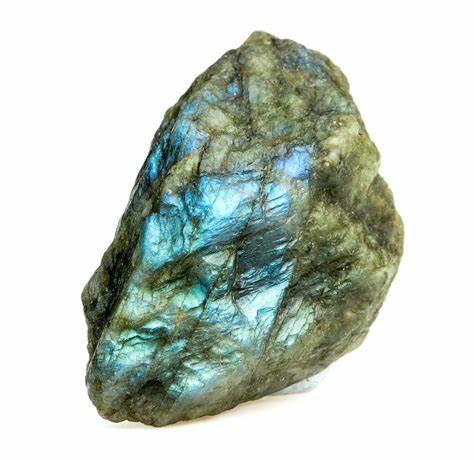
Labradorite is a calcium-rich plagioclase feldspar with composition ranging from (Ca,Na)(Al,Si)₄O₈ — specifically the An₅₀ to An₇₀ range of the plagioclase solid solution series. It is the mineral behind labradorescence, a schiller effect that produces sudden flashes of blue, green, gold, copper, and violet when light strikes internal lamellae at critical angles. The effect comes from thin, alternating layers of feldspar compositions with slightly different refractive indices — light reflecting off these internal boundaries creates the color flash through interference. Without the right viewing angle, labradorite looks like ordinary gray rock. Rotate it a few degrees, and it lights up.
Oregon sunstone is a related variety of feldspar (oligoclase to labradorite composition) that contains native copper platelets responsible for its aventurescence — a metallic, sparkling flash distinct from labradorescence. The copper inclusions also give some Oregon sunstones red, green, and bicolored body colors. Both labradorite and sunstone are collectible in the US, though at very different kinds of sites.
Labradorite Geology: Anorthosite and Basalt Origins
Labradorite forms in two primary geological settings in the US. The first is anorthosite — an intrusive igneous rock composed almost entirely of plagioclase feldspar. Anorthosite bodies form deep in the crust from slow-cooling magma chambers where feldspar crystals accumulate. The Adirondack Mountains in New York contain one of the largest anorthosite massifs in North America, and labradorite is a major constituent of that rock.
The second setting is volcanic basalt. Basalt flows in eastern Oregon contain phenocrysts (large crystals that grew before the lava erupted) of labradorite-to-andesine composition that, in rare cases, incorporated native copper as they grew. When these basalt flows weathered, the feldspar crystals were released into the soil as loose gems — what we call Oregon sunstone. The basalt is roughly 15 million years old (Miocene), and the feldspar phenocrysts survived weathering because feldspar, while softer than quartz, is reasonably durable in the dry high-desert climate.
For the collector, the practical difference is this: Adirondack labradorite is extracted from solid rock or found in road cut exposures. Oregon sunstone is picked up as loose crystals from the surface or dug from shallow soil above decomposed basalt. The Oregon sunstone sites are far more productive for a day's collecting.
Top Labradorite and Sunstone Collecting Locations
Oregon — BLM Sunstone Collection Area (Harney & Lake Counties)
Land Status: BLM land (Burns District Office). Open to public collecting year-round. Free, no permit required.
Location: Approximately 42.910°N, 120.010°W. North of Plush, OR. Elevation ~4,800 ft.
Access: Gravel roads from Plush. Last several miles are dirt — passable by sedan in dry conditions but AWD recommended after rain.
Vehicle: AWD recommended. Sedan possible in dry summer months but the road is washboarded.
Specimens: This is the premier feldspar collecting locality in the United States. The BLM maintains a designated 4,300-acre collection area where sunstones occur loose on the surface and in shallow soil overlying weathered basalt. Colors range from clear (schiller-free) to straw yellow, green, red, and bicolored red-green. The most valuable specimens show strong copper schiller — a metallic flash from internal copper platelets. Some large gems (5+ carats) have been found here, though most are under 1 carat. You can collect up to 7 pounds per person per day on the BLM area.
What to expect: You will be on your hands and knees in dry, silty soil, sifting with screens or picking through the surface. Sunstones are small and translucent — they catch the light differently from surrounding rock. Work a small area systematically rather than wandering. The best finds are often just below the surface (2–6 inches deep). Bring water — this is high desert with no services. Nearest gas and food is in Plush or Lakeview.
Oregon — Fee-Dig Sunstone Mines (Harney & Lake Counties)
Land Status: Private mining claims. Fee-dig operations.
Location: Several operations in the same general area as the BLM site, approx. 42.880°N, 119.980°W.
Access: Same roads as BLM area. Check with individual operators for directions to their claim.
Fee: Varies by operator. Typically $50–$100+/day. Some charge per pound of rough material kept.
Specimens: The private fee-dig operations — including Dust Devil Mining, Spectrum Sunstone Mine, and Double Eagle Mining — work claims in the same basalt field as the BLM area but often on ground with higher gem density. These operations may provide mechanized digging (backhoe trenches or pits) that expose fresh basalt decomposition layers where sunstone concentrations are higher. You sort through the material with screens and hand tools. The fee-dig mines typically produce higher quality and larger stones than surface picking on the BLM area, which has been heavily collected. Some operations offer guided experiences and on-site faceting.
New York — Adirondack Anorthosite (Essex County)
Land Status: State highway rights-of-way, Adirondack Park (mix of public and private land).
Location: NY Route 73 between Keene and Lake Placid, approx. 44.180°N, 73.850°W.
Access: Sedan OK on Route 73. Park in pulloffs — do not block traffic.
Vehicle: Sedan. Paved highway.
Specimens: Road cuts along NY Route 73 expose massive anorthosite — a rock that is 90%+ plagioclase feldspar. The labradorite within this rock shows blue to golden flash on fresh cleavage surfaces. You can see the labradorescence on the road cut faces in direct sunlight, especially in early morning or late afternoon when the light angle is low. Collecting from road cuts is generally allowed on state highway rights-of-way, but avoid private property bordering the road. The Essex County anorthosite body extends for miles and is one of the largest in North America.
What to expect: You are working solid, hard anorthosite. A rock hammer is needed to break off pieces, and a chisel helps extract cleaner specimens. The best labradorescence appears on flat, fresh cleavage surfaces — break the rock along its natural cleavage planes rather than randomly. Wet the surface with a spray bottle and rotate the specimen in sunlight to find the flash angle. Not every piece shows strong flash; you may break several chunks before finding good labradorescence.
Utah — Milford Flat / Modena Area (Beaver County)
Land Status: BLM land (Cedar City Field Office). Open to personal-use collecting.
Location: Milford Flat area, approx. 38.400°N, 113.000°W. Modena area farther southwest.
Access: Dirt and gravel roads. High-clearance vehicle recommended.
Vehicle: High-clearance. 4x4 for more remote areas.
Specimens: Basalt flows in southwestern Utah contain sunstone-bearing feldspar phenocrysts similar to the Oregon deposits. The Utah sunstones show copper schiller and range from clear to pale yellow and orange. They are generally smaller and less intensely colored than Oregon material, but this area sees far less collecting pressure. Check with the BLM Cedar City Field Office for specific location guidance and current access conditions. The basalt is scattered across a large area, and productivity varies — some flows are rich and others are barren.
Arizona — San Carlos Apache Reservation (Gila County)
Land Status: San Carlos Apache Tribal land. Permit required from the tribe.
Location: Peridot Mesa area, approx. 33.350°N, 110.450°W.
Access: Contact the San Carlos Apache Tribe Recreation & Wildlife Department for permits and access.
Specimens: While this locality is primarily famous for peridot, the same basalt flows occasionally yield feldspar specimens with weak schiller. This is not a primary sunstone/labradorite locality, but it is worth mentioning for collectors already visiting for peridot. Tribal permits are required — collecting without authorization is illegal on reservation land.
Labradorite and Sunstone Specimen Types
| Type | Composition | Optical Effect | US Sources |
|---|---|---|---|
| Labradorite (spectrolite) | An₅₀–An₇₀ plagioclase | Labradorescence — blue/green/gold flash from internal lamellae | Adirondacks, NY |
| Oregon sunstone (clear) | Labradorite-andesine | Transparent; no schiller | Plush, OR (BLM + fee-dig) |
| Oregon sunstone (copper-schiller) | Labradorite-andesine with Cu | Aventurescence — metallic copper flash | Plush, OR (BLM + fee-dig) |
| Oregon sunstone (red/green) | Labradorite-andesine with Cu | Body color from copper; some dichroic | Plush, OR (fee-dig operations) |
| Utah sunstone | Labradorite composition | Weak copper schiller | Milford Flat / Modena, UT |
How to Identify Labradorite in the Field
| Property | Labradorite | Look-Alike: Gray Quartz | Look-Alike: Biotite Schist |
|---|---|---|---|
| Hardness | 6–6.5 (Mohs) | 7 — scratches feldspar | 2.5–3 (mica flakes) |
| Color | Gray base with colored flash on rotation | Gray, no directional flash | Dark gray to black; shiny flakes |
| Luster | Vitreous to pearly on cleavage | Vitreous | Pearly to submetallic on mica |
| Cleavage | Two directions at ~86° (plagioclase) | No cleavage — conchoidal fracture | One perfect cleavage (basal mica) |
| Streak | White | White | White to gray |
| Key Test | Rotate in sunlight — flash appears/disappears | No directional optical effect | Flakes apart in sheets; too soft |
Labradorite looks like ordinary gray rock until you rotate it and catch the flash. That sudden appearance and disappearance of color as you change the viewing angle is diagnostic — no other common gray mineral does this. Wet the surface with a spray bottle and tilt the specimen in direct sunlight at a low angle. The labradorescence appears as a sudden sheet of color — blue and gold are most common in Adirondack material.
Oregon sunstones are easier to spot: hold a small crystal up to the sun and look for transparency and a metallic copper sparkle inside the stone. The copper platelets create a reflective flash that is visible from specific angles. Non-gem-quality sunstone may just look like a clear to pale yellow pebble — the schiller only shows when light enters at the right angle.
Labradorite is softer than quartz (6–6.5 vs. 7), so a hardness test can help distinguish it from gray chalcedony or agate. It also has two cleavage directions that meet at approximately 86° — flat, shiny cleavage surfaces are characteristic of feldspar and absent in quartz.
Tools and Equipment for Labradorite and Sunstone Collecting
- Spray bottle — essential for revealing labradorescence and evaluating flash intensity. A wet surface shows color far better than dry rock.
- Small shovel or trowel — for Oregon sunstone collecting where you dig into shallow soil above decomposed basalt.
- Classifying screen (1/4" mesh) — for sifting soil at sunstone sites. Sunstones are small and easy to miss in loose dirt.
- Rock hammer and cold chisel — for extracting labradorite from anorthosite road cuts in the Adirondacks.
- Direct sunlight — labradorescence and aventurescence are best observed in full sun at low angles. Cloudy days make scouting for flash very difficult.
- Knee pads — sunstone collecting involves extended time kneeling and sifting. Protect your joints.
- Small containers or gem jars — sunstones are small and easy to lose. Store finds in individual containers or padded gem jars as you go.
- Water (2+ gallons per person) — the Oregon BLM sunstone area is remote high desert with no water source. Bring everything you need.
Legal Information and Collecting Rules
The BLM Sunstone Collection Area near Plush, OR, allows personal-use collecting of up to 7 pounds per person per day. No permit is needed. Motorized equipment and commercial collecting are prohibited on the BLM area. Fee-dig operations on private claims set their own rules and fees.
On NY state highway rights-of-way, small-scale collecting from road cut exposures is generally tolerated. Do not cross onto posted private land. The Adirondack Park has a complex mix of public and private parcels — check land ownership before venturing off the road.
On BLM land in Utah, personal-use collecting with hand tools is permitted under standard BLM regulations (25 pounds/day, 250 pounds/year). Contact the Cedar City Field Office for specific location guidance and any seasonal restrictions.
Tribal lands require tribal permits. Collecting on reservation land without authorization is a federal offense.
Interactive Labradorite Location Map
Use our interactive labradorite location map to find collecting sites with GPS coordinates, land status, and reported specimens. You can also browse all specimen maps or search by state.