
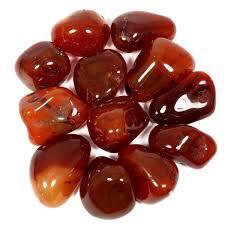
Carnelian is a translucent, reddish-orange variety of chalcedony (SiO₂) colored by finely dispersed hematite (iron oxide, Fe₂O₃) within the microcrystalline quartz structure. The color ranges from pale orange through deep blood-red, and the best specimens have a warm, even glow when backlit. Carnelian has been carved and polished for jewelry and seals for at least 4,000 years — Roman signet rings, Egyptian amulets, and Islamic calligraphy stamps were all cut from carnelian. The material is still prized by modern lapidaries for cabochons and tumbled stones.
Carnelian forms in the same volcanic environments as other chalcedony varieties — silica-rich fluids fill vesicles and fractures in basalt and rhyolite, and iron from the surrounding rock provides the red-orange color. The iron is incorporated as sub-microscopic hematite inclusions during precipitation. Higher iron concentrations produce deeper red; lower concentrations yield pale orange. Because carnelian is just iron-colored chalcedony, it occurs wherever agate and chalcedony occur — but not every chalcedony deposit produces good carnelian. The iron concentration has to be right.
Carnelian Geology: Iron, Heat, and Color Development
An interesting aspect of carnelian color: heat intensifies it. Carnelian found in desert environments where surface temperatures routinely exceed 120°F often has deeper, richer color than identical material from cooler climates. This is because mild heating (150–300°C) converts yellow-brown iron oxyhydroxides (goethite, limonite) in the chalcedony to red hematite. The conversion happens naturally over geologic time in hot environments. It also happens artificially — carnelian has been heat-treated to improve color since antiquity. A pale orange piece baked in an oven at 250°C for a few hours will turn a deeper red. There is no reliable test to distinguish naturally heat-improved from artificially heated material, so for field collectors, the color you find is the color you get.
The practical takeaway: desert-collected carnelian from Arizona, California, and Nevada tends to have stronger color than beach-collected material from the Pacific Northwest, where temperatures never got high enough to fully convert iron minerals. Oregon and Washington beach carnelian is often pale orange to amber. Arizona BLM land carnelian can be a deep, saturated red-orange.
Geologically, look for carnelian in three settings: (1) loose gravel derived from eroded basalt flows, especially in arid regions where dark desert varnish on basalt contrasts with the warm orange of carnelian on the ground surface; (2) ocean and lake beaches where volcanic-derived gravel has been sorted and tumbled by wave action; and (3) stream gravels fed by volcanic source areas.
Top Carnelian Collecting Locations in the United States
Oregon — Southern Coast Beaches (Curry County)
Land Status: Public beach (Oregon Beach Bill — all Oregon beaches are public below vegetation line).
Location: Gold Beach to Brookings shoreline, approx. 42.240°N, 124.410°W (Gold Beach) to 42.050°N, 124.280°W (Brookings).
Access: Sedan OK. Multiple beach access points from US-101. Free, no permit.
Vehicle: Sedan. Paved highway to beach parking areas.
Specimens: The southern Oregon coast yields water-worn carnelian pebbles in the surf zone and gravel bars. Material erodes from volcanic formations in the Coast Range and Klamath Mountains and is transported to beaches by rivers. Carnelian here ranges from pale amber to medium orange — rarely the deep red of desert material. Pieces are typically marble-size to golf-ball-size, tumbled smooth by wave action. The best collecting is after winter storms that expose fresh gravel on the beach. Walk the high-tide line and gravel bars, scanning for warm-colored translucent stones among the gray and brown cobbles. Wet the stones — carnelian stands out vividly when wet but can look dull and unremarkable when dry.
Oregon — Priday Agate Beds / Madras Area (Jefferson County)
Land Status: BLM land (Prineville District). Open to personal-use collecting.
Location: East of Madras, approx. 44.590°N, 121.010°W.
Access: Gravel and dirt roads. High-clearance vehicle recommended.
Vehicle: High-clearance. 4x4 helpful after rain.
Specimens: The Priday beds (also called the Richardson Ranch area) are famous for thundereggs and plume agate, but the same volcanic terrain produces carnelian alongside other chalcedony varieties. Carnelian occurs as small nodules in volcanic gravel and as loose float on the desert surface. Colors are typically pale to medium orange. The BLM land surrounding the area permits personal-use collecting with hand tools.
Oregon / Idaho — Succor Creek and Owyhee River Drainages (Malheur County, OR / Owyhee County, ID)
Land Status: BLM land (Vale District, OR / Boise District, ID). Open to personal-use collecting.
Location: Succor Creek area: approx. 43.100°N, 117.050°W. Owyhee River drainages east into Idaho.
Access: Gravel roads. High-clearance vehicle required. Remote — no services.
Vehicle: High-clearance 4x4. Some roads impassable when wet.
Specimens: The Succor Creek and Owyhee River drainages in the Oregon-Idaho border region produce carnelian, agate, jasper, and thundereggs from volcanic tuff and basalt. Carnelian here is found as rounded pebbles in creek gravel and as surface float on desert pavement. The volcanic terrain is extensive and under-collected compared to more popular sites closer to Madras. Bring extra water, fuel, and a spare tire — this is genuinely remote BLM land with no cell service.
Washington — Pacific Coast Beaches (Pacific & Grays Harbor Counties)
Land Status: Public beach. Washington beaches are generally public below ordinary high water mark.
Location: Long Beach Peninsula: approx. 46.350°N, 124.060°W. Westport area: approx. 46.900°N, 124.110°W.
Access: Sedan OK. Beach access from state parks and public roads. Free, no permit.
Vehicle: Sedan to parking areas. Some beaches allow vehicle access.
Specimens: Washington's Pacific beaches receive volcanic gravel from the Columbia River drainage and Coast Range rivers. Carnelian, agate, and jasper all turn up in the surf-zone gravel. The material tends to be small and pale orange. Beach collecting is best after storms and at low tide when gravel beds are exposed. The Long Beach Peninsula and beaches near Westport and Ocean Shores are productive for mixed agate/carnelian hunting.
California — Mojave Desert BLM Lands (San Bernardino & Riverside Counties)
Land Status: BLM land (Barstow and Palm Springs-South Coast Field Offices). Open to personal-use collecting.
Location: Widespread across the Mojave. Hauser Geode Beds area: approx. 32.980°N, 115.140°W. Wiley Well area: approx. 33.530°N, 115.120°W.
Access: Dirt roads. High-clearance 4x4 required.
Vehicle: 4x4. Desert terrain — sand, rocks, and no services.
Specimens: The Mojave Desert produces carnelian in volcanic gravel deposits across a huge area of BLM land. The dry, hot environment produces well-colored material — desert-baked carnelian from California and Arizona tends toward deeper red-orange than Pacific Northwest beach material. Carnelian occurs as small nodules, rounded pebbles, and occasional vein sections. It is found alongside agate, jasper, chalcedony roses, and geodes. Surface collecting is the primary method — walk slowly across desert pavement, scanning for the distinctive warm color. The Hauser Geode Beds and Wiley Well areas are the most visited, but carnelian turns up across much of the Mojave where volcanic gravel is present.
Arizona — Saddle Mountain and Quartzsite Areas (Maricopa & La Paz Counties)
Land Status: BLM land (Phoenix and Yuma Field Offices). Open to personal-use collecting.
Location: Saddle Mountain: approx. 33.300°N, 112.870°W. Quartzsite area: approx. 33.660°N, 114.230°W.
Access: Dirt roads. High-clearance recommended.
Vehicle: High-clearance. 4x4 for more remote areas.
Specimens: BLM land across southern Arizona produces carnelian in desert pavement — the iron-rich environment and intense solar heating produce deeply colored material. Carnelian here often occurs as small, rounded surface nodules that have weathered from volcanic gravels. The Saddle Mountain area east of Buckeye and the extensive BLM land around Quartzsite are productive collecting areas. Quartzsite draws tens of thousands of rockhounds each winter (the annual Quartzsite gem shows run January–February), and carnelian is one of the common finds on the surrounding desert BLM land. Surface collecting only — no mechanized equipment.
Great Lakes — Lake Superior Beaches (Michigan, Wisconsin, Minnesota)
Land Status: Public shoreline. Beach collecting below high-water mark is permitted.
Location: Keweenaw Peninsula, MI: approx. 47.430°N, 87.870°W. Bayfield Peninsula, WI: approx. 46.810°N, 90.820°W. North Shore, MN: approx. 47.500°N, 91.200°W.
Access: Sedan OK to beach access points. State parks and public roads.
Vehicle: Sedan.
Specimens: Lake Superior beaches produce carnelian alongside the famous Lake Superior agates. The iron-rich regional geology (Precambrian iron formations and 1.1-billion-year-old Midcontinent Rift basalts) provides the iron that colors the chalcedony. Beach carnelian here ranges from pale orange to a rich red-orange. The best collecting is after fall storms when wave action exposes fresh gravel on the beach. Walk slowly along the gravel bars at the waterline. Wet stones show color far better than dry ones. The Keweenaw Peninsula in Michigan, the Bayfield Peninsula in Wisconsin, and the North Shore in Minnesota (Duluth to Grand Marais) are all productive stretches.
Carnelian Specimen Types
| Type | Color Range | Typical Size | Best Sources |
|---|---|---|---|
| Beach-tumbled pebbles | Pale orange to amber | Marble to golf ball | OR/WA coast, Lake Superior |
| Desert nodules | Medium to deep red-orange | Marble to fist-size | AZ, CA, NV BLM land |
| Vein carnelian | Variable — depends on iron content | Pieces to several inches | Eastern OR, desert sites |
| Carnelian in agate | Orange bands alternating with white | Nodule to cobble | Lake Superior, OR |
| Carnelian with jasper | Orange grading into opaque red | Variable | Widespread in volcanic areas |
How to Identify Carnelian in the Field
| Property | Carnelian | Look-Alike: Red Jasper | Look-Alike: Orange Glass (Slag) |
|---|---|---|---|
| Hardness | 6.5–7 (Mohs) — scratches glass | 6.5–7 — same range | 5–6 — may or may not scratch glass |
| Transparency | Translucent — light through thin edges | Opaque — no light transmission | Transparent to translucent |
| Luster | Waxy to vitreous | Dull to waxy | Vitreous (glassy) |
| Fracture | Conchoidal (smooth curves) | Conchoidal to granular | Conchoidal with sharp edges |
| Streak | White | White to reddish | White |
| Key Test | Translucent on thin edges; warm orange glow | Opaque even on thin edges | Bubbles visible under 10x loupe; lighter weight |
The single most important field test for carnelian is the translucency check. Pick up a suspect orange stone, hold a thin edge toward the sun (or press a bright flashlight against one side), and look for light passing through with a warm orange glow. Carnelian is translucent — you will see light diffusing through the stone. Red jasper is opaque — no light passes through at all, no matter how thin the edge. This one test separates carnelian from jasper every time.
Carnelian differs from banded agate by lacking distinct concentric or parallel banding. Some carnelian shows faint color zoning (gradual transitions from lighter to darker orange), but this is different from the sharp, defined bands of agate. A specimen with distinct orange-and-white alternating bands is carnelian agate, not pure carnelian.
Watch out for orange glass slag near old mining, smelting, or dump sites. Slag glass can look remarkably like carnelian at first glance. Under a 10x loupe, glass slag typically shows bubbles, flow lines, and an irregular, "melted" appearance. Natural carnelian has a uniform, granular texture under magnification. Slag is also typically lighter in weight than chalcedony.
Wet the surface. This cannot be overstated. Dry carnelian on a beach or desert pavement can look dull brown or gray and blend in with surrounding gravel. Splash water on it and the translucent orange color appears immediately. A spray bottle on your belt is the single most useful tool for carnelian hunting.
Tools and Equipment for Carnelian Collecting
- Spray bottle — the essential carnelian tool. Wetting stones reveals color, translucency, and banding that are invisible when dry.
- Knee pads — carnelian collecting on beaches and desert pavement means extended time kneeling and scanning gravel at ground level. Quality knee pads save a trip.
- Eye for color — train yourself to scan for warm tones. Carnelian stands out as orange-amber among gray-brown gravel. Once your eye calibrates to the color, you will start spotting it faster.
- Collecting bag or bucket with padding — carnelian is hard but brittle. Specimens banging together chip edges. Separate finds with newspaper or towel strips.
- Flashlight (bright LED) — for the translucency test. Even in full sun, pressing a flashlight against a stone gives a definitive read on light transmission.
- Rock hammer — rarely needed for carnelian, which is usually found as loose float. Useful if you find carnelian in place within vesicular basalt and want to extract it.
- Tide chart (for beach collecting) — plan beach trips around low tide to expose maximum gravel. The hour before and after low tide is prime collecting time.
- Sun protection and water — desert sites in AZ and CA require 1+ gallon of water per person, hat, and sunscreen. Beach sites can be windy and cold — layer up.
Legal Information and Collecting Rules
Oregon beaches are public by law (the Oregon Beach Bill, 1967). Collecting rocks and minerals below the vegetation line is allowed for personal use. There is no daily limit specified, but the intent is personal collecting, not commercial harvest.
Washington beaches below the ordinary high water mark are generally public. State park beaches may have specific rules — check posted regulations.
On BLM land, personal-use mineral collecting is permitted under 43 CFR 8365. The standard limit is 25 pounds per day plus one piece, not to exceed 250 pounds per year. Hand tools only — no mechanized equipment. Desert collecting areas near Quartzsite and in the Mojave are heavily used during winter collecting season, and BLM rangers do patrol.
Lake Superior beach collecting below the high-water mark is legal on public shoreline. State parks may restrict collecting — check with the individual park. Michigan, Wisconsin, and Minnesota each have state-specific rules for rock collecting on state lands.
Interactive Carnelian Location Map
Use our interactive carnelian location map to find collecting sites with GPS coordinates, land status, and reported specimens. You can also browse all specimen maps or search by state.