
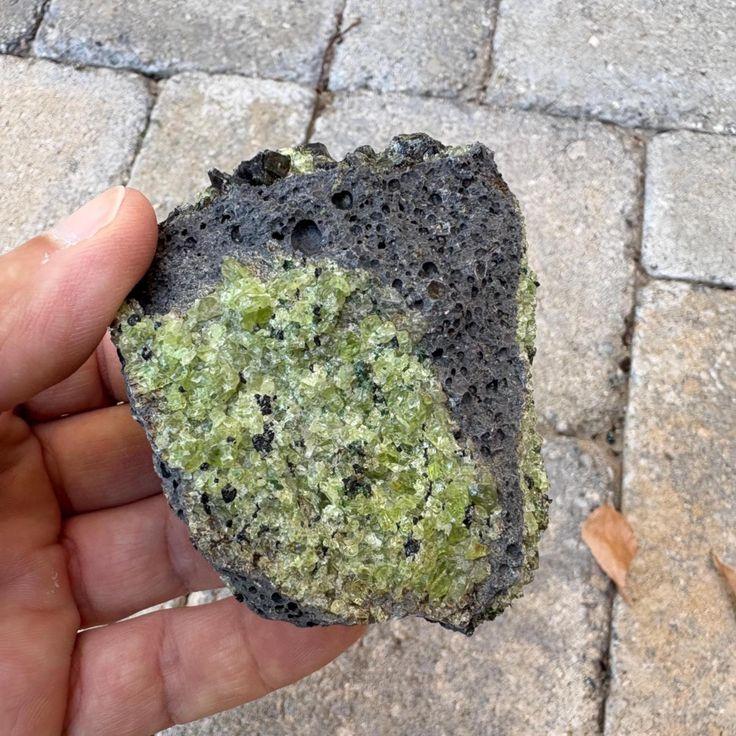
Peridot: A Gem Born in the Earth's Mantle
Peridot is the gem-quality variety of olivine, a magnesium-iron silicate with the formula (Mg,Fe)2SiO4. It is one of only a handful of gemstones that occurs in a single color — green — with the shade varying from yellow-green to olive to brownish-green depending on the iron-to-magnesium ratio. Higher iron content pushes the color toward brownish tones; lower iron gives a brighter, more purely green hue. The finest peridot is a saturated lime-green with minimal brown.
What makes olivine geologically interesting is its origin. This mineral forms at high temperatures and pressures deep in the Earth's upper mantle, typically at depths of 20 to 55 miles below the surface. It reaches the surface through volcanic eruptions that carry mantle rock upward as xenoliths — chunks of foreign rock entrained in the rising magma. When you hold a peridot crystal, you are holding a piece of the mantle that traveled to the surface inside an erupting volcano. That is not marketing language — it is the actual geological process.
The United States produces the majority of the world's commercial peridot, almost entirely from a single source in Arizona. But collectible olivine and occasional gem-grade peridot can be found at several other volcanic localities across the country.
How Peridot Forms: The Geology
Olivine is one of the first minerals to crystallize from a cooling basaltic magma. It forms at temperatures above 1,200 degrees Celsius and is stable under the pressure conditions of the upper mantle. In the mantle, olivine is the dominant mineral in a rock called peridotite (the rock is named after the gem, not the other way around). Mantle peridotite is composed primarily of olivine with subordinate pyroxene and minor garnet or spinel.
When basaltic magma erupts, it sometimes rips chunks of the mantle wall rock loose and carries them upward. These xenoliths — from the Greek for "foreign stone" — survive the trip because the eruption is fast enough that they do not completely melt or react with the surrounding magma. Once the basalt flow cools, the xenoliths are preserved as rounded green nodules in the dark gray or black basalt. Weather the basalt long enough and the olivine crystals erode free.
At maar volcanoes — explosive volcanic craters formed by the interaction of magma and groundwater — the eruption blasts fragments of mantle rock to the surface as basalt bombs. These bombs contain olivine nodules that can be cracked open to extract the green crystals inside. Kilbourne Hole in New Mexico is a classic example of this type of deposit.
Gem-quality peridot requires olivine crystals that are transparent, relatively free of fractures, and large enough to facet — generally above 1 carat. Most olivine found in the field does not meet these criteria. It is translucent at best, full of fractures, and small. But even non-gem olivine is worth collecting as a mineral specimen, and the occasional clean crystal turns up.
Where to Find Peridot in the United States
1. San Carlos Apache Reservation, Arizona — Gila County
The San Carlos Reservation produces roughly 80 to 95 percent of the world's commercial peridot. The Peridot Mesa area on the reservation contains olivine-bearing basalt flows where gem-quality stones weather out of the rock and accumulate on the surface. The basalt here erupted approximately 0.5 to 1 million years ago and carried abundant mantle xenoliths to the surface.
Access to the San Carlos Reservation is controlled by the San Carlos Apache Tribe. Collecting is restricted to tribal members and authorized parties. Non-tribal members cannot walk onto the reservation and collect peridot. The tribe mines and markets the stones commercially through licensed dealers.
- GPS: Approximately 33.35°N, 110.45°W (Peridot Mesa area, San Carlos Reservation, Gila County, AZ)
- Land Status: San Carlos Apache Reservation — sovereign tribal land. Access requires permission from the San Carlos Apache Tribe. Unauthorized collecting is trespassing on tribal land and is prosecuted.
- Vehicle: Not applicable for unauthorized visitors.
- What to Expect: If you have authorized access, peridot crystals weather loose from basalt onto the ground surface. Quality ranges from translucent green pebbles to transparent facet-grade gems. Most commercial material is under 5 carats. Purchase peridot from licensed tribal dealers or at gem shows if you cannot access the reservation.
2. BLM Land Near San Carlos, Arizona — Gila and Graham Counties
Outside the reservation boundary, BLM-managed land in the same volcanic province occasionally produces small olivine crystals. The basalt flows extend beyond the reservation, and weathering releases olivine from the rock. The crystals found on BLM land tend to be smaller and lower quality than San Carlos reservation material, but they are collectible and legal to pick up for personal use.
- GPS: Approximately 33.25°N, 110.50°W (BLM land south of San Carlos, general area)
- Land Status: BLM land. Personal-use surface collecting is permitted. Verify land boundaries carefully — the reservation boundary is not always clearly marked on the ground. Use BLM maps or the BLM's online land status records to confirm you are on public land.
- Vehicle: High-clearance vehicle recommended. Desert roads are rough and may be wash-boarded or sandy.
- What to Expect: Small olivine grains and occasional pea-sized crystals in basalt float and on the ground surface. Most material is translucent rather than transparent. Bring a hand lens to evaluate clarity.
3. Kilbourne Hole, New Mexico — Dona Ana County
Kilbourne Hole is a maar volcanic crater — roughly 1.7 miles across and 300 feet deep — formed by an explosive eruption where rising basaltic magma encountered groundwater about 24,000 years ago. The explosion blasted fragments of upper mantle peridotite to the surface as bombs embedded in basaltic tephra. These xenolith-bearing bombs litter the rim and inner slopes of the crater.
The olivine at Kilbourne Hole ranges from opaque green masses to translucent grains to occasional gem-quality transparent peridot. The mantle xenoliths also contain pyroxene and spinel, making them geologically interesting beyond just the olivine content. This is a classic teaching locality for mantle petrology.
- GPS: Approximately 31.97°N, 106.97°W (Kilbourne Hole, Dona Ana County, NM)
- Land Status: BLM land. Personal-use mineral collecting is permitted. The site was designated a National Natural Landmark in 1975, but collecting remains legal under BLM surface management regulations.
- Vehicle: High-clearance 4WD strongly recommended. The last several miles of access road are unimproved desert track through soft sand and volcanic terrain. Getting stuck is a real possibility for low-clearance vehicles.
- What to Expect: Olivine-bearing basalt bombs and xenolith fragments litter the crater rim. Break open dark basalt bombs to find green olivine nodules inside. Most olivine is translucent; gem-quality transparent peridot is uncommon but does occur. This is remote desert — no facilities, no cell service, no shade. Carry at least 2 gallons of water per person, food, a spare tire, and let someone know where you are going and when you expect to return.
4. Potrillo Volcanic Field, New Mexico — Dona Ana County
The Potrillo volcanic field, which includes Kilbourne Hole, also contains other maar craters and basalt flows with olivine-bearing xenoliths. Hunt's Hole, a smaller maar about 4 miles south of Kilbourne Hole, produces similar olivine specimens. The geology is essentially the same — explosive maar eruptions that brought mantle material to the surface.
- GPS: Approximately 31.92°N, 107.00°W (Hunt's Hole, Dona Ana County, NM)
- Land Status: BLM land. Same collecting rules as Kilbourne Hole. Be aware of the proximity to the Mexican border — you may encounter Border Patrol activity.
- Vehicle: 4WD required. Access is more difficult than Kilbourne Hole.
- What to Expect: Similar to Kilbourne Hole but less visited and potentially more productive. Same safety precautions apply.
5. San Bernardino Volcanic Field, Arizona — Cochise County
The San Bernardino volcanic field in the extreme southeastern corner of Arizona contains basalt flows with olivine xenoliths. The area is remote and little-visited by collectors. Some basalt exposures contain mantle-derived peridotite nodules similar to those at Kilbourne Hole.
- GPS: Approximately 31.35°N, 109.25°W (San Bernardino area, Cochise County, AZ)
- Land Status: Mix of BLM land, state land, and private ranches. Verify land status before collecting. Some areas are within the San Bernardino National Wildlife Refuge, where collecting is prohibited.
- Vehicle: 4WD required. Very remote, very hot in summer.
- What to Expect: Olivine in basalt xenoliths. Quality is generally lower than San Carlos or Kilbourne Hole. This is an exploratory trip for experienced collectors.
6. Hawaii — Big Island Volcanic Terrain
Hawaii's Big Island sits on top of an active volcanic hotspot and produces enormous volumes of olivine-bearing basalt. The most famous olivine locality is Papakolea Beach (Green Sand Beach), where a cinder cone rich in olivine has eroded into the surf, producing a beach of green olivine sand.
- GPS: Approximately 18.94°N, 155.63°W (Papakolea Beach, Ka'u District, Big Island, HI)
- Land Status: State land managed by the Department of Land and Natural Resources. Removing sand, rocks, or minerals from Papakolea Beach is prohibited. Collecting within Hawaii Volcanoes National Park is also prohibited.
- Vehicle: 4WD required for the approach to Papakolea Beach (or a 2.5-mile hike each way).
- What to Expect: You can see and photograph olivine sand but cannot take it. Loose olivine crystals do occur on lava flows outside park boundaries, but check current collecting regulations carefully. Hawaiian cultural practices and state law both restrict mineral removal in many areas.
Peridot Specimen Varieties
| Type | Color | Transparency | Typical Size | Best US Source | Gem Potential |
|---|---|---|---|---|---|
| Gem-grade peridot | Lime green to yellow-green | Transparent | 0.5-5 ct (rarely larger) | San Carlos, AZ | High — facetable |
| Translucent olivine | Olive to dark green | Translucent | Pea to marble-sized | All localities | Low — cabochon at best |
| Olivine in basalt | Green spots in dark rock | Opaque in matrix | Hand specimen | Kilbourne Hole, NM | None — mineral specimen |
| Peridotite xenolith | Green granular rock | Opaque | Walnut to grapefruit-sized | Kilbourne Hole, NM; HI | None — geological specimen |
| Olivine sand | Green grains | Translucent grains | Sand-sized | Papakolea Beach, HI | None (collecting prohibited) |
Field Identification: How to Confirm Peridot and Avoid Look-Alikes
| Property | Value |
|---|---|
| Hardness | 6.5 to 7 (Mohs) |
| Color | Yellow-green to olive green |
| Luster | Vitreous to oily |
| Streak | White |
| Crystal System | Orthorhombic |
| Fracture | Conchoidal |
| Specific Gravity | 3.27 to 3.37 |
| Transparency | Transparent to translucent (gem-grade is transparent) |
In the field, look for green spots in dark basaltic rock. Olivine stands out clearly against the black or dark gray basalt matrix — it is the green in the black. When you break open a basalt bomb or xenolith, look for rounded green nodules composed of granular olivine crystals. Individual crystals that are transparent and clean green are the ones with gem potential.
Wet the crystal and hold it up to the light. Gem-grade peridot is transparent — you can see through it clearly. Translucent material passes light but you cannot see through it. Opaque material has no gem value but is still a good mineral specimen.
Common Look-Alikes
- Green bottle glass: Smooth, conchoidal fracture, similar color. But glass has no crystal structure, lower specific gravity, and is usually found near human activity, not in basalt xenoliths. Glass feels lighter than olivine.
- Epidote: Yellow-green to pistachio-green, similar hardness (6-7), but epidote forms prismatic crystals, occurs in metamorphic rocks (not volcanic xenoliths), and has a distinct yellowish streak. Epidote also has one direction of perfect cleavage that olivine lacks.
- Green pyroxene (diopside, augite): Occurs alongside olivine in mantle xenoliths. Pyroxene is typically darker green, has two cleavage planes at nearly 90 degrees (olivine has poor to absent cleavage), and forms more elongated crystals.
- Chrysolite / green chrysoberyl: Much harder (8.5) than peridot (6.5-7). Not found in basaltic volcanic settings.
Tools and Equipment for Peridot Collecting
- Rock hammer (3 lb): For breaking open basalt bombs and xenolith-bearing rock. The basalt is tough — hit squarely on a natural fracture if possible.
- Hand lens (10x): To evaluate clarity, color, and fracture density of small crystals in the field.
- Small containers and vials: Peridot crystals are usually small — pea-sized or smaller — and easy to lose in the desert sand. Carry small zip-top bags or vials with cotton padding.
- Sun protection: Hat, long sleeves, sunscreen, and sunglasses are mandatory. All major US peridot sites are in exposed desert or volcanic terrain with zero shade. Heat exhaustion is a real risk.
- Water: At minimum 2 gallons per person per day at desert sites. Kilbourne Hole and the San Carlos BLM areas have no water sources.
- Spray bottle: Wetting olivine crystals helps evaluate color and transparency in the field.
- Eye protection: Required when hammering basalt.
- GPS or detailed maps: Desert sites are remote and features can be difficult to distinguish. Do not rely on cell phone GPS in areas without cell service.
Legal Considerations
- San Carlos Apache Reservation: No unauthorized collecting. This is sovereign tribal land. Respect the boundary.
- BLM land: Personal-use collecting of reasonable quantities is permitted on BLM-managed public land. No commercial collecting without a mining claim or permit.
- National Natural Landmarks: Kilbourne Hole is a National Natural Landmark, but this designation does not prohibit surface collecting. It does mean you should treat the site with respect and avoid large-scale disturbance.
- Hawaii: Collecting is prohibited in Hawaii Volcanoes National Park and at Papakolea Beach. Check state regulations before collecting anywhere on the Big Island.
- National Wildlife Refuges: Collecting is prohibited in NWRs, including the San Bernardino NWR in southeastern Arizona.
Explore the Interactive Peridot Map
Use our interactive peridot location map to find collecting sites with GPS coordinates, access information, and land status details.