
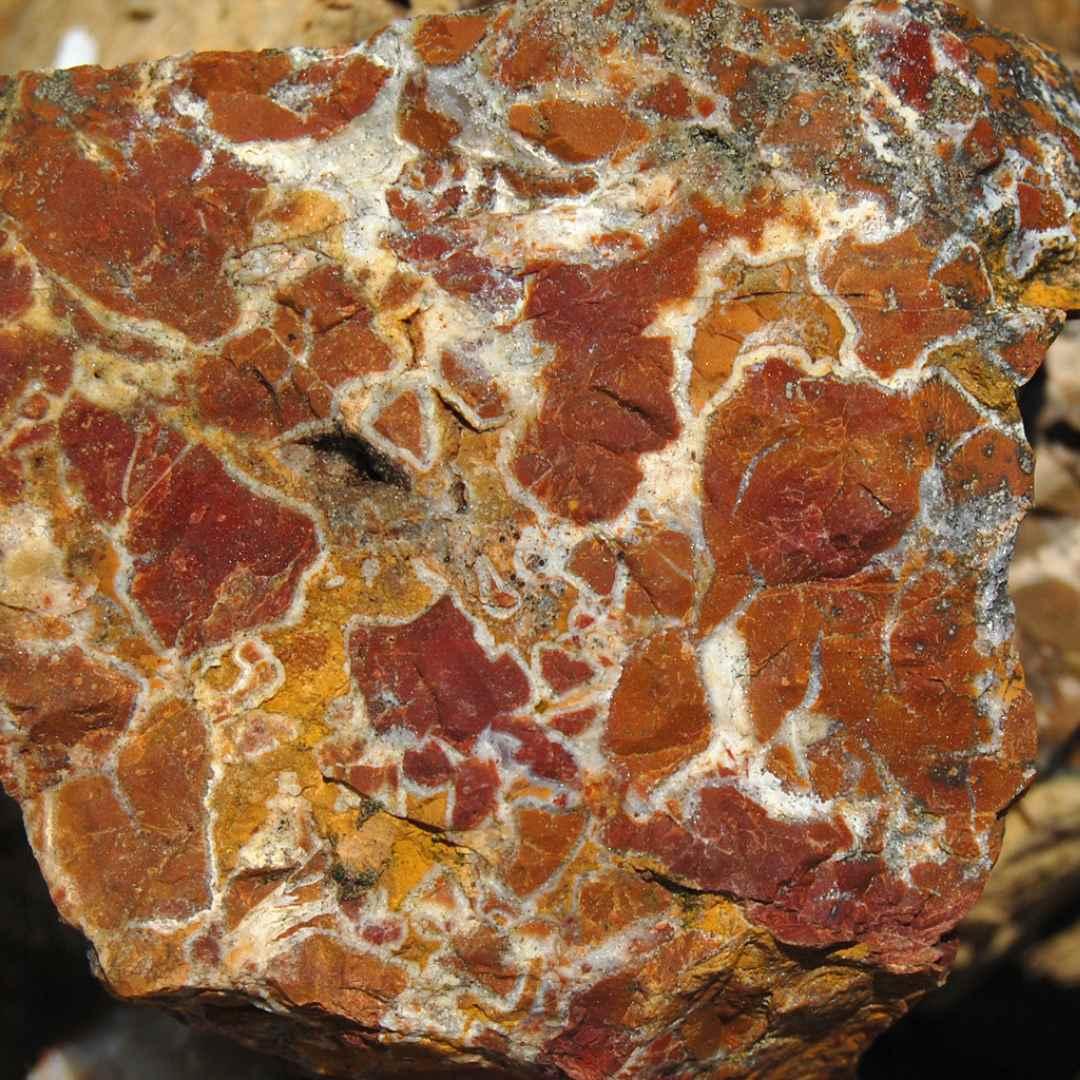
Jasper: The Collector's Chalcedony
Jasper is an opaque, microcrystalline variety of chalcedony (silicon dioxide, SiO2) colored by mineral inclusions, primarily iron oxides. Where agate is translucent and often banded, jasper is opaque and comes in a wider range of colors and patterns: solid red, yellow, brown, green, and the multi-colored "picture" and "scenic" jaspers that display landscape-like images formed by mineral staining during formation. A polished slab of good picture jasper looks like a painting done by geology over millions of years.
Jasper is one of the most widely available collecting minerals in the western United States. Vast stretches of BLM-managed desert and volcanic terrain in Oregon, California, Idaho, Arizona, and Nevada produce dozens of named jasper varieties, and most of it is free for the picking on public land. You do not need a fee-dig ticket or a mining claim — just a rock hammer, a truck with clearance, and some knowledge of where to look.
How Jasper Forms: The Geology
Jasper forms through the precipitation of silica (SiO2) from groundwater in sedimentary and volcanic environments. The silica replaces original rock material or fills fractures and voids, and mineral impurities get locked into the silica matrix during deposition. Iron oxides are the most common coloring agents: hematite produces red jasper, goethite produces yellow and brown, and chlorite or celadonite produces green.
In the Pacific Northwest, much of the collectible jasper formed in association with Miocene-age volcanism. Volcanic ash deposits, lake sediments, and basalt flows provided both the silica source and the structural voids that jasper fills. Biggs jasper, for example, formed in a lacustrine (lake) environment where silica replaced fine-grained sediments, preserving sedimentary layering as scenic banding. Morrisonite jasper from the Owyhee region formed through similar silicification of volcanic sediments, producing the complex multicolored patterns that make it one of the most valuable lapidary materials in the world.
In desert environments like the Mojave and Sonoran, jasper occurs in volcanic flows, fault zones, and alluvial gravels. Red jasper from Lavic Siding near Pisgah Crater in California formed from silicification of volcanic material with pervasive iron oxide staining. Desert pavement — the surface lag of rocks left behind after wind removes fine sediment — can concentrate jasper cobbles on the ground surface, making them easy to find.
Petrified or opalized wood is a related silicification product where jasper or opal replaces the cellular structure of buried wood. The silica preserves the wood grain while mineral impurities provide color. The boundary between jasper and petrified wood is fuzzy — some material is both.
Where to Find Jasper in the United States
1. Biggs Junction Area, Oregon — Sherman County
Biggs jasper comes from the area around Biggs Junction in north-central Oregon, where the Deschutes River meets the Columbia. The jasper formed in lacustrine sediments associated with Miocene volcanism and displays the scenic banding — brown, cream, and tan landscape-like patterns — that makes it one of the most recognized picture jaspers in the world.
- GPS: Approximately 45.62°N, 120.83°W (Biggs Junction area, Sherman County, OR)
- Land Status: The original Biggs jasper source is on private ranch land and is largely collected out or access-restricted. BLM land in the surrounding area produces similar jasper varieties, though not identical to classic Biggs. Verify land status with the BLM Prineville District Office before collecting.
- Vehicle: High-clearance vehicle recommended for back roads. The main highways (US 97, I-84) are sedan-accessible.
- What to Expect: Picture jasper with scenic banding in alluvial gravels and on exposed hilltops. Quality varies enormously — most material is plain brown jasper. Scenic picture jasper with clean, contrasting patterns is the prize and requires sorting through a lot of ordinary rock to find.
2. Owyhee Region, Oregon — Malheur County
The Owyhee country of southeastern Oregon is one of the richest jasper-producing regions in North America. The area produces Morrisonite (a multicolored jasper from a single claim that is now largely inaccessible), Owyhee jasper (blue with brown scenic patterns), and numerous other named and unnamed varieties. The jasper formed through silicification of volcanic sediments in the Owyhee volcanic field.
- GPS: Approximately 43.00°N, 117.50°W (general Owyhee region, Malheur County, OR)
- Land Status: Largely BLM land, with scattered private ranches and mining claims. BLM land permits personal-use collecting. The Morrisonite claim is private and access is restricted. Other jasper varieties are findable on open BLM land. Check with the BLM Vale District Office for current land status.
- Vehicle: High-clearance 4WD required. The Owyhee is remote, rough, and has limited maintained roads. Some areas require river crossings. This is not a day trip from Portland — plan for a multi-day expedition with full supplies.
- What to Expect: Multiple jasper varieties in volcanic terrain. Blue Owyhee jasper, picture jasper, and various banded and patterned types. Material is found as surface float and in exposed sedimentary and volcanic beds. Bring a spray bottle — wetting jasper in the field reveals pattern and color that dry surfaces hide.
3. Prineville / Madras Area, Oregon — Crook and Jefferson Counties
Central Oregon around Prineville and Madras produces multiple jasper and agate varieties. The Ochoco Mountains east of Prineville have produced thundereggs with jasper and opal centers, and various jasper types occur in volcanic terrain throughout the area. The Richardson's Rock Ranch near Madras is a well-known fee-dig site for thundereggs.
- GPS: Approximately 44.30°N, 120.73°W (Prineville area, Crook County, OR)
- Land Status: Mix of BLM land, Ochoco National Forest, and private land. BLM and National Forest land permit personal-use collecting. Fee-dig ranches charge daily rates. Verify land boundaries before collecting on unfamiliar ground.
- Vehicle: Sedan accessible to towns and fee-dig sites. High-clearance vehicle recommended for BLM and forest roads to backcountry sites.
- What to Expect: Jasper, agate, and thundereggs in volcanic terrain. Less remote and more accessible than the Owyhee region, with more infrastructure and collecting options.
4. Lavic Siding, California — San Bernardino County (Mojave Desert)
Lavic Siding, near Pisgah Crater on old Route 66 in the Mojave Desert, produces red and brown jasper in basaltic and volcanic terrain. The area has been collected for decades and the easy surface material near the railroad siding is largely picked over, but jasper is still findable across the broader volcanic field on BLM land.
- GPS: Approximately 34.75°N, 116.37°W (Lavic Siding area, San Bernardino County, CA)
- Land Status: BLM land. Personal-use collecting is permitted. Some areas near Pisgah Crater may have restrictions — check with the BLM Barstow Field Office.
- Vehicle: Sedan accessible to Lavic Siding via National Trails Highway (old Route 66). High-clearance vehicle recommended for exploring beyond the immediate siding area.
- What to Expect: Red and brown jasper in basaltic volcanic terrain. Much of the easy material has been collected, but walking farther from the road and looking more carefully still produces finds. This is hot, exposed desert — collect in cooler months (October through April) and carry plenty of water.
5. Wiley Well / Hauser Geode Beds, California — Imperial/Riverside Counties
The Wiley Well area near Blythe in the southeastern California desert produces jasper, agate, geodes, and various chalcedony varieties in the Chocolate Mountains. Multiple collecting areas on BLM land are accessed from Wiley Well Road off I-10.
- GPS: Approximately 33.58°N, 114.88°W (Wiley Well area, Imperial/Riverside Counties, CA)
- Land Status: BLM land. Personal-use collecting is permitted. This is a designated Rockhounding Area on BLM land — one of the few officially designated collecting areas in the California desert.
- Vehicle: High-clearance vehicle recommended. Desert roads are sandy and rutted.
- What to Expect: Various jasper types along with agate, geodes, chalcedony roses, and other desert collectibles. Scattered across the desert pavement and in volcanic outcrops. A productive and well-known collecting area, but spread out enough that there is always material to find.
6. Bruneau Canyon, Idaho — Owyhee County
Bruneau Canyon in southwestern Idaho produces Bruneau jasper — a brown and cream scenic jasper with bold patterns that polishes beautifully. The jasper formed in sedimentary deposits along the Bruneau River canyon walls. The canyon is deep, remote, and access is difficult.
- GPS: Approximately 42.70°N, 115.75°W (Bruneau Canyon area, Owyhee County, ID)
- Land Status: Mix of BLM land and private ranches. BLM land permits personal-use collecting. The canyon rim and upper slopes are generally BLM land; some lower areas and access roads cross private ranch land. Verify access routes with the BLM Boise District Office.
- Vehicle: High-clearance 4WD required. The access roads are rough and remote. Cell service is nonexistent. Bring a spare tire, water, and basic recovery equipment.
- What to Expect: Brown and cream scenic jasper (Bruneau jasper) on the canyon rim and upper slopes. Material ranges from small float cobbles to larger pieces in exposed beds. The quality of the scenic patterns varies — most material is plain brown or cream, and finding pieces with the bold contrasting patterns requires patience.
7. Saddle Mountain, Arizona — Maricopa County (BLM Land Near Tonopah)
The Saddle Mountain area west of Phoenix on BLM land near Tonopah produces red, yellow, and banded jasper alongside fire agate. The jasper occurs in volcanic terrain and is found as surface float and in exposed outcrops.
- GPS: Approximately 33.50°N, 112.95°W (Saddle Mountain area, Maricopa County, AZ)
- Land Status: BLM land. Personal-use collecting is permitted. Check with the BLM Phoenix District Office for any seasonal or area-specific restrictions.
- Vehicle: High-clearance vehicle recommended. Desert access roads are rough.
- What to Expect: Red, yellow, and banded jasper on the desert surface. Fire agate is also found here and is the premium find. Jasper is more common and easier to locate. Collect in cooler months.
Jasper Specimen Varieties
| Variety Name | Colors / Pattern | Primary Source | Lapidary Quality | Relative Availability |
|---|---|---|---|---|
| Biggs jasper | Brown/cream scenic banding | Biggs Junction, OR | Excellent | Scarce (original site restricted) |
| Morrisonite | Multicolored complex patterns | Owyhee, OR | Exceptional | Very scarce (private claim) |
| Owyhee blue jasper | Blue with brown scenic patterns | Owyhee region, OR | Excellent | Moderate (BLM land) |
| Bruneau jasper | Brown/cream scenic | Bruneau Canyon, ID | Excellent | Moderate |
| Red jasper | Solid red (hematite-stained) | Widespread — CA, AZ, OR | Good | Common |
| Deschutes jasper | Green/brown/red banded | Central OR | Good to excellent | Moderate |
| Imperial jasper | Green/red/yellow orbs | Mexico (not US), but similar material in CA/AZ desert | Excellent | Rare in US |
Field Identification: How to Confirm Jasper and Distinguish It from Agate
| Property | Value |
|---|---|
| Hardness | 6.5 to 7 (Mohs) |
| Color | Red, brown, yellow, green — usually multicolored or patterned |
| Luster | Waxy to dull on weathered surfaces; vitreous on fresh breaks |
| Streak | White to yellowish-brown |
| Fracture | Conchoidal |
| Transparency | Opaque (this is the key distinction from agate) |
| Specific Gravity | 2.58 to 2.91 |
The single most important distinction in the field is between jasper and agate: agate is translucent, jasper is opaque. Hold a thin edge up to bright sunlight. If light passes through, you have agate or chalcedony. If the material is completely opaque, it is jasper. Both are forms of microcrystalline quartz (chalcedony) and have the same hardness and fracture pattern — the only reliable field difference is transparency.
Jasper's weathered exterior is often rough, chalky, and much less attractive than the interior. Always break or chip a corner to see the true color and pattern before discarding a piece. A spray bottle helps — wetting a jasper surface reveals the color you will see after polishing, which is always more vivid than the dry, weathered exterior.
Common Look-Alikes
- Agate: Translucent vs. jasper's opaque. Same hardness and fracture. Many specimens are gradational between jasper and agate.
- Chert / flint: Also opaque microcrystalline quartz, but typically gray, black, or white and lacking the vivid colors and patterns of jasper. The terms overlap — some geologists consider jasper a colored variety of chert.
- Rhyolite: Some rhyolite can look similar to jasper on the surface but is a volcanic rock, not a silica replacement. Rhyolite is softer in the groundmass and usually shows a different texture on fresh breaks.
- Petrified wood: Shows wood grain structure. Can be jasper or opal. The distinction matters more to collectors than to geologists — call it what it is.
Tools and Equipment for Jasper Collecting
- Rock hammer (3 lb): For checking interiors by breaking surface float. A clean break reveals the true color and pattern hidden under the weathered rind.
- Spray bottle: The most useful jasper-hunting tool after a hammer. Wetting a dry, dusty piece of jasper reveals the polished color. Carry at least a quart of water for spraying.
- Sturdy backpack or 5-gallon bucket: Jasper is dense. A pack full of jasper cobbles gets heavy fast. Pace yourself and prioritize quality over quantity.
- GPS or detailed maps: Desert jasper sites are remote and many look alike. Mark productive spots so you can find them again. Cell phone GPS may not work without cell service — carry a standalone GPS unit or paper maps.
- High-clearance vehicle with full-size spare: Most western jasper sites require travel on rough, unpaved roads. A flat tire 30 miles from pavement is a planning failure, not bad luck.
- Water and sun protection: Most jasper collecting in the western US happens in desert or semi-arid terrain. Carry more water than you think you need.
Legal Considerations
- BLM land: Most jasper collecting in the western US takes place on BLM-managed public land. Personal-use collecting of reasonable quantities (typically interpreted as up to 25 pounds per day plus one piece, not to exceed 250 pounds per year) is permitted under the casual collecting regulations (43 CFR 8365). No commercial collecting without a permit.
- National Forest: Personal-use collecting is generally permitted on National Forest land. Check with the local Ranger District for any area-specific restrictions.
- National Parks and Monuments: Collecting is prohibited in all National Parks and National Monuments. This includes Petrified Forest National Park in Arizona — do not collect jasper or petrified wood within park boundaries.
- Private land and mining claims: Get permission before collecting on private land. Check claim status before collecting in areas with known mineral deposits.
- Wilderness areas: Mineral collecting is prohibited or restricted in designated wilderness areas, even on BLM land. Check boundaries.
Explore the Interactive Jasper Map
Use our interactive jasper location map to find collecting sites with GPS coordinates, access information, and land status details.