
Pennsylvania's Crystal-Bearing Geology
Pennsylvania is not a premier geode destination — it will never compete with Iowa's Keokuk belt or the volcanic thunderegg fields out west. But the state has an unusually complex geology spanning four distinct physiographic provinces, and each one produces crystal-lined cavities of some type. If you know where to look and adjust your expectations, Pennsylvania can reward a patient collector with calcite vugs, quartz geodes, celestite crystals, and zeolite pockets that hold their own against specimens from anywhere.
The key is understanding that Pennsylvania's best crystal specimens come from subsurface exposures — quarries, road cuts, and deep creek channels — rather than from surface-scattered geodes lying in farm fields. This makes access more dependent on permissions and timing than in western states with open BLM land.
Geological Framework
Pennsylvania stretches from the Atlantic Coastal Plain in the southeast to the Appalachian Plateau in the northwest, with the Piedmont and Ridge and Valley provinces between them. The Ridge and Valley province is the core geode zone. Here, folded Paleozoic limestones and dolomites — Ordovician through Devonian in age — have been dissolving along bedding planes and fractures for millions of years, creating vugs lined with calcite, quartz, and occasionally celestite. The folding concentrated fluids along anticlinal crests and thrust faults, precipitating crystals in the opened spaces.
In the Piedmont, Precambrian and lower Paleozoic metamorphic rocks host quartz veins with crystal pockets. The serpentine barrens of Chester County sit on altered ultramafic rock that produces an unusual suite of minerals. The Triassic basins — Gettysburg and Newark — contain diabase intrusions where zeolite minerals fill vesicles and fracture surfaces in ways that function like small geodes.
Top Collecting Locations
1. Chester County Serpentine Barrens — Piedmont
GPS (general area): 39.88°N, 75.80°W (West Nottingham Township area)
Land status: Mostly private quarries; some state-managed natural areas
Vehicle: 2WD
The serpentine barrens in southern Chester County are one of Pennsylvania's most geologically distinctive areas. The bedrock is serpentinized ultramafic rock — the remnant of ancient ocean crust thrust onto the continent during the Taconic orogeny. Quarries in this terrain have produced chromite, magnetite, deweylite, and brucite, along with quartz veins carrying crystal-lined vugs. The old quarries near Nottingham County Park and the Cedar Hill and Wood's Chrome Mine areas have historically produced specimens. Most active quarries are closed to the public. Join the Delaware Valley Earth Science Society or the Philadelphia Mineral Society — both organize permitted quarry visits several times per year.
2. Ridge and Valley Limestone — Central Pennsylvania
GPS (general area): 40.70°N, 77.60°W (Centre County, State College area)
Land status: State forests, state game lands, private
Vehicle: 2WD for paved roads; AWD for forest roads
The folded Paleozoic carbonates of central Pennsylvania's Ridge and Valley province contain calcite-lined vugs ranging from thumbnail-size to fist-size cavities. The Ordovician Trenton and Black River limestones and the Devonian Onondaga and Helderberg limestones are the most productive units. Road cuts along US-322, US-22, and I-99 expose these formations and occasionally reveal freshly opened vugs with well-formed calcite rhombs and dog-tooth spar. Stream channels cutting through the limestone valleys also expose crystal-bearing beds.
Pennsylvania has over 2.2 million acres of state forest land and 1.5 million acres of state game lands. Personal mineral collecting is generally permitted on state forest land — check with the district forester for any area-specific restrictions. State game lands have more variable policies.
3. Adams County Diabase — Gettysburg Basin
GPS (general area): 39.85°N, 77.05°W (Gettysburg area)
Land status: Mixed private and public; Gettysburg National Military Park strictly prohibits collecting
Vehicle: 2WD
The Triassic Gettysburg Basin contains thick diabase sills and dikes intruded into red sedimentary rocks roughly 200 million years ago. As the diabase cooled, vesicles and fractures became lined with zeolite minerals — prehnite, stilbite, natrolite, apophyllite, and datolite. These are not traditional round geodes, but the crystal-filled cavities are functionally identical. The old quarries in the diabase near Gettysburg, Cashtown, and Aspers have produced museum-quality zeolite specimens.
Do NOT collect at Gettysburg National Military Park. The battlefield is a protected landscape and all collecting is prohibited. The diabase quarries outside the park boundaries are where specimens originate — and even those require quarry-operator permission.
4. Monroe County — Pocono Plateau
GPS (general area): 41.00°N, 75.30°W
Land status: State game lands, Delaware Water Gap National Recreation Area (collecting prohibited in NRA), private
Vehicle: 2WD
The Devonian formations exposed in Monroe County and the Pocono Plateau produce small quartz geodes and calcite vugs in limestone and shale. The Marcellus and Hamilton formations contain septarian concretions — mud-cracked nodules with calcite-filled internal fractures that create a turtle-shell pattern when cut. Creek drainages on state game lands east of Stroudsburg have produced specimens. The Delaware Water Gap National Recreation Area prohibits collecting — stay on state-managed land.
5. Lancaster County Quarries — Piedmont
GPS (general area): 40.04°N, 76.30°W
Land status: Private quarries
Vehicle: 2WD
Lancaster County sits on Ordovician and Cambrian carbonates that have been heavily quarried for aggregate and agricultural lime. The limestone quarries occasionally expose vugs with calcite, celestite (sky-blue strontium sulfate crystals), and small quartz geodes. Celestite specimens from Lancaster County quarries have been especially sought by collectors. Access is entirely through quarry operators — never enter an active or abandoned quarry without permission. Local mineral clubs are the best route to arranged visits.
What You Will Find: Pennsylvania Specimens
| Specimen Type | Typical Size | Common Interior | Where Found |
|---|---|---|---|
| Calcite vug | 1–6 inches | Dog-tooth spar, rhombic calcite | Ridge and Valley road cuts, quarries |
| Quartz geode | 1–3 inches | Clear to milky quartz druzy | Monroe Co., Chester Co. |
| Celestite pocket | 1–4 inches | Blue tabular celestite crystals | Lancaster Co. quarries |
| Zeolite vug (diabase) | 1–3 inches | Prehnite, stilbite, natrolite | Adams Co. diabase quarries |
| Septarian concretion | 3–10 inches | Calcite-filled internal fractures | Monroe Co., Devonian shales |
How to Identify Specimens in the Field
Calcite vugs in limestone are usually visible as open pockets in exposed bedrock or quarry faces. Look for the glint of crystal faces catching light. Dog-tooth spar calcite has sharp, pointed terminations that are easy to recognize. Quartz geodes in Pennsylvania tend to be small and embedded in host rock rather than loose in creek gravel — you will need to look at exposed bedding surfaces rather than sifting through cobbles.
Zeolites in diabase are typically pale green (prehnite), white to colorless (stilbite, natrolite), or glassy (apophyllite). They fill vesicles and line fracture surfaces in the dark gray-black diabase. The color contrast makes them easy to spot on a freshly broken surface.
Celestite crystals are a distinctive pale blue. They form tabular or prismatic crystals in vugs within gray limestone. If you see blue crystals in a limestone quarry face, you are almost certainly looking at celestite (or possibly a pale blue-gray barite — test hardness: celestite is 3–3.5, barite is 3–3.5 but noticeably heavier).
Recommended Tools and Gear
- Rock hammer and cold chisel: For carefully extracting crystal vugs from quarry rock and road cuts
- Safety glasses: Mandatory when hammering on any rock, especially in quarries
- Hard hat: Required for any quarry visit
- Newspaper and small boxes: For wrapping delicate calcite and zeolite specimens
- Spray bottle: Wetting exposed rock surfaces makes crystal pockets easier to spot
- Hand lens (10x): For identifying small zeolite species and crystal habit
- Field notebook: Record GPS, formation name, and quarry for each specimen
Legal Rules and Access
- State forests: Pennsylvania Bureau of Forestry generally permits personal mineral collecting on state forest land. No commercial collecting. Contact the district forester for area-specific rules.
- State game lands: Managed by the Pennsylvania Game Commission. Policies vary by unit — some allow collecting, others do not. Check before you go.
- Quarries: The most productive collecting in Pennsylvania happens in quarries. Active quarries almost never allow walk-in public access due to liability. Join a local mineral club — the Chester County Mineral and Gem Society, Delaware Valley Earth Science Society, or Nittany Mineralogical Society all organize permitted quarry visits.
- Gettysburg NMP: All collecting prohibited on National Military Park land. No exceptions.
- Delaware Water Gap NRA: All collecting prohibited within the National Recreation Area.
- Best season: Year-round for quarry visits (club-organized trips run fall through spring); summer for creek collecting
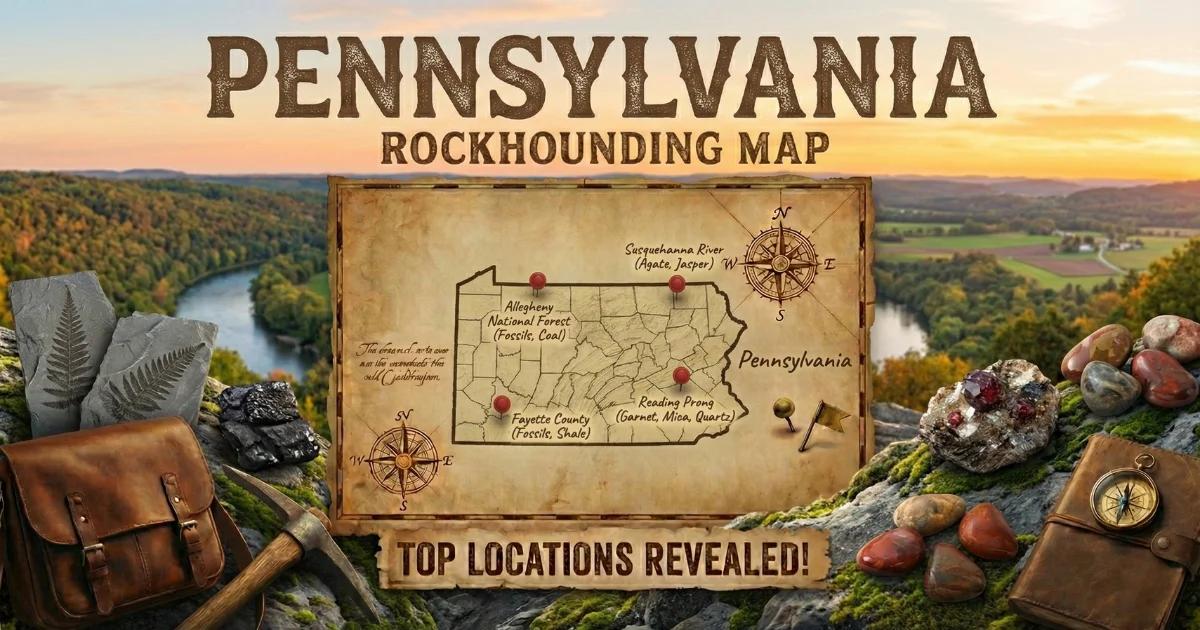
Browse our Pennsylvania rockhounding map for GPS coordinates and additional collecting locations.