
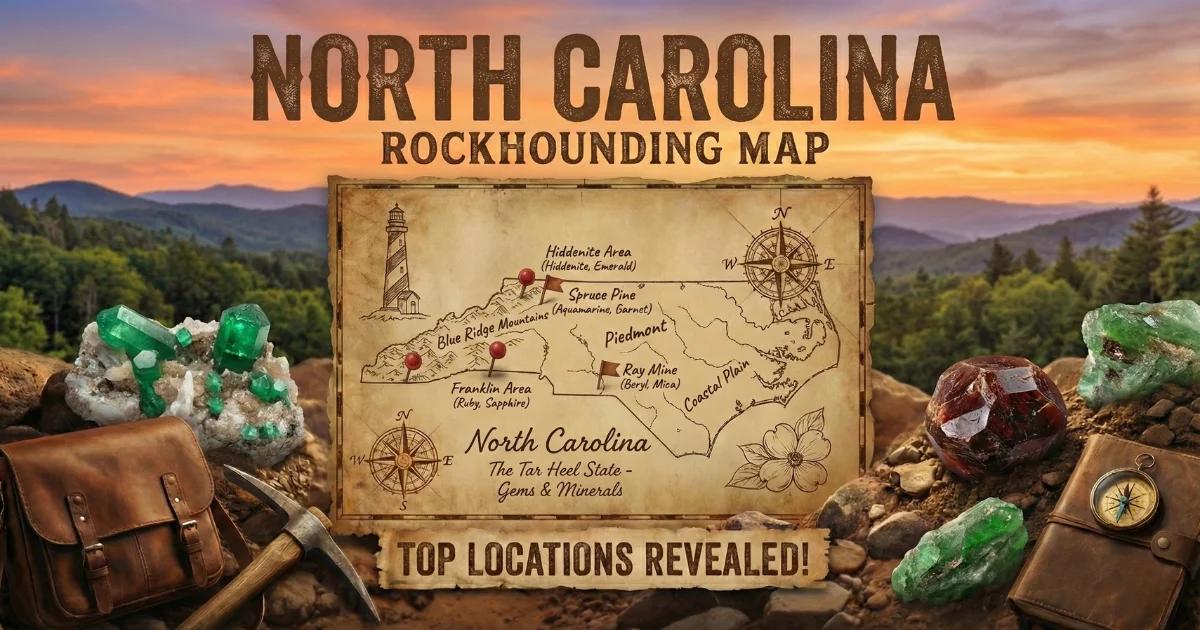
North Carolina's Crystal-Producing Geology
North Carolina spans three distinct geological provinces, each with different collecting potential. The Coastal Plain in the east is flat, young, and composed of unconsolidated sediments — it produces almost nothing for the crystal hunter. The Piedmont in the central part of the state is built from metamorphosed volcanic and sedimentary rocks, cut by granitic intrusions, and hosts the Carolina Slate Belt — a band of low-grade metamorphic rocks with occasional quartz-lined vugs. The Blue Ridge Mountains in the west contain the oldest and most complex geology: high-grade metamorphic rocks, pegmatite dikes, and the eroded roots of ancient mountain chains stretching back over a billion years.
North Carolina does not produce classical hollow geodes in significant numbers. What the state does produce — and produces well — are crystal-lined pegmatite pockets, quartz veins with open vugs, and an extraordinary variety of gem minerals in alluvial and pegmatite settings. The pegmatite pockets of the Spruce Pine district and the Hiddenite area are functionally identical to geodes: hollow cavities in rock lined with well-formed crystals. The difference is the host rock (pegmatite and gneiss rather than limestone) and the crystal species (emerald, aquamarine, hiddenite, and garnets rather than the quartz and calcite found in Midwestern geodes).
The geological engine behind these deposits is repeated episodes of igneous intrusion during the Paleozoic, particularly during the Taconic and Acadian orogenies (roughly 480 to 360 million years ago). Granitic magmas intruded the metamorphic country rock, and the most volatile-rich portions of those magmas crystallized as pegmatites — coarse-grained igneous rocks with pockets where the last fluids and gases collected, allowing large, well-formed crystals to grow in open space.
Top Collecting Sites
1. Emerald Hollow Mine — Hiddenite (Alexander County)
GPS: Approximately 35.72°N, 81.10°W
Land status: Private fee-dig operation
Vehicle: 2WD — paved road access
The Emerald Hollow Mine near Hiddenite is the only emerald mine in the United States open to public fee-digging. The pegmatite veins here cut through gneiss and schist, and the crystal-lined pockets within those veins have produced emerald, hiddenite (the rare green variety of spodumene that was first identified at this locality), aquamarine, sapphire, garnet, rutile, and quartz. These pockets are true vugs — hollow cavities lined with crystals growing inward — and opening one delivers the same rush as cracking a geode.
The mine offers several collecting options: sluicing buckets of native material through a flume, digging in designated areas with hand tools, and (seasonally) creeking — collecting from the mine's creek drainage. Fees range from $15 to $30 per person depending on the activity. The mine provides basic tools and identification help. Finding a genuine emerald or hiddenite crystal is not common, but it happens regularly enough that the mine stays busy. Quartz crystals, garnet, and rutile are more frequent finds.
2. Spruce Pine Mining District (Mitchell County)
GPS: Approximately 35.92°N, 82.07°W
Land status: Mixed private mining claims and Pisgah National Forest
Vehicle: 2WD for main roads; high-clearance for mine access roads
The Spruce Pine district has been mined for industrial feldspar, mica, and quartz for over a century — the region supplies the majority of the ultra-pure quartz used in semiconductor manufacturing worldwide. The pegmatites here are massive, and the crystal pockets they contain have produced some of the largest and most well-formed quartz crystals found in the eastern United States. Some pockets have yielded quartz crystals over a foot long, along with beryl (aquamarine and golden beryl), garnet, and mica books.
Current collecting opportunities are limited because most productive pegmatites are on active mining claims. Some mine operators allow collecting on their dump piles — check with local rock shops in Spruce Pine and Little Switzerland for current access. The Pisgah National Forest surrounds the district, and personal collecting of loose surface specimens on unclaimed National Forest land is permitted. The streams draining the mining district carry pegmatite minerals in their gravel — walk the creek channels and check the cobbles.
3. Cowee Valley — Franklin Area (Macon County)
GPS: Approximately 35.22°N, 83.40°W
Land status: Multiple private fee-dig mines
Vehicle: 2WD
The Franklin area sits in the historic corundum belt of North Carolina, where erosion of corundum-bearing metamorphic rocks has concentrated rubies and sapphires in alluvial gravels. Multiple fee-dig operations offer buckets of native sapphire and ruby-bearing gravel for screening: Cherokee Ruby Mine, Mason Mountain Mine, Sheffield Mine, and others. Fees typically run $15 to $25 per bucket.
The gems here occur in alluvial gravel rather than in geode-like pockets, so the collecting method is different — you are washing and screening gravel through a sluice rather than cracking open rocks. But the thrill of finding a ruby or sapphire in your screen is comparable. Star rubies are the classic find at the Cherokee Ruby Mine. Most specimens are small (under 1 carat rough), but larger stones are found regularly. Some mines supplement their native material with enriched buckets — ask whether you are screening native or enriched gravel before paying.
4. Crowders Mountain Area (Gaston County)
GPS: Approximately 35.21°N, 81.29°W
Land status: Crowders Mountain State Park (limited collecting); surrounding streams on private land
Vehicle: 2WD
The Carolina Slate Belt in the central Piedmont contains low-grade metamorphic volcanic rocks — the remnants of an ancient volcanic arc. These rocks occasionally contain quartz-filled vugs and small geodes, making this one of the few areas in North Carolina where you can find something that genuinely qualifies as a geode. The streams around Crowders Mountain and Kings Mountain carry small quartz geodes (1 to 3 inches) in their gravel, eroded from the surrounding volcanic rocks. The state park has specific rules about collecting — check with park staff before removing any specimens. Streams outside the park boundary on private land may be accessible with landowner permission.
5. Graves Mountain (Lincoln County, Georgia border area)
GPS: Approximately 33.72°N, 82.51°W (just across the Georgia line)
Land status: Private — organized digs only (typically two weekends per year)
Vehicle: 2WD
Graves Mountain is technically in Georgia but is close enough to the North Carolina border that many North Carolina collectors visit. The mountain is a metamorphosed pyrite deposit that produces lazulite, rutile, pyrophyllite, kyanite, iridescent hematite, and quartz crystals in vugs. The landowner opens the site for organized public collecting typically two weekends per year (spring and fall). Hundreds of collectors attend each dig. The crystal-lined vugs in the metamorphic rock deliver a geode-like collecting experience. Check with the local mineral clubs (Lynchburg Rock Raiders, Georgia Mineral Society) for dig dates.
Specimens You Can Expect to Find
| Specimen | Crystal Content | Typical Size | Where Found |
|---|---|---|---|
| Pegmatite Crystal Pocket | Quartz, feldspar, beryl, garnet, mica in open cavity | 2 - 12+ inches | Spruce Pine, Hiddenite |
| Emerald/Hiddenite Crystal | Green beryl (emerald) or green spodumene (hiddenite) | Under 1 inch (typically) | Emerald Hollow Mine |
| Ruby/Sapphire (alluvial) | Corundum — red (ruby), blue/gray/white (sapphire) | Under 1 carat rough (typically) | Cowee Valley fee-dig mines |
| Quartz Geode (Piedmont) | Druzy quartz lining in volcanic host rock | 1 - 3 inches | Crowders Mountain area, Carolina Slate Belt |
| Quartz Crystal (pegmatite) | Clear to smoky quartz points and clusters | 1 - 12+ inches | Spruce Pine district mine dumps |
Recommended Tools and Gear
- Sluice screen and trowel: For fee-dig mines in the Franklin area. Most mines provide screens, but bringing your own ensures the mesh size you prefer.
- Rock hammer (2-3 lb): For checking vugs in Piedmont volcanic rocks and splitting pegmatite material on mine dumps.
- Cold chisels: For carefully extracting crystals from pegmatite pockets without breaking them.
- Safety glasses: Mandatory when splitting any rock. Pegmatite and metamorphic rock throw sharp fragments.
- Spray bottle: Wet minerals in the field to check color, clarity, and crystal form.
- Small containers and cotton: Gem-quality crystals need careful packing. Bring pill bottles or small boxes lined with cotton for delicate specimens.
- Rubber boots: For creek collecting in the Piedmont and mountain streams.
- Magnifying loupe (10x): Small gem crystals require magnification for proper evaluation. Essential at fee-dig mines.
- Sunscreen and bug spray: North Carolina summers are hot and humid. Ticks are a significant hazard in wooded collecting areas from April through October.
Legal Rules and Access
Fee-Dig Mines: Private operations with their own rules. Fees, hours, and tool restrictions vary by mine. Call ahead to confirm operating dates — some are seasonal. Everything you find at a fee-dig mine is yours to keep.
Pisgah and Nantahala National Forests: Personal collecting of rocks, minerals, and loose surface specimens is permitted on unclaimed National Forest land. No commercial collecting without a special-use permit. Do not excavate large pits or disturb archaeological sites. Check with the local Ranger District for specific area rules.
State Parks: North Carolina state parks have varying rules on mineral collecting. Some allow limited surface collecting; others prohibit it entirely. Crowders Mountain State Park allows some collecting but with restrictions — check with park rangers before removing any material. Do not assume state parks permit collecting without verifying.
Mining Claims: The Spruce Pine district has active mining claims. Collecting on active claims without the claim holder's permission is illegal. Verify claim status before digging at any pegmatite site. Surface collecting of loose material along roads and public creek channels is generally acceptable.
Private Land: Most productive collecting sites in North Carolina are on private land. Get explicit permission before entering. The landowners in the Franklin and Spruce Pine areas are accustomed to mineral collectors and many are receptive to polite requests.
Best Season to Collect
Fee-dig mines operate year-round at lower elevations (Hiddenite, Franklin) and from approximately April through November at higher elevations (Spruce Pine area). Creek collecting is best from late summer through fall when water levels are at their lowest.
Spring and fall offer the most comfortable field conditions. Summer in the Piedmont and lower mountains is hot and humid, with afternoon thunderstorms nearly every day from June through August. Winter at higher elevations brings cold temperatures and occasional snow, but lower-elevation sites remain accessible year-round. Tick season runs from April through October — wear long pants and check thoroughly after collecting in wooded areas.
See our North Carolina rockhounding map for GPS coordinates and access details on all collecting locations.