
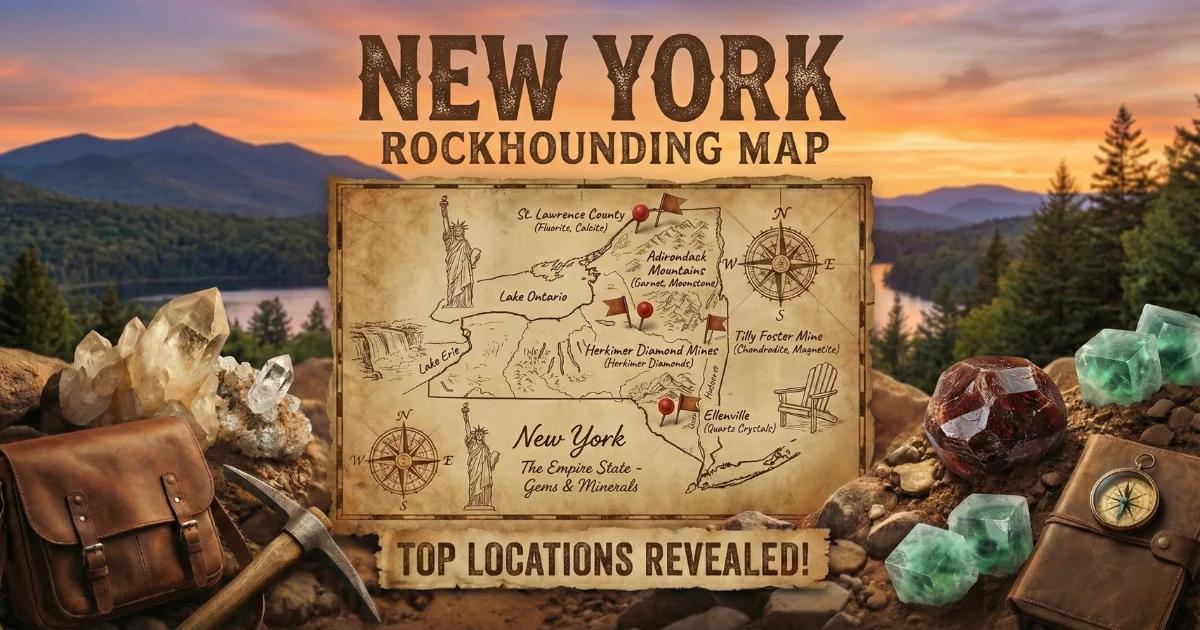
New York's Geode Geology: What the Bedrock Actually Produces
New York does not produce the classic round, hollow sedimentary geodes you find in Iowa or Indiana. The state's bedrock tells a different story. What New York delivers instead is something collectors prize just as much — and in some cases more. The Cambrian-age Little Falls Dolostone, exposed across Herkimer County, hosts vugs (small cavities) filled with doubly-terminated quartz crystals so clear they earned the name "Herkimer diamonds." These vugs are geodes by any functional definition: you crack open host rock and find crystals inside.
The geological mechanism is straightforward. Around 500 million years ago, shallow seas deposited carbonate sediments that became dolostone. As the rock lithified and underwent diagenesis, silica-rich fluids migrated through pore spaces and fractures. Where those fluids encountered voids — gas pockets, dissolution cavities, or spaces between sediment grains — quartz crystals nucleated and grew freely in all directions. The result is doubly-terminated crystals with no attachment point, floating in clay-filled pockets within the dolostone matrix.
Beyond Herkimer County, New York's geological diversity produces other crystal-bearing sites. The Ordovician and Silurian limestones and dolomites of the Hudson Valley contain calcite-lined vugs. The Adirondack metamorphic complex yields almandine garnets in gneiss pockets. The Devonian shales of western New York occasionally produce septarian nodules with calcite crystal centers. None of these are textbook geodes, but all of them put crystals in your hands.
Where to Collect: Five Producing Sites with Access Details
1. Herkimer Diamond Mines — Middleville, Herkimer County
GPS: 43.1714, -74.9803
Land status: Private fee-dig operation (open April through October)
Fee: $15–18 per person per day
This is the largest commercial Herkimer diamond operation and the site most collectors visit first. The mine exposes a long wall of Little Falls Dolostone with visible vugs at every scale. You work the rock face with hammers and chisels, splitting dolostone along natural bedding planes and joint surfaces to expose crystal pockets. Most pockets contain crystals in the 1–10 mm range, but specimens exceeding 3 cm turn up regularly. The best crystals are water-clear with sharp terminations on both ends and no matrix attachment. Some pockets contain dozens of crystals embedded in a black hydrocarbon-rich clay — a signature of Herkimer sites. The mine provides basic tools, but serious collectors bring their own crack hammers, chisels, and pry bars.
2. Ace of Diamonds Mine — Middleville, Herkimer County
GPS: 43.1748, -74.9765
Land status: Private fee-dig operation
Fee: $12–15 per person
Located near the main Herkimer Diamond Mines, Ace of Diamonds operates on the same dolostone formation but draws smaller crowds. The geology and crystal quality are identical. Some collectors prefer this site because you can work a pocket without competing for elbow room. The exposed dolostone face is smaller, but the crystal-to-effort ratio is comparable. The operation is family-run and provides a more relaxed atmosphere than the larger commercial mine.
3. Crystal Grove Diamond Mine — St. Johnsville, Herkimer County
GPS: 43.0041, -74.6700
Land status: Private fee-dig operation (seasonal, check availability)
East of Middleville, Crystal Grove operates on the same Little Falls Dolostone belt. The site offers both hard-rock mining on exposed outcrops and sluicing through pre-broken material. The sluicing option works well for younger collectors or anyone who prefers not to swing a hammer for hours. Hard-rock pockets here have produced some exceptionally large and clear Herkimer diamonds over the years.
4. Barton Garnet Mine — North Creek, Warren County
GPS: 43.6892, -73.9792
Land status: Private (tours and limited collecting sometimes available)
The Barton Mine sits on Gore Mountain in the Adirondacks, producing almandine garnets from Precambrian garnet-hornblende gneiss. These are not geodes in the traditional sense, but the garnets occur in pockets within the metamorphic rock — you break open gneiss and find dark red crystals up to several inches across. The mine has operated commercially since 1878, primarily producing industrial abrasive garnet. Collector visits and tours are offered periodically. The garnets here are among the largest almandine crystals found anywhere in the world, with individual crystals sometimes exceeding 10 cm in diameter.
5. Hudson Valley Calcite Vugs — Kingston to Rosendale, Ulster County
GPS: 41.8506, -74.0806 (general Rosendale area)
Land status: Mixed — abandoned quarries (some publicly accessible), active quarries (private, permission required)
The Ordovician and Silurian limestones and dolomites exposed in the Hudson Valley produce calcite-lined vugs and occasional small geodes. The old cement-mining quarries near Rosendale and Kingston have historically yielded excellent calcite crystal specimens — clear to honey-colored rhombohedral and scalenohedral crystals lining dissolution cavities in the limestone. Most quarries are private or restricted. The best access is through organized mineral club field trips. The Mid-Hudson Valley Gem and Mineral Society runs regular outings to productive quarry sites in this area.
Specimens You Can Expect to Find
| Specimen | Location | Typical Size | Notes |
|---|---|---|---|
| Herkimer diamond (doubly-terminated quartz) | Herkimer County fee-dig mines | 1–30 mm | Water-clear, no matrix attachment; some contain hydrocarbon inclusions |
| Druzy quartz on dolostone | Herkimer County | Vug linings 2–15 cm | Sparkling crystal carpets lining vug walls |
| Calcite crystals (rhombohedral/scalenohedral) | Hudson Valley quarries | 1–5 cm crystals | Clear to honey-colored; some with phantom growth zoning |
| Almandine garnet | Barton Mine, North Creek | 1–10+ cm | Dark red dodecahedral crystals in gneiss matrix |
| Septarian nodules | Western NY Devonian shales | 5–20 cm | Calcite crystal veins in clay-ironstone concretions |
Tools and Equipment
Herkimer diamond mining is physical work. You are hammering into solid dolostone for hours. Bring the right gear or you will have a frustrating day.
- Crack hammer (3–4 lb): Your primary tool for splitting dolostone along bedding planes. A standard rock hammer is too light for this work.
- Cold chisels (various widths): For working into cracks and prying apart layers to expose crystal pockets.
- Pry bar (18–24 inch): Essential for levering apart large dolostone slabs once you have opened a crack.
- Safety glasses: Non-negotiable. Dolostone chips fly when hammered. Wrap-around style recommended.
- Work gloves: Leather gloves protect against sharp rock edges and blisters from sustained hammering.
- Knee pads: You will spend most of your time kneeling on broken rock. Good knee pads make a significant difference in comfort.
- Containers: Egg cartons or small plastic containers with cotton padding for transporting crystals. Herkimer diamonds are hard (Mohs 7) but can chip on sharp impacts.
- Spray bottle: Water on the rock surface makes crystal pockets easier to spot — wet quartz reflects light differently than wet dolostone.
Legal Considerations and Access Rules
New York's collecting rules vary by land ownership. Fee-dig operations on private land are straightforward — pay the fee, follow the site rules, and keep what you find. Public land collecting in New York is more restricted than in western states.
- State parks: Collecting rocks, minerals, and fossils is generally prohibited in New York State Parks unless specifically posted otherwise.
- Adirondack Park: The Adirondack Park contains both public (Forest Preserve) and private land. Collecting on Forest Preserve land is prohibited. Private land within the park boundary follows normal private property rules — get landowner permission.
- Road cuts: Collecting from highway road cuts is technically on state right-of-way. Pull well off the road, stay aware of traffic, and do not excavate or damage the cut face.
- Quarries: All quarries — active or abandoned — are private property. Never enter without explicit written permission from the owner or operator.
- Mineral clubs: Joining a local mineral club (e.g., New York Mineralogical Club, Mid-Hudson Valley Gem and Mineral Society) provides access to organized quarry visits, private site permissions, and experienced collectors who know the productive spots.
Planning Your Trip
The Herkimer County fee-dig mines operate from April through October. The best collecting conditions come in late spring and early summer when snowmelt and spring rains have washed fresh material from the rock faces. Weekdays are far less crowded than weekends. Plan to spend at least a full day at a fee-dig site — it takes time to learn the rock, identify promising fracture zones, and develop a rhythm with the hammer. First-time visitors should budget two days: one to learn the technique and one to apply it productively.
For Hudson Valley calcite sites and Adirondack locations, fall is the best season. Lower water levels expose creek gravel, quarry walls are dry and stable, and the weather is comfortable for sustained outdoor work.
Browse our New York rockhounding map for all documented collecting locations across the state.