
New Hampshire Geology and Why True Geodes Are Absent
New Hampshire earned its "Granite State" nickname honestly. The bedrock across most of the state is Devonian- to Carboniferous-age granite, gneiss, and schist — hard, crystalline, igneous and metamorphic rock that was never the right host for sedimentary geode formation. Geodes in the classic sense — hollow, rounded nodules that weather out of limestone or shale — require a marine sedimentary sequence that New Hampshire simply does not have. The Paleozoic seas that deposited the Warsaw and Keokuk limestones in Iowa and Missouri never extended this far northeast.
What New Hampshire does have is pegmatite. Pegmatites are coarse-grained igneous intrusions that cool slowly deep underground, allowing crystals to grow to large sizes inside gas pockets and fluid-filled cavities. When a pegmatite vein is exposed by erosion, the pockets inside it function like natural geodes — hollow cavities lined with well-formed crystals. The White Mountains batholith and related Devonian-age plutons produced hundreds of pegmatite dikes across Grafton, Carroll, and Coos counties. These are the geological structures that crystal hunters target in New Hampshire.
Granite itself also produces vugs — small crystal-lined cavities where late-stage fluids concentrated quartz, feldspar, and mica. Conway granite, the coarse pink-gray granite that dominates the eastern White Mountains, is known for scattered vugs containing smoky quartz points. These are small (rarely more than an inch across) but occasionally produce gem-quality specimens.
Where to Find Crystal-Lined Pockets and Vugs
1. Grafton County Pegmatites (Grafton / Orange / Canaan Area)
GPS (general area): 43.81°N, 72.06°W
Land status: Mixed — private land, some White Mountain National Forest parcels
Vehicle: 2WD to trailheads; AWD for unpaved forest roads
Grafton County has been the center of New Hampshire mineral collecting for over 150 years. The pegmatite dikes here intruded into mica schist and gneiss, producing crystal-lined pockets that contain smoky quartz, feldspar (both orthoclase and albite), muscovite books, and occasional beryl (aquamarine variety in some localities). The most famous site — the Ruggles Mine near Grafton village — operated as a fee-dig destination for decades but is now permanently closed.
Surrounding the old mine, several pegmatite exposures on White Mountain National Forest land are still accessible. Creek gravel in the Smith River drainage and the headwaters of the Mascoma River contains water-worn pegmatite minerals, including smoky quartz and garnet. The collecting here is surface work — walk the gravel bars and scan for crystal faces and unusual colors.
2. Conway Granite Vugs (North Conway / Bartlett Area)
GPS (general area): 44.05°N, 71.13°W
Land status: White Mountain National Forest (personal mineral collecting generally permitted)
Vehicle: 2WD for paved roads; AWD for forest service roads
The Conway granite occupies a large area of the eastern White Mountains from North Conway north through Bartlett and Jackson. This granite contains scattered miarolitic cavities — gas pockets lined with quartz, feldspar, and occasionally fluorite. The cavities are the closest thing to geodes in New Hampshire. Most are small (half-inch to two inches), but road cuts and stream exposures occasionally reveal larger vugs with well-terminated smoky quartz crystals.
Creek gravel in the Saco River, Swift River, and Ellis River drainages is the easiest place to find quartz-bearing specimens. After spring floods, fresh material washes down from the bedrock. Look for angular quartz pieces with crystal terminations — these indicate a nearby vug source in the upstream bedrock.
3. Franconia / Sugar Hill Area (Grafton County)
GPS (general area): 44.17°N, 71.75°W
Land status: White Mountain National Forest and private
Vehicle: 2WD for main roads; AWD for seasonal forest roads
The Franconia Range sits over granitic bedrock intruded by pegmatite dikes. Some old quarry sites and road cuts in the Sugar Hill and Easton areas have exposed pegmatite pockets with smoky quartz, mica, and feldspar. The Gale River and Ham Branch drainages contain water-worn pegmatite minerals in their gravel. This area is less well known than Grafton, so competition is lighter.
4. Acworth / Lempster Area (Sullivan County)
GPS (general area): 43.22°N, 72.28°W
Land status: Mostly private; some town forest land
Vehicle: 2WD
The Acworth area contains pegmatite dikes that have produced beryl, garnet, and smoky quartz. Several old mica mines in the area exposed crystal pockets during historical operations. While the mines themselves are on private land, the surrounding creek drainages contain eroded pegmatite minerals. Ask landowners before crossing property boundaries — many are willing to grant access if asked politely.
Specimens You Can Expect
| Mineral | Where Found | Typical Size | Notes |
|---|---|---|---|
| Smoky quartz | Pegmatite pockets, granite vugs | 0.5–4 inches | Most common crystal; ranges from pale gray to nearly black |
| Feldspar (orthoclase/albite) | Pegmatite pockets | 1–6 inches | Often twinned; blocky white to pink crystals |
| Muscovite mica | Pegmatite dikes | 1–8 inch books | Silvery sheets; historically mined for window glass |
| Beryl | Grafton and Sullivan County pegmatites | 0.5–3 inches | Green to blue-green (aquamarine); uncommon but present |
| Garnet (almandine) | Schist and pegmatite contacts | 0.25–1 inch | Dark red dodecahedral crystals; common in creek gravel |
| Fluorite | Conway granite vugs | Under 0.5 inch | Rare; green or purple cubes in miarolitic cavities |
How to Identify Pegmatite Pockets in the Field
Pegmatite dikes stand out from the surrounding metamorphic country rock because of their coarse grain size. A typical pegmatite vein in New Hampshire is a few inches to several feet wide, with visible crystals of quartz, feldspar, and mica. The contact between the pegmatite and the host schist or gneiss is usually sharp.
Crystal pockets occur where the pegmatite texture becomes especially coarse and open. Look for zones where the rock transitions from solid intergrown crystals to open cavities with crystal faces pointing inward. The walls of the pocket will show well-formed crystal terminations rather than the irregular broken surfaces of massive pegmatite.
In creek gravel, pegmatite-derived material is angular to sub-rounded and distinctly coarser-grained than the surrounding metamorphic fragments. Smoky quartz with flat crystal faces is the best indicator — it tells you a pocket source is somewhere upstream.
Tools and Gear
- Rock hammer (2–3 lb): For breaking along cracks in exposed pegmatite
- Cold chisel set: For working crystal pockets without damaging specimens
- Safety glasses: Mandatory when hammering — quartz splinters are razor-sharp
- 5-gallon bucket: For carrying specimens from creek collecting
- Newspaper or bubble wrap: For wrapping crystal specimens
- Hand lens (10x): For identifying small crystals in vugs
- GPS or phone with offline maps: Cell coverage is spotty in the White Mountains
- Sturdy boots: Creek walking on wet granite is slippery
Legal and Access Notes
- White Mountain National Forest: Personal mineral collecting (non-commercial, reasonable quantities) is generally permitted on National Forest land. Power tools, explosives, and heavy equipment are not allowed. Check with the local Ranger District office for any area-specific closures.
- Private land: Most productive pegmatite exposures in Grafton County are on private property. Always get permission. Do not assume an unmarked area is public.
- State parks and protected areas: Collecting is prohibited in New Hampshire state parks, state forests managed for conservation, and Franconia Notch State Park.
- Best season: June through October. Mountain roads and forest service roads close during winter and mud season (April–May). Summer weekdays are the least crowded.
Nearby Alternatives Worth the Drive
If crystal-lined geodes and pockets are your primary goal, New Hampshire is honest but limited territory. Two nearby states offer significantly better collecting. Maine's Oxford County pegmatites — about 90 minutes east — produce tourmaline, beryl, and large crystal pockets at fee-dig mines like Mount Mica and Perham's. New York's Herkimer Diamond Mines — about four hours west — offer guaranteed doubly-terminated quartz crystals in dolostone vugs. Both are worth a day trip if your New Hampshire collecting comes up short.
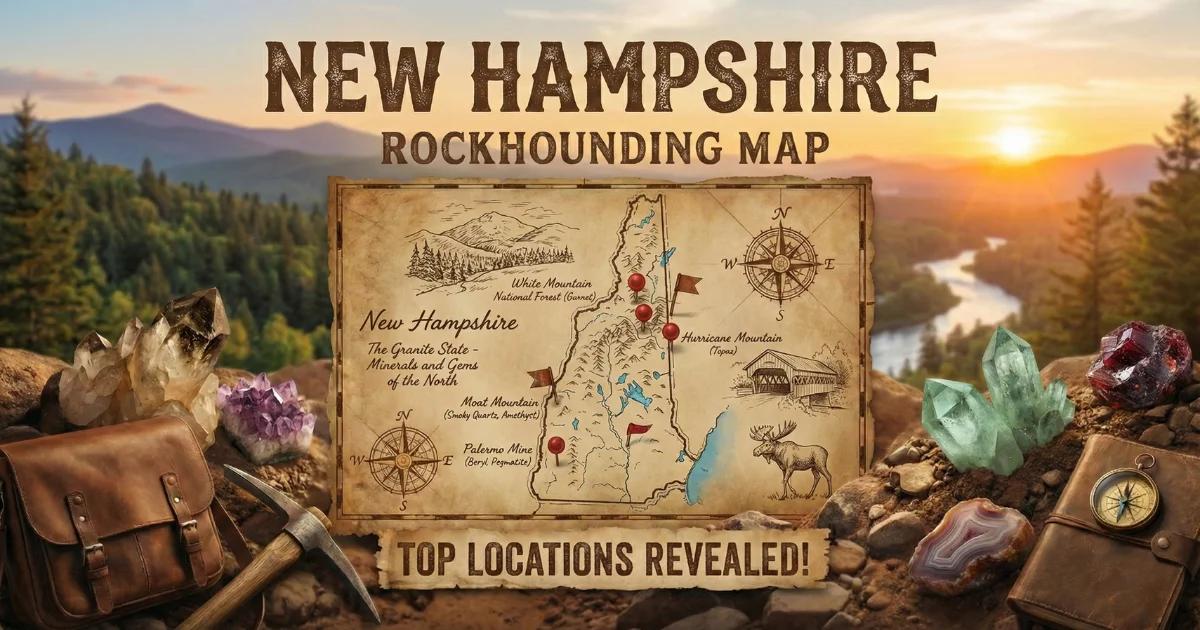
See our New Hampshire rockhounding map for GPS coordinates and more collecting locations.