
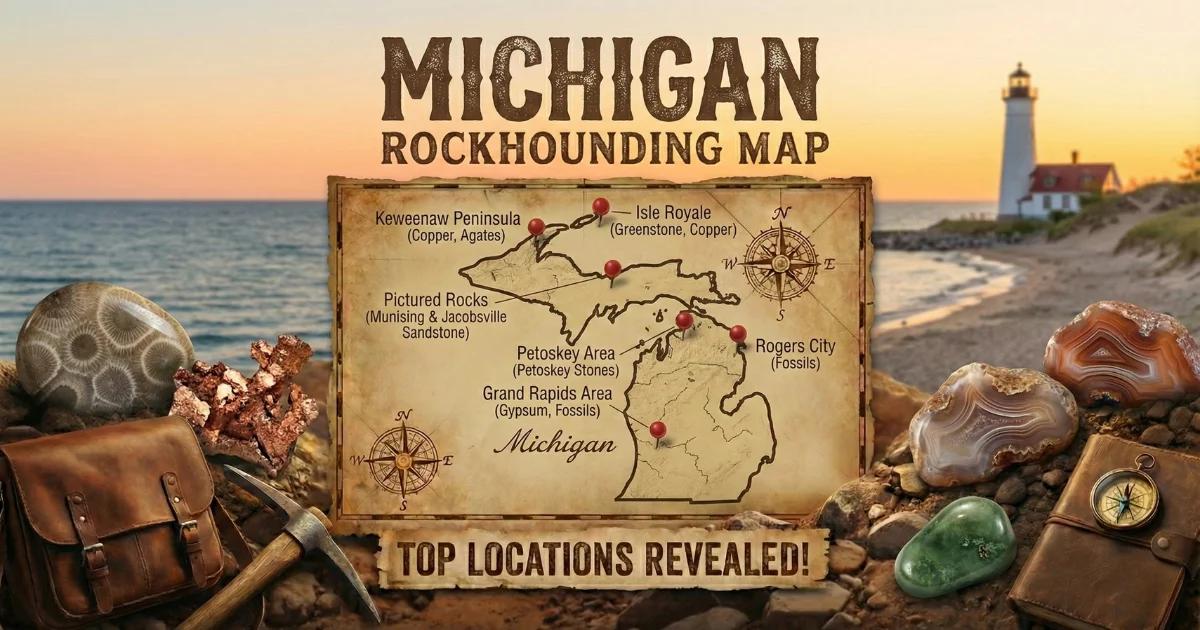
Michigan's Geological Background
Michigan is not a classic geode state. The Lower Peninsula sits on a basin of Paleozoic sedimentary rock — limestones, dolomites, shales, and evaporites — that does not produce the hollow crystal-lined spheres found in the Warsaw Formation of the Midwest. The Upper Peninsula is a different geological province entirely, built from Precambrian igneous and metamorphic rocks that are among the oldest exposed rocks on the continent, ranging from 1.1 to 2.7 billion years old.
What Michigan does produce are crystal-lined vugs in ancient basalt, Lake Superior agates that formed in gas vesicles of Precambrian lava flows, and Petoskey stones — fossilized colonial corals from the Devonian Period. None of these are classical geodes in the strict geological definition, but the collecting experience — finding a round stone, cracking it open or wetting it to reveal hidden crystal structure — is the same thrill that draws people to geode hunting.
The key geological event behind Michigan's best collectible stones is the Midcontinent Rift, a 1.1-billion-year-old failed continental rift that produced massive basalt flows across the Lake Superior region. Those basalt flows contained gas vesicles that were later filled with native copper, calcite, prehnite, and banded chalcedony (agate). The Pleistocene glaciers then ripped those nodules out of the bedrock and scattered them across the landscape, which is why you can find Lake Superior agates on beaches, in farm fields, and in gravel pits hundreds of miles from the original source rock.
Top Collecting Sites
1. Petoskey and Charlevoix Beaches (Emmet and Charlevoix Counties)
GPS: Approximately 45.38°N, 84.95°W (Petoskey State Park beach)
Land status: Public Great Lakes beaches; Petoskey State Park (collecting permitted)
Vehicle: 2WD — paved road access to all beach parking areas
Michigan's official state stone is the Petoskey stone, a fossilized colonial coral (Hexagonaria percarinata) from Devonian-age limestone roughly 350 million years old. When dry, these stones look like ordinary gray-brown rocks. Wet them with lake water or a spray bottle and the hexagonal coral pattern jumps out — a distinctive honeycomb of fossilized coral polyps.
The best beaches for Petoskey stones are along the Lake Michigan shoreline between Petoskey and Charlevoix. Petoskey State Park, Magnus City Park Beach, and the beaches along M-119 (the "Tunnel of Trees" road) are reliable producers. The stones are concentrated in the gravel and cobble zones of the beach. Walk slowly, spray as you go, and look for the distinctive pattern. After storms or spring ice breakup, fresh material washes onto shore. Early morning collecting, before other hunters have worked the beach, is most productive.
2. Grand Marais and Whitefish Point (Alger and Chippewa Counties)
GPS: Approximately 46.67°N, 85.98°W (Grand Marais beach)
Land status: Public Great Lakes beaches; Pictured Rocks National Lakeshore (collecting prohibited within park boundaries)
Vehicle: 2WD for town beaches; some seasonal roads to remote beaches
The Lake Superior shoreline of the Upper Peninsula is the primary collecting ground for Lake Superior agates. These banded chalcedony nodules formed in vesicles of Precambrian basalt over a billion years ago and were transported by glacial action across the entire Lake Superior basin. The agates range from thumbnail-sized pebbles to rare fist-sized specimens. The banding is typically red, orange, and white — iron oxide staining gives them their characteristic warm colors.
Grand Marais, Whitefish Point, and the beaches east of Munising produce agates regularly. The catch: you are scanning thousands of cobbles for one agate. Wet scanning is essential — carry a spray bottle and systematically wet sections of beach gravel. After major storms, wave action churns up fresh material from the lake bottom. Collecting is legal on public Great Lakes beaches below the ordinary high-water mark. Do not collect within Pictured Rocks National Lakeshore boundaries.
3. Keweenaw Peninsula (Keweenaw and Houghton Counties)
GPS: Approximately 47.25°N, 88.40°W (Copper Harbor area)
Land status: Mixed state land, private, and some public beach access
Vehicle: 2WD for main roads; high-clearance for mine dump access roads
The Keweenaw Peninsula is the heart of Michigan's native copper country. The Portage Lake Volcanics — a thick sequence of Precambrian basalt flows — contain vesicles filled with native copper, silver, calcite, epidote, prehnite, datolite, and other minerals. These crystal-lined cavities in basalt are the closest thing to true geodes that Michigan produces. Some vesicles are several inches across with well-formed crystal clusters growing inward from the cavity walls.
The historic copper mine dumps scattered across the Keweenaw contain waste rock with crystal-lined vugs. The Cliff Mine dump, Delaware Mine (which offers underground tours and surface collecting for a fee), and numerous roadside exposures produce specimens. Beach cobbles along the Keweenaw shoreline occasionally contain copper-bearing vugs. The mineral variety here is world-class — more than 30 mineral species have been documented from these basalt flows.
4. Gravel Pits and Farm Fields (Lower Peninsula)
GPS: Varies — scattered across the northern Lower Peninsula
Land status: Private (permission required)
Vehicle: 2WD
Glacial deposits throughout the northern Lower Peninsula contain transported Lake Superior agates, Petoskey stones, and other collectible cobbles. Active and abandoned gravel pits are the best access points. The glacial till was carried south from the Lake Superior basin and deposited across northern Michigan. Ask gravel pit operators for permission to collect — many allow it during non-operating hours. After spring plowing, farm fields in the northern Lower Peninsula occasionally expose agates and fossils. Permission from the landowner is required.
Specimens You Can Expect to Find
| Specimen | Interior/Pattern | Typical Size | Where Found |
|---|---|---|---|
| Petoskey Stone | Hexagonal fossilized coral pattern (solid) | 1 - 6 inches | Lake Michigan beaches, Petoskey to Charlevoix |
| Lake Superior Agate | Banded chalcedony — red, orange, white | 0.5 - 3 inches | Lake Superior beaches, gravel pits |
| Copper-bearing Vug | Native copper, calcite, prehnite, datolite crystals | 1 - 4 inches | Keweenaw Peninsula mine dumps |
| Basalt Amygdule | Chlorite, epidote, quartz, pumpellyite fill | 0.5 - 2 inches | Upper Peninsula basalt exposures |
| Charlevoix Stone | Fossilized Favosites coral (smaller pattern than Petoskey) | 1 - 4 inches | Lake Michigan beaches near Charlevoix |
Recommended Tools and Gear
- Spray bottle: The single most important tool for Michigan collecting. Petoskey stones and agates are nearly invisible when dry. Wet them constantly as you scan.
- Knee pads: Beach collecting means hours on your knees sorting through gravel. Protect them.
- Rock hammer (2 lb): For checking vugs in Keweenaw mine dump material.
- Safety glasses: Mandatory when splitting basalt on mine dumps.
- Mesh collecting bag: Lets water drain as you collect from the beach. Easier than buckets for beach work.
- Polarized sunglasses: Reduce surface glare on wet cobbles, making patterns easier to spot.
- Bug spray: Upper Peninsula blackflies and mosquitoes from May through July are aggressive. Bring head nets for serious protection.
- Towel: For drying and examining specimens in the field.
Legal Rules and Access
Great Lakes Beaches: Collecting rocks, minerals, and fossils is legal on public Great Lakes beaches in Michigan. Collect below the ordinary high-water mark. Do not collect from bluffs, dunes, or posted private property.
State Parks: Michigan allows rock and fossil collecting in most state parks, though some parks have specific restrictions. Check with park staff before collecting. Petoskey State Park explicitly permits Petoskey stone collecting from the beach.
National Lakeshore: Collecting is prohibited within Pictured Rocks National Lakeshore and Sleeping Bear Dunes National Lakeshore boundaries. Federal law applies — removing rocks, minerals, or fossils from National Park Service lands carries significant fines.
Mine Dumps: Most Keweenaw mine dumps are on private land. Some offer fee-based collecting (like the Delaware Mine). Others are on land owned by mining companies or private individuals. Do not assume old mine dumps are abandoned or public — check land ownership before collecting.
Private Land: Always obtain permission before entering private property, gravel pits, or farm fields. Trespassing is a misdemeanor in Michigan.
Best Season to Collect
Beach collecting is best in spring after ice breakup (late April through May) and in fall after autumn storms (October through November). These weather events churn up fresh material and deposit it on the beaches. Summer collecting works too, but you will be competing with heavier tourist traffic on popular beaches.
The Keweenaw Peninsula is best visited from June through September when roads are clear and mine dump access is reliable. Winter in the UP brings heavy snow and sub-zero temperatures that make outdoor collecting impractical.
Browse our Michigan rockhounding map for GPS coordinates and access details on all collecting locations.