
Why Massachusetts Does Not Produce True Geodes
If you are searching for geodes in Massachusetts, you need to understand what is and is not geologically possible here. Classical geodes — hollow, crystal-lined spheres weathering out of sedimentary or volcanic host rock — require specific formation conditions that Massachusetts does not have.
Geodes form in two main ways. Sedimentary geodes (like the famous Keokuk geodes of Iowa) develop when mineral-rich groundwater fills cavities in Mississippian-age limestone over millions of years. Volcanic geodes form when gas bubbles in basalt or rhyolite flows fill with silica, zeolites, or calcite. Massachusetts has neither accessible Mississippian limestone nor thick sequences of gas-rich volcanic flows.
What Massachusetts does have is complex. The western third of the state is built on folded and metamorphosed Paleozoic rocks — schist, gneiss, marble, and quartzite — that form the southern end of the Berkshire Mountains. The Connecticut River Valley running through the center contains Triassic-Jurassic rift basin sediments and basalt flows. Eastern Massachusetts is dominated by igneous intrusions (granite, diorite) overlain by glacial till deposited during the last ice age roughly 15,000 years ago.
This geology produces quartz veins with occasional crystal-lined vugs, pegmatite pockets with well-formed crystals, and glacially transported stones from all over New England. None of these are geodes in the strict sense, but some deliver the same collecting experience — breaking open rock to find crystals inside.
What to Look For Instead
Massachusetts mineral collecting centers on three types of specimens that approximate the geode-hunting experience:
Quartz vugs in metamorphic rock. When metamorphic rocks are folded and faulted, open spaces form along fractures and fold hinges. Silica-rich fluids migrate into these voids and deposit quartz crystals on the cavity walls. The result is a vug — an irregularly shaped pocket lined with crystal points. These occur throughout the Berkshire schists and gneisses in western Massachusetts. They are smaller than most geodes (typically 1-4 inches across) and irregular in shape, but the crystals can be sharp and glassy.
Calcite pockets in marble. The marble belt running through Berkshire County (the same formation that extends into Vermont) contains solution cavities lined with calcite crystals. These formed when slightly acidic groundwater dissolved portions of the marble, then conditions changed and calcite recrystallized on cavity walls. Specimens are uncommon but well-formed when found.
Glacially transported stones. The Laurentide Ice Sheet scraped across all of New England and deposited a jumbled mix of rocks from Maine to Canada across Massachusetts. Beach gravel on Cape Cod, river gravel in the Connecticut Valley, and glacial till throughout the state can contain agate, jasper, quartz, and occasionally crystal-bearing stones carried from distant formations. You will not find geodes this way, but you will find interesting rocks.
Collecting Locations
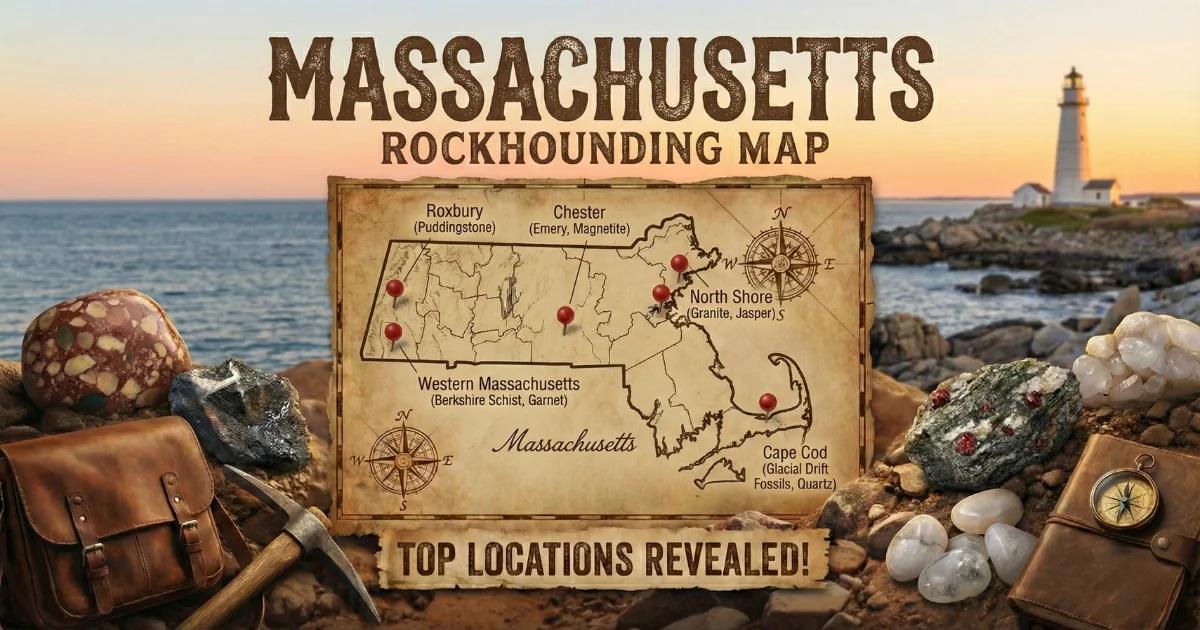
1. Chester Emery Mine Area — Hampden County
GPS: 42.2850°N, 72.9700°W (general area)
Land status: Mixed public/private — verify boundaries before collecting
Vehicle: 2WD to trailhead; short hike required
The Chester emery deposits sit in the Berkshire foothills along Route 20. The emery here is a natural mixture of corundum and magnetite that formed during regional metamorphism of aluminum-rich sediments. The deposit was commercially mined in the 1800s.
For crystal hunters, the interest is the surrounding metamorphic terrain. Quartz veins cut through the schist and gneiss, and small crystal vugs occur where veins intersect fracture zones. You are not going to find geodes, but you may find quartz crystals to 1 inch in length growing into open vugs. Garnet crystals (almandine) also occur in the schist as loose, well-formed dodecahedrons weathering out of the matrix.
Stay on public land and road cuts. Much of the surrounding area is private. The old mine workings themselves are on private property.
2. Cape Cod National Seashore Beaches — Barnstable County
GPS: 41.8600°N, 69.9700°W (Coast Guard Beach area)
Land status: National Seashore — collecting restrictions apply
Vehicle: 2WD to parking areas
Cape Cod is a glacial deposit. The entire peninsula is made of sand, gravel, cobbles, and boulders dropped by retreating glaciers. This means the beach gravel is a random sample of bedrock from across New England and eastern Canada.
Walk the wrack line after a nor'easter or strong storm. Wave action exposes fresh material from the glacial bluffs. You will find granite, gneiss, schist, basalt, quartzite, and occasionally agate and jasper among the cobbles. Quartz pebbles with visible crystal faces are uncommon but present. No geodes will be found here, but it is a good place to practice rock identification.
Important: Cape Cod National Seashore prohibits removing natural materials. Collect on town beaches outside the National Seashore boundaries. Nauset Beach (Orleans) and Marconi Beach (Wellfleet) town sections allow casual beachcombing. Check local regulations before pocketing anything.
3. Berkshire County Quarries — Western Massachusetts
GPS: 42.6400°N, 73.1900°W (general Berkshire marble belt)
Land status: Private quarry operations — permission required
Vehicle: 2WD
The marble and limestone quarries scattered through Berkshire County have produced calcite crystal specimens from vugs within the marble. The marble here is Ordovician-age Stockbridge Marble, the same formation quarried more extensively in Vermont. Calcite crystals in vugs range from small, transparent rhombohedrons to larger, cloudy masses.
Active quarries do not allow public collecting without explicit permission from the operator. Abandoned quarries may be accessible but are often on private land. Contact the Berkshire Museum in Pittsfield or the Springfield Mineralogical Society for information about organized field trips to accessible sites.
4. Connecticut River Valley Road Cuts — Hampshire/Franklin Counties
GPS: 42.3500°N, 72.6300°W (general area around Holyoke Range)
Land status: Public road cuts and state land
Vehicle: 2WD
The Connecticut Valley in Massachusetts contains the same Triassic-Jurassic rift basin geology found in Connecticut. Basalt flows (trap rock) in the Holyoke Range and Mount Tom area contain gas vesicles that were filled by zeolites, prehnite, and calcite during burial and hydrothermal alteration. These zeolite-filled cavities are the closest thing to volcanic geodes that Massachusetts offers.
Road cuts along Routes 116 and 47 near the Holyoke Range expose trap rock with visible vesicles. Most are filled solid, but occasional specimens show well-formed zeolite crystals (stilbite, heulandite) in partially open cavities. Collect only from loose material at the base of road cuts — do not hammer on rock faces along active roadways.
Specimens You May Find
| Specimen | Where Found | Notes |
|---|---|---|
| Quartz crystals (vugs) | Berkshire metamorphics, Chester area | Small, clear to milky points in schist fractures |
| Calcite crystals | Berkshire marble quarries | Rhombohedral crystals in marble solution cavities |
| Almandine garnet | Western MA schists | Dark red dodecahedrons, often weathered free of matrix |
| Zeolites (stilbite, heulandite) | Connecticut Valley trap rock | White to pink crystal clusters in basalt vesicles |
| Prehnite | Connecticut Valley trap rock | Pale green botryoidal masses in basalt cavities |
| Agate/jasper pebbles | Cape Cod beaches, river gravels | Glacially transported, small, tumble-grade |
| Emery | Chester, Hampden County | Dark, heavy masses of corundum + magnetite |
Field Identification Tips
Vugs vs. geodes: A vug is an irregularly shaped cavity in solid rock, lined with crystals. A geode is a rounded, self-contained hollow sphere that can be separated from the host rock. Massachusetts produces vugs, not geodes. If you find a round, hollow stone in Massachusetts, it was almost certainly transported here by glaciers from somewhere else.
Testing quartz vs. calcite: Both form crystals in vugs. Quartz is harder (Mohs 7) and will scratch glass. Calcite is softer (Mohs 3) and fizzes with dilute hydrochloric acid. Quartz crystals are six-sided prisms with pointed terminations. Calcite forms rhombohedrons or scalenohedral ("dogtooth") shapes.
Identifying zeolites: Zeolite crystals in trap rock vesicles are typically white, pearly, and soft (Mohs 3.5-5). Stilbite forms bow-tie shaped crystal clusters. Heulandite forms coffin-shaped tabular crystals. Both break easily — collect carefully.
Glacial erratics: Any unusual stone sitting on top of different bedrock is likely a glacial erratic. Massachusetts is full of them. The rock could have originated anywhere from central Maine to Hudson Bay. Do not assume a rounded stone is a geode — shake it. True geodes sometimes rattle if loose crystals are inside, but most Massachusetts round stones are solid granite cobbles.
Recommended Tools
- Rock hammer (16 oz) — for breaking quartz veins and freeing vug specimens
- Cold chisels (1/2" and 3/4") — for extracting crystals from tight vugs without damage
- Safety glasses — mandatory when hammering any rock
- Hand lens (10x) — for identifying small crystals in vugs and vesicles
- Newspaper and egg cartons — for wrapping delicate crystal specimens
- Dilute HCl (10%) — for testing calcite vs. quartz in the field
- GPS device or phone app — for marking productive vug locations
- 5-gallon bucket — for carrying beach stones and gravel specimens
Legal Notes
State Parks: Massachusetts state parks generally prohibit removing rocks, minerals, and natural materials. Check with individual park offices before collecting.
National Seashore: Cape Cod National Seashore prohibits all collecting of natural materials. Collect only on town-managed beaches outside the National Seashore boundary.
Private Land: Most quarries and mine sites in Massachusetts are on private property. Get written permission before entering. Trespassing is a misdemeanor.
Road Cuts: Collecting from road cuts on state highways is generally tolerated for personal use if you do not obstruct traffic or create a safety hazard. Pull completely off the roadway and work only on loose material at the base of cuts.
National Forest: There is no National Forest in Massachusetts. The closest is Green Mountain National Forest in Vermont, which allows limited personal collecting of minerals.
Better Options Nearby
If you specifically want geodes or high-quality crystal collecting, Massachusetts is not the state for it. These nearby destinations deliver much better results:
- Herkimer Diamond Mines, New York — 3 hours west. Fee-dig quartz crystal mines in Cambrian dolostone. Double-terminated "Herkimer diamonds" are world-class specimens.
- Oxford County, Maine — 3-4 hours north. Pegmatite crystal pockets with tourmaline, beryl, and quartz. Some of the best crystal collecting in the eastern US.
- Portland, Connecticut — 1.5 hours south. Pegmatite vugs with garnet, beryl, and tourmaline. Historic collecting area.
- Keokuk, Iowa — If you want real geodes, the nearest productive geode field is in the Midwest. Plan a dedicated trip.
Browse all documented collecting locations on our interactive Massachusetts rockhounding map.