
Why Hawaii Does Not Have Geodes
If you search "geodes in Hawaii," you need to understand what you are working with geologically. The Hawaiian Islands are young shield volcanoes built entirely from basaltic lava flows — the Big Island's Kilauea and Mauna Loa are still actively adding material. The oldest rocks on the main islands are roughly 5 million years old (Kauai), and the Big Island's rocks are less than 700,000 years old. Geologically, that is yesterday.
Classic geodes form in sedimentary rock — typically Mississippian-age limestone or shale — where silica-rich groundwater fills cavities over tens of millions of years, depositing concentric layers of chalcedony and quartz. Hawaii has no sedimentary bedrock, no limestone formations, no shale, and no history of the marine carbonate deposition that produces geodes elsewhere. The rock is basalt, top to bottom.
Basalt does contain gas vesicles — holes left by volcanic gases trapped in the cooling lava. In older volcanic terrains (like the Columbia River Basalt in Oregon or the Deccan Traps in India), these vesicles fill with zeolite minerals, chalcedony, or quartz over millions of years, producing what geologists call amygdules. Hawaiian basalt is too young and too iron-rich for significant secondary mineral deposition in its vesicles. Some zeolite minerals (analcime, chabazite, phillipsite) occur in vesicles on older flows, but they are small, uncommon, and not what most collectors picture when they think "geode."
What Hawaii Does Offer Mineral Collectors
1. Olivine (Peridot) — Papakolea Beach, Big Island
GPS: 18.93°N, 155.63°W
Land status: State-managed shoreline within Ka Lae (South Point) area
Vehicle: 2WD to the trailhead parking; 3-mile round-trip hike to the beach
Papakolea Beach (Green Sand Beach) near South Point on the Big Island is one of four green sand beaches on Earth. The green color comes from olivine — a magnesium-iron silicate (the gem variety is peridot) — that weathers out of a littoral cone (Pu'u Mahana) composed of basalt rich in olivine crystals. Wave action concentrates the dense, resistant olivine grains while washing away the lighter basalt fragments.
Individual olivine crystals are visible in the sand as small (1–3 mm) translucent green grains. Larger crystals (up to 5–8 mm) can occasionally be found, though most gem-quality Hawaiian peridot comes from xenoliths (chunks of mantle rock) carried to the surface by lava, not from beach sand.
Collecting status: Removing sand or rocks from Papakolea Beach is discouraged and potentially illegal under Hawaii state law. The beach is culturally significant and ecologically sensitive. You can observe and photograph, but removing material may result in fines and is considered disrespectful to the land and its Native Hawaiian stewards.
2. Zeolites in Basalt Vesicles — Various Locations
GPS (example — North Shore, Oahu): 21.57°N, 158.10°W
Land status: Varies — coastal exposures, road cuts, private land
Vehicle: 2WD
Zeolite minerals form in the vesicles of older Hawaiian basalt flows (generally flows older than 1 million years). On Oahu, where the Waianae and Koolau volcanoes are 2.5 to 3.5 million years old, zeolites are more common than on the younger Big Island. The minerals occur as small crystal clusters lining gas vesicles in exposed basalt — road cuts, coastal cliffs, and stream-cut valleys occasionally expose them.
The most commonly reported Hawaiian zeolites are analcime (white trapezohedral crystals), chabazite (rhombohedral, sometimes pinkish), and phillipsite (elongated prismatic). The crystals are typically small — under 5 mm — and require a hand lens to appreciate. They are the closest thing to "geode minerals" that Hawaii produces, but you would need to be a dedicated micromount collector to find them satisfying.
Most zeolite-bearing exposures on Oahu are on private land or within protected watershed areas. Collecting opportunities are limited.
3. Volcanic Glass — Pele's Hair and Pele's Tears
GPS (general area — Kilauea): 19.42°N, 155.29°W
Land status: Hawaii Volcanoes National Park (collecting strictly prohibited)
Vehicle: 2WD to park access roads
During active eruptions, Kilauea and Mauna Loa produce two distinctive forms of volcanic glass. Pele's hair consists of thin glass filaments (sometimes over a foot long) formed when lava spray is drawn into threads by the wind. Pele's tears are small (3–12 mm) glass droplets formed from individual lava spatters that cool in flight. Both are named for Pele, the Hawaiian goddess of fire and volcanoes.
These specimens accumulate downwind of active vents and lava fountains. They are fragile — Pele's hair is thinner than human hair in many cases — and must be handled carefully.
Collecting status: Collecting any rock, mineral, sand, or lava from Hawaii Volcanoes National Park is a federal crime under 36 CFR 2.1. This is strictly enforced. Pele's hair and tears found outside park boundaries (on private land, with permission) are legal to collect, but they are uncommon away from active vent areas.
4. Beach Minerals and Coral — Statewide
Land status: Public shoreline (all Hawaiian beaches are public below the high-water mark)
Vehicle: 2WD
Hawaiian beaches produce a variety of visually interesting natural materials: wave-rounded basalt cobbles, black sand (pulverized basalt), coral fragments, shell material, and occasional sea glass. None of these are geodes or traditional mineral collecting targets, but they provide an introduction to volcanic and marine geology.
Black sand beaches (like Punalu'u on the Big Island) are composed of fine basalt glass fragments created by lava entering the ocean. The sand is dramatic to look at but is not collectible — removing sand is prohibited at most Hawaiian beaches under state law.
Specimens Comparison Table
| Material | Island(s) | Typical Size | Collectible? | Notes |
|---|---|---|---|---|
| Olivine (peridot) | Big Island | 1–8 mm crystals | No (Papakolea); limited elsewhere | Green translucent grains; gem variety of olivine |
| Zeolites (analcime, chabazite) | Oahu, Maui, Kauai | Under 5 mm | Very limited; most sites restricted | White to pink crystals in basalt vesicles |
| Pele's hair / tears | Big Island | Variable | No (in National Park); rare outside | Volcanic glass; extremely fragile |
| Basalt cobbles | All islands | 2–8 inches | Yes, from unrestricted beaches | Dense, dark, heavy; vesicular varieties have gas holes |
| Coral fragments | All islands | Variable | Restricted at many beaches | Not a mineral; calcium carbonate marine organism |
Cultural Considerations — This Matters
Native Hawaiian tradition holds that removing rocks from the islands offends Pele and brings misfortune to the collector. This is not a tourist legend — it is a genuine cultural belief rooted in the Hawaiian relationship with the land (aina). Every year, Hawaii Volcanoes National Park and hotels across the islands receive packages of returned rocks from visitors who report experiencing bad luck after taking lava home.
Whether or not you subscribe to this belief, respecting it is the right thing to do. Hawaii's natural landscape is under constant pressure from tourism, development, and invasive species. Removing rocks contributes to erosion and degrades the sites that make the islands worth visiting. The environmental and cultural case for leaving Hawaiian rocks where you find them is strong.
If you want mineral specimens from Hawaiian geology, purchase them from licensed dealers who source material legally from private land outside protected areas.
Legal Summary
- Hawaii Volcanoes National Park: Collecting any natural material — rocks, minerals, sand, plants, shells — is prohibited under 36 CFR 2.1. Fines start at $100 and can reach $5,000.
- Haleakala National Park: Same federal prohibition applies.
- State beaches: Hawaii Revised Statutes Section 171-58.5 and related rules restrict removal of sand, rock, and coral from many state-managed beaches. Enforcement varies by location, but the legal risk is real.
- Private land: With explicit landowner permission, collecting is legal on private property. This is the only reliable legal avenue for acquiring Hawaiian mineral specimens.
- Cultural sites: Many beaches, lava fields, and volcanic features are culturally significant to Native Hawaiians. Even where collecting is technically legal, exercise judgment and respect.
Alternatives for Geode Hunters Visiting Hawaii
If you are a dedicated geode collector visiting Hawaii, accept that geode hunting is not on the agenda. Instead, use the trip to study volcanic geology in the field — Hawaii is one of the best places on Earth to observe active volcanism, shield volcano morphology, lava tube formation, and the very earliest stages of soil development on fresh lava flows. Visit the Hawaii Volcanoes National Park Jaggar Museum exhibits, walk the Thurston Lava Tube, and observe the current eruption status at the USGS Hawaiian Volcano Observatory website.
For actual collecting, save your energy for the mainland. Oregon, Nevada, Utah, and California all produce volcanic geodes on accessible public land within a day's travel of major airports.
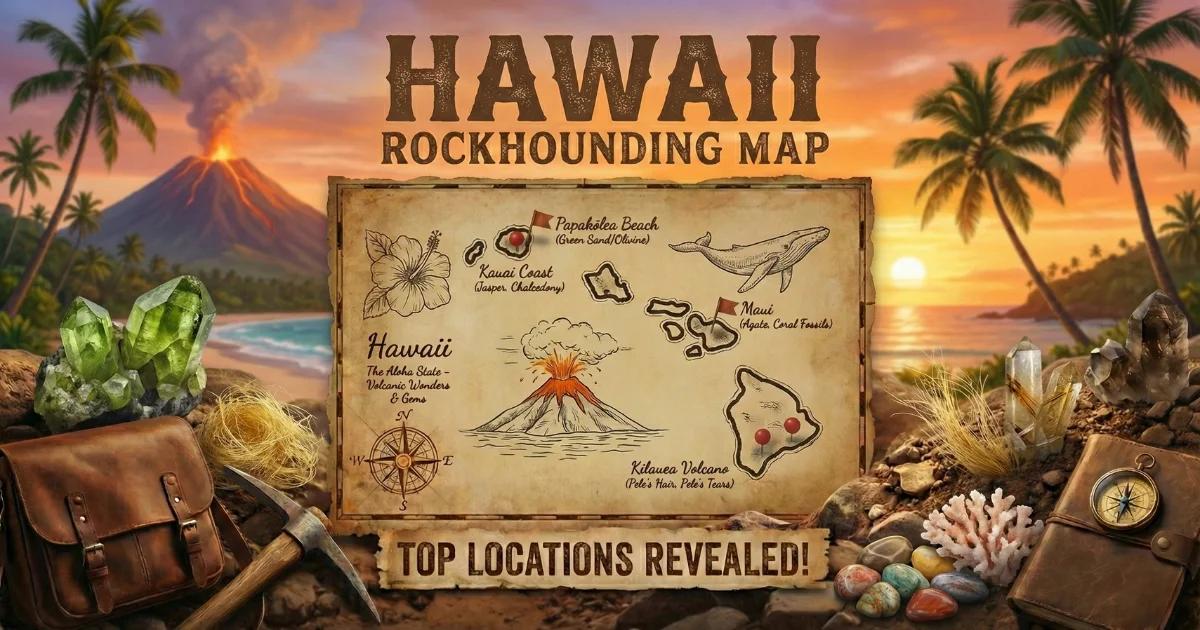
See our Hawaii rockhounding map for more information on island geology and points of interest.