
Why Delaware Has No Geodes
Delaware is the second-smallest state in the US and the most geologically limited for rock and mineral collectors. The short answer: there are no geodes in Delaware. Not rare ones, not small ones — none. The geology simply does not allow it.
Understanding why requires a look at what geodes need to form. Sedimentary geodes develop in ancient limestone when groundwater dissolves cavities and then deposits crystals (quartz, calcite, dolomite) inside those voids over millions of years. Volcanic geodes form in basalt or rhyolite flows when gas bubbles fill with secondary minerals. Both processes require solid bedrock — limestone, dolostone, basalt, or rhyolite — exposed at or near the surface.
Delaware has none of these. The state sits almost entirely on the Atlantic Coastal Plain. From roughly the I-95 corridor southward, every inch of Delaware's surface is unconsolidated sediment — sand, clay, silt, and gravel deposited over the last 70 million years by rivers, ocean transgressions, and coastal processes. There is no exposed bedrock south of Wilmington. Drill down through hundreds of feet of sediment before hitting basement rock. You cannot find geodes in sand and clay.
The single exception is the extreme northern tip of the state around Wilmington, where a sliver of Piedmont metamorphic rock crosses the Fall Line from Pennsylvania. This Piedmont geology produces small quartz specimens in creek gravel but still no geodes.
What Delaware's Geology Does Produce
Delaware is not a total dead zone for collectors. The Coastal Plain sediments and the tiny Piedmont exposure offer three categories of collectible material:
Marine fossils. The Cretaceous and Tertiary sediments beneath Delaware's surface contain fossil shells, shark teeth, and invertebrate remains from ancient oceans that covered the region. Where construction, canal dredging, or natural erosion exposes these layers, fossil collecting is productive.
Beach-tumbled stones. Delaware's Atlantic beaches receive material from offshore deposits and longshore drift. Wave action sorts and polishes stones, producing a continuous supply of smooth pebbles. Most are quartz, quartzite, and chert, but interesting pieces show up.
Piedmont creek minerals. The Brandywine Creek and its tributaries near Wilmington cut through metamorphic bedrock (gneiss, schist, amphibolite) and produce small mineral specimens in the stream gravel — quartz, feldspar, garnet, and occasionally mica books.
Collecting Locations
1. Chesapeake and Delaware Canal — New Castle County
GPS: 39.5500°N, 75.7100°W (Summit Bridge area)
Land status: US Army Corps of Engineers managed — check current access rules
Vehicle: 2WD
The C&D Canal is Delaware's single best collecting location. When the canal was dug and later widened, it sliced through Cretaceous-age (Merchantville and Mount Laurel Formations) and Tertiary-age marine sediments that are normally buried under surface soils. The exposed banks reveal layers of greensand (glauconite-rich sand), clay, and fossiliferous marl.
Fossils here include Cretaceous belemnites, oyster shells (Exogyra), gastropods, and occasional shark teeth. Tertiary layers produce bivalve molds and casts. Material erodes from the canal banks after heavy rain and collects along the waterline.
Access points exist along the canal trail system. The Corps of Engineers manages the canal corridor, and rules about collecting change periodically. Check with the C&D Canal Wildlife Area office before collecting. Do not climb or dig into the canal banks — collect only from loose material at the waterline.
2. Brandywine Creek State Park — New Castle County
GPS: 39.8100°N, 75.5700°W
Land status: Delaware State Park — collecting may be restricted
Vehicle: 2WD
Brandywine Creek State Park sits on the Fall Line where Delaware's Piedmont meets the Coastal Plain. The creek cuts through Wissahickon Schist and Wilmington Complex gneiss — the only exposed bedrock in the state. Creek gravel here contains a mix of Piedmont metamorphic rocks and Coastal Plain sedimentary material.
In the gravel bars, look for milky quartz pebbles, dark red garnet grains weathered from schist, and occasional feldspar specimens. Mica flakes are visible in many of the metamorphic cobbles. No geodes or crystal-lined vugs occur here, but it is the closest thing Delaware has to "real" rock collecting.
State park rules may prohibit removing natural materials. Check at the nature center before collecting. The Brandywine Creek corridor outside the state park (further upstream toward Chadds Ford, Pennsylvania) may offer more flexibility, but that crosses into Pennsylvania.
3. Cape Henlopen State Park — Sussex County
GPS: 38.7900°N, 75.0900°W
Land status: Delaware State Park
Vehicle: 2WD
Cape Henlopen sits at the mouth of Delaware Bay, where the Atlantic Ocean meets the bay. The beach here receives material from offshore deposits, bay currents, and longshore drift. Beach gravel includes wave-polished quartz, quartzite, chert, and occasional jasper pebbles. Shark teeth (Miocene and Pliocene age, reworked from offshore formations) wash up here and along the Delaware Bay beaches.
The best collecting follows storms. Strong northeasters and winter storms rearrange beach sediment and expose fresh material from the offshore gravel beds. Walk the tide line at low tide the morning after a storm. Focus on areas where coarse gravel concentrates — near jetties, groins, and the point where the bay beach meets the ocean beach.
Shark teeth here are mostly small (under 1 inch) and dark brown to black. Species include sand tiger, mako, and occasionally fragmentary megalodon teeth from Miocene deposits.
4. Rehoboth Beach and Indian River Inlet — Sussex County
GPS: 38.7200°N, 75.0800°W (Rehoboth); 38.6100°N, 75.0600°W (Indian River Inlet)
Land status: Public beaches
Vehicle: 2WD
Delaware's southern ocean beaches produce the same beach-tumbled material as Cape Henlopen, with the addition of material reworked by the Indian River Inlet jetties. The jetty rock itself is imported (mostly granite and trap rock from northern quarries), but the beach gravel between and around the jetties concentrates natural material from the offshore seafloor.
Indian River Inlet is a productive spot for shark teeth. The tidal currents through the inlet sort and concentrate heavy objects (teeth, bone fragments, dense stones) on the north side of the south jetty. Visit at low tide.
Specimens You May Find
| Specimen | Where Found | Notes |
|---|---|---|
| Shark teeth | Cape Henlopen, Rehoboth, Indian River Inlet, C&D Canal | Miocene/Pliocene age, mostly small, dark brown/black |
| Fossil shells (Exogyra, gastropods) | C&D Canal banks | Cretaceous marine fossils in marl and greensand |
| Belemnite guards | C&D Canal | Bullet-shaped calcite fossils from Cretaceous seas |
| Quartz pebbles | All beaches, Brandywine Creek | Wave-polished, milky to clear, tumble-grade |
| Garnet grains | Brandywine Creek | Small almandine garnets weathered from Piedmont schist |
| Chert/jasper pebbles | Ocean beaches | Glacially or wave-transported, small |
| Glauconite (greensand) | C&D Canal | Dark green sand grains — a potassium-iron mineral |
Field Identification Tips
Shark teeth vs. shell fragments: Shark teeth are shiny, dark, and triangular or fang-shaped. Shell fragments are dull, lighter colored, and curved. In Delaware's beach gravel, both concentrate in the same areas — look among the darkest, densest material at the tide line.
Quartz vs. glass: Beach glass (sea glass) is common on Delaware beaches and can be confused with tumbled quartz. Sea glass has a frosted surface and often shows bubbles or flow lines inside. Natural quartz is harder, heavier for its size, and has a conchoidal fracture pattern when broken.
Fossils in greensand: The C&D Canal greensand layers are soft and crumbly. Fossils embedded in greensand are fragile. Do not try to pry them out in the field — collect the surrounding matrix with the fossil and clean it at home with water and a soft brush.
Round stones are not geodes: You may find rounded, heavy stones on Delaware beaches. These are quartzite cobbles, granite pebbles, or chert nodules — all solid. There are no hollow, crystal-lined geodes in Delaware's beach gravel. Shake any suspicious round stone before getting excited. It will be solid.
Recommended Tools
- Mesh sifting screen (1/4" mesh) — for sorting beach gravel and finding small shark teeth
- Sand scoop — for digging in beach gravel at the tide line
- Small containers with lids — for storing shark teeth and small fossils without breakage
- Hand lens (10x) — for identifying fossils in greensand and examining beach pebbles
- Knee pads — beach collecting involves a lot of kneeling
- Field guide to Atlantic Coast fossils — for identifying shell species and shark tooth types
- Bucket — for carrying wet beach material to sort later
Legal Notes
State Parks: Delaware state parks (Brandywine Creek, Cape Henlopen) may restrict or prohibit collecting natural materials. Check with park staff before removing anything. Rules vary by park.
C&D Canal: The canal is managed by the US Army Corps of Engineers. Collecting from the canal banks is sometimes permitted, sometimes restricted depending on ongoing projects. Contact the C&D Canal office at (302) 834-1890 before visiting.
Public Beaches: Casual collecting of beach stones and shark teeth on public ocean beaches is generally tolerated in Delaware. Do not dig large holes or disturb dune vegetation.
Private Land: Most of Delaware's undeveloped land is private agricultural property. Do not enter fields, quarries, or construction sites without permission.
Quantity Limits: Delaware does not publish specific weight or volume limits for casual collecting, but use common sense. A pocketful of shark teeth is fine. A truckload of beach cobbles is not.
Better Options Nearby
Delaware is surrounded by states with much better mineral and crystal collecting:
- Chester County, Pennsylvania — 30 minutes north. Quarries and road cuts in Piedmont metamorphics produce garnet, kyanite, and quartz specimens.
- Sterling Hill Mining Museum, New Jersey — 2 hours north. World-class fluorescent mineral collecting from zinc mine dumps.
- Western Maryland — 2-3 hours west. Limestone quarries with calcite specimens and occasional small geodes in the Appalachian Valley.
- Virginia — 3-4 hours south. Fairy stones (staurolite crystals) and Shenandoah Valley collecting.
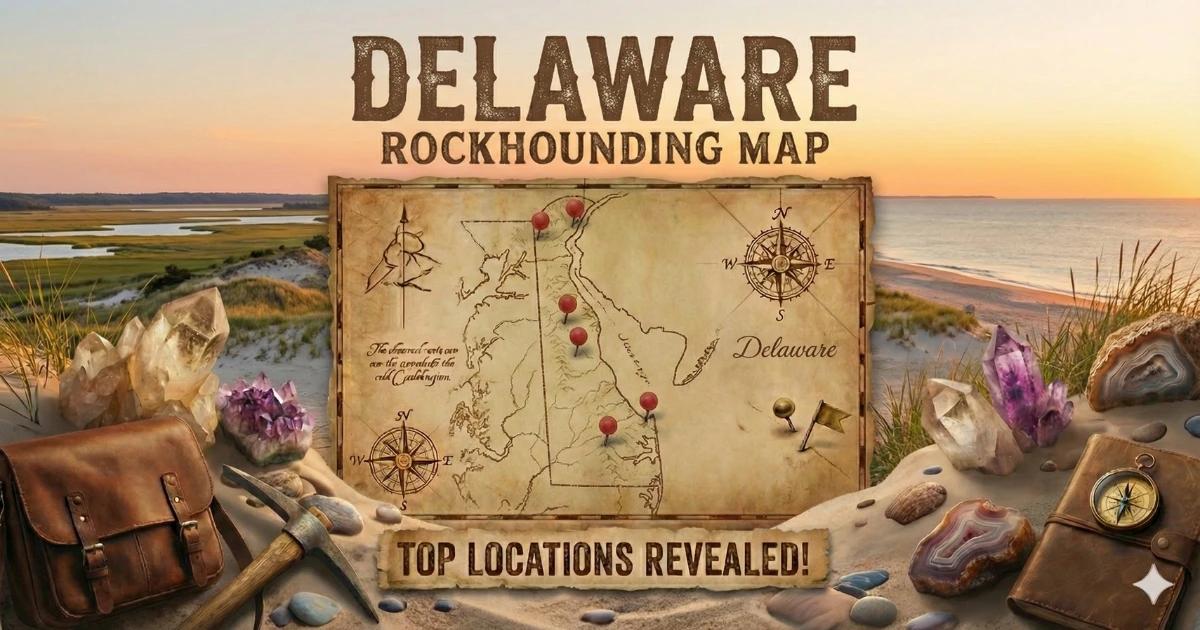
Explore all Delaware collecting sites on our interactive Delaware rockhounding map.