
Why Alaska Does Not Produce Geodes
Alaska is the largest state in the US, covering 663,000 square miles of some of the most geologically complex terrain on the planet. You would think that in all that rock, geodes would turn up somewhere. They do not — at least not in any documented, accessible way.
The reason comes down to geology and access. Geodes form in two main settings: Mississippian-age limestone formations (like those producing Keokuk geodes in Iowa and Missouri) and gas-vesicle-bearing volcanic flows (like the rhyolite beds producing thundereggs in Oregon). Alaska has volcanic rock in enormous quantities — the Aleutian chain is one of the most active volcanic arcs on Earth. But these volcanics are either underwater, extremely remote, or composed of andesite and basalt rather than the rhyolite and welded tuff that typically produce geodes.
Alaska also has limestone — the Alexander terrane in Southeast Alaska contains Paleozoic carbonate rocks. But these limestones have been intensely deformed, faulted, and metamorphosed during terrane accretion. The gentle conditions needed for geode preservation (burial without deformation, followed by uplift and erosion) have not applied to most of Alaska's carbonate rocks.
The third problem is access. Even if geode-bearing formations exist in remote Alaska, reaching them would require float planes, boats, or multi-day backcountry trips. No one has documented finding geodes in these areas because very few people have looked.
What Alaska Offers Instead
Alaska is a poor geode state but a world-class collecting state for other materials. The state produces jade, gold, garnet, fossils, and volcanic minerals that are worth traveling for on their own terms.
Nephrite jade. Alaska's state gemstone is nephrite jade, and the state produces some of the finest nephrite in North America. The jade occurs in serpentinite bodies associated with ultramafic rocks along ancient fault zones. Colors range from dark green to nearly black, with occasional apple-green pieces that rival Wyoming jade.
Placer gold. Alaska's gold rush history is real, and recreational gold panning remains productive in dozens of streams. The interior (Fairbanks district), western Alaska (Nome), and Southeast Alaska (Juneau) all have active recreational gold panning areas.
Garnet. The garnet ledge at Wrangell is one of Alaska's most unusual collecting sites — a garnet-bearing schist exposure managed by the Boy Scouts, where children collect and sell garnet specimens to cruise ship passengers.
Fossils. Pleistocene megafauna (mammoth, bison, horse) from Interior Alaska's permafrost deposits produce ivory, bone, and occasional complete skeletons. Paleozoic marine fossils occur in limestone terranes in Southeast Alaska.
Collecting Locations
1. Kobuk River Valley — Northwest Arctic Borough
GPS: 67.0000°N, 157.0000°W (general Kobuk Valley area)
Land status: Kobuk Valley National Park, Gates of the Arctic NP, and BLM land — collecting rules vary
Vehicle: No road access. Float plane or boat only.
The Kobuk River valley is Alaska's premier jade locality. Nephrite jade boulders occur in the river gravel and along tributaries, having weathered from serpentinite source rocks in the Jade Mountains (Cosmos Hills). Jade boulders range from fist-sized to multi-ton. Colors range from dark spinach green to lighter apple green.
Access is the challenge. There are no roads to the Kobuk Valley. You fly in from Kotzebue (scheduled air service from Anchorage) and travel by riverboat. Collecting on BLM land is permitted for personal use. Collecting is prohibited inside Kobuk Valley National Park and Gates of the Arctic National Park. Know exactly which land you are on before picking up any stones.
This is a serious expedition, not a day trip. Budget a minimum of one week and several thousand dollars for a Kobuk Valley jade-hunting trip. Bring bear spray, a satellite communicator, and complete self-sufficiency gear.
2. Wrangell Garnet Ledge — Southeast Alaska
GPS: 56.4100°N, 132.2800°W
Land status: Managed by the Boy Scouts of America; children have priority collecting rights
Vehicle: Boat access from Wrangell (no road)
The garnet ledge near Wrangell is a famous Alaska collecting site. A garnet-bearing mica schist exposure on the shore of the Stikine River produces almandine garnet crystals to 1 inch in diameter. The site has been managed by the Boy Scouts since 1962, when the landowner deeded it to them. Children collect garnets and sell them on the Wrangell waterfront to cruise ship visitors.
Adults can visit and collect, but children have first priority. Access is by boat from Wrangell — charter boats and water taxis are available. The garnets are embedded in schist and can be extracted with a chisel and hammer. Most are dark red and opaque, but occasional transparent pieces occur.
3. Fairbanks Mining District — Interior Alaska
GPS: 64.8400°N, 147.7200°W (general Fairbanks area)
Land status: Mixed BLM, state, and private mining claims
Vehicle: 2WD to most access points; 4WD for backcountry mining roads
The Fairbanks area is Alaska's most accessible mineral collecting region. The gold-bearing creeks around Fairbanks (Pedro Creek, Goldstream Creek, Cleary Creek) have been mined since 1902 and still produce recreational gold. BLM and state land in the area allows recreational gold panning.
Beyond gold, the Fairbanks schist belt produces garnet, stibnite (antimony ore), and scheelite (tungsten ore) in creek gravels and bedrock exposures. The Pedro Dome area has produced fine stibnite crystal specimens from quartz veins. No geodes, but legitimate mineral collecting with road access.
Check claim status before panning or collecting. Much of the productive ground is under active mining claims. The BLM Fairbanks District Office maintains claim records. Recreational panning with a gold pan only (no sluice box, no motorized equipment) is generally allowed on unclaimed BLM and state land.
4. Nome Beach — Western Alaska
GPS: 64.5000°N, 165.4100°W
Land status: Public beach (city of Nome)
Vehicle: 2WD in Nome; fly-in access from Anchorage
Nome's beaches are open to recreational gold panning. The beach gravels contain fine gold concentrated by wave action, along with garnet sand, magnetite, and occasional small mineral specimens. This is one of the few places in the world where you can pan gold on an ocean beach.
Small-scale mining equipment (sluice boxes, rocker boxes) is allowed on Nome's beaches with appropriate permits. Gold pan only requires no permit. The summer season (June through September) is the productive window. Nome has no road connection to the rest of Alaska — you fly in from Anchorage.
Specimens You May Find
| Specimen | Where Found | Notes |
|---|---|---|
| Nephrite jade | Kobuk River valley, Seward Peninsula | State gemstone; dark to apple green; float plane access |
| Placer gold | Fairbanks, Nome, Juneau, numerous creeks | Fine to coarse flakes and small nuggets |
| Almandine garnet | Wrangell garnet ledge | Dark red crystals to 1 inch; boat access |
| Stibnite | Fairbanks area quartz veins | Metallic gray antimony ore; prismatic crystals |
| Mammoth ivory/bone | Interior Alaska river gravels | Pleistocene fossils; legal to collect on most public land |
| Volcanic glass (obsidian) | Alaska Peninsula, Aleutians | Extremely remote; expedition-level access only |
| Scheelite | Fairbanks district | Tungsten ore; fluoresces bright blue under UV |
Field Identification Tips
Jade vs. serpentine: Both are green and found in the same areas. Jade (nephrite) is extremely tough — you cannot break it with a hammer blow. Serpentine is softer (Mohs 2.5-4 vs. jade's 6-6.5) and will scratch with a knife. Serpentine also tends to be lighter green and waxy-looking, while jade is darker and has a greasy-to-silky luster.
Gold vs. pyrite in creek gravel: Real gold is soft, malleable, and stays bright when crushed. Pyrite ("fool's gold") is hard, brittle, and shatters into powder when struck. In your gold pan, gold settles to the very bottom and stays in the crease. Pyrite washes away with lighter material.
Garnet in schist: Almandine garnets at Wrangell and in the Fairbanks schist belt appear as dark red, glassy bumps protruding from silvery mica schist. They are hard (Mohs 7-7.5) and resist weathering, so they often stand proud of the matrix as the softer schist erodes away.
Round stones on Alaska beaches: Alaska beaches have many rounded cobbles. None are geodes. They are wave-tumbled granite, basalt, quartzite, and greenstone. Do not waste time cracking them open expecting crystals inside.
Recommended Tools
- Gold pan (14-inch) — for recreational gold panning in creeks and on beaches
- Rock hammer (16 oz) — for testing hardness and extracting garnet from schist
- Cold chisel — for extracting garnet crystals from the Wrangell ledge
- Safety glasses — mandatory when hammering
- Bear spray — non-negotiable in Alaska. Brown bears and black bears are present everywhere.
- Satellite communicator (inReach, SPOT) — cell service is absent in most collecting areas
- UV flashlight (shortwave) — scheelite fluoresces bright blue; useful for night prospecting in the Fairbanks district
- Hand lens (10x) — for identifying minerals in creek gravel
- Tide chart — essential for Nome beach collecting; work at low tide
Legal Notes
BLM land: Casual collecting of rocks, minerals, and reasonable quantities of gold (pan only) is permitted on BLM land in Alaska that is not under active mining claims. This covers millions of acres. Check with the BLM Alaska office for specific area restrictions.
National Parks and Refuges: Collecting rocks, minerals, and fossils is prohibited in all Alaska National Parks (Denali, Glacier Bay, Kobuk Valley, etc.) and National Wildlife Refuges. This is strictly enforced. Know your boundaries.
National Forest: The Tongass and Chugach National Forests allow personal collecting of reasonable quantities. No commercial collecting without a permit.
State Land: Alaska state land generally allows recreational mineral collecting and gold panning. Active mining claims are off-limits unless you have the claim holder's permission.
Native Corporation Land: Large areas of Alaska are owned by Alaska Native Regional and Village Corporations. Collecting on Native Corporation land requires permission from the corporation. Do not assume remote land is public.
Mammoth ivory: Legal to collect on most public land in Alaska. Legal to sell. This is different from elephant ivory, which is heavily regulated. Keep documentation of where you found it.
Safety
Alaska collecting is fundamentally different from Lower 48 collecting. The state demands respect.
- Bears: Carry bear spray and know how to use it. Make noise on the trail. Store food in bear-resistant containers. This is not optional.
- Weather: Alaska weather changes rapidly. Carry rain gear and warm layers even in summer. Hypothermia kills more people in Alaska than bears do.
- Remoteness: Most productive collecting areas have no cell service, no emergency response, and no other people. A satellite communicator is essential safety equipment, not a luxury.
- River crossings: Glacial rivers are cold, fast, and opaque. Do not wade rivers you cannot see the bottom of. Unbuckle your pack's waist belt before crossing so you can shed it if you fall.
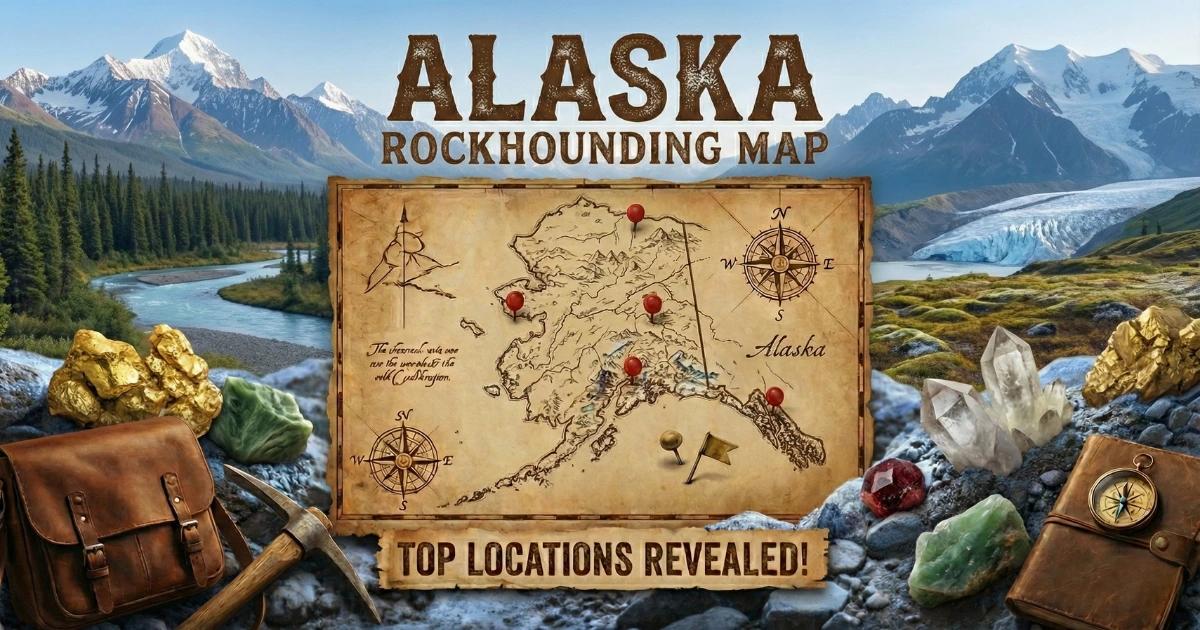
Explore all Alaska collecting sites on our interactive Alaska rockhounding map.