
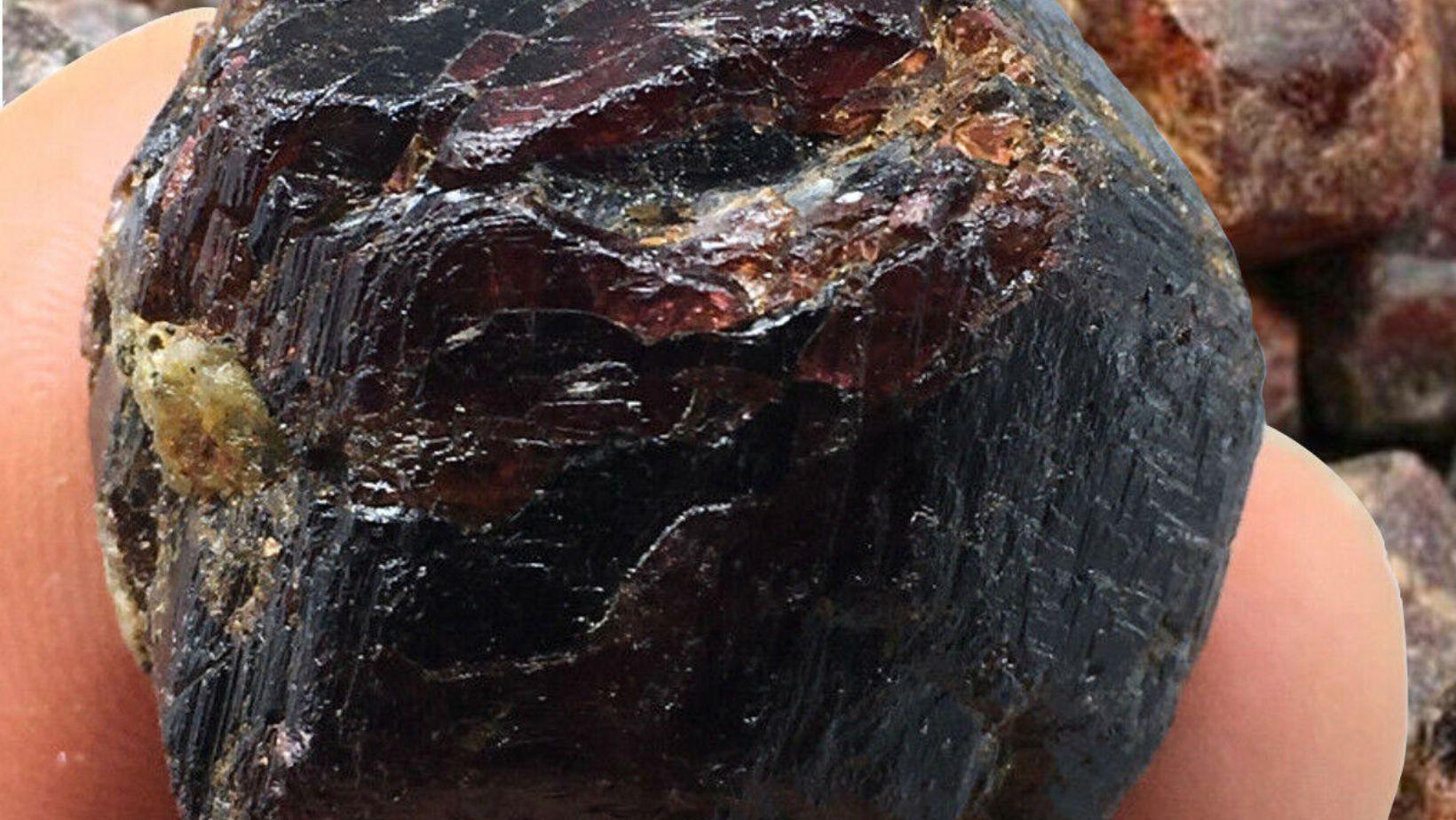
Garnet: A Family of Minerals, Not Just One
Garnet is not a single mineral — it is a group of silicate minerals that share a common crystal structure (isometric, typically forming dodecahedrons or trapezohedrons) but vary in chemical composition. The garnet group includes almandine (iron-aluminum), pyrope (magnesium-aluminum), grossular (calcium-aluminum), andradite (calcium-iron), spessartine (manganese-aluminum), and uvarovite (calcium-chromium). In practice, most garnets you find collecting in the US are almandine or pyrope, with the occasional rhodolite (a pyrope-almandine intermediate).
Garnets form in metamorphic rocks — schist, gneiss, amphibolite — where heat and pressure drive chemical reactions that concentrate aluminum, iron, and magnesium into the garnet crystal structure. They also occur in some igneous rocks, particularly peridotites and eclogites from deep in the crust or upper mantle. Because garnet is hard (6.5 to 7.5 on Mohs) and chemically resistant, it survives weathering and concentrates in stream gravels, often alongside other heavy minerals like magnetite, ilmenite, and zircon.
The United States has garnet localities spread across dozens of states. Idaho produces the rare star garnet. New York has the world's largest garnet mine. North Carolina offers family-friendly fee-dig operations. Alaska has garnet beaches. If you know what geological setting to look in, garnet is one of the most findable minerals in the country.
How Garnet Forms: The Geology
Regional metamorphism is the primary garnet-forming process. When sedimentary or igneous rocks are buried to depths where temperatures exceed roughly 500 degrees Celsius and pressures climb above several kilobars, the original minerals recrystallize into new assemblages stable at those conditions. In aluminum-rich rocks (like shale or mudstone), garnet is one of the first high-grade metamorphic minerals to appear. It grows as equidimensional crystals — the classic 12-sided dodecahedron — embedded in a matrix of mica, quartz, and feldspar.
Contact metamorphism — where hot magma bakes the surrounding country rock — also produces garnet, particularly grossular and andradite in limestone and dolomite near igneous intrusions (a rock type called skarn).
Star garnets are a special case. The asterism (star effect) is caused by rutile needles aligned along crystallographic directions inside the garnet. When the garnet is cut en cabochon and polished, light reflecting off these needle inclusions produces a four-rayed or six-rayed star pattern. Only two locations on Earth produce star garnets in significant quantity: the St. Joe River area of Idaho and parts of southern India.
Where to Find Garnet in the United States
1. Emerald Creek Garnet Area, Idaho — Benewah County (St. Joe National Forest)
Emerald Creek is the best-known garnet collecting site in the United States and the only reliable source of star garnets in the Western Hemisphere. The site is managed by the USDA Forest Service as a designated recreational mineral collecting area. Almandine garnets — some displaying four- or six-rayed asterism — are found by screening gravel from designated digging areas along Emerald Creek.
- GPS: Approximately 47.04°N, 116.26°W (Emerald Creek Garnet Area, Benewah County, ID)
- Land Status: St. Joe National Forest — USDA Forest Service managed fee-dig site. Open approximately late May through September (season depends on weather). A Forest Service permit is required, available on-site. The fee is modest. The area is well-maintained with designated digging zones, restrooms, and picnic areas.
- Vehicle: Sedan accessible. The access road is maintained gravel, suitable for all vehicles in dry conditions.
- What to Expect: You dig gravel from designated areas along the creek and screen it through classifying screens. Garnets show up as dark red to brownish-red equidimensional crystals in the concentrate. Star garnets are the prize — hold each garnet up to a bright light source (flashlight or direct sun) and look for the reflected star pattern on the surface. Star garnets represent a minority of the total garnets found, so screen a lot of gravel. Most garnets are thumbnail-sized or smaller, but larger ones (1 inch plus) do turn up.
2. Gore Mountain (Barton Mine), New York — Warren County (Adirondacks)
Gore Mountain in the Adirondacks hosts the world's largest garnet mine, operated by the Barton Mines Corporation since the late 1800s. The garnets here are almandine, embedded in amphibolite — a dark, tough metamorphic rock composed primarily of hornblende. The garnets can reach enormous sizes — individual crystals measuring 6 inches or more across have been extracted from the mine.
- GPS: Approximately 43.67°N, 74.05°W (Barton Mine, Gore Mountain, Warren County, NY)
- Land Status: Private — Barton Mines Corporation. The active mine is not open to public collecting, but the company operates a tourist area where visitors can collect garnets from tailings piles during the summer season (typically late June through early October). Admission fee required.
- Vehicle: Sedan accessible. The mine is reached via NY Route 28 and a paved access road.
- What to Expect: Dark red to nearly black almandine garnets in amphibolite matrix. Crystals on the tailings piles range from small to several inches across. Most are rough and embedded in matrix — clean, well-formed crystals are uncommon but rewarding when found. The garnets are hard and tough — you will need a hammer and chisel to extract them from the amphibolite. Wear eye protection.
3. Cowee Valley, North Carolina — Macon County (near Franklin)
The Cowee Valley near Franklin is one of the best-known gem-collecting areas in the eastern US. Several fee-dig operations in the valley allow screening for gems in alluvial gravels, and garnets are among the most common finds. The garnets here are almandine and rhodolite (a pyrope-almandine variety with a purplish-red color), found alongside sapphire, ruby, and other gems in the stream gravels.
- GPS: Approximately 35.23°N, 83.38°W (Cowee Valley, Macon County, NC)
- Land Status: Private fee-dig operations. Mason Ruby and Sapphire Mine, Sheffield Mine, and other operations offer day-use access. Fees vary. Most operations are family-friendly and provide buckets of pre-dug gravel and screening equipment.
- Vehicle: Sedan accessible. Paved roads to all major fee-dig sites.
- What to Expect: Deep red almandine and purplish-red rhodolite garnets in alluvial gravel concentrates. Most are small (under 1 cm) but occasionally larger stones turn up. The rhodolite from this area is a particularly nice color. Garnets here are secondary finds — the primary draw is sapphire and ruby, but you will pull plenty of garnets from your screening bucket.
4. Ruby Range and Tobacco Root Mountains, Montana — Madison County
Southwestern Montana's metamorphic terrain produces almandine and pyrope garnets in mica schist and gneiss. The Ruby Range and Tobacco Root Mountains contain extensive exposures of Precambrian metamorphic rocks where garnets weather out of schist and accumulate on the surface and in drainage gravels.
- GPS: Approximately 45.40°N, 112.00°W (Ruby Range area, Madison County, MT)
- Land Status: Mix of BLM land, Beaverhead-Deerlodge National Forest, and private ranches. Personal-use collecting is permitted on BLM and National Forest land. Verify boundaries and land status before collecting. Some areas may have active mining claims.
- Vehicle: High-clearance 4WD required for most backcountry access. Mountain roads are rough, steep, and potentially snow-covered into June.
- What to Expect: Dark red almandine garnets weathering out of mica schist exposures. Crystals range from small (under 1 cm) to occasionally impressive specimens several centimeters across. The garnets are typically rough-surfaced from weathering. Look for exposed schist outcrops on ridges and along creek banks where garnets weather free and collect in the drainage.
5. Wrangell, Alaska — Wrangell Island
The beaches near Wrangell, Alaska, are known as "garnet beaches" because almandine garnet crystals wash out of metamorphic rock on the Stikine River delta and accumulate on the shoreline. The garnets come from garnet-mica schist exposed in the surrounding mountains. The Garnet Ledge, a garnet-rich schist outcrop on the Stikine River, is the primary source.
- GPS: Approximately 56.47°N, 132.38°W (Wrangell area, AK)
- Land Status: The Garnet Ledge property was deeded to the Boy Scouts of America (Wrangell Chapter) and later to the children of Wrangell. Garnet collecting at the ledge is traditionally reserved for children under 18. Beach collecting along the Wrangell shoreline is generally available to the public. Check local regulations and traditions.
- Vehicle: Wrangell is accessible by ferry (Alaska Marine Highway) or floatplane. A vehicle is helpful on the island but not strictly necessary for beach collecting. The Garnet Ledge requires a boat trip up the Stikine River.
- What to Expect: Dark red almandine garnets, many showing well-formed dodecahedral crystal faces, in beach gravel and on exposed schist. Crystals range from pea-sized to golf-ball-sized. Some are well-formed and display excellent crystal geometry. The setting — forested islands, tidal shorelines, bald eagles overhead — is unlike any other garnet locality in the country.
6. River Valley, North Carolina and Georgia — Appalachian Schist Belt
Garnet-bearing mica schist is exposed extensively through the Appalachian mountain belt from Georgia to Maine. Road cuts, stream banks, and construction excavations regularly expose garnet-bearing schist. While specific fee-dig or public collecting sites are limited, any exposed garnet-mica schist in the southern and central Appalachians is a potential collecting opportunity — with landowner permission.
- GPS: General Appalachian garnet occurrences are too widespread for a single GPS coordinate. Look for exposed mica schist along highway road cuts in western North Carolina, northern Georgia, and western Virginia.
- Land Status: Varies — mostly private land. Road-cut collecting may be on state highway right-of-way (check your state DOT regulations) or private land (get permission).
- Vehicle: Sedan accessible for road cuts along major highways.
- What to Expect: Almandine garnets in mica schist matrix. Crystals are often embedded and require hammer work to extract. Some road cuts expose excellent garnet porphyroblasts (large crystals grown in finer-grained matrix).
Garnet Specimen Varieties
| Garnet Species | Color | Host Rock | Best US Source | Special Features |
|---|---|---|---|---|
| Almandine | Deep red to brownish-red | Mica schist, gneiss, amphibolite | NY, ID, MT, AK | Most common US garnet |
| Star garnet (almandine) | Dark red to purple-red | Schist-derived alluvium | Emerald Creek, ID | 4- or 6-rayed asterism |
| Rhodolite (pyrope-almandine) | Purplish-red to raspberry | Alluvial gravel | Cowee Valley, NC | Gem-quality color |
| Pyrope | Blood red | Peridotite xenoliths, kimberlite | MT, AZ (rare) | Mantle-derived |
| Grossular | Green to orange (hessonite) | Skarn, marble | CA, VT | Gem variety is tsavorite/hessonite |
| Spessartine | Orange to reddish-orange | Pegmatite, metamorphic rock | VA, CT (uncommon) | Distinctive orange color |
Field Identification: How to Confirm Garnet and Avoid Mistakes
| Property | Value |
|---|---|
| Hardness | 6.5 to 7.5 (Mohs) |
| Color | Red, orange, green, purple (varies by species) |
| Luster | Vitreous to resinous |
| Streak | White |
| Crystal System | Isometric — dodecahedral (12-sided) or trapezohedral (24-sided) habit |
| Cleavage | None (conchoidal to uneven fracture) |
| Specific Gravity | 3.5 to 4.3 (heavier than quartz) |
Garnet's crystal shape is the best field identifier. Look for equidimensional crystals with 12 or 24 flat faces, roughly spherical in overall outline. No other common mineral consistently forms this shape. In gravel, garnets appear as rounded, dark red to brown glassy pebbles that feel heavier than the surrounding quartz gravel.
Transmitted light helps with color evaluation. Hold a garnet up to the sun or a bright flashlight so light passes through thin edges. The transmitted color — red, purple, orange — is the true body color, which can be different from the reflected-light appearance (which often looks nearly black on large, dark almandine crystals).
For star garnets, test each specimen by holding it under a single bright point light source (direct sun or a penlight) and rotating it. The star appears as bright lines radiating from a central point on the garnet's surface. Not every garnet from a star-garnet locality will show the star — only those with properly oriented rutile needle inclusions.
Common Look-Alikes
- Dark red spinel: Isometric like garnet, similar color, but typically forms octahedral crystals rather than dodecahedrons. Spinel is uncommon at most US garnet localities.
- Dark red tourmaline (rubellite): Hexagonal prism, not equidimensional. Tourmaline crystals are elongated, garnets are equant. Easy to distinguish by shape.
- Red jasper pebbles: Opaque, waxy luster, conchoidal fracture. No crystal faces. Much lighter weight than garnet.
- Hematite nodules: Can be dark red-brown and rounded, but hematite has a red-brown streak (garnet's streak is white), is heavier, and lacks crystal faces.
Tools and Equipment for Garnet Collecting
- Classifying screens (1/4" and 1/8" mesh): Essential at gravel-screening sites like Emerald Creek and the Cowee Valley fee-digs. Stack screens and wash gravel through them with water.
- Rock hammer and chisel: For extracting garnets from host rock in outcrop (Gore Mountain, Montana schist exposures).
- Hand lens (10x): To examine crystal faces and look for asterism indicators.
- Penlight or bright flashlight: Hold behind a garnet to check for star effect (asterism) and to evaluate color by transmitted light.
- Bucket and shovel: For moving gravel to screening stations.
- Eye protection: When hammering amphibolite, gneiss, or schist.
- Tweezers: For picking small garnets out of screen concentrates.
Legal Considerations
- USDA Forest Service fee-dig (Emerald Creek, ID): A permit is required and is available on-site. Collecting season is limited to summer months. Follow all Forest Service regulations — stay in designated digging areas, do not divert the creek, and pack out your trash.
- Private fee-dig operations (NY, NC): Pay the admission fee and follow site rules. Keep what you find.
- BLM and National Forest land (MT): Personal-use collecting is permitted. Verify boundaries and claim status.
- Alaska: Beach collecting is generally permitted below the ordinary high-tide line. Respect the Wrangell children's garnet tradition at the Garnet Ledge.
- Road cuts: Collecting on highway road cuts occupies a legal gray area in many states. Some state DOTs permit it; others do not. Check your state's regulations. Safety is a major concern — park well off the road, wear a high-visibility vest, and never work on road cuts during heavy traffic.
Explore the Interactive Garnet Map
Use our interactive garnet location map to find collecting sites near you with GPS coordinates, access information, and land status details.