
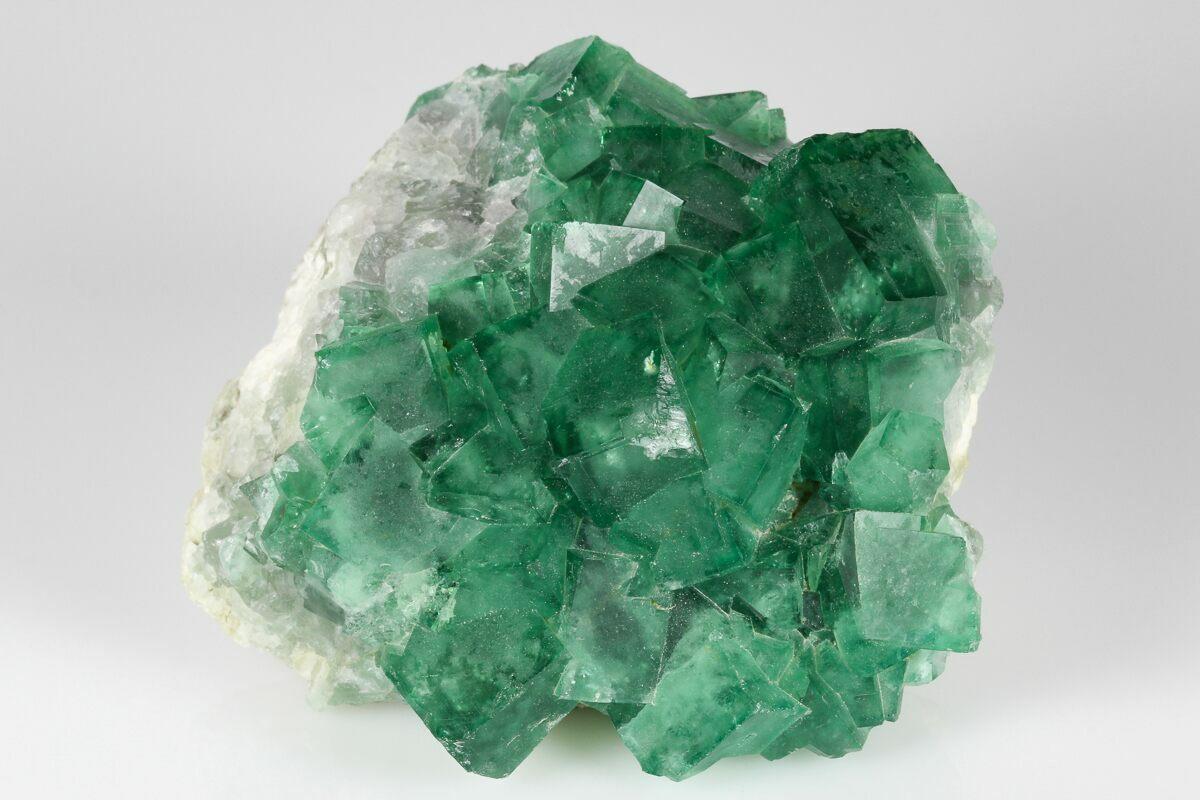
Fluorite: The Collector's Mineral
Fluorite (CaF2) is calcium fluoride, a halide mineral that sits at 4 on the Mohs hardness scale — literally defining that point on the scale. It crystallizes in the isometric system, typically forming cubes, octahedrons, or combinations of both. What draws collectors to fluorite is its color range: purple, green, yellow, blue, colorless, pink, and every shade between. Single crystals often display color zoning, with different growth layers showing different colors. And then there is the fluorescence. The word "fluorescence" was coined after fluorite — many specimens glow blue-violet under ultraviolet light, a property that makes a UV flashlight one of the most useful tools in the fluorite hunter's kit.
The United States has produced some of the world's finest fluorite specimens. The Illinois-Kentucky Fluorspar District once supplied the majority of the nation's industrial fluorite, and the mine dumps from that era still yield excellent cabinet specimens. Other productive localities stretch from New Mexico to Colorado to New Hampshire, each producing fluorite with its own character and color range.
How Fluorite Forms: The Geology
Fluorite is a hydrothermal mineral — it precipitates from hot, fluorine-bearing fluids that migrate through fractures and faults in the crust. In the Mississippi Valley-type (MVT) deposits that characterize the Illinois-Kentucky district, these fluids were basinal brines that moved upward along fault zones during regional tectonic events. The brines carried dissolved calcium and fluorine, and when temperature, pressure, or chemistry changed at the site of deposition, fluorite crystallized in open spaces along faults, in breccia zones, and as replacements of limestone.
In the western US, fluorite also forms in association with igneous activity. Pegmatites, hydrothermal veins around granitic intrusions, and volcanic-hosted epithermal systems all produce fluorite. The Crystal Peak area of Colorado, for example, produces fluorite in weathered Pikes Peak granite — a very different geological setting from the sedimentary-hosted deposits of Illinois and Kentucky, but the same mineral precipitating from fluorine-bearing fluids.
Fluorite commonly occurs with calcite, quartz, galena, sphalerite, barite, and pyrite. In MVT deposits, it is often a gangue mineral — the non-economic mineral surrounding economic lead and zinc ores. In granitic settings, it appears alongside feldspar, smoky quartz, and amazonite.
Where to Find Fluorite in the United States
1. Illinois-Kentucky Fluorspar District — Hardin County, IL and Crittenden County, KY
The Fluorspar District straddling the Illinois-Kentucky border was the largest fluorite-producing region in the United States for over a century. Centered on Rosiclare and Cave-in-Rock in Hardin County, Illinois, and Marion in Crittenden County, Kentucky, this district produced millions of tons of fluorite from underground mines and open pits working faulted Mississippian-age limestone.
Commercial mining ceased decades ago, but the old mine dumps, prospect pits, and surrounding outcrops still produce excellent specimens. Purple, yellow, amber, and blue fluorite cubes are the most common forms. Some specimens show phantoms — ghost outlines of earlier growth stages visible inside later crystal overgrowths. Two-toned cubes with purple corners and yellow centers are a classic Fluorspar District look.
- GPS: Approximately 37.47°N, 88.17°W (Rosiclare area, Hardin County, IL); 37.33°N, 88.08°W (Marion area, Crittenden County, KY)
- Land Status: Mix of private land and Shawnee National Forest. Most old mine sites are on private property — get written permission before collecting. The Ben E. Clement Mineral Museum in Marion, KY, can direct collectors toward accessible localities and connect you with landowners who allow collecting.
- Vehicle: Sedan accessible to towns; high-clearance vehicle recommended for dirt roads to remote dump sites in the Shawnee National Forest.
- What to Expect: Purple and yellow cubes up to 3 cm on edge are common on mine dumps. Larger specimens require more digging. Fluorite here is often coated with clay and requires washing to reveal its true color. Bring buckets and brushes.
2. Elmwood Mine, Tennessee — Smith County
The Elmwood Mine in the central Tennessee zinc district has produced some of the most sought-after fluorite specimens on the planet. Large yellow and blue cubes perched on sphalerite matrix, some measuring 10 cm or more on edge, have come from this mine and now sit in museum collections worldwide. The clarity and color saturation of Elmwood fluorite is hard to match.
The Elmwood Mine is a commercial zinc-mining operation and is not open to public collecting. You cannot walk in and dig. Specimens come to market through miners who recover them during commercial operations and sell them through mineral dealers. If you want Elmwood fluorite, you buy it.
- GPS: Approximately 36.34°N, 85.99°W (Smith County, TN)
- Land Status: Private commercial mine. No public access.
- Vehicle: Not applicable — no public collecting.
- What to Expect: Specimens are available through mineral dealers and at major gem and mineral shows. Prices range from modest for small crystals to thousands of dollars for large display pieces.
Smaller fluorite occurrences in the central Tennessee zinc district on more accessible land do exist. Ask at the Ben E. Clement Mineral Museum or contact the Nashville-area mineral clubs for information on collectible sites in middle Tennessee.
3. Hansonburg Mining District, New Mexico — Socorro County
The Hansonburg district, located about 25 miles east of Socorro in the Oscura Mountains, produced fluorite commercially in the early and mid-20th century. The deposits occur as veins and replacements in Paleozoic limestone along fault zones. Fluorite here is typically purple to deep blue-purple, often occurring with barite, galena, and calcite.
- GPS: Approximately 33.80°N, 106.47°W (Hansonburg district, Socorro County, NM)
- Land Status: BLM land. Personal-use mineral collecting is permitted. Verify current access with the Socorro BLM Field Office, as some areas near White Sands Missile Range may have restricted access.
- Vehicle: 4WD required. Access roads are rough, unimproved, and rocky. Not suitable for sedans or low-clearance vehicles.
- What to Expect: Old mine dumps and prospect pits yield purple fluorite cubes and cleavage fragments. Some specimens show strong fluorescence under shortwave UV. Bring a UV flashlight for field identification. This is remote desert — carry water, food, a spare tire, and let someone know your plans.
4. Bingham District, New Mexico — Socorro County
The Bingham district in the Black Range of western Socorro County has produced purple and green fluorite from veins in volcanic and sedimentary host rocks. The deposits are associated with Tertiary volcanic activity and related hydrothermal systems.
- GPS: Approximately 33.82°N, 107.28°W (Bingham area, Socorro County, NM)
- Land Status: Mix of BLM land and Cibola National Forest. Personal-use collecting generally permitted. Verify boundaries and access.
- Vehicle: High-clearance 4WD recommended. Remote mountain roads.
- What to Expect: Green and purple fluorite on old prospect dumps. Smaller specimens than Hansonburg but sometimes better color.
5. Crystal Peak, Colorado — Teller County
The Crystal Peak area near Lake George in Teller County sits on weathered Pikes Peak granite, a 1.08-billion-year-old anorogenic granite body. Pockets and cavities in the granite produce smoky quartz, amazonite (green microcline feldspar), and fluorite. The fluorite here ranges from green to purple and typically occurs as small cubes or octahedrons associated with smoky quartz and amazonite on pocket walls.
- GPS: Approximately 38.95°N, 105.30°W (Crystal Peak area, Teller County, CO)
- Land Status: Mix of private claims and Pike National Forest. Several fee-dig claims operate in the area. National Forest land permits personal-use collecting. Check with the South Park Ranger District for current regulations.
- Vehicle: High-clearance vehicle recommended. Forest roads are rough and may be snowbound into early summer.
- What to Expect: Small but well-formed fluorite crystals, often as accessory minerals in amazonite-smoky quartz pockets. Fluorite is not the primary find here — amazonite and smoky quartz are — but good fluorite specimens do come out.
6. Cripple Creek District, Colorado — Teller County
The Cripple Creek gold mining district produces fluorite as a gangue mineral in gold-telluride veins hosted by Tertiary alkalic volcanic rocks. While the active mine (Cripple Creek and Victor Gold Mining Company) is not open to public collecting, old prospect dumps and exposed outcrops in the district occasionally yield fluorite specimens.
- GPS: Approximately 38.75°N, 105.18°W (Cripple Creek, Teller County, CO)
- Land Status: Mix of private land, mining claims, and BLM. Verify status before collecting. The active mining operation occupies a large area. Stick to clearly public land.
- Vehicle: Sedan accessible to the town; high-clearance vehicle for backcountry access.
- What to Expect: Fluorite here is incidental to the gold-mining geology. Small purple cubes in vein material.
7. Grafton County, New Hampshire — New England Pegmatite Belt
Several pegmatites in Grafton County, New Hampshire, produce fluorite alongside tourmaline, beryl, and other pegmatite minerals. The pegmatites here are part of the New England pegmatite province, which extends from Connecticut through Maine. Fluorite typically occurs as small purple crystals in pockets and vugs within the pegmatite.
- GPS: Approximately 43.85°N, 71.90°W (general Grafton County area, NH)
- Land Status: Mix of White Mountain National Forest and private land. National Forest land permits personal-use collecting. Several private sites require landowner permission.
- Vehicle: Varies by site. Most are accessible by sedan via maintained forest roads.
- What to Expect: Small purple fluorite crystals, typically under 2 cm. The pegmatites here are better known for beryl and tourmaline, with fluorite as a secondary find.
Fluorite Specimen Varieties
| Color Variety | Crystal Habit | Typical Size | Best US Source | Fluorescence |
|---|---|---|---|---|
| Purple cubes | Cubic | 1-5 cm on edge | IL-KY Fluorspar District | Blue-violet (SW UV) |
| Yellow cubes | Cubic | 2-10+ cm on edge | Elmwood Mine, TN | Variable |
| Blue cubes | Cubic | 1-8 cm on edge | IL-KY; Elmwood, TN | Blue-violet (SW UV) |
| Green cubes/octahedrons | Cubic to octahedral | 0.5-3 cm | Crystal Peak, CO | Variable |
| Deep purple | Cubic to massive | 1-5 cm | Hansonburg, NM | Strong blue (SW UV) |
| Color-zoned (phantom) | Cubic with internal zones | 2-5 cm | IL-KY Fluorspar District | Zones fluoresce differently |
Field Identification: How to Confirm Fluorite and Avoid Mistakes
| Property | Value |
|---|---|
| Hardness | 4 (Mohs) — scratched easily by a steel knife |
| Color | Purple, green, yellow, blue, colorless, pink |
| Luster | Vitreous |
| Streak | White |
| Crystal System | Isometric (cubic habit common) |
| Cleavage | Perfect octahedral — 4 directions |
| Specific Gravity | 3.18 |
| Fluorescence | Often blue-violet under shortwave UV |
Three field tests will confirm fluorite almost every time. First, the scratch test: a steel knife blade (hardness 5.5) scratches fluorite easily. If a purple crystal cannot be scratched by steel, it is probably amethyst (quartz, hardness 7), not fluorite. Second, cleavage: fluorite breaks along four octahedral planes, producing triangular cleavage faces. No other common purple or green mineral cleaves this way. Third, a UV flashlight: many fluorites glow bright blue-violet under shortwave UV. Carry a battery-powered shortwave UV lamp in the field — it is the single most useful fluorite identification tool after a knife blade.
Common Look-Alikes
- Amethyst (purple quartz): Same color as purple fluorite, but much harder (7 vs. 4), hexagonal crystal habit, conchoidal fracture, and no octahedral cleavage. A knife will not scratch amethyst. Amethyst will scratch fluorite.
- Calcite: Can occur in similar colors and is also soft, but calcite has rhombohedral cleavage (three directions, not four), reacts with dilute hydrochloric acid (fizzes), and has a lower specific gravity.
- Barite: Heavy, often tabular crystals. Perfect cleavage but in different directions than fluorite. Does not fluoresce the same way.
- Apatite: Similar hardness (5) and can be green or purple, but has hexagonal crystal habit and no octahedral cleavage.
Tools and Equipment for Fluorite Collecting
- Rock hammer and cold chisel: For extracting cubes from matrix rock. Work carefully — fluorite's perfect cleavage means a badly placed blow can split a crystal along cleavage planes.
- UV flashlight (shortwave): The single best identification tool. Many fluorites glow dramatically under shortwave UV. Carry spare batteries.
- Padding and wrapping material: Fluorite is a soft mineral that chips and scratches easily. Wrap every specimen individually in newspaper or bubble wrap before placing it in your pack. Never let fluorite specimens rub against each other.
- Buckets and brushes: Fluorite from mine dumps is often clay-coated. A stiff brush and bucket of water help clean specimens in the field so you can evaluate quality before hauling them out.
- Steel knife: For the scratch test. If the blade scratches the crystal, it is fluorite (hardness 4). If not, look at other candidates.
- Eye protection: Mandatory when using hammer and chisel.
- 5-gallon buckets: Useful for carrying bulk dump material to a sorting area or for soaking specimens to remove clay.
Legal Considerations
- BLM land: Personal-use collecting of reasonable quantities is permitted under federal regulation. No commercial collecting without a mining claim or permit.
- National Forest: Personal-use collecting generally allowed. Check with the local Ranger District for any area-specific restrictions.
- Private land and mine dumps: Most of the best Fluorspar District sites are on private property. Get written permission. Trespassing on posted private land is a criminal offense in most states.
- Active mines: Never enter an active mine without authorization. This includes the Elmwood Mine and any operating quarries or commercial mines.
- Abandoned mines: Old mine openings are dangerous. Do not enter underground workings. Collect from surface dumps only.
Explore the Interactive Fluorite Map
Use our interactive fluorite location map to find collecting sites with GPS coordinates, access information, and land status details.