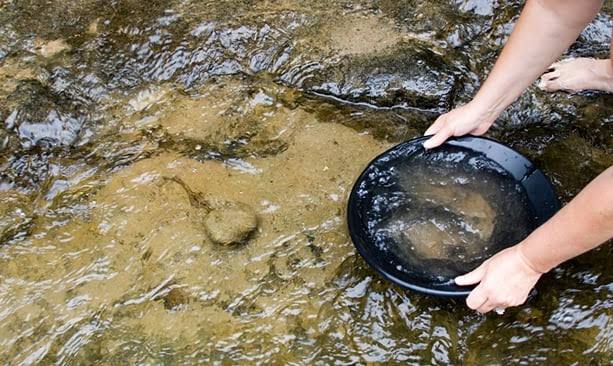
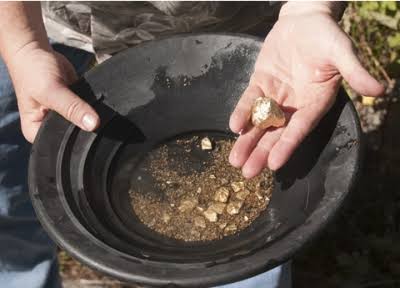
Lode gold is still in the rock where it formed, most often in quartz veins but also as grains too small to see in rocks like Nevada’s Carlin deposits. Placer gold has weathered out of that rock and collected in sand and gravel, usually on or near bedrock.
Tap a number on the drawing to follow gold from the vein to the stream.
A gold nugget from a river still has bits of white quartz stuck in it. What does that tell you?
Path
From the vein to the stream
Lode gold is still in the rock where it formed. Placer gold has weathered out and been carried down into sand and gravel.
+–How we know
The USGS describes two principal kinds of gold deposit: lode (primary) deposits, the target of the hardrock prospector at the place where gold was laid down from mineralizing solutions, and placer (secondary) deposits, which formed when erosion and weathering freed gold from lode deposits and gravity concentrated it. Gold resists weathering, so once free it travels downstream as dust, flakes, grains or nuggets.
The step in between is real too. In the USGS model for gold-quartz veins, like those at Grass Valley and the Mother Lode in California, the soil over a vein holds abundant quartz chips, and gold can be panned from that soil.
Federal mining law uses the same split. A lode claim, under 30 U.S.C. 23, covers veins or lodes of quartz or other rock in place bearing gold. A placer claim, under 30 U.S.C. 35, covers all forms of deposit except veins of quartz or other rock in place.
This gold is still stuck in the white quartz it grew in. To get it out, miners have to break or crush the rock.
Rock
Vein quartz
Mined by
Hardrock mining: digging and crushing the vein
This piece
Grass Valley, California
+–How we know
Grass Valley is one of the type examples in Byron Berger’s USGS model of low-sulfide gold-quartz veins (Bulletin 1693, 1986): gold in massive, persistent quartz veins, mostly in metamorphosed volcanic and sedimentary rocks. The model says the productive quartz is grayish or bluish in many places because of fine sulfides, and lists arsenopyrite, pyrite and galena among its minerals.
Not all lode gold sits in quartz veins. The same bulletin’s model for carbonate-hosted gold, the kind found in Nevada’s Carlin trend, describes very fine grained gold and sulfides spread through limy, carbon-rich rock, gold too small to see.
The photographer, James St. John, took this picture of a specimen on display at the Montana Bureau of Mines and Geology Mineral Museum in Butte.
This nugget still holds bits of quartz from its vein. A river rolled it until its bumps wore smooth.
Found
In river gravel, so it counts as placer gold
Still holds
Grains of vein quartz
This piece
California
+–How we know
The photographer, James St. John, labels this piece a gold-quartz river clast and placer gold from California, on display at the Carnegie Museum of Natural History in Pittsburgh. A clast is a broken piece of older rock.
It shows the USGS account in one object: placer gold comes from lode deposits by erosion and the breakdown of the rock around the gold, and gold is so resistant to weathering that it survives the trip while softer pieces are worn away.
Placer gold has been freed from its rock and washed into a stream. It is so heavy that it sinks to the bottom of the gravel.
Gold
About 19.3 times as heavy as water
Quartz sand
About 2.65 times
Collects
On or near bedrock
These pieces
Washington State
+–How we know
The Handbook of Mineralogy gives gold a measured density of 19.3 grams per cubic centimeter and quartz 2.65, so gold is about 7 times as heavy as the quartz sand around it (19.3 ÷ 2.65 = 7.3).
The USGS explains that gold in streams is often concentrated on or near bedrock because it moves downward during high water, when the whole bed of sand, gravel and boulders is stirred. Rich layers of gold in gravel are called pay streaks.
The photographer, James St. John, took this picture of placer gold from Washington State at the Field Museum in Chicago.
Under the federal Mining Law, which kind of claim covers gold in a quartz vein?
Interactive lesson
How do quartz veins form?
Hot water under pressure moves up cracks and cools, leaving quartz, gold and sulfides on the walls, often in repeated pulses that build banded veins.
Read this lesson+
1. Hot water deep down
Deep underground, water at about 300 °C squeezes up a crack in the rock. The weight of rock above keeps it from boiling, and it carries dissolved quartz and gold.
The gold-quartz veins of California's Sierra Nevada foothills, including the Mother Lode and Grass Valley, formed between about 140 and 110 million years ago, on average about 120 to 115 million years ago.
The water was about 300 to 350 °C and carried carbon dioxide. At Grass Valley the veins formed about 8 km down, some 10 to 11 km down. Around the world, veins like these formed anywhere from 15 to 20 km deep up to near the surface.
Where the water came from is still argued. Böhlke and Kistler tied it to magma deep below; Goldfarb and Groves favour water driven out of rocks heated deep in the crust.
Böhlke and Kistler 1986, Economic Geology 81:296; Taylor et al. 2021, Economic Geology; Groves et al. 1998, Ore Geology Reviews; Goldfarb and Groves 2015, Lithos 233:2.
2. The fault slips
An earthquake jerks the rock and the crack snaps open. The water's pressure drops at once, and it lets go of its quartz and gold.
Geologists call this a fault valve. The fault stays sealed while water pressure builds below it; then a quake breaks it open and the water rushes up.
In one computer model of a magnitude 4 quake 11 km down, the pressure in a gap that suddenly opened fell from 290 to 0.2 megapascals, about 1,000 times, and the water, near 390 °C, flashed to vapour and dropped its load within perhaps a few tenths of a second. Even the model's tiniest quake, with 0.13 mm of slip, halved the pressure.
Not everyone agrees the water boils. At Grass Valley, Taylor and others found no sign in the fluid trapped in the quartz that the water boiled; there a sudden pressure drop and reactions with the wall rock dropped the gold. The white fizz in our picture marks the pressure drop, not proof of boiling.
Sibson, Robert and Poulsen 1988, Geology 16:551; Weatherley and Henley 2013, Nature Geoscience 6:294, model figures as reported by Scientific American; Taylor et al. 2021, Economic Geology.
3. Crystals seal the crack
Quartz crystals grow in from both walls until they meet and seal the crack. Below the seal, water piles up and the pressure climbs again.
At Grass Valley the first quartz grew as the water cooled. Later quartz grew as sharp-faced crystals, some of them into open space.
The water pressure there probably swung back and forth between the full weight of the rock above and the far lower pressure of water in open, connected cracks. That is what the fault-valve idea predicts: seal, build up, break, drain, seal again.
Taylor et al. 2021, Economic Geology; Sibson, Robert and Poulsen 1988, Geology 16:551.
4. Again and again
Each new quake splits the vein open and a new band of quartz grows. Band after band, the vein gets thicker and striped.
Weatherley and Henley argue that many quakes build a gold deposit up bit by bit. They suggest one fault system can have thousands to hundreds of thousands of small quakes a year, and over hundreds of thousands of years these could drop large amounts of gold.
Real veins reopen in different places, sometimes down the middle as we show, sometimes along an edge. We draw 8 openings, each made far wider than real so you can see it.
Each slip also moves one side of the fault. Watch the pale layer on the right step upward.
Weatherley and Henley 2013, Nature Geoscience 6:294, and as reported by Scientific American; Ramsay 1980, Nature 284:135; Sibson, Robert and Poulsen 1988.
5. Gold and pyrite
Most of the vein is plain white quartz. Gold sits in small specks, often near brassy pyrite, the mineral people call fool's gold.
At Grass Valley, the biggest historic gold producer in the mountains of western North America, gold came in two rounds. First it grew with pyrite and arsenopyrite where the water reacted with the wall rock, hidden inside the pyrite in grains too small to see. Last came gold you can see, after a sudden pressure drop.
The water also changed the rock beside the veins: that is the pale rim in our picture, with pyrite in it.
We show far more visible gold than most veins hold. How big nuggets form is still open. In a 2024 lab test, squeezing quartz in gold-bearing water made enough voltage to plate gold onto it, and the gold grew on grains already there. No one has yet shown this happens in real veins.
Taylor et al. 2021, Economic Geology; Böhlke and Kistler 1986, Economic Geology 81:296; Voisey et al. 2024, Nature Geoscience.
6. Make the next quake
Now you are the earthquake. Tap the rock to make the fault slip, and build three more bands.
Veins like this reach the surface only after the rock above wears away. Weathering then frees the gold, and streams carry it into their gravels.
California has produced more than 40 million troy ounces of gold from placers. The USGS traces the great bulk of it to the quartz veins of the Mother Lode and related systems in the western Sierra Nevada.
Yeend, Shawe and Wier 1989, USGS Bulletin 1857.
7. You built a banded vein
Turn the block with your finger. Tap a band, the gold or the pyrite to name it.
Check: what made the stripes in a banded quartz vein?
Each stripe grew after the crack opened again. Each quake opened the crack again, and hot water filled the new gap with another band of quartz.
The written version of the interactive lesson “How do quartz veins form?”.
Hidden in Stone: Discover the Surprising Rocks That Harbor Gold
Gold has fascinated humans for thousands of years. From ancient civilizations that crafted jewelry and coins to modern miners who search remote mountains, gold has always represented wealth, beauty, and mystery. But one question still excites rockhounds and prospectors alike: where does gold actually come from, and what types of rocks contain it?
When most people think of finding gold, they imagine panning in a river or spotting a shiny nugget on the ground. While that does happen, it's only part of the story. Gold is often locked away in rocks deep beneath the surface, formed through geological processes that took place millions of years ago. To understand how and where to look for it, we need to explore the kinds of rocks that host this precious metal, the conditions that create deposits, and how rockhounds can identify potential gold-bearing sites.
This article takes you through the science in plain English. We'll talk about how gold ends up in rocks, the main types of rocks that contain it, and how you can recognize these rocks in the field. We'll also look at famous gold deposits around the world and share tips for anyone who wants to go rockhounding for gold responsibly.
How Gold Gets Into Rocks
Before we talk about the specific rocks, it helps to understand how gold actually gets there. Gold doesn't just appear randomly; it's transported and deposited by natural processes over long spans of time. The main process is something geologists call hydrothermal activity.
Deep underground, hot fluids rich in minerals move through cracks and fractures in the Earth's crust. These fluids carry dissolved metals, including gold. When the fluids cool down or encounter changes in pressure, the gold drops out and gets trapped in the surrounding rocks. Over millions of years, this can form veins, small inclusions, or even large-scale ore deposits.
Gold can also accumulate in riverbeds and other sedimentary environments. As rocks containing gold break down through weathering, the heavier gold particles wash downstream and settle in low spots where water slows down. That's how placer deposits form—the source of many nuggets found by panners.
In short, gold ends up in rocks through two main paths:
Being locked into the rock itself during hydrothermal or geological processes.
Being concentrated by erosion and transport into sediments.
Knowing this helps us understand why certain rocks are far more likely to contain gold than others.
Quartz Veins in Igneous and Metamorphic Rocks
If you've ever seen a piece of quartz shot through with tiny golden specks, you've already met one of the most common hosts of gold: quartz veins. Quartz is a hard, glassy mineral made of silica, and it often forms when hot, mineral-rich fluids cool and crystallize in fractures. These fluids are the same ones that can carry gold, so quartz veins are natural traps for gold deposition.
Many of the world's classic gold districts, from California's Mother Lode to Australia's goldfields, are famous for their quartz-gold relationships. Gold in quartz can appear in two main ways. Sometimes you can actually see visible "free gold" as small flakes or even nuggets nestled in the quartz. Other times, the gold is microscopic, trapped inside sulfide minerals like pyrite ("fool's gold"), arsenopyrite, or chalcopyrite that are mixed with the quartz.
Gold-bearing quartz veins are most often found in igneous rocks like granite and rhyolite, or in metamorphic rocks like schist and slate. These rocks provide the fractures and the geological environments where hydrothermal fluids can move and deposit minerals. For rockhounds, seeing quartz veins cutting through darker host rock can be a sign worth investigating.
Sedimentary Hosts: Carlin-Type and Placer Deposits
While quartz veins are probably the most famous gold host, sedimentary rocks also play an important role. In Nevada, for example, a huge amount of gold is found in what geologists call Carlin-type deposits. These deposits don't usually contain visible gold; instead, the gold is present as tiny particles dispersed within pyrite and other sulfide minerals in carbonate rocks like limestone and dolomite.
Carlin-type deposits form when hot, chemically active fluids move through sedimentary basins. Instead of depositing large nuggets, they leave behind microscopic gold that's often invisible to the naked eye. Nevada's Carlin Trend is one of the world's richest gold-producing regions because of this unusual process.
On the other end of the spectrum are placer deposits, which are probably the most familiar to amateur prospectors. Placer deposits form when gold erodes out of primary rocks (like quartz veins) and gets transported by water. Because gold is heavy, it tends to settle in places where the current slows down, such as bends in rivers, cracks in bedrock, or behind large rocks. Over time, these accumulations can become rich enough to mine.
There are different kinds of placer deposits:
Alluvial placers in active rivers and streams.
Eluvial placers, where gold accumulates downslope of its original source.
Paleo-placers, which are ancient riverbeds now buried by other rock layers.
One of the most famous paleo-placer deposits is South Africa's Witwatersrand Basin, which has produced more gold than any other region in history.
Hydrothermal Systems: Orogenic and Skarn Deposits
Another major group of gold-bearing rocks are those associated with hydrothermal systems. These include orogenic gold deposits, which form along fault zones during mountain-building events, and skarn deposits, which form where hot fluids from an intrusion react with carbonate rocks like limestone.
In orogenic deposits, gold is usually found in quartz-carbonate veins together with sulfide minerals. These veins often cut across metamorphic rocks that have been highly deformed by tectonic forces. Orogenic deposits are a global phenomenon and have provided much of the world's lode gold.
Skarn deposits are a bit different. They occur where igneous intrusions, like granite bodies, come into contact with carbonate rocks. The heat and fluids from the intrusion cause chemical reactions that produce new minerals, and gold can be concentrated in the altered zones. Skarns are often associated with copper and other metals, but some can be surprisingly rich in gold.
Both types of deposits highlight the role of hot, mineral-rich fluids and the right geological conditions. Without fractures, reactive host rocks, and the right chemistry, the gold would never be deposited in concentrated amounts.
Other Mineral Associations
Gold doesn't always travel alone. It often appears alongside other minerals that can act as clues for prospectors. Common companions include quartz, carbonates like calcite, and sulfides such as pyrite and arsenopyrite. In some cases, gold is linked with tellurides (minerals combining gold with tellurium), stibnite (antimony sulfide), or fahlore (a group of copper-antimony-sulfide minerals).
While these minerals don't guarantee gold, their presence can suggest that the geological system had the right conditions to concentrate it. Experienced rockhounds often learn to read these mineral "signatures" in the field.
How to Identify Gold-Bearing Rocks in the Field
For hobbyists and rockhounds, the challenge is figuring out whether a rock might actually contain gold. While laboratory testing provides the most reliable results, there are some field clues to watch for.
Quartz veins cutting through other rocks are always worth a look, especially if they show signs of iron staining (a rusty color) from sulfide minerals breaking down. Areas near old faults or shear zones can also be promising, since these structures often guided the flow of gold-bearing fluids.
If you're panning in a stream, heavy black sands made of magnetite and other dense minerals can signal good conditions for placer gold. Gold itself is distinctively heavy, soft, and malleable compared to pyrite or mica, which can look similar but behave differently when tested.
For more serious prospecting, geologists often use hand lenses, streak plates, or even acid tests to check minerals. But for casual rockhounds, the main thing is learning what promising rocks look like and knowing where to look for them.
Famous Gold Deposits Around the World
To see these principles in action, let's look at a few real-world examples.
The Mother Lode region of California is a classic case of quartz veins rich in gold. During the Gold Rush of the 1800s, prospectors followed these veins for miles, uncovering a network of lodes that fueled a historic boom.
In Nevada, the Carlin Trend illustrates sediment-hosted gold. Instead of nuggets, miners extract microscopic gold invisible to the naked eye. This type of deposit has made Nevada one of the top gold producers in the world.
Meanwhile, South Africa's Witwatersrand Basin shows the power of placer deposits. These ancient riverbeds, now buried beneath layers of rock, have yielded more gold than any other single location on Earth.
Each of these examples highlights how gold can occur in very different geological settings, from quartz veins to sedimentary basins to ancient river deposits.
Tips for Rockhounding Enthusiasts
If you're interested in looking for gold yourself, start by studying the geology of your region. Local rockhounding clubs, geological surveys, or even old mining reports can point you toward areas with a history of gold occurrence. Look for places with quartz veins, fault zones, or old placer workings.
When prospecting, always make sure you understand the rules. Some areas are private property, others are protected lands where collecting is prohibited. There are also safety considerations, especially around abandoned mines or unstable rock outcrops.
The best approach is to treat gold hunting as an adventure and a learning experience. Even if you don't strike it rich, you'll gain knowledge about geology and enjoy the excitement of discovery. Many rockhounds find that the real reward is the connection with nature and the thrill of uncovering hidden stories in stone.
Pulling It All Together
So, what types of rocks contain gold? The answer is diverse. Gold hides in quartz veins within igneous and metamorphic rocks, in microscopic form within sedimentary basins, in river gravels as placer deposits, and in hydrothermal systems like orogenic and skarn deposits. It can appear alongside sulfide minerals, in association with tellurides or carbonates, or locked away in ancient riverbeds.
For rockhounds, knowing these rock types isn't just about science—it's about adventure. Each outcrop or streambed offers the chance of discovery. And while not every rock will sparkle with gold, learning to read the signs can make the hunt all the more rewarding.
Gold may be hidden in stone, but with knowledge, patience, and a keen eye, you can begin to uncover its secrets.
Frequently Asked Questions About Rocks That Contain Gold
No, gold isn't evenly spread across all rocks. It's concentrated in specific geological environments, such as quartz veins in igneous and metamorphic rocks, sedimentary deposits like the Carlin Trend, and placer deposits in riverbeds. While trace amounts of gold exist in many rocks, only certain rock types contain enough to be of interest to rockhounds or miners.
The biggest look-alike is pyrite, also called fool's gold. Unlike real gold, pyrite forms sharp, cube-like crystals and is brittle—it will shatter if struck. Gold, on the other hand, is soft and malleable; you can flatten it with a hammer without breaking it. Gold also has a warm yellow color that doesn't tarnish, while pyrite can look brassy or develop a dull surface over time.
Not always. Some deposits, especially Carlin-type deposits in Nevada, contain gold that's microscopic and invisible to the naked eye. In these rocks, gold occurs as tiny particles locked within sulfide minerals. In other cases, such as quartz veins, gold may appear as visible flakes or even nuggets.
For most beginners, quartz veins are the best starting point. They're relatively easy to spot in the field—white or glassy streaks cutting through darker host rocks—and have a strong historical association with gold. Streams draining from areas with quartz veins are also great places to check for placer gold.
Yes. Metamorphic rocks like schist and slate often host gold-bearing quartz veins, especially in regions where mountain-building has created fault zones and fractures. Many famous "orogenic" gold deposits are found in metamorphic belts formed during tectonic collisions.
Absolutely. Volcanic rocks such as rhyolite and basalt can contain gold, especially when they've been fractured and filled with quartz veins. Hydrothermal systems linked to volcanic activity often transport and deposit gold. Some epithermal gold deposits, for example, are directly tied to ancient volcanic systems.
Placer gold is most often found in streambeds where water slows down. Look in cracks in bedrock, behind large rocks, inside bends of rivers, or at the base of waterfalls. These natural traps allow heavy gold particles to settle while lighter materials wash away.
It depends on where you're searching. On private land, you'll need the owner's permission. On public land, rules vary—some areas allow recreational panning or rock collecting, while others are off-limits to protect natural resources. Always check local regulations before collecting, and never dig or pan in restricted or protected areas.
While it's technically possible, it's rarely practical or safe. Gold locked inside sulfide minerals or microscopic grains requires specialized equipment and chemical processes to extract. Crushing and panning quartz for visible free gold is something hobbyists can try on a small scale, but large-scale extraction should be left to professionals.
Quartz forms from the same hydrothermal fluids that carry gold. As these hot, mineral-rich fluids move through fractures in the Earth's crust, quartz crystallizes out—and gold often precipitates at the same time. This is why quartz veins are one of the strongest indicators of possible gold mineralization.