
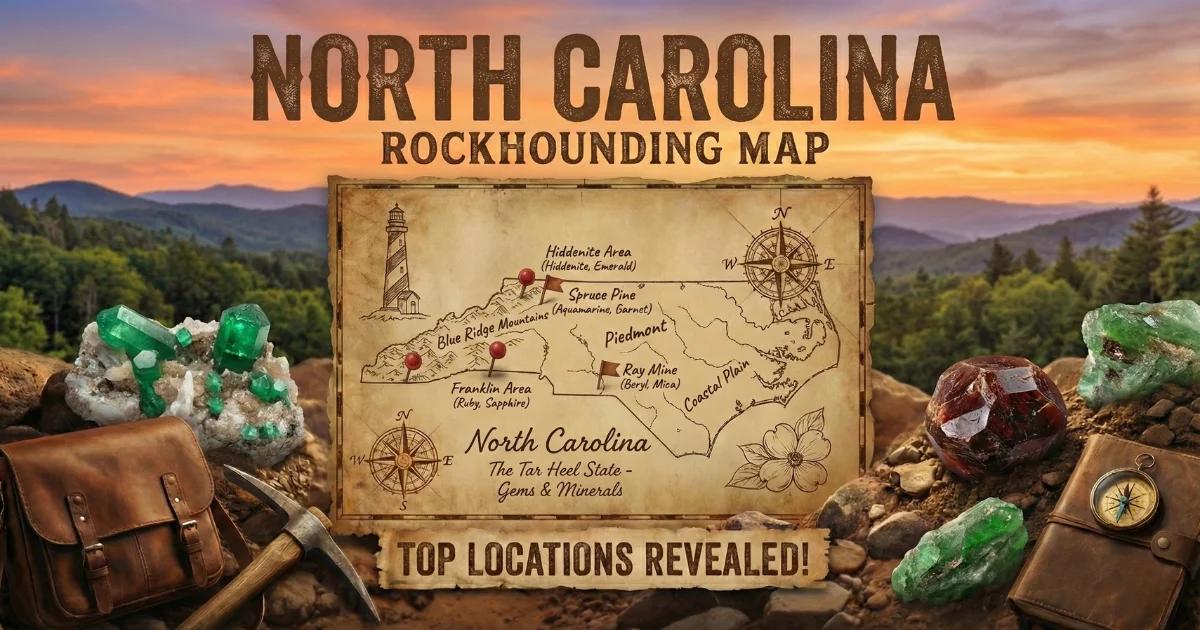
North Carolina has produced more gem-quality mineral species than any other state east of the Mississippi. The western mountains sit on Precambrian metamorphic and igneous basement rock — gneiss, schist, and pegmatite — that yields rubies, sapphires, emeralds, aquamarine, garnet, moonstone, and dozens of other gem minerals. The three primary collecting districts are Franklin (corundum), Hiddenite (emerald and hiddenite), and Spruce Pine (aquamarine and pegmatite gems).
Most collecting happens at fee-dig operations on private land. Public collecting on National Forest land in the Nantahala and Pisgah ranges is possible for surface specimens, but gem-bearing veins on federal land require no commercial extraction.

Rubies and Sapphires — Cowee Valley, Franklin (Macon County)
Land Status: Private fee-dig mines. No BLM land in North Carolina.
The Cowee Valley near Franklin sits on the Cowee-Buck Creek mafic-ultramafic complex, a belt of corundum-bearing rock that runs through Macon County. This area has produced rubies and sapphires since the late 1800s. The corundum occurs in placer gravels derived from weathered amphibolite and dunite.
Cherokee Ruby & Sapphire Mine
Location: 41 Cherokee Mine Rd, Franklin, NC 28734 (approx. 35.196°N, 83.384°W).
Access: Paved road, sedan OK. Open April–October, typically 9 AM–5 PM.
Fee: $25 per bucket of native gravel. Sluice provided.
Specimens: Ruby (pink-red corundum), sapphire (blue, pink, white, yellow), rhodolite garnet, rutile, sillimanite, moonstone.
What to expect: This is native ground — unenhanced Cowee Valley alluvial gravel. Most rough is under 1 carat, but stones over 5 carats appear occasionally. The rubies tend toward pink rather than deep red. Heat treatment by local lapidaries can improve color saturation. Bring tweezers and a 10x loupe to pick small stones from the sluice.
Sheffield Mine
Location: 385 Sheffield Mine Rd, Franklin, NC 28734 (approx. 35.198°N, 83.376°W).
Access: Gravel road, sedan OK in dry conditions. Open May–October.
Fee: Varies by bucket size. Call ahead: (828) 369-8383.
Specimens: Sapphires in blues, pinks, whites, and occasional star sapphire rough. Also garnet, sillimanite, kyanite.
What to expect: Native ground. Sheffield is known for producing larger sapphire rough than neighboring mines. The material is screened and sluiced on-site. Staff can help identify finds.
Mason Mountain Mine & Cowee Gift Shop
Location: 5315 Bryson City Rd, Franklin, NC 28734 (approx. 35.213°N, 83.398°W).
Access: Paved road. Open April–October.
Fee: $25+ per bucket.
Specimens: Rhodolite garnet (the site produces some of the best rhodolite in the Southeast), sapphire, ruby, moonstone, rutile.
What to expect: Native Cowee Valley material. The rhodolite garnet here is a raspberry-red color and can be gem-quality. Bring a spray bottle — wetting stones reveals color better than viewing them dry.
How to Identify Corundum in the Sluice
| Property | Corundum (Ruby/Sapphire) | Common Look-Alikes |
|---|---|---|
| Hardness | 9 (Mohs) — scratches everything except diamond | Garnet: 6.5–7.5. Quartz: 7. |
| Crystal Shape | Hexagonal barrel or tabular crystal | Garnet: dodecahedral. Quartz: prismatic. |
| Heft | Heavy — SG 4.0 | Garnet: SG 3.5–4.3. Quartz: SG 2.65. |
| Color | Ruby: pink to red. Sapphire: blue, pink, white, yellow, green | Rhodolite garnet is raspberry-pink, often confused with ruby. |
| Parting/Fracture | Conchoidal fracture, no cleavage | Same for garnet and quartz. |
The scratch test is the most reliable field method. If the stone scratches a steel file (hardness 6.5), it may be corundum or garnet. If it also scratches quartz (hardness 7), it is almost certainly corundum.
Emeralds — Hiddenite (Alexander County)
Land Status: Private fee-dig mine.
The small town of Hiddenite is named after hiddenite, a green variety of spodumene first discovered here in 1879 by W.E. Hidden. The area sits on the Kings Mountain shear zone, where pegmatite veins intruding through gneiss and schist produce emerald, hiddenite, aquamarine, sapphire, garnet, and rutile.
Emerald Hollow Mine
Location: 484 Emerald Hollow Mine Dr, Hiddenite, NC 28636 (approx. 35.724°N, 81.107°W).
Access: Paved road, sedan OK. Open year-round (weather permitting).
Fee: $15–$30 per person depending on activity (sluicing, creeking, or digging).
Specimens: Emerald (chromium-bearing beryl), hiddenite (green spodumene — the mineral this town is named after), aquamarine, sapphire, garnet, rutile, smoky quartz, tourmaline, and amethyst.
What to expect: This is the only emerald mine in the US open to the public. The pegmatite veins produce genuine chromium-colored beryl — not just green beryl, but actual emerald with chromium as the chromophore. Most specimens are small, fractured, and translucent rather than transparent, but occasional gem-grade stones appear. The digging area exposes pegmatite and country rock where you extract material yourself. Creeking involves walking the stream and picking up float. Sluicing uses provided equipment.
How to identify emerald in the field: Look for green hexagonal prisms in white quartz or pegmatite matrix. Emerald has a hardness of 7.5–8, so it scratches quartz easily. Color ranges from pale green to deep green. Do not confuse with green epidote (hardness 6–7, pistachio green, prismatic crystals) or chrome diopside (hardness 5.5–6.5, darker green). If in doubt, staff at the mine can help with identification.
Aquamarine and Pegmatite Gems — Spruce Pine (Mitchell County)
Land Status: Mix of private mines and Pisgah National Forest (surface collecting only on NF land — no digging or commercial extraction).
The Spruce Pine mining district in Mitchell County is one of the world's largest concentrations of pegmatite. The area has been mined commercially for feldspar, mica, and high-purity quartz for over a century. The pegmatite veins also produce gem-quality aquamarine, golden beryl (heliodor), smoky quartz, moonstone, garnet, and occasionally emerald.
Gem Mountain
Location: 13780 NC-226 Hwy S, Spruce Pine, NC 28777 (approx. 35.868°N, 82.096°W).
Access: Paved highway. Open May–October.
Fee: Varies by bucket type. Enriched and native options available — ask which is which.
Specimens: Aquamarine, emerald, sapphire, ruby, garnet, citrine, amethyst, smoky quartz, tourmaline.
Note: Some buckets here are enriched (salted with non-native material). If you want genuine Spruce Pine minerals, specifically request native buckets and ask staff about the source.
Mine Dumps and Private Claims
Numerous historic feldspar and mica mine dumps exist throughout Mitchell County. Most are on private land. Check with local rock shops — particularly the Spruce Pine Gem & Mineral Museum — for current access to any open claims. Permission is required. Never enter a posted or fenced mine property.
Crabtree Emerald Mine (Historic)
Location: Near Crabtree Falls, approx. 35.811°N, 82.139°W.
Status: Currently closed to public collecting. Historically produced some of North Carolina's finest emeralds from pegmatite veins. The site is on private land. Do not trespass.
Other NC Gem Hunting Locations
Little Switzerland (McDowell County)
Location: Along the Blue Ridge Parkway, approx. 35.850°N, 82.034°W.
The area around Little Switzerland has produced garnet, emerald, and aquamarine from pegmatite veins. Emerald Village (operated by the NC Mining Museum) offers an underground mine tour and gem panning. Fee: ~$10–25.
Ray Mine (Burnsville, Yancey County)
Location: Near Burnsville, approx. 35.918°N, 82.289°W.
The Ray Mine is a historic mica and feldspar pegmatite that has produced aquamarine, golden beryl, and garnet. Access varies — check with the Yancey County Chamber of Commerce or local rock shops for current status.
Nantahala National Forest — Surface Collecting
Land Status: US Forest Service. Surface collecting of reasonable quantities for personal use is permitted. No digging, blasting, or commercial extraction. Follow 36 CFR 261.9(a) regulations.
What to look for: Garnet, staurolite, kyanite, and quartz crystals in stream gravels and road cuts. The metamorphic rocks throughout the Nantahala range contain these minerals. Road cuts along US-64 between Franklin and Highlands occasionally expose garnet-bearing schist.
What to Bring
| Item | Why |
|---|---|
| 10x hand lens (loupe) | Essential for examining crystal faces and identifying corundum vs. garnet |
| Tweezers | Picking small gems from sluice screens |
| Spray bottle | Wetting stones reveals true color — dry corundum often looks dull gray |
| Small containers/vials | Protect small gem rough from scratching |
| Sunscreen and hat | Fee-dig sites are exposed. Even mountain sun burns at elevation. |
| Sturdy shoes | Stream beds and mine areas are uneven with sharp rocks |
| Steel file | Scratch testing: if the stone scratches the file (hardness 6.5), it may be corundum |
| Rock hammer and chisel | For digging areas at Emerald Hollow or mine dumps (not needed for sluicing) |
Practical Tips
- Native vs. enriched: Ask each mine directly whether their material is native (from the actual local ground) or enriched (non-local stones added to buckets). The mines listed in the Franklin section above use native Cowee Valley alluvial material. Some Spruce Pine operations enrich.
- Cutting services: Multiple lapidaries in Franklin will cut and facet your rough. Expect $30–75 per stone depending on size and complexity. Ask at the mine for current recommendations.
- Best season: April through October for most fee-dig operations. July and August are hottest and busiest. Late September and early October offer cooler temps and thinner crowds.
- Rainy days: Some sluice operations run rain or shine (you are already working with water). Heavy rain can close digging areas. Call ahead.
- Accommodation: Franklin has multiple motels and campgrounds. The Cowee Valley mines are a 10–15 minute drive from downtown Franklin.
Minerals You Can Find in North Carolina
| Mineral | Hardness | Where in NC | What to Look For |
|---|---|---|---|
| Ruby (corundum) | 9 | Cowee Valley, Franklin | Pink to red hexagonal crystals in gravel |
| Sapphire (corundum) | 9 | Cowee Valley, Franklin | Blue, pink, white, yellow rough. Heavy for its size. |
| Emerald (beryl) | 7.5–8 | Hiddenite, Crabtree, Spruce Pine | Green hexagonal prisms in quartz/pegmatite |
| Aquamarine (beryl) | 7.5–8 | Spruce Pine, Mitchell County | Pale blue-green hexagonal crystals in pegmatite |
| Hiddenite (spodumene) | 6.5–7 | Hiddenite, Alexander County | Yellow-green to emerald-green prismatic crystals |
| Rhodolite garnet | 7–7.5 | Cowee Valley, Mason Mountain | Raspberry-red to purple dodecahedral crystals |
| Staurolite | 7–7.5 | Blue Ridge road cuts, Nantahala NF | Brown cruciform (cross-shaped) twins — "fairy crosses" |
| Kyanite | 5–7 | Blue Ridge road cuts | Blue bladed crystals in schist. Hardness varies by direction. |
| Moonstone (feldspar) | 6–6.5 | Cowee Valley, pegmatites | Translucent with bluish adularescence (sheen) |
| Smoky quartz | 7 | Spruce Pine pegmatites | Brown to black translucent prismatic crystals |
Interactive Map
Find all North Carolina gem mines, fee-dig sites, and collecting locations on our North Carolina rockhounding map with GPS coordinates and access details.