
New York Geology: Why This State Produces World-Class Minerals
New York sits on some of the most geologically varied terrain in the eastern United States. The bedrock tells a story that spans more than a billion years, from the Precambrian metamorphic core of the Adirondack Mountains to the Devonian sedimentary basins of the Finger Lakes region. That range of rock types and ages is exactly why New York produces such a diverse mineral suite.
The Adirondack dome is an exposed section of the Grenville Province, a belt of high-grade metamorphic and igneous rocks that formed during continental collisions roughly 1.0 to 1.3 billion years ago. These rocks were buried 15 to 25 miles deep, subjected to granulite-facies metamorphism, then slowly uplifted. That extreme pressure and temperature history is responsible for the world-class garnet deposits at Gore Mountain, the labradorite-rich anorthosite bodies, and the wollastonite occurrences near Willsboro. The Adirondacks are not part of the Appalachian chain. They are a separate structural dome of ancient basement rock that punched through younger cover.
South of the Adirondacks, the Mohawk Valley and Herkimer County expose Cambro-Ordovician carbonate rocks, specifically the Little Falls Dolostone. This 500-million-year-old formation hosts the vugs and cavities where Herkimer diamonds grow. The crystals formed when silica-rich fluids migrated through porous dolomite over hundreds of millions of years, depositing quartz in open spaces.
Central and western New York are dominated by Devonian-age shales, limestones, and sandstones laid down in a shallow sea roughly 360 to 420 million years ago. These rocks are the source of well-preserved fossils: trilobites, brachiopods, crinoids, and corals. The Finger Lakes region, carved by Pleistocene glaciers, exposes these fossil-bearing beds in stream cuts and road cuts throughout the area.
In the southeastern corner, the Manhattan Prong (the bedrock beneath New York City and Westchester County) consists of metamorphosed Paleozoic sediments, including the Manhattan Schist, which contains small but collectible almandine garnets. Subway excavations and construction projects have turned up garnets for over a century.
This geological diversity makes New York one of the top mineral-collecting states east of the Mississippi. The state has produced over 350 documented mineral species. What follows is a field-level guide to the best collecting locations, the minerals you can expect, and the logistics of getting there.
Top Collecting Locations
1. Herkimer Diamond Mines — Middleville, Herkimer County
GPS: 43.1714 N, 74.9817 W
Land status: Private, fee-dig. Open to the public seasonally (typically April through November).
Vehicle: 2WD. Paved road to the site. Parking lot on-site.
Minerals: Doubly-terminated quartz crystals (Herkimer diamonds), some with hydrocarbon inclusions (black "anthraxolite" inclusions), rare skeletal quartz, druzy quartz.
This is the flagship fee-dig operation for Herkimer diamonds and the most visited mineral collecting site in the state. The mine exposes the Little Falls Dolostone at the surface. Collectors work exposed bedrock benches using hammers and chisels to crack open vugs (cavities) in the dolomite. Crystals range from a few millimeters to fist-sized specimens, though anything over 2 cm with good clarity is a solid find.
The geology here is straightforward. The dolostone contains solution cavities lined with druzy quartz and, in productive pockets, free-standing doubly-terminated crystals. The double termination occurs because the crystals grew unattached inside open vugs rather than growing off a matrix wall. This is what distinguishes a Herkimer diamond from ordinary quartz points.
Admission runs $15 to $18 per person per day. Tools are available for rent. The site includes a rock shop, restrooms, and picnic areas. Expect crowds on summer weekends. Weekdays in May or September are the best times for serious collecting with fewer people.
2. Ace of Diamonds Mine — Middleville, Herkimer County
GPS: 43.1542 N, 74.9731 W
Land status: Private, fee-dig. Seasonal operation.
Vehicle: 2WD. Paved access.
Minerals: Herkimer diamonds, smoky quartz crystals, dolomite crystals, occasional pyrite.
Ace of Diamonds is the second major fee-dig operation in the Herkimer district. It sits on the same geological formation as the Herkimer Diamond Mines but offers a different collecting experience. The operation is smaller, less commercial, and typically less crowded. Fees run $12 to $15 per day.
The exposed rock here tends to be slightly more weathered in some areas, which can make pocket extraction easier for beginners. The same collecting techniques apply: crack the dolostone along natural fracture planes, look for vugs, and extract crystals carefully to preserve terminations. A 3-pound crack hammer and flat-blade chisels are the primary tools. Pry bars help with larger blocks.
Some collectors report finding smoky-colored Herkimer diamonds at this location more frequently than at the main mine. Smoky coloration results from natural irradiation of the quartz over geological time and these specimens command a premium among collectors.
3. Gore Mountain / Barton Mine — North Creek, Warren County
GPS: 43.6728 N, 74.0486 W
Land status: The Barton Mine is privately owned by Barton International. Public access is limited to seasonal guided tours. Gore Mountain itself is partly on state land. No unauthorized collecting.
Vehicle: 2WD to the mine tour parking area. Backcountry access to surrounding Adirondack areas may require high-clearance vehicle or hiking.
Minerals: Almandine garnet (crystals up to 3 feet across in the bedrock), hornblende, biotite, plagioclase feldspar.
Gore Mountain contains the largest known garnet deposit on Earth. The garnets here formed during Grenville-age metamorphism when gabbroic rock (metagabbro) was subjected to amphibolite-facies conditions. The result is almandine garnet crystals that can exceed one meter in diameter in the host rock. These are not gem-quality at large sizes; they are opaque, dark red to nearly black, and heavily fractured. But smaller crystals in the 1 to 5 cm range can show good color and translucency.
The Barton Mine has operated commercially since 1878, producing garnet abrasives for sandpaper, waterjet cutting, and filtration media. The company offers guided tours during summer months. Collecting is restricted. You cannot hammer the outcrops. However, loose garnet crystals can sometimes be picked up from tailings piles during tours, depending on current policy. Check with Barton International before visiting.
The surrounding Adirondack Park land contains scattered garnet occurrences in metamorphic rock. Road cuts along NY Route 28 between North Creek and Indian Lake occasionally expose garnet-bearing gneiss. Collecting from road cuts on state highway rights-of-way occupies a legal gray area. Stick to loose material on the ground surface to stay safe.
4. Pierrepont — St. Lawrence County
GPS: 44.4908 N, 74.9656 W (general area; specific outcrops require local knowledge)
Land status: Mix of private land and state forest. Permission required for private parcels. Check DEC regulations for state land.
Vehicle: High-clearance recommended for some back roads. Some sites require hiking 0.5 to 1 mile from parking.
Minerals: Dravite tourmaline, tremolite, talc, phlogopite, diopside, calcite, pyrite.
The Pierrepont area in St. Lawrence County is one of the classic mineral localities in the northeastern United States. The rocks here are Precambrian marbles and calc-silicate gneisses of the Adirondack Lowlands. Metamorphism of impure carbonate rocks produced a suite of calcium and magnesium silicates, with dravite (magnesium tourmaline) being the standout collector mineral.
Pierrepont dravite occurs as brown to dark brown prismatic crystals, sometimes exceeding 5 cm in length, embedded in white calcite marble. Well-formed crystals with good terminations are prized cabinet specimens. Associated minerals include green diopside, white tremolite blades, golden phlogopite mica books, and occasional pyrite cubes.
Access is the main challenge here. Many of the best-known outcrops are on private land, and landowner relationships have varied over the years. Some landowners have historically allowed collecting by permission; others have not. The local mineral club (St. Lawrence County Mineral Club) is a good resource for current access information. Never collect on private land without explicit permission.
5. Willsboro / Lewis Area — Essex County
GPS: 44.3631 N, 73.3928 W (Willsboro area)
Land status: NYCO Minerals (now Imerys) operates the wollastonite mine commercially. Public access is not generally permitted to the active mine. Road cuts and adjacent outcrops on public rights-of-way may yield specimens.
Vehicle: 2WD for road cuts. High-clearance for back roads in the area.
Minerals: Wollastonite, garnet, diopside, labradorite, titanite (sphene), scapolite.
The Willsboro wollastonite deposit is one of the largest in the world. Wollastonite is a calcium inosilicate (CaSiO3) that forms during contact metamorphism of siliceous limestone. The mineral occurs here as white to pale gray bladed masses, sometimes in spectacular radiating clusters. Industrial wollastonite is used in ceramics, plastics, and paint.
For collectors, the interest lies in wollastonite specimens with associated garnet, diopside, and titanite. Road cuts along NY Route 9N between Elizabethtown and Willsboro expose metamorphic rocks that occasionally contain these assemblages. The Adirondack anorthosite in this region also produces labradorite feldspar with blue-green iridescence (labradorescence). Look for this in the grayish anorthosite outcrops along I-87 (the Northway) through Essex County.
6. Finger Lakes Devonian Shale Belt — Central/Western New York
GPS: 42.6 N, 76.8 W (general region; specific sites span from Cayuga to Canandaigua lakes)
Land status: State parks, stream beds, and public road cuts. Collecting regulations vary by park. Fossils may be collected for personal use from most state land, but check individual park rules. No collecting in gorge trails without permission.
Vehicle: 2WD for most sites. Parking available at state parks and roadside pull-offs.
Minerals/Fossils: Trilobites (Phacops, Greenops, Eldredgeops), brachiopods (Mucrospirifer, Mediospirifer), crinoid columnals, horn corals (Heliophyllum), tabulate corals (Favosites), bryozoans, gastropods, pelecypods.
The Devonian shales and limestones of central and western New York are among the most productive fossil-collecting grounds in the eastern United States. The rocks were deposited in a shallow epicontinental sea during the Middle and Late Devonian, roughly 380 to 360 million years ago. Glacial erosion during the Pleistocene carved the Finger Lakes and exposed thousands of feet of fossiliferous section in gorge walls, stream beds, and hillside outcrops.
Key collecting areas include Eighteenmile Creek near Hamburg (Erie County), Kashong Shale exposures near Penn Yan (Yates County), Tully Limestone near Tully (Onondaga County), and the Windom Shale near Canandaigua. Trilobites are the most sought-after specimens. Enrolled Phacops (Eldredgeops rana) is common in the Windom Shale and can often be found by splitting shale slabs along bedding planes. Complete specimens are uncommon but not rare. Brachiopods are abundant at nearly every exposure.
Stream-bed collecting after spring floods is productive. High water scours fresh material from upstream outcrops and deposits it on gravel bars. Bring a flat-blade chisel and a small sledge for splitting shale. Newspaper and bubble wrap are essential for protecting finds during transport.
Key Minerals and Specimens
| Mineral | Composition | Hardness | Primary Location | Notes |
|---|---|---|---|---|
| Herkimer diamond (quartz) | SiO2 | 7 | Herkimer County | Doubly-terminated, water-clear. Some contain hydrocarbon inclusions. |
| Almandine garnet | Fe3Al2(SiO4)3 | 7 - 7.5 | Warren County (Gore Mountain), Adirondacks, Manhattan | World's largest crystals at Gore Mountain. Small gem-quality stones possible. |
| Labradorite | (Ca,Na)(Al,Si)4O8 | 6 - 6.5 | Essex County, Adirondack anorthosite | Blue-green iridescence. Best seen on polished faces. |
| Dravite (tourmaline) | NaMg3Al6(BO3)3Si6O18(OH)4 | 7 - 7.5 | Pierrepont, St. Lawrence County | Brown prismatic crystals in calcite marble. |
| Wollastonite | CaSiO3 | 4.5 - 5 | Willsboro, Essex County | White bladed masses. Industrial mineral. Specimen-quality pieces available. |
| Diopside | CaMgSi2O6 | 5.5 - 6.5 | Pierrepont, Willsboro | Green prismatic crystals in calc-silicate rocks. |
| Tremolite | Ca2Mg5Si8O22(OH)2 | 5 - 6 | St. Lawrence County | White to pale green bladed crystals. Handle with care (fibrous varieties exist). |
| Titanite (sphene) | CaTiSiO5 | 5 - 5.5 | Essex County | Wedge-shaped brown to yellow crystals. High dispersion when gem-quality. |
| Phacops trilobite (fossil) | Calcite replacement | 3 (matrix) | Finger Lakes, central/western NY | Enrolled and outstretched specimens. Middle Devonian shales. |
| Pyrite | FeS2 | 6 - 6.5 | Scattered statewide | Cubic crystals in shales and metamorphic rocks. |
Field Identification Tips
Herkimer Diamonds vs. Ordinary Quartz
A genuine Herkimer diamond is doubly terminated, meaning both ends come to a point. This happens because the crystal grew freely inside a vug rather than attached to a matrix. Check for the characteristic 18 facets (six on each termination, six on the prism). True Herkimer diamonds are typically water-clear, though some contain black hydrocarbon inclusions (anthraxolite) or tiny fluid inclusions that create rainbow effects. If a crystal has only one pointed end and a flat or rough base, it grew attached to the cavity wall and is technically a quartz point, not a Herkimer diamond in the strict sense. Hardness is 7; it will scratch glass easily.
Garnet Identification
Adirondack garnets are almandine, which is the iron-aluminum garnet species. In the field, look for dark red to reddish-brown crystals with a characteristic dodecahedral or trapezohedral crystal habit (12 or 24 faces). Garnets have no cleavage; they fracture conchoidally. Hardness is 7 to 7.5. They will scratch quartz. In metamorphic rock, garnets often appear as round "eyes" or porphyroblasts standing out from the surrounding foliated matrix. Small garnets (under 1 cm) from the Manhattan Schist are sometimes transparent enough to see red color when held to light.
Labradorite vs. Plain Feldspar
Labradorite in the Adirondack anorthosite looks like ordinary gray feldspar until you catch it at the right angle. The iridescence (labradorescence) appears as flashes of blue, green, gold, or orange on cleavage surfaces. It is caused by light interference from alternating thin layers of different feldspar compositions within the crystal. To test a suspected piece in the field, wet the surface and rotate it in sunlight. If you see a color flash on a flat cleavage face, it is labradorite. Not every piece of anorthosite will show play of color. Be selective.
Dravite Tourmaline
Pierrepont dravite is brown to dark brown, with a vitreous luster and striated prism faces. Tourmaline has a distinctive rounded triangular cross-section. Hardness is 7 to 7.5. Do not confuse it with brown hornblende (amphibole), which has two good cleavage planes at roughly 56 and 124 degrees. Tourmaline has no cleavage. If you can see the cross-section of a broken crystal, the rounded triangle shape is diagnostic.
Fossil Identification in Devonian Shale
Trilobites are arthropods with a body divided into three longitudinal lobes (hence the name). In New York Devonian shales, they are often preserved as internal molds or compressions in dark gray to black shale. Phacops has a distinctive large compound eye with individual lenses visible under a hand lens. Brachiopods look superficially like clam shells but differ in symmetry: brachiopods are symmetrical across the midline of each valve, while bivalves are symmetrical between the two valves. Horn corals (Rugosa) appear as conical or cylindrical forms with internal septa visible on broken cross-sections.
Recommended Tools
- 3-lb crack hammer: The primary tool for Herkimer diamond mining. Use to break dolostone along fracture planes. A pointed-tip or chisel-end hammer works best.
- Cold chisels (flat blade, 3/4" and 1"): For splitting rock and prying open vugs. Carry at least two sizes.
- Pry bar (18" to 24"): Essential for leveraging larger blocks of dolostone at the Herkimer mines.
- Safety glasses: Non-negotiable. Dolostone fragments are sharp. Rock chips travel at high velocity. Wear ANSI Z87.1-rated glasses at all times when hammering.
- Gloves: Leather work gloves protect hands from sharp rock edges and blisters during extended hammering sessions.
- Knee pads: You will spend hours kneeling on rough dolostone at the Herkimer mines. Gel-core knee pads are worth the investment.
- 10x hand lens (loupe): For examining crystal terminations, garnet habit, trilobite eyes, and mineral inclusions in the field.
- Spray bottle with water: Wetting a specimen reveals color, luster, and labradorescence that are invisible on dry surfaces.
- Newspaper and bubble wrap: For wrapping delicate crystals and fossil specimens. Herkimer diamonds are hard but their terminations are fragile. Trilobites in shale break easily.
- 5-gallon bucket: Standard container for hauling rock and specimens at fee-dig operations.
- Small sledge (4-lb) and flat chisels: For splitting Devonian shale slabs when fossil hunting. A lighter touch works better than brute force.
- Geologist's pick (rock hammer): Useful for garnet-bearing metamorphic rock and general prospecting. The flat end pries, the pointed end tests hardness and breaks along foliation.
- Field notebook and marker: Label each specimen with the collecting locality, date, and formation name before wrapping. Specimens without provenance lose most of their scientific and resale value.
- Streak plate (unglazed porcelain tile): For mineral identification. Garnet leaves a white streak. Pyrite leaves a greenish-black streak (distinguishes it from gold). Hematite leaves a red-brown streak.
Legal Notes and Access Rules
New York has a mix of private land, state forest, Adirondack Park (a mix of public and private), state parks, and national forest. Collecting rules differ by jurisdiction.
- Fee-dig operations (Herkimer Diamond Mines, Ace of Diamonds): Fully legal. You pay admission and keep what you find. These are the simplest collecting situations in the state.
- New York State Forests: The Department of Environmental Conservation (DEC) generally allows collection of rocks, minerals, and fossils for personal, non-commercial use on state forest land. Specimens must be hand-collected using hand tools only. No power tools, no blasting, no excavation that disturbs the surface beyond reasonable hand digging. Check the specific unit management plan for any restrictions.
- Adirondack Park: The Park is a patchwork of public (state-owned Forest Preserve) and private land. On Forest Preserve land, Article XIV of the New York State Constitution (the "forever wild" clause) prohibits removal of timber and minerals. Collecting rocks and minerals from Forest Preserve land is technically a violation. However, enforcement on small-scale surface collecting of loose specimens is minimal. The legal position remains ambiguous for casual collectors. Private land within the Park is governed by the private landowner.
- State Parks: Collecting is generally prohibited in New York State Parks unless specifically authorized. Check with individual park management. Some parks along the Devonian shale belt have allowed fossil collecting from beach or stream-bed areas.
- Road cuts on state highways: Collecting from exposed bedrock in highway rights-of-way is a gray area. The state owns the right-of-way, and stopping to collect is not formally permitted. If you do collect from road cuts, park safely off the road, wear a high-visibility vest, and take only loose material. Do not hammer road cut faces.
- Private land: Always get written permission before collecting on private land. Trespass laws in New York are enforced. Many of the best mineral localities (Pierrepont tourmaline, certain garnet exposures) are on private property. Building relationships with landowners through local mineral clubs is the best approach.
- New York City: Collecting in city parks (including Central Park) is prohibited by Parks Department rules. Manhattan Schist garnets are occasionally available from construction excavation spoil piles, but access depends on the construction company. Do not enter active construction sites.
- Commercial collecting: Any commercial-scale mineral extraction on state land requires permits from the DEC. This includes collecting for resale in quantity. Casual collecting of a few specimens for personal collections generally falls below the threshold of commercial activity, but the line is not precisely defined.
Manhattan Schist Garnets: Urban Collecting
New York City sits on some of the most mineralogically interesting bedrock of any major city in the world. The Manhattan Schist, a Paleozoic metasedimentary rock that underlies much of Manhattan, contains almandine garnets ranging from 1 mm to over 2 cm. These garnets are embedded in a silvery-gray mica-rich schist and are often well-formed dodecahedra.
You cannot legally collect in Central Park or other city parks. However, schist outcrops are visible throughout northern Manhattan (Fort Tryon Park, Inwood Hill Park, and along Riverside Drive). When subway tunnels, building foundations, or utility trenches are excavated, garnet-bearing schist blocks sometimes end up in spoil piles on the sidewalk. Keeping an eye on construction projects in Upper Manhattan has yielded specimens for alert collectors over the years. This is not systematic collecting. It is opportunistic salvage, and it depends entirely on timing and the willingness of construction workers to let you pick through their waste pile.
Labradorite in the Adirondack Anorthosite
The Adirondack anorthosite is one of the largest anorthosite bodies in the world, covering roughly 2,500 square miles. Anorthosite is an igneous rock composed almost entirely of plagioclase feldspar, in this case labradorite. The rock formed as a deep-seated pluton during the Grenville orogeny and was subsequently uplifted.
Not all of this anorthosite shows labradorescence. The iridescent variety occurs in patches and zones within the larger body. Road cuts along I-87 (the Adirondack Northway) between Exit 29 (North Hudson) and Exit 34 (Keeseville) pass through anorthosite. Some of these exposures show blue-green labradorescence on freshly broken or weathered cleavage surfaces. Collecting from active highway rights-of-way carries the legal ambiguity noted above. Examine loose blocks at the base of road cuts rather than hammering faces.
Quality labradorite specimens from this area can show strong blue or spectral iridescence comparable to material from Labrador, Canada, or Madagascar. Specimens that display color on a sawn and polished face are suitable for cabochon cutting.
Seasonal Considerations
New York's collecting season is constrained by weather. The fee-dig Herkimer diamond operations open in April and close in November. The Adirondack backcountry is accessible from late May through October; snow and mud close many forest roads from November through April. Devonian fossil collecting in the Finger Lakes region is best in late spring after snowmelt and high water have scoured fresh material from stream banks. Summer and early fall provide the most reliable access statewide.
Winter collecting is limited to road cuts and urban sites. Some Devonian shale exposures along Lake Erie (Eighteenmile Creek, for example) can be productive in winter during low-water conditions, but cold weather makes extended fieldwork miserable and potentially hazardous on ice-covered slopes.
Where Specimens End Up
Herkimer diamonds are the most commercially traded New York mineral. Clean, water-clear doubly-terminated crystals in the 1 to 3 cm range sell for $5 to $50 at shows, depending on clarity and form. Larger specimens (over 5 cm) or those with unusual inclusions (enhydro with moving bubbles, rainbow inclusions, smoky color) can bring $100 to $500. Museum-quality clusters on matrix are rare and command four-figure prices.
Adirondack garnets in the rough are modestly valued. Small transparent almandines suitable for faceting sell for $2 to $10 per stone. The value is more in the collecting experience than the market price. Pierrepont dravite, when well-crystallized with terminations, is a legitimate cabinet specimen mineral and trades at $30 to $200 for good pieces among collectors of northeastern U.S. classics.
Devonian fossils from New York are common on the market but well-prepared complete trilobites always find buyers. A complete Phacops rana in matrix sells for $20 to $100 depending on size and preparation quality.
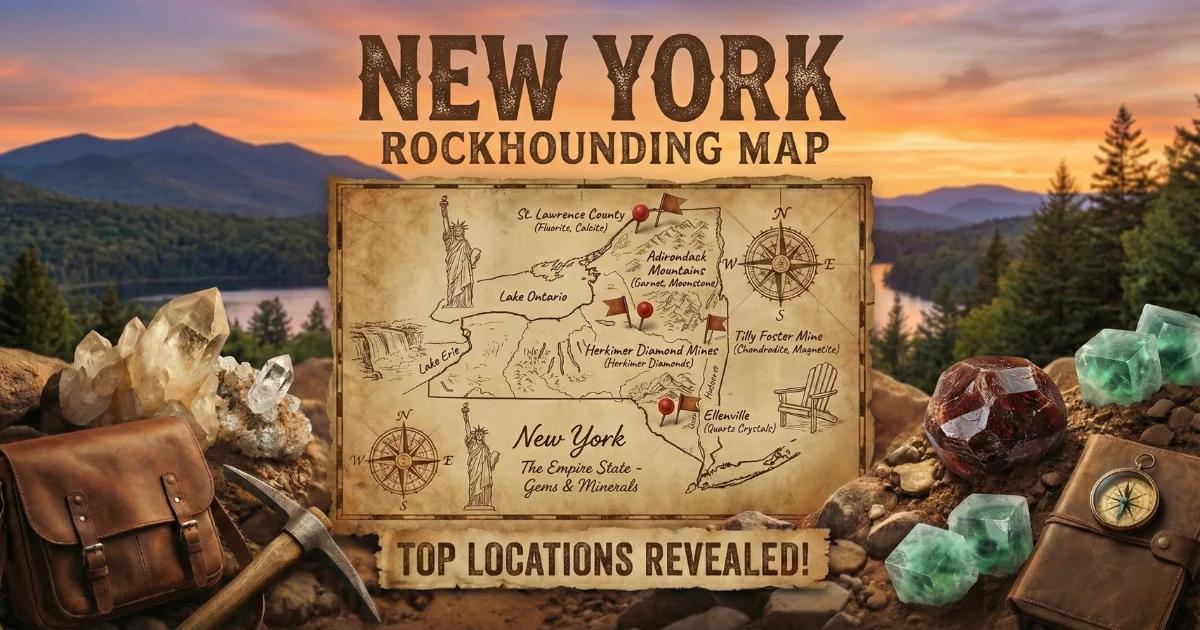
New York Rockhounding Map
For a full interactive map of collecting sites across the state, visit our New York rockhounding map. The map includes fee-dig locations, public collecting areas, and points of geological interest across all regions of the state.