
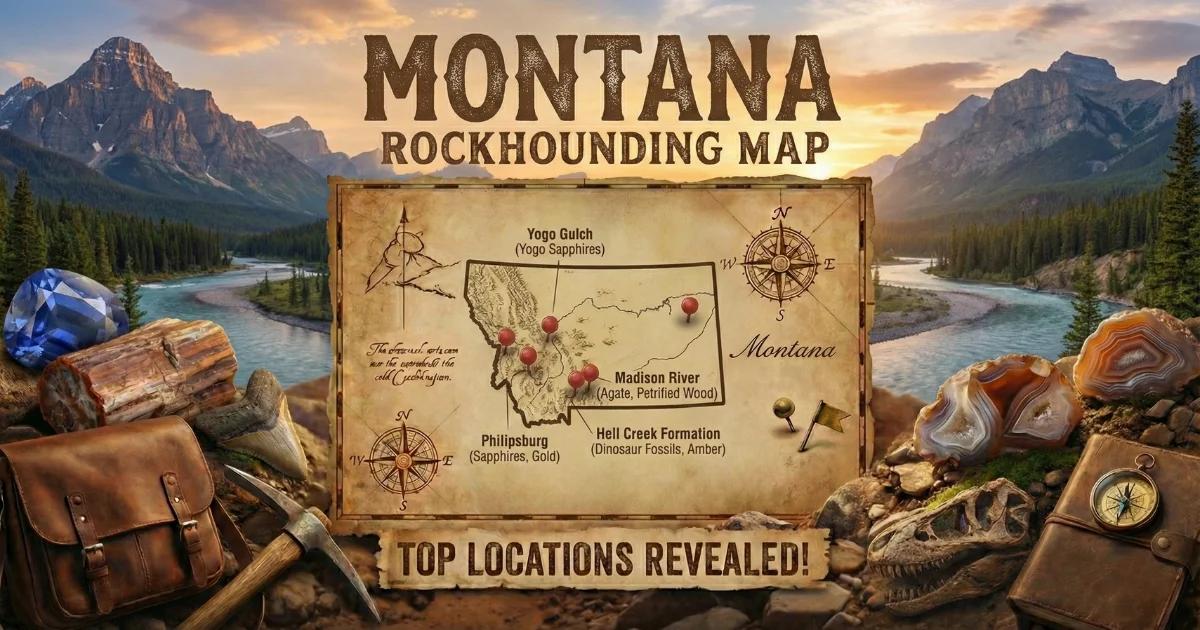

Montana sits on some of the most geologically active ground in the Lower 48. The northern Rockies, Tertiary-age volcanic fields, and ancient Precambrian basement rock converge here to create collecting conditions that few states can match. The state produces sapphires in commercial quantity from alluvial deposits and hard-rock dikes, yields dendritic agates that rank among the finest in North America, and still gives up placer gold on public waterways more than 160 years after the first strikes. If you want to hunt gems in the field rather than buy them from a dealer, Montana is where you go.
This guide covers the geology behind those deposits, the specific locations where you can collect today, how to identify what you find, what tools to bring, and the legal framework that governs collecting on public and private land in Montana.
Geology of Montana's Gem Deposits
To find gems efficiently, you need to understand why they occur where they do. Montana's gem deposits are not randomly scattered. They are locked to specific geological events, and knowing those events tells you where to look and what to expect.
Sapphires
Montana's sapphires come from two distinct geological settings. The first is alluvial (placer) deposits where sapphires have been eroded out of their host rock and concentrated in river gravels over millions of years. The Rock Creek deposit near Philipsburg, the Missouri River gravels near Helena, and the Dry Cottonwood Creek deposit all fall into this category. These alluvial sapphires formed in deep-seated igneous or metamorphic source rocks, were released by weathering, and were transported and sorted by water. Because water acts as a natural concentrator, heavy minerals like sapphire (specific gravity ~4.0) settle into pay streaks alongside other dense minerals: garnet, zircon, and magnetite. When you screen gravel at a fee-dig operation, you are working material that nature has already partially concentrated for you.
The second setting is the Yogo dike in Judith Basin County. This is a Cretaceous-age lamprophyre dike, a narrow intrusion of dark, potassium-rich igneous rock that cuts through Madison Group limestone. The Yogo sapphires crystallized within this magma at depths of roughly 25 to 90 miles before being carried to the surface during eruption. Unlike the alluvial sapphires, Yogos require no heat treatment. Their vivid cornflower blue color is entirely natural, a result of trace iron and titanium in the crystal lattice combined with the specific pressure-temperature conditions of their formation. The Yogo dike is not open for public collecting, but understanding it helps you appreciate why Montana sapphires as a group are so geologically significant.
Montana sapphires span the full corundum color range: blue, green, yellow, orange, pink, and bicolor or color-change varieties. The alluvial deposits produce all of these. Color is determined by trace elements: iron gives blue and green, chromium gives pink and red, and combinations produce the parti-color stones that Montana is known for.
Montana Moss Agate
Montana moss agate is a variety of translucent chalcedony (microcrystalline quartz) containing dendritic inclusions of manganese oxide and iron oxide. These inclusions formed when mineral-bearing solutions infiltrated silica gel that had filled cavities in volcanic rock. The source material is Tertiary-age volcanic tuff and basalt in the Yellowstone River drainage. As these host rocks eroded, the agate nodules were released into the river system and transported downstream. Today, the densest concentrations of Montana agate occur in Yellowstone River gravels from Billings east through Yellowstone County to Miles City. The agates are found as water-worn cobbles on gravel bars, in cutbanks, and mixed into terrace gravels above the current floodplain.
Quartz and Amethyst
Crystal Park in Beaverhead County exposes a hydrothermally altered zone where silica-rich fluids deposited quartz crystals in vugs and fractures within Cretaceous-age granitic rock. The crystals range from clear rock crystal to smoky quartz to pale amethyst. The amethyst coloration comes from trace iron and natural irradiation over geological time. This is an unusual collecting site because the U.S. Forest Service has specifically designated it for public mineral collecting.
Placer Gold
Montana's gold deposits are Tertiary and Cretaceous-age lode deposits that have been eroding into stream systems for millions of years. The original lode gold occurs in quartz veins associated with granitic intrusions in the Boulder Batholith, the Tobacco Root Mountains, and other ranges. Placer gold concentrates in streams wherever gradient decreases or flow is obstructed: inside bends, behind boulders, in bedrock cracks, and at the heads of gravel bars. The gold is dense (specific gravity 19.3) and settles to bedrock while lighter material washes over it.
Collecting Locations
The following locations are confirmed accessible for collecting as of early 2026. Always verify current access status before making a long drive, as land status and fee-dig operations can change season to season.
1. Gem Mountain -- Philipsburg, Granite County
- GPS: 46.3211N, 113.2920W (approximate)
- Land Status: Private (fee-dig operation)
- Target Minerals: Sapphire (blue, green, yellow, orange, pink, color-change), garnet, zircon
- Season: Late May through mid-October (weather dependent)
- Fee: $25 to $200+ per bucket depending on grade (economy, premium, super-premium)
Gem Mountain is the most accessible sapphire mining experience in the United States. The operation sells pre-washed gravel sourced from the Rock Creek sapphire deposit. You work the gravel through provided sluice boxes, screening the concentrate and picking sapphires by hand. Economy buckets yield smaller stones, typically under one carat rough, while premium and super-premium buckets regularly produce two to five carat rough stones and occasional larger pieces. The on-site heat-treatment lab can improve color and clarity for an additional fee. Heat treatment is standard practice in the sapphire industry and does not diminish the stone's identity as a natural sapphire.
The gravel also contains garnet, zircon, and other heavy minerals, so pay attention to everything in your concentrate, not just the sapphires. Bring a hand lens and tweezers. The facility provides sluice equipment, but you will want your own small containers and labels for sorting finds.
2. Spokane Bar Sapphire Mine -- Helena, Lewis and Clark County
- GPS: 46.6380N, 111.8820W (approximate)
- Land Status: Private (fee-dig operation)
- Target Minerals: Sapphire (predominantly pale blue, green, yellow), garnet
- Season: Summer months (check operator for current schedule)
The Missouri River sapphire deposit near Helena has produced sapphires since placer gold miners first noticed the blue stones in the 1860s. The Spokane Bar operation offers buckets of sapphire-bearing gravel from this deposit. Missouri River sapphires tend toward lighter colors than Rock Creek stones: pale blue, light green, and soft yellow. These lighter-colored stones respond well to heat treatment and can produce attractive finished gems. The site is conveniently located near Helena, making it an easy side trip if you are passing through central Montana.
3. Rock Creek Sapphire Area -- Near Philipsburg, Granite County
- GPS: 46.30N, 113.30W (general area)
- Land Status: Mixed public (BLM/Forest Service) and private -- verify specific parcels before collecting
- Target Minerals: Sapphire, garnet, zircon
Rock Creek is one of the four major Montana sapphire deposits. The alluvial gravels along the creek and its tributaries contain sapphires eroded from upstream source rocks that have never been definitively identified. Besides Gem Mountain's commercial operation, some public land in the general area may allow casual collecting, but land ownership is a patchwork here. You must confirm the land status of any specific gravel bar or bench deposit before digging. BLM and Forest Service lands may allow casual collecting under standard regulations, but private land requires written permission. Carry a detailed land-status map (available from the BLM Montana/Dakotas State Office) and a GPS unit.
4. Yellowstone River Gravel Bars -- Billings to Miles City, Yellowstone County and Eastward
- GPS: 45.78N, 108.50W (Billings area) to 46.41N, 105.84W (Miles City area)
- Land Status: Public river access points, BLM land, state land -- verify at each access point
- Target Minerals: Montana moss agate, common agate, jasper, petrified wood
- Season: Best during low water, typically late summer through early fall
The Yellowstone River is the primary source for Montana moss agate. Walk exposed gravel bars during low-water periods and scan for translucent, slightly waxy-looking cobbles. When wet, moss agates often show their dendritic inclusions clearly, especially when held up to sunlight. The agates glow with transmitted light in a way that ordinary river cobbles do not. Concentrate your search at the downstream ends of gravel bars and along the high-water line where heavier cobbles accumulate. Public access to the Yellowstone is available at numerous fishing access sites (FAS) maintained by Montana Fish, Wildlife & Parks. Collecting on state-managed FAS land is generally permitted for personal quantities, but check current regulations. BLM parcels along the river also allow casual collecting.
5. Crystal Park -- Beaverhead County, Beaverhead-Deerlodge National Forest
- GPS: 45.5960N, 112.8470W (approximate)
- Land Status: U.S. Forest Service (Beaverhead-Deerlodge National Forest) -- designated public collecting area, free
- Target Minerals: Quartz crystals (clear, smoky, amethyst), minor accessory minerals
- Season: Typically mid-June through mid-September (road access is weather dependent; the access road is a dirt Forest Service road at elevation)
Crystal Park is one of the few sites in the National Forest system specifically designated for public mineral collecting at no charge. The U.S. Forest Service maintains the area with marked digging zones, and you can dig in the decomposed granite soil to unearth quartz crystals. Most crystals are clear or smoky, but pale amethyst occurs here as well. Crystal size ranges from thumbnail specimens to occasional fist-sized points. The site is family-friendly, and children can find crystals within minutes of digging in the soft soil. The Forest Service limits collecting to what you can carry for personal use; no commercial extraction is permitted. Bring a small hand rake, a trowel, and containers for your finds. The access road to Crystal Park is unpaved and can be rough; high-clearance vehicles are recommended though not always required.
6. Libby Creek Gold Panning Area -- Lincoln County, Kootenai National Forest
- GPS: 48.3750N, 115.5500W (approximate, along Libby Creek south of Libby)
- Land Status: U.S. Forest Service (Kootenai National Forest) -- designated recreational gold panning area, free
- Target Minerals: Placer gold, garnet, magnetite, occasional sapphire
- Season: Late spring through fall; water levels affect access and productivity
The Kootenai National Forest has designated a stretch of Libby Creek as a recreational gold panning area. This is legal, no-fee placer gold panning on public land. Gold occurs in the creek gravels as fine flakes and small flattened pieces, concentrated in bedrock cracks, behind large boulders, and in the inside bends of the stream channel. You are limited to hand tools: gold pan, sluice box, hand-operated suction devices. No motorized equipment is allowed. The creek also produces small garnets and magnetite as byproducts in your pan. Work the material down to a heavy mineral concentrate and pick out the gold with tweezers. Experienced panners consistently find color here, though do not expect nuggets. This is a fine-gold creek. Pack out everything you pack in, and respect the riparian zone.
7. Eastern Montana River Gravels -- Missouri River Breaks and Tributaries
- GPS: Widely distributed; 47.0-48.0N, 105.0-110.0W (general range along Missouri and tributary systems)
- Land Status: Mixed BLM, state, and private -- verify before collecting
- Target Minerals: Agate (common, fortification, banded), jasper, petrified wood, occasional fossil material
Eastern Montana's river systems, particularly the Missouri and its tributaries in the Breaks region, carry agate, jasper, and petrified wood in their gravels. These are not the same moss agates found along the Yellowstone, but rather fortification agates, banded agates, and common chalcedony. The material erodes from Cretaceous and Tertiary-age formations. Collecting on BLM land is permitted under casual-use rules. This is big, open country with long distances between services, so plan your fuel, water, and supplies accordingly. Permission is required on private ranch land, and most landowners will grant it if you ask politely and close gates behind you.
Montana Collectible Minerals Reference Table
| Mineral | Chemical Formula | Mohs Hardness | Specific Gravity | Crystal System | Primary Montana Locations |
|---|---|---|---|---|---|
| Sapphire (corundum) | Al2O3 | 9 | 3.95-4.10 | Trigonal | Rock Creek, Missouri River, Dry Cottonwood Creek, Yogo Gulch |
| Montana Moss Agate (chalcedony) | SiO2 | 6.5-7 | 2.58-2.64 | Trigonal (microcrystalline) | Yellowstone River gravels, Billings to Miles City |
| Quartz (rock crystal, smoky, amethyst) | SiO2 | 7 | 2.65 | Trigonal | Crystal Park (Beaverhead County) |
| Garnet (almandine-pyrope) | Fe3Al2(SiO4)3 | 6.5-7.5 | 3.50-4.30 | Isometric | Ruby Range (Madison County), sapphire gravels statewide |
| Gold (native) | Au | 2.5-3 | 19.3 | Isometric | Libby Creek, Alder Gulch, Grasshopper Creek, statewide placers |
| Jasper | SiO2 | 6.5-7 | 2.58-2.91 | Trigonal (microcrystalline) | Eastern Montana river gravels, Missouri Breaks |
| Petrified Wood | SiO2 (replacement) | 6.5-7 | 2.58-2.91 | Amorphous/microcrystalline | Eastern Montana, Gallatin NF areas |
Field Identification Guide
Knowing what you are looking at in the field separates productive collecting from aimless gravel-picking. Here is how to identify Montana's key collectibles without lab equipment.
Sapphire
Raw Montana sapphires in alluvial deposits are typically water-worn, rounded to sub-rounded pebbles ranging from a few millimeters to about 15 millimeters across. They are barrel-shaped or tabular, rarely showing well-developed crystal faces. Color in the rough can be deceptive: many sapphires appear grayish, greenish, or nearly colorless when covered in river grime. Wet the stone and hold it to light. Sapphire is transparent to translucent and will transmit light where ordinary gravel will not. Hardness is the definitive field test: sapphire is 9 on the Mohs scale and will scratch every common mineral except diamond. If a small pebble in your concentrate scratches a piece of quartz (hardness 7) easily, you are holding corundum. The stone will also feel heavier than you expect for its size due to its high specific gravity (~4.0).
Montana Moss Agate
Look for cobbles with a slightly waxy or greasy luster, translucent edges, and a lighter overall color than surrounding basalt and granite cobbles. When wet, dendritic inclusions (dark branching patterns resembling trees, ferns, or moss) become visible through the translucent body. The definitive field test: hold the wet stone up against sunlight. Moss agate transmits light and glows, while ordinary opaque cobbles do not. The dendritic patterns are manganese oxide and are black to dark brown. The body color ranges from water-clear to milky white to light gray. Some specimens show red-orange iron oxide staining. Do not confuse moss agate with ordinary quartz pebbles, which lack the dendritic inclusions, or with jasper, which is opaque.
Quartz Crystals (Crystal Park)
At Crystal Park, quartz crystals are found loose in decomposed granite soil. They show the classic hexagonal prismatic habit with pyramidal terminations. Clear crystals are transparent with a vitreous (glassy) luster. Smoky quartz ranges from light gray-brown to nearly black. Amethyst shows pale to medium purple coloration. Test with a steel knife blade: quartz (hardness 7) will scratch steel easily. Crystals may have surface etching, iron oxide coatings, or clay coatings from soil contact. Clean specimens carefully with water and a soft brush in the field to assess quality.
Placer Gold
Gold in the pan appears as bright yellow metallic flakes, flattened grains, or small irregular pieces that stay in the bottom of the pan with the heaviest material. Gold is malleable: you can flatten it against a hard surface with a knife blade. It does not shatter or crumble. Gold does not tarnish or oxidize, so it stays bright yellow even after sitting in river gravel for millennia. Do not confuse it with pyrite ("fool's gold"), which is brassy yellow, harder, and breaks into powder when struck. Pyrite will also be angular with crystal faces, while placer gold is rounded and flattened from tumbling in the stream.
Garnet
Montana garnets appear as dark red to reddish-brown rounded grains in stream concentrates, typically 1-5 millimeters in diameter. In the Ruby Range of Madison County, larger crystals occur in metamorphic host rock. Field ID: garnets are hard enough (6.5-7.5) to scratch glass but typically appear as rounded grains without visible crystal faces in alluvial settings. They concentrate alongside sapphire and magnetite in heavy mineral fractions. Hold them to light: almandine-pyrope garnets transmit deep red to purplish-red light through thin edges.
Tools and Equipment
What you bring depends on where you are going and what you are collecting. Here is a breakdown by collecting scenario.
Fee-Dig Sapphire Operations (Gem Mountain, Spokane Bar)
- Tweezers (fine-point, stainless steel) for picking sapphires from concentrate
- 10x hand lens or 20x loupe for evaluating color and clarity
- Small sorting containers (pill boxes, gem jars with foam inserts) for organizing finds by size and color
- Spray bottle with water for cleaning stones during sorting
- Sunscreen, hat, and water -- you will be in the sun for hours
- The operation provides sluice equipment; you generally do not need your own screens
River Agate Collecting (Yellowstone River)
- Sturdy footwear with good traction for walking on wet cobble bars (wading boots or hiking boots)
- Spray bottle for wetting stones to check translucency
- Backpack or collecting bag rated for the weight of river cobbles
- A small pry bar or rock pick for checking material in cutbanks (where legal)
- Polarized sunglasses to reduce glare on wet gravel
- GPS or smartphone for marking productive spots
Crystal Park (Quartz Collecting)
- Hand rake or small garden cultivator for scraping through decomposed granite
- Trowel or small folding shovel
- Soft brush for cleaning clay off crystals in the field
- Newspaper or bubble wrap for wrapping crystals (terminated points are fragile)
- 5-gallon bucket for hauling material and finds
Gold Panning (Libby Creek)
- 14-inch gold pan (steel or plastic; plastic is lighter and easier for beginners to read)
- Classifier screen (1/4-inch mesh) to remove large gravel before panning
- Snuffer bottle for picking up fine gold from the pan
- Small glass vial with water for storing gold
- Crevicing tools: small screwdriver, spoon, or crevice sucker for cleaning bedrock cracks
- Rubber boots or waders -- you will be in the creek
Universal Gear (All Locations)
- Topographic maps and/or GPS with land-status overlays
- First aid kit
- Sufficient water and food (many locations are remote)
- Cell phone (coverage is unreliable in many Montana collecting areas)
- Sunscreen and insect repellent
- Vehicle with adequate ground clearance for Forest Service and BLM roads
Legal Framework for Collecting in Montana
The legality of mineral collecting in Montana depends entirely on land ownership and management status. Getting this wrong can result in fines, confiscation of material, or criminal charges. Here is the breakdown.
U.S. Forest Service Land
Casual collecting of rocks, minerals, and gemstones for personal, non-commercial use is generally permitted on National Forest land in Montana under 36 CFR 228 and Forest Service directives. Some forests have specific mineral-collection orders or closures. Crystal Park in the Beaverhead-Deerlodge NF and the Libby Creek panning area in the Kootenai NF are explicitly designated for public collecting. On other NF land, check with the local ranger district for any restrictions. No motorized extraction equipment is permitted under casual-use rules. Volume limits apply: you may collect "reasonable quantities" for personal use, which the Forest Service generally interprets as what one person can carry.
BLM Land
The Bureau of Land Management allows casual collection of rocks, minerals, and invertebrate fossils on BLM-administered public land under 43 CFR 8365. Collection must be for personal, non-commercial purposes, and you are limited to reasonable quantities. No surface disturbance beyond what is necessary for hand collecting is allowed. Mechanized equipment requires a plan of operations. Petrified wood has specific limits: no more than 25 pounds per day plus one piece, up to 250 pounds per year. Always verify that the specific BLM parcel you intend to collect on is not withdrawn from mineral entry or subject to special restrictions (ACEC, WSA, etc.).
State Land
Montana state trust lands are managed by the Montana Department of Natural Resources and Conservation (DNRC). Recreational use of state lands, including rockhounding, generally requires a State Land Recreational Use License. Rules differ from federal land, and mineral rights on state land may be separately managed. Check with DNRC before collecting on state sections.
Private Land
All fee-dig operations (Gem Mountain, Spokane Bar, etc.) are on private land with owner permission granted through your paid admission. On any other private land, you must obtain written permission from the landowner before collecting anything. Trespass on private land is a misdemeanor in Montana. If you see fence posts, closed gates, or "no trespassing" signs, do not enter without permission. Many Montana ranchers are willing to grant access if you ask in advance, explain what you are looking for, and agree to close gates and stay on roads.
National Parks and Monuments
Collecting any rocks, minerals, or fossils in Yellowstone National Park, Glacier National Park, or any unit of the National Park Service is strictly prohibited under 36 CFR 2.1. Do not collect in these areas regardless of what you see on the ground. Penalties include fines up to $5,000 and/or six months imprisonment.
Mining Claims
Active mining claims exist throughout Montana on both BLM and Forest Service land. A mining claim gives the claimant the right to extract minerals from that specific parcel. Collecting on someone else's active mining claim without permission is theft. Check the BLM LR2000 database or the Montana DEQ mining claim records to verify whether a specific area is under active claim before you dig.
Montana Gem Hunting Location Map
Use our interactive map to find all documented collecting locations across Montana, including the sites described in this guide. The map shows land status, access points, and reported minerals for each location.
View the Montana Rockhounding Map
Montana rewards the prepared collector. The geology is right, the public land base is large, and several designated collecting areas make it possible to find sapphires, quartz crystals, and placer gold on the same trip. Study the land status before you go, bring the right tools for the material you are targeting, and respect both the land and the regulations that protect it. The stones have been in the ground for millions of years. They will wait for you to do your homework.