
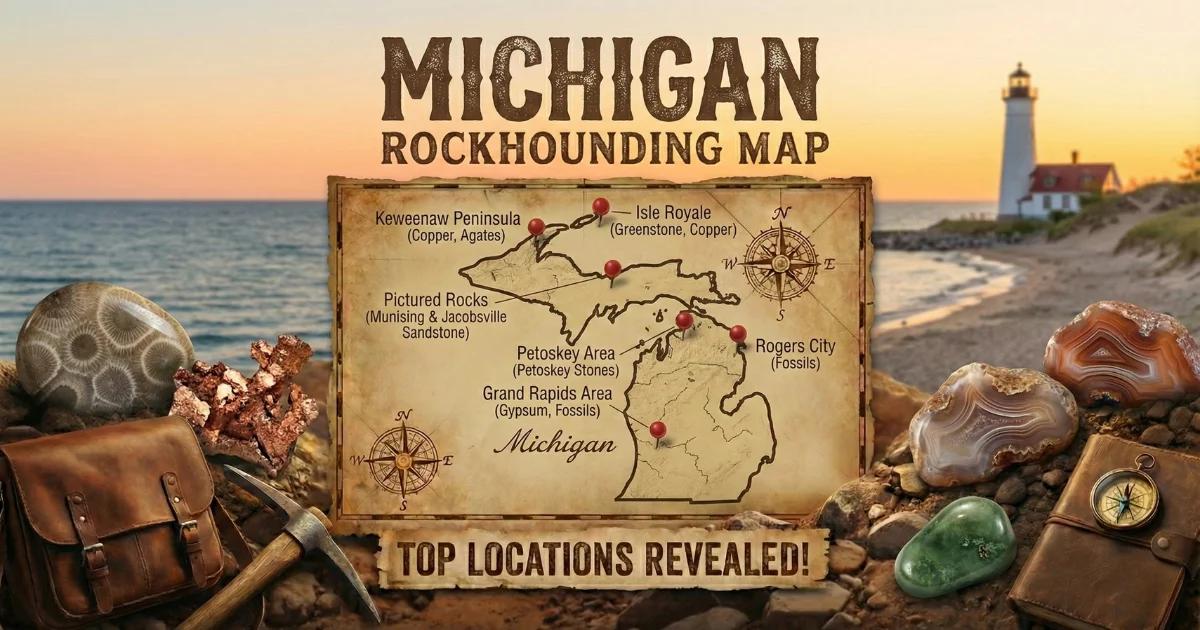
Michigan Geology: Two Peninsulas, 1.1 Billion Years of Collecting
Michigan sits on some of the oldest exposed rock in North America. The Upper Peninsula (UP) is anchored by Precambrian basalts and rhyolites of the Midcontinent Rift System — a failed continental rift dated to roughly 1.1 billion years ago. These flood basalts, which can exceed 5 km total thickness in the Keweenaw Peninsula, host the native copper deposits and amygdaloidal minerals (thomsonite, chlorastrolite, prehnite, datolite) that define UP collecting. Glacial action over the past 2 million years ripped copper, agates, and jasper from bedrock and scattered them across both peninsulas in till, outwash, and beach gravel.
The Lower Peninsula tells a different story. Paleozoic sedimentary rocks — Devonian limestones and shales, Mississippian sandstones, Pennsylvanian coal measures — underlie the landscape. The Devonian strata produced Michigan's official state stone, the Petoskey stone, a fossilized colonial coral. Between the two peninsulas, Michigan offers gem and mineral collecting that ranges from Precambrian copper and agates to Devonian fossils, all within public shoreline and state-managed land.
Top Collecting Locations
1. Keweenaw Peninsula Beaches — Lake Superior Agates and Copper
Land status: Public beaches below the ordinary high-water mark are open to collecting. Much of the shoreline is within state parks, road easements, or Keweenaw County land. Some areas abut private mining claims — stay below the high-water line.
GPS (Great Sand Bay): 47.3592, -87.9578
GPS (Agate Beach, near Copper Harbor): 47.4681, -87.8634
Vehicle: 2WD to most beach access points. Brockway Mountain Drive is paved. Some back roads to shoreline pulloffs benefit from higher clearance, but nothing requires 4WD.
Minerals: Lake Superior agates (red, orange, and yellow banded chalcedony, iron-oxide stained), native copper (float copper nuggets and sheets in beach gravel), thomsonite nodules (white/pink/green zeolite in basalt), prehnite, datolite (occasionally with native copper inclusions), and epidote.
Lake Superior agates formed in gas vesicles within the Midcontinent Rift basalts. Iron-rich groundwater deposited concentric bands of chalcedony (microcrystalline quartz) and iron oxides within these cavities. Glaciers later plucked the agates from bedrock and deposited them across the Upper Midwest. The Keweenaw beaches are one of the best source-area locations — agates here are less water-worn than those found hundreds of miles south in glacial drift.
Collect after storms. High-energy wave action rearranges the cobble beaches and exposes fresh material. Walk slowly and scan wet gravel — the translucency and warm color of agates stands out against the dark basalt cobbles. Early morning and late afternoon light with a low sun angle makes the waxy luster of agate easier to spot. Copper float appears as dull reddish-green masses (oxidized surface). Break a small piece and the fresh surface is bright salmon-pink metal.
2. Petoskey and Charlevoix — Petoskey Stones
Land status: Public beaches and Petoskey State Park are open to collecting. Magnus Park (City of Petoskey) and the public beach at Charlevoix's North Point are both city-managed public access. Collecting is allowed for personal use; no permits needed.
GPS (Petoskey State Park): 45.3903, -84.9014
GPS (Magnus Park, Petoskey): 45.3784, -84.9559
GPS (North Point, Charlevoix): 45.3371, -85.2340
Vehicle: 2WD. Paved roads to all access points. State park entrance requires a Michigan Recreation Passport ($17/year for residents, $34/year for non-residents, or $9 day pass).
Minerals: Petoskey stones (fossilized Hexagonaria percarinata coral), Charlevoix stones (fossilized Favosites coral — smaller, honeycomb pattern), crinoid stems, horn corals, and occasional brachiopods.
Petoskey stones are colonies of the rugose coral Hexagonaria percarinata, preserved in Devonian-age limestone roughly 350 million years old. When dry, the stones often look like ordinary gray limestone cobbles. Wet the surface — the hexagonal coral pattern appears immediately. Each "eye" in the pattern is a single coral polyp, with radiating septa (internal partitions) visible as lines fanning out from the center. The best collecting is in spring after ice-out, when winter storms have churned the nearshore gravel.
Work the wave-wash zone. Wade ankle-deep and scan cobbles as waves roll them. Carry a spray bottle to wet suspect stones. The most productive stretches are between Petoskey and Harbor Springs and along the shore south toward Charlevoix. Gravel roads and driveways sometimes expose Petoskey stones in fill material sourced from local gravel pits — these are fair game if the property is yours or you have permission.
3. Copper Country — Native Copper Specimens (Keweenaw County)
Land status: Mixed. Mine dumps and stamp sands vary — some are on state or county land (open to collecting), others are on private mining claims. Verify before entering. The Quincy Mine (Hancock) and Delaware Mine (Delaware) offer paid tours with limited specimen collecting. Several old stamp sand piles along Torch Lake are on county-managed land and are open for surface collecting.
GPS (Delaware Mine, public tours): 47.4667, -87.9667
GPS (Torch Lake stamp sands): 47.1500, -88.4200
Vehicle: 2WD for Delaware Mine and Quincy Mine. High-clearance recommended for exploring back roads to old mine sites in Keweenaw County.
Minerals: Native copper (crystallized, sheet, wire, and massive), native silver (rare), datolite nodules (porcelain-white to pink/green), epidote, prehnite, calcite, and quartz crystals.
Michigan's Copper Country produced roughly 11 billion pounds of native copper between the 1840s and the 1960s. The copper occurs in amygdaloidal and interflow conglomerate layers within the Portage Lake Volcanics — a thick sequence of Precambrian basalt flows. Unlike most copper deposits worldwide, the Keweenaw copper is native metal, not a sulfide ore. This means you find actual metallic copper — sometimes in crystal form — rather than green or blue copper minerals.
The stamp sands (crushed mine tailings) along the Lake Linden to Gay shoreline on Torch Lake contain fine copper grains and occasionally small native copper masses. Surface collecting only. Do not dig into or excavate mine dumps without confirming land status. Many old mine properties have changed hands multiple times and ownership can be unclear.
4. Grand Ledge Fossil Ledges — Eaton County
Land status: Fitzgerald Park (Eaton County park). Open to the public. Fossil collecting allowed for personal use. No tools that damage the rock face — hand collecting of loose material only.
GPS (Fitzgerald Park): 42.7522, -84.7439
Vehicle: 2WD. Paved parking lot.
Minerals/Fossils: Pennsylvanian-age sandstone and shale exposures with plant fossils (fern impressions, Calamites, Lepidodendron bark patterns), brachiopods, and crinoid fragments.
The sandstone ledges along the Grand River at Grand Ledge are one of the few natural rock outcrops in Michigan's Lower Peninsula. The exposed strata date to the Pennsylvanian Period (roughly 310 million years ago), when Michigan was near the equator and covered in swampy coal forests. Fern fossils and tree-bark impressions are common in the shale layers between sandstone beds. Collect from fallen blocks and talus at the base of the ledges. Do not pry material from the cliff face — the ledges are a geological landmark and climbing destination.
5. UP Beaches — Thomsonite and Beach-Worn Gems
Land status: Public beaches below ordinary high-water mark. Some stretches are within state or national forest boundaries — collecting of reasonable quantities for personal use is permitted on USFS land.
GPS (Christmas, MI beach): 46.4234, -86.6942
GPS (Paradise Beach, Whitefish Point area): 46.7554, -85.1277
Vehicle: 2WD to most access points. Some Lake Superior shore roads in Alger and Luce counties are gravel — passable in a sedan but slow.
Minerals: Thomsonite (zeolite group — white, pink, green, banded nodules in basalt), agate, jasper, prehnite, chlorastrolite (rare), pudding stone (jasper conglomerate), and beach-worn copper.
Thomsonite forms as a secondary mineral in the vesicles and fractures of basalts. Beach-worn nodules are often round and smooth with concentric color banding in white, pink, and pale green. They look similar to small agates but have a slightly lower hardness (5–5.5 vs. 7 for agate). A hardness test with a steel nail (H ~6.5) will scratch thomsonite but not agate.
6. Isle Royale — Chlorastrolite (State Gem)
Land status: National Park Service (NPS). Collecting of any rocks, minerals, or natural objects is PROHIBITED on Isle Royale. This applies to chlorastrolite (Isle Royale greenstone), copper, agates, and all other specimens.
GPS: 48.0000, -88.8500 (island center)
Vehicle: No roads on Isle Royale. Access by ferry from Houghton or Copper Harbor, or by seaplane.
Minerals (look, do not collect): Chlorastrolite (green stellate pumpellyite — the state gem of Michigan), native copper, prehnite, thomsonite, agate.
Chlorastrolite is a variety of the mineral pumpellyite that forms radial, star-shaped (stellate) clusters of green crystals in basalt vesicles. The chatoyant green flash when polished makes it a desirable gem. It occurs in small nodules, rarely exceeding 1 cm. While Isle Royale is the type locality and best-known source, chlorastrolite also occurs in mainland Keweenaw Peninsula basalts and on some UP beaches — mainland finds are your legal collecting option. Any chlorastrolite in collections should come from mainland sources or pre-NPS-era Isle Royale material.
Michigan Minerals and Gems Reference
| Mineral / Gem | Composition | Hardness | Where Found | Notes |
|---|---|---|---|---|
| Lake Superior Agate | SiO₂ (chalcedony with iron oxide) | 7 | Keweenaw beaches, glacial gravel statewide | Red/orange banding, translucent. State gemstone of Minnesota, but Michigan produces excellent specimens. |
| Petoskey Stone | CaCO₃ (calcite replacing coral) | 3.5–4 | Lake Michigan beaches, Petoskey to Charlevoix | Michigan state stone. Fossilized Hexagonaria coral. Devonian age (~350 Ma). |
| Native Copper | Cu | 2.5–3 | Keweenaw Peninsula mine dumps, stamp sands, beaches | Occurs as native metal — sheets, crystals, masses. 1.1 Ga Portage Lake Volcanics. |
| Chlorastrolite | Ca₂(Mg,Fe)Al₂(SiO₃OH)₂(Si₂O₇)(OH)₂·H₂O | 5–6 | Isle Royale (no collecting), Keweenaw mainland, UP beaches | Michigan state gem. Green stellate pumpellyite. Chatoyant when polished. |
| Thomsonite | NaCa₂Al₅Si₅O₂₀·6H₂O | 5–5.5 | UP Lake Superior beaches, in basalt | Zeolite group. Banded nodules — white, pink, green. |
| Datolite | CaBSiO₄(OH) | 5–5.5 | Keweenaw copper mines | Porcelain-like nodules — white, pink, green. Some contain native copper inclusions. |
| Pudding Stone | Jasper clasts in quartzite matrix | 7 | Glacial till, both peninsulas, concentrated in SE Lower Michigan | Jasper conglomerate. Red/pink jasper pebbles in white/gray quartzite. Precambrian origin. |
| Prehnite | Ca₂Al₂Si₃O₁₀(OH)₂ | 6–6.5 | Keweenaw mine dumps, UP beaches | Pale green botryoidal masses. Secondary mineral in basalt. |
| Charlevoix Stone | CaCO₃ (calcite replacing coral) | 3.5–4 | Lake Michigan beaches near Charlevoix | Fossilized Favosites coral. Smaller honeycomb pattern vs. Petoskey stone. |
Field Identification Tips
Lake Superior Agates
Visual: Look for warm colors — reds, oranges, yellows — against the gray and black basalt beach cobbles. The waxy, slightly translucent surface is the key feature. Hold suspect stones up to sunlight. Agate transmits light; ordinary quartz and most other beach stones do not.
Surface texture: Agates have a conchoidal fracture (smooth, curved breakage surfaces) and often show a pitted or dimpled exterior from weathering of softer surrounding rock. The pitting creates an "orange peel" texture on the surface.
Banding: True Lake Superior agates show concentric banding in cross-section. If you see parallel (non-concentric) banding, you may have jasper or banded iron formation instead — still worth keeping, but geologically different.
Weight: Agates are denser than most beach cobbles of the same size. A stone that feels heavy for its size in a basalt-cobble beach is worth a second look.
Petoskey Stones
The water test: Carry a spray bottle or simply dip the stone in the lake. The hexagonal coral pattern appears when wet and fades when dry. If you see a regular pattern of "eyes" with radiating internal lines, you have a Petoskey stone.
Look-alikes: Favosites (Charlevoix stones) have a smaller, tighter honeycomb pattern without the prominent radiating septa. Horn corals are solitary (single tube) rather than colonial. Bryozoan fossils have much smaller pore patterns.
Quality grading: The best specimens show well-defined, evenly spaced coral pattern across the entire surface, with minimal mud-filled or recrystallized areas. Water-polished beach specimens with good pattern definition are the most prized.
Native Copper
Streak test: Copper streaks bright pinkish-copper on unglazed porcelain. The surface will usually be weathered to green (malachite patina) or dull reddish-brown (cuprite). Scratch the surface with a knife — bright salmon-pink metal underneath confirms copper.
Density: Copper is heavy — specific gravity of 8.9. A copper-bearing beach cobble feels noticeably heavier than basalt (SG ~3.0) or agate (SG ~2.6) of the same size.
Magnetism: Pure copper is not magnetic. If a beach stone sticks to a magnet, it is likely magnetite or a piece of steel, not copper.
Thomsonite vs. Agate
Hardness: Thomsonite scratches at 5–5.5 on the Mohs scale. A steel nail (H ~6.5) will scratch thomsonite but will not scratch agate (H = 7). This is the definitive field test.
Luster: Thomsonite has a vitreous to pearly luster, compared to the waxy luster of agate. Thomsonite nodules also tend to be whiter and more opaque than agates.
Recommended Tools
- Spray bottle: Essential for Petoskey stone hunting. Wetting stones reveals the coral pattern and the translucency of agates. A small plant mister works well.
- 10x hand lens (loupe): For examining coral patterns, banding detail, and crystal structure in the field.
- Rock hammer (16 oz): For examining cross-sections of cobbles and splitting open geodes or nodules. Not needed for pure beach collecting.
- Steel nail or knife: Hardness testing tool. Distinguishes thomsonite (H 5–5.5) from agate (H 7).
- UV flashlight (365 nm): Some Michigan calcite fluoresces. Useful for night beach hunts — Lake Superior agates often fluoresce faintly under UV.
- Mesh sieve / screen: Useful for sorting through stamp sand and fine beach gravel for small copper nuggets and agate chips.
- Sturdy bag or bucket: Beach cobbles add weight fast. A 5-gallon bucket with a handle is the standard for serious beach collecting.
- Knee pads: Hours of crouching and kneeling on cobble beaches will destroy your knees without padding.
- Waders or waterproof boots: Lake Superior water temperatures range from 38°F to 55°F even in summer. Neoprene waders allow you to work the wave-wash zone without losing feeling in your feet.
- GPS unit or phone with offline maps: Cell service is unreliable across much of the UP. Download offline maps before heading to remote beaches.
Legal Notes
Public Beach Access (Great Lakes)
Michigan's Great Lakes shoreline below the ordinary high-water mark is held in public trust. You may walk and collect along the beach below this line even where the upland is privately owned. Do not cross private land to reach the beach — use public access points, road ends, and parks. Petoskey State Park, Wilderness State Park, and numerous county road-end access points provide legal entry to productive beaches.
State Parks and Recreation Areas
Rock and mineral collecting for personal use is permitted in Michigan state parks and recreation areas. You may not use mechanized equipment, explosives, or power tools. Collecting is limited to reasonable quantities for personal, non-commercial use. A Michigan Recreation Passport ($17/resident, $34/non-resident annually, or $9 day pass) is required for vehicle entry.
National Park Service Land — Isle Royale
Collecting is prohibited on all NPS land. This is federal law (36 CFR 2.1). Isle Royale National Park, Pictured Rocks National Lakeshore, and Sleeping Bear Dunes National Lakeshore are all off-limits for rock and mineral collecting. This includes chlorastrolite, copper, agates, and Petoskey stones. Violations carry fines up to $5,000.
National Forest Land
The Hiawatha National Forest and Ottawa National Forest cover large portions of the UP. Collecting of reasonable quantities of rocks and minerals for personal use is permitted on USFS land under the General Mining Law and forest regulations. No permit is needed for hand collecting. Bulk or commercial collecting requires a permit from the forest district ranger.
Private Land and Mine Sites
Many old copper mines, stamp sand piles, and mine dumps in Keweenaw County are on private land. Some are posted, some are not. Do not assume an unposted mine dump is open to collecting — check county records or ask locally. The Keweenaw County Historical Society and local rock shops can provide current access information. Trespassing on posted mine sites carries fines and the possibility of criminal charges.
Commercial Collecting
Selling Petoskey stones, agates, and copper specimens collected from public land is legal in Michigan, provided you collected them from legal access points. However, large-scale commercial operations on public land may require a permit. If you are collecting to sell, keep quantities reasonable and know the rules for each specific parcel.
Seasonal Considerations
Spring (April–May): Best season for Petoskey stones. Winter ice scour and spring storms rearrange beach gravel and expose fresh material. Water levels are typically high. Lake Michigan beaches near Petoskey and Charlevoix produce well in spring. Snow may still be on the ground in the UP through late April.
Summer (June–August): Prime season for UP beach collecting. Long days, calm lake conditions, and warm(ish) weather. Lake Superior water temperature peaks around 55°F nearshore in August. Mosquitoes and black flies are severe in June and early July — bring DEET or permethrin-treated clothing. This is the best time for kayak access to remote Keweenaw Peninsula beaches that are difficult to reach by land.
Fall (September–October): Storm season begins. Strong northwest winds churn Lake Superior and expose fresh agate and copper on beaches. Post-storm collecting can be exceptional. October storms (the "gales of November" often start in late October) produce the best beach turnover. Water temperatures drop fast — waders are mandatory.
Winter (November–March): Most UP beaches are ice-locked. Lake Michigan beaches near Petoskey can be accessible on mild winter days, and ice-fractured cobbles sometimes reveal agate interiors. Access roads in the UP may be impassable. Not recommended for casual collecting.
Michigan Rockhounding Map
View all Michigan collecting locations, access points, and mineral occurrences on our Michigan rockhounding map.