
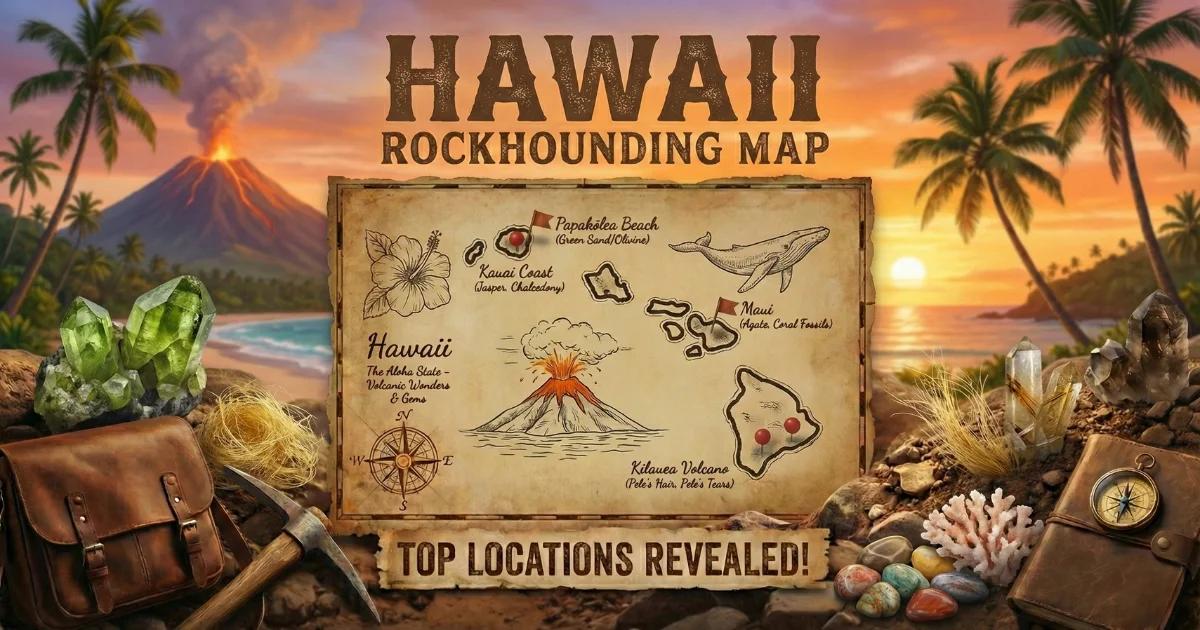
Geology of the Hawaiian Islands
The Hawaiian archipelago sits over a mantle hotspot in the central Pacific. As the Pacific Plate drifts northwest at roughly 7 cm per year, successive shield volcanoes build up from the ocean floor, erupt for a few million years, then move off the hotspot and go dormant. The result is a chain of islands arranged by age: Kauai (approximately 5.1 million years old) in the northwest, and the Big Island (Hawaii) — still actively building — in the southeast. Kilauea and Mauna Loa on the Big Island continue to erupt, producing fresh basalt flows, while Loihi Seamount, 35 km off the southeast coast, is the newest volcanic center still below sea level.
The dominant rock type across all islands is tholeiitic basalt, an iron- and magnesium-rich lava that forms during the shield-building stage. As volcanoes age and eruption rates slow, the chemistry shifts to alkalic basalt and eventually to differentiated lavas like hawaiite and mugearite. This progression matters to collectors because each stage produces different mineral assemblages. Fresh tholeiitic basalt carries olivine and pyroxene. Older alkalic basalt may host zeolite minerals in vesicles and fractures. Silica-rich late-stage differentiates occasionally produce volcanic glass with enough silica content to qualify as obsidian.
Erosion, wave action, and tropical weathering work fast in Hawaii. Older islands like Kauai are deeply dissected — the Na Pali coast and Waimea Canyon expose thick sequences of altered basalt where secondary minerals (zeolites, calcite, clay minerals) have filled every pore and fracture. On the Big Island, fresh lava flows less than a few decades old still look like the day they cooled. This range of weathering states, from fresh glass to deeply altered rock, gives Hawaii a mineral diversity that belies its simple basaltic composition.
Collecting Locations
Before visiting any site listed below, read the Legal and Cultural Notes section of this article in full. Hawaii has some of the most restrictive collecting regulations in the United States, and cultural protocols carry real weight here. Several locations described below are observation-only — included because collectors ask about them and need to understand why removal is not permitted.
1. Papakolea (Green Sand Beach) — South Point, Big Island
- GPS: 18.9336, -155.6408
- Land status: State of Hawaii (Department of Land and Natural Resources). Adjacent to Ka Lae (South Point), a National Historic Landmark. The cinder cone (Pu'u Mahana) is on state land.
- Vehicle: 2WD to the South Point Road parking area. The 2.5-mile trail from the parking lot to the beach is rough, unimproved, and exposed. Local shuttle trucks operate informally. No AWD required for the road, but the walk is mandatory — the access road beyond the lot is gated.
- Minerals: Olivine (Mg-rich forsterite, the mineral that produces gem peridot) as loose green sand grains, 1-3 mm. Grains weather out of the Pu'u Mahana littoral cone, a 49,000-year-old cinder cone composed of olivine-rich basalt. Individual grains are rounded by surf action. Rare larger crystals (up to 5 mm) occur in intact cinder fragments on the cone walls.
- Collecting status: NO COLLECTING. Removing sand, rock, or any natural material from this beach is prohibited under Hawaii Revised Statutes Chapter 171 and 205A (Coastal Zone Management). The site is also culturally significant. Rangers and local residents monitor the area. Fines apply.
This is an observation-only site. Come to see one of only four green sand beaches on Earth. Photograph the olivine grains against dark basalt — a hand lens makes the crystal shapes visible. Do not put sand in your pockets.
2. Mahana Beach and Pu'u Mahana Cone Vicinity — Big Island
- GPS: 18.9340, -155.6420 (cone area above the beach)
- Land status: State of Hawaii. Same jurisdiction as Papakolea.
- Vehicle: Same access as Papakolea (see above).
- Minerals: Olivine phenocrysts (to 8 mm) still embedded in basalt matrix on the eroding cone face. These are better crystal specimens than the beach sand — you can see euhedral olivine shapes in cross-section. Pyroxene (augite) occurs alongside olivine in some layers.
- Collecting status: NO COLLECTING. Same restrictions as Papakolea. The cone itself is eroding and unstable; climbing on it accelerates damage to the formation.
The olivine-basalt relationship visible in the cone walls is one of the best field examples of mantle xenolith disaggregation anywhere in the Pacific. Worth the hike for the geology lesson alone.
3. Kilauea Lava Fields — Hawaii Volcanoes National Park, Big Island
- GPS: 19.4069, -155.2834 (Kilauea Visitor Center). Lava fields extend along Chain of Craters Road and the coastal flats south of the caldera.
- Land status: National Park Service (NPS). Federal land.
- Vehicle: 2WD. Crater Rim Drive and Chain of Craters Road are paved. Access to active flow areas is controlled by NPS rangers and may be closed without notice due to volcanic hazard.
- Minerals: Pele's tears (small droplets of volcanic glass, typically 1-10 mm, tear-shaped, black to dark brown, formed when lava fountains eject molten blobs that solidify in flight). Pele's hair (extremely fine threads of volcanic glass, golden-brown, sometimes forming mats downwind of active vents). Olivine in fresh pahoehoe and aa basalt. Sulfur crystals around fumaroles (do not approach — toxic SO2 gas). Reticulite (thread-lace scoria, the lowest-density rock on Earth).
- Collecting status: NO COLLECTING. Federal law (36 CFR 2.1) prohibits removing any natural object — rocks, sand, plants, or artifacts — from National Park land. The park receives thousands of rocks mailed back each year by visitors who report bad luck (see Cultural Notes below). NPS rangers enforce this strictly.
Pele's tears and Pele's hair are the specimens most visitors want to find. You can observe and photograph them on the surface of recent flows. Pele's hair is often caught in cracks and on rough aa surfaces downwind of vent areas. Bring a macro lens or hand lens — these specimens are small and easily missed.
4. Mauna Kea Summit and Adze Quarry — Big Island
- GPS: 19.8207, -155.4681 (Mauna Kea Access Road junction). The adze quarry complex is near the summit at approximately 19.8280, -155.4740, elevation 3,900 m (12,800 ft).
- Land status: Mauna Kea is managed by the University of Hawaii under a state lease, with oversight from the Department of Land and Natural Resources. The Mauna Kea Adze Quarry is a National Historic Landmark and a site of deep cultural significance to Native Hawaiians.
- Vehicle: 4WD required above the Onizuka Visitor Center (Mauna Kea Visitor Information Station at 2,800 m). The summit road is unpaved and steep. Rental car contracts typically prohibit driving to the summit. Guided tours available.
- Minerals: Dense basalt (hawaiite composition) used by Hawaiians for adze manufacture. Obsidian-like volcanic glass occurs in thin selvages and flow margins in the summit area — this material is more accurately classified as tachylite (basaltic glass with abundant microlites) rather than true rhyolitic obsidian, but it fractures conchoidally. Small olivine crystals in some cinder deposits along the access road.
- Collecting status: NO COLLECTING. The summit area is culturally sacred and legally protected. The adze quarry is a National Historic Landmark — disturbing any stone is a federal offense. Altitude sickness is a real hazard above 4,000 m; acclimatize at the visitor center.
The Mauna Kea adze quarry is the largest ancient quarry in the Pacific. Hawaiian craftsmen selected dense, fine-grained basalt here for tool production over a span of at least 500 years. The quarry debitage (flaking waste) is extensive and must not be disturbed.
5. Black Sand Beaches — Punaluu and Kehena, Big Island
- GPS: Punaluu: 19.1362, -155.5039. Kehena: 19.4469, -154.9636.
- Land status: Punaluu Beach Park is county land (Hawaii County). Kehena Beach is on state land below the highway.
- Vehicle: 2WD for both. Paved road access. Punaluu has a parking lot and facilities. Kehena requires a steep trail descent from Highway 137.
- Minerals: The black sand is fragmented basalt glass and olivine, produced when hot lava enters the ocean and shatters (hyaloclastite). Under a hand lens, individual grains show glassy luster and conchoidal fracture surfaces. Occasional olivine grains (green) are mixed in. Magnetite is present — a magnet dragged through dry sand will pick up black grains.
- Collecting status: NO COLLECTING of sand. Hawaii state law restricts removal of beach sand. Punaluu is also a critical habitat for Hawaiian green sea turtles (honu) — stay at least 3 meters from resting turtles. Observe the sand with a hand lens in place.
Punaluu is the most accessible black sand beach in Hawaii. The sand here is geologically young — derived from lava flows that entered the sea within the last few thousand years. Older black sand beaches on the island have been ground finer and mixed with lighter carbonate fragments over time.
6. Zeolite Localities — Oahu and Kauai
- GPS: Table Mountain (Oahu): approximately 21.5100, -158.1400. Kilauea area (Kauai, the north shore town — not the volcano): approximately 22.2100, -159.3500.
- Land status: Variable — private land, state land, and military reservation. Many of the classic zeolite localities on Oahu are on private property or within military installations (Schofield Barracks area) with no public access.
- Vehicle: 2WD for road access, but reaching outcrop may require hiking on unimproved trails.
- Minerals: Zeolites — specifically chabazite, phillipsite, analcime, and natrolite — fill vesicles and fractures in weathered basalt on the older islands. These formed over millions of years as groundwater percolated through porous basalt, depositing silicate minerals in cavities. Specimens range from small drusy crusts to well-formed crystals up to 1 cm. Calcite and chalcedony also occur as secondary void-fillers in the same rock.
- Collecting status: EXTREMELY LIMITED. Most known zeolite outcrops on Oahu are on private or military land. You must obtain landowner permission before entering. Do not trespass. Some roadcuts along highways expose zeolite-bearing basalt on state road rights-of-way — legality of collecting from roadcuts is ambiguous. On Kauai, much of the north shore is private agricultural land or state park. Always confirm land status before collecting anything.
Zeolite collecting in Hawaii requires more research and landowner contact than any other mineral target in the state. The minerals are scientifically interesting — Hawaii is the type locality for several zeolite species — but access is the limiting factor. Contact the local rock and mineral club (see below) for current site access information.
Minerals of Hawaii
| Mineral | Composition | Hardness (Mohs) | Where Found | Notes |
|---|---|---|---|---|
| Olivine (forsterite-fayalite series) | (Mg,Fe)₂SiO₄ | 6.5-7 | Big Island: Papakolea, lava flows statewide | Gem-quality = peridot. Hawaiian olivine is Mg-rich (Fo85-90). Green, vitreous luster, granular in basalt. |
| Pele's tears | Basaltic glass (SiO₂ ~50%) | 5-5.5 | Big Island: near active vents, Kilauea | Tear-shaped glass droplets, 1-10 mm. Black to amber. Formed during lava fountaining. |
| Pele's hair | Basaltic glass (drawn fibers) | 5-5.5 | Big Island: downwind of active vents | Golden-brown glass threads, sometimes meters long. Extremely fragile. Accumulates in cracks and on rough surfaces. |
| Volcanic glass (tachylite) | Basaltic glass with microlites | 5-5.5 | Big Island: Mauna Kea summit area, flow margins | Dark, opaque glass. Not true obsidian (which is rhyolitic). Conchoidal fracture. Used for adzes historically. |
| Magnetite | Fe₃O₄ | 5.5-6.5 | Black sand beaches statewide | Magnetic grains in sand. Easily separated with a magnet. |
| Augite (pyroxene) | (Ca,Na)(Mg,Fe,Al)(Si,Al)₂O₆ | 5.5-6 | All islands, in basalt matrix | Black prismatic crystals in basalt. Common but rarely gem-quality. |
| Chabazite | (Ca,Na₂,K₂)Al₂Si₄O₁₂ · 6H₂O | 4-5 | Oahu, Kauai: weathered basalt vesicles | Rhombohedral crystals, white to pinkish. Classic zeolite of Hawaiian basalts. |
| Phillipsite | (K,Na,Ca)₁₋₂(Si,Al)₈O₁₆ · 6H₂O | 4-4.5 | Oahu, Kauai: vesicles in altered basalt | Twinned prismatic crystals, white. Often associated with chabazite. |
| Calcite | CaCO₃ | 3 | Older islands: veins and vesicles | Secondary mineral in weathered basalt. White, fizzes in dilute HCl. |
| Native sulfur | S | 1.5-2.5 | Big Island: fumaroles at Kilauea | Yellow crystals around volcanic vents. Toxic SO₂ gas hazard — do not approach active fumaroles. |
Field Identification Tips
Olivine: Look for green, glassy grains embedded in dark basalt. In the field, olivine stands out by color alone — it is the only common green mineral in Hawaiian basalt. Crystal shape is stubby prismatic when euhedral but usually occurs as rounded, granular masses in lava. Hardness is 6.5-7 (scratches glass, not scratched by a steel knife). Weathered olivine turns reddish-brown (iddingsite alteration) — if the green grains in your basalt sample are rusty-orange on the surface, that is still olivine, just altered. Gem-quality peridot is transparent with no visible fractures. Most field-found Hawaiian olivine is translucent at best and too small for faceting.
Pele's tears vs. obsidian: Pele's tears are basaltic glass (about 50% SiO2), not rhyolitic obsidian (70%+ SiO2). They appear as small, dark, drop-shaped beads, sometimes with a thin golden-brown skin. True obsidian is rare in Hawaii because Hawaiian magmas lack the silica content to produce it. The glass at Mauna Kea's summit is tachylite — it looks dark and glassy but is compositionally basaltic. If someone offers to sell you "Hawaiian obsidian," ask about the source. Genuine Hawaiian volcanic glass is basaltic; true obsidian would have been imported.
Pele's hair: These are extremely thin (less than 0.5 mm diameter) golden glass fibers, often tangled into mats. They form when wind stretches molten lava droplets during fountaining. They are fragile and break on handling. In the field, look for golden wisps caught in crevices on recent flows downwind of vent areas. Do not confuse with dried plant fibers, which are thicker and opaque.
Black sand vs. ordinary sand: Pick up a pinch and look with a 10x hand lens. Black sand from Hawaiian beaches is angular basalt glass fragments with high luster — not rounded quartz sand. It feels heavier than mainland beach sand because basalt (density ~3.0 g/cm3) is denser than quartz (2.65 g/cm3). A pocket magnet will pull magnetite-rich grains out of the sample.
Zeolites: In road cuts and exposed weathered basalt on Oahu and Kauai, look for white or pale mineral fillings inside vesicles (gas bubbles) in the rock. Zeolite crystals are small, typically under 5 mm, and require a hand lens to see crystal form. Chabazite shows a rhombohedral (pseudo-cubic) shape. Phillipsite forms twinned prisms. Both are white, soft (hardness 4-5), and scratch with a steel point. Calcite fillings look similar but fizz in dilute hydrochloric acid; zeolites do not.
Recommended Tools and Equipment
- 10x hand lens (loupe): Mandatory. Most Hawaiian mineral specimens are small — olivine grains, zeolite crystals, Pele's tears. A hand lens turns sand into a specimen tray.
- Pocket magnet: For separating magnetite from black sand. A small rare-earth magnet in a plastic bag works well — pull the bag inside out to release grains.
- Small sample containers: Plastic vials or resealable bags for the few situations where legal collecting is possible (e.g., loose float on accessible private land with permission).
- Macro camera or clip-on macro lens for phone: Since collecting is restricted at most sites, photography becomes your primary collecting tool. A clip-on macro lens (15x or higher) captures crystal detail in olivine and zeolites.
- Rock hammer and chisel: Of limited use in Hawaii. Most sites prohibit collecting, and fresh basalt is extremely hard (difficult to break cleanly without a sledge). If you have legal permission to collect on private land, a 2-lb crack hammer and cold chisel will work on vesicular basalt.
- Sturdy closed-toe shoes or hiking boots: Fresh lava (especially aa) will shred sandals and lightweight trail runners. The rough glass surface can slice through thin soles. Ankle support is recommended for walking on uneven pahoehoe.
- Sun protection: Full-brim hat, SPF 50 sunscreen, long sleeves. Hawaiian lava fields are fully exposed with zero shade. Dehydration is a risk on longer hikes (e.g., the Papakolea trail).
- Water: Carry at least 2 liters per person for any lava field hike. There is no potable water at most sites.
- GPS device or phone app: Cell service is unreliable in remote areas (South Point, Chain of Craters Road). Download offline maps before your trip.
Legal and Cultural Notes
Hawaii is the most restricted state in the country for mineral collecting. Every collector needs to understand three overlapping layers of restriction before entering the field.
Federal Land (National Parks)
Hawaii Volcanoes National Park and Haleakala National Park are under NPS jurisdiction. Under 36 CFR 2.1, removing any natural object — rocks, minerals, sand, plants, or artifacts — is a federal offense punishable by fine up to $5,000 and/or six months imprisonment. This applies to a single pebble. Rangers enforce this, and they know exactly what Pele's tears look like in your pocket.
State Land
Most beaches, shoreline areas, and significant portions of undeveloped land in Hawaii are state-owned and managed by the Department of Land and Natural Resources (DLNR). Hawaii Revised Statutes (HRS) Chapter 171, 183, and 205A collectively restrict removal of sand, rock, coral, and other natural materials from state land. Coastal Zone Management regulations (Chapter 205A) add an extra layer of protection to shoreline areas. Fines for removing beach sand can exceed $1,000 per offense.
Hawaiian Cultural Considerations
This is not a footnote; it is central to collecting ethics in Hawaii. In Hawaiian tradition, rocks and sand are physical manifestations of Pele, the goddess of fire and volcanoes. Removing stones from the islands is considered disrespectful to Pele and to the land itself. The concept of "Pele's curse" — the belief that those who take rocks from Hawaii will experience bad luck until the rocks are returned — is widely known. Hawaii Volcanoes National Park receives an estimated 2,000+ packages per year from visitors mailing back rocks they removed, often with letters describing misfortune.
Whether or not you accept the spiritual dimension, the cultural reality is clear: Native Hawaiians regard the removal of stones from their land as an act of disrespect. This is not a quaint superstition to be dismissed. It is a living cultural practice tied to Hawaiian sovereignty, land stewardship, and religious belief. The State of Hawaii recognizes Native Hawaiian traditional and customary rights under the Hawaii State Constitution (Article XII, Section 7). Responsible collectors respect this.
Practical Guidance
- National Park land: Do not collect. Period. This is federal law.
- State beaches and shoreline: Do not remove sand, rock, or coral. This is state law.
- State forest reserves and conservation land: Collecting is generally prohibited without a permit from DLNR.
- Private land: With explicit written permission from the landowner, small-scale personal collecting may be legal. Confirm with the landowner and verify no conservation easements or historic preservation overlays apply to the parcel.
- Road cuts on state highways: A legal gray area. Material blasted during road construction is arguably no longer in its natural state, but DLNR may still assert jurisdiction. Proceed with caution and be prepared to explain yourself if questioned.
- Purchasing specimens: Hawaiian olivine, volcanic glass, and zeolite specimens are available from mineral dealers on the Big Island and at gem shows. This is the most reliable and legally unambiguous way to obtain Hawaiian mineral specimens. Verify the dealer's sourcing — reputable dealers collect from private land with landowner permission.
Local Resources
The Hawaii Gem and Mineral Society (based on Oahu) can provide current information on accessible collecting sites and legal status. Connecting with local club members before your trip is the single most productive step you can take.
What You Can Do Instead of Collecting
Hawaii rewards the observer. Because most sites are off-limits for collecting, plan your trip around observation, photography, and education.
- Photograph specimens in place. A macro lens on a phone produces publication-quality images of olivine grains, zeolite crystals, and volcanic glass. Build a photo collection instead of a physical one.
- Visit the Jagger Museum exhibits (when open) and the Kilauea Visitor Center at Hawaii Volcanoes National Park for curated displays of Pele's tears, Pele's hair, olivine, and sulfur.
- Buy specimens legally from licensed dealers at the Hilo Farmers Market, gem shows, or online Hawaiian mineral dealers. This supports local economies and avoids legal risk.
- Study lava textures in the field. Pahoehoe ropy surfaces, aa clinker, lava tubes, lava trees, and pillow basalt are all visible in Hawaii without removing anything. The Big Island is an open-air geology textbook.
- Join a guided geology tour. Several operators on the Big Island run geology-focused hikes that cover mineral identification, volcanic processes, and cultural history.
Explore the Hawaii Rockhounding Map
Use our interactive Hawaii rockhounding map to view site locations, access notes, and mineral occurrences across all islands. The map includes GPS coordinates, land status labels, and links to current access information for each site.