
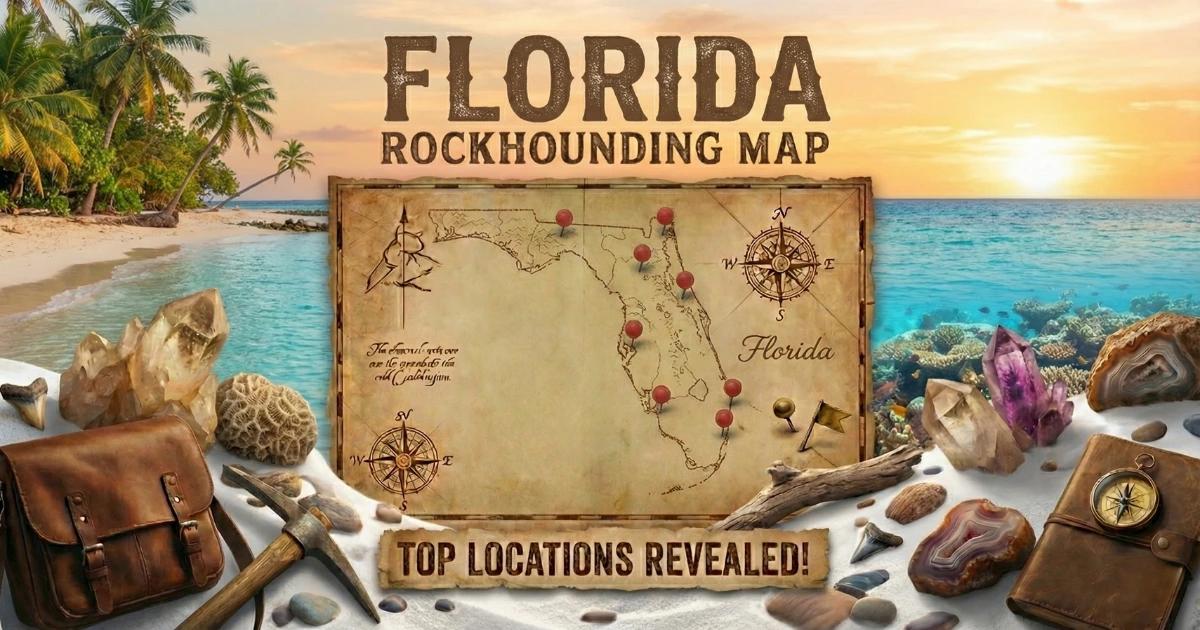
Florida Geology: A Sedimentary Platform, Not a Mountain State
Florida sits on a thick carbonate platform — hundreds of meters of limestone, dolostone, and sand deposited over the past 40-plus million years on what was once a shallow marine shelf. There is no igneous or metamorphic basement rock accessible at the surface anywhere in the state. The highest natural point, Britton Hill in the panhandle, tops out at 105 meters (345 feet). That means no pegmatites, no hydrothermal veins, no exposed granite plutons, and no hard-rock mineral deposits of the kind you would find in the Appalachians or the Rockies.
What Florida does have is a fossil record that rivals any state in the country. The Hawthorn Group (Miocene), the Peace River Formation (Miocene-Pliocene), and the Tamiami Formation (Pliocene) are loaded with vertebrate and invertebrate fossils. Silica replacement of Oligocene and Eocene corals created agatized coral — Florida's official state stone since 1979. Dissolution of the underlying Ocala Limestone produced karst features (sinkholes, springs, caves) and, in select pockets, calcite crystal-lined voids that function as Florida's version of geodes.
If you arrive in Florida expecting to dig quartz points or pan for gold, you will leave empty-handed. If you come prepared to work rivers, beaches, and mine spoil for fossils and silicified coral, you will fill buckets.
Top Collecting Locations
Each site below lists land status first, because that determines whether you can legally collect at all. GPS coordinates are approximate centroids — always confirm boundaries with the managing agency or landowner before you dig.
1. Venice Beach (Sarasota County) — Shark Teeth
Land status: Public beach. Free access. No permit required for surface collecting.
GPS: 27.0986, -82.4543
Vehicle: Any passenger car. Paid and free parking within walking distance of the beach.
Specimens: Fossilized shark teeth (bull shark, lemon shark, great white, tiger shark, occasional megalodon fragments), ray plates, fish vertebrae, fossil bone fragments.
Venice calls itself the "Shark Tooth Capital of the World," and the claim holds up. Teeth erode from Miocene and Pliocene deposits offshore and wash onto the beach with each tidal cycle and storm event. The best hunting is at low tide, particularly after strong west or southwest winds that churn the bottom sediment. Walk the waterline and scan the shell hash — teeth are black to dark brown, glossy, and triangular. Most are under 2 cm, but palm-sized teeth turn up several times a year.
Many collectors use a "Venice Beach shark tooth sifter" — a long-handled wire basket that you drag through shallow water. The sand passes through; teeth, shells, and fossils stay in the basket. Caspersen Beach, the southernmost stretch, is generally less crowded and produces well.
2. Peace River (Hardee and DeSoto Counties) — Megalodon Teeth, Mammoth Bones, Agatized Coral
Land status: Public access at designated launch points and county parks. Some stretches run through private ranch land — stay in the river channel below the ordinary high-water mark or obtain landowner permission.
GPS (Brownville Park launch): 27.4352, -81.8127
Vehicle: Any vehicle to the launch. A canoe or kayak is the standard way to cover river distance. Outfitters in Arcadia and Wauchula rent canoes and run shuttle service.
Specimens: Megalodon teeth (up to 6+ inches), smaller shark teeth, dugong ribs, mammoth and mastodon bone and tooth fragments, horse teeth, tapir jaw sections, turtle shell, agatized coral cobbles, fossil gastropods.
The Peace River cuts through the Bone Valley region — Miocene and Pliocene phosphate-rich sediments that have yielded one of the densest vertebrate fossil concentrations in North America. The collecting method is straightforward: wade into the river at gravel bars and riffles, scoop substrate with a shovel into a screen (1/4-inch hardware cloth on a frame), and sift. Heavy items — teeth, bone, dense coral — stay on the screen. Sand and silt wash through.
Water levels matter more than any other variable. Low water in spring (before summer rains) exposes gravel bars and concentrates fossils. After tropical storms or heavy rain events, the river scours new material from the banks. Both conditions produce good finds. Mid-summer high water makes sifting difficult and can be dangerous due to current.
A full megalodon tooth in good condition from the Peace River can be worth $50 to $500+ depending on size, root completeness, and enamel quality. Even fragments are worth keeping for display.
3. Rucks Pit (Okeechobee County) — Agatized Coral
Land status: Private property. Access varies — the pit has historically been open to collectors for a fee, but operational status changes. Call ahead or check with local clubs before driving out.
GPS: 27.1850, -80.9400 (Fort Drum area)
Vehicle: High-clearance truck or SUV recommended. Unpaved access roads can be soft after rain.
Specimens: Agatized coral (chalcedony/quartz-replaced colonial coral heads), calcite crystal-lined fossil clam shells ("geodes"), fossil echinoids, fossil gastropods.
Rucks Pit is the single most important locality for gem-grade agatized coral in Florida. The material comes from the Oligocene-age Ocala Limestone, exposed in a borrow pit originally dug for road fill. Coral heads replaced by chalcedony display radial patterns of the original coral polyp structure in colors ranging from white and gray to honey, red, and blue-black. The best pieces take a high polish and are cut into cabochons, bookends, and display slabs.
The same formation produces calcite crystal-lined voids inside fossil bivalve shells. These are small (fist-sized or smaller) but the calcite crystals are well-formed and clear to honey-colored. They are the closest thing Florida has to geodes.
4. Tampa Bay Area — Agatized Coral, Fossil Echinoids
Land status: Mixed. Ballast Point Park (public, City of Tampa). River and creek exposures may cross private land — verify before collecting. Phosphate mine spoil piles are private property; trespassing is prosecuted.
GPS (Ballast Point Park): 27.8880, -82.4830
Vehicle: Passenger car.
Specimens: Agatized coral pieces (tumbled by wave and river action), fossil echinoids (sea urchins), fossil shark teeth, fossil shells.
The Tampa Bay shoreline and tributary streams have produced agatized coral since collectors first worked the area in the early 1900s. Specimens wash out of Oligocene and Miocene formations and accumulate in gravel lags along the shore and in creek beds. The coral is typically smaller and more water-worn than Rucks Pit material but still polishes well. Ballast Point Park, on the south shore of the Interbay Peninsula, is the classic public-access spot. Low tide exposes gravel flats where coral fragments, echinoids, and occasional shark teeth concentrate.
Nearby, the Alafia River and Hillsborough River drainages cut through phosphate-bearing strata and produce similar material. Always confirm whether you are on public land or private mining property before collecting in these drainages.
5. Withlacoochee and Suwannee Rivers (Citrus, Levy, Suwannee Counties) — Agatized Coral, Fossils
Land status: Public access at state parks and designated river launches. Much of the surrounding land is in private or state timber ownership. Stay below the ordinary high-water mark or use designated public access points.
GPS (Suwannee River State Park): 30.3835, -83.1717
Vehicle: Passenger car to launches. Canoe or kayak for river access.
Specimens: Agatized coral, fossil echinoids, calcified bone fragments, chert nodules, occasional quartz-replaced fossils.
Both rivers cut through Eocene and Oligocene limestone, exposing fossil-bearing beds along their banks and in gravel bars. The Suwannee River, with its dark tannic water, is particularly productive in low-water periods when limestone shelves and gravel bars emerge. Agatized coral and chert cobbles accumulate on the downstream side of rock ledges. The Withlacoochee (the southern one — there are two Withlacoochee Rivers in Florida) drains through similar geology and produces comparable material.
These rivers are also popular paddling corridors, so combining a fossil hunt with a day of kayaking is a practical approach. Bring a dry bag for specimens.
6. Crystal River Area (Citrus County) — Fossils, Echinoids
Land status: Mixed public and private. Crystal River Preserve State Park allows hiking but check current collecting rules — state parks generally prohibit removal of natural materials. Creek banks outside park boundaries on public road rights-of-way or with landowner permission are options.
GPS (Crystal River area): 28.9023, -82.5926
Vehicle: Passenger car.
Specimens: Fossil echinoids, fossil bivalves and gastropods, occasional calcite crystal pockets in limestone exposures, chert.
The Crystal River area exposes Eocene Ocala Limestone at or near the surface. Road cuts, drainage ditches, and construction excavations periodically uncover fossil-rich beds. Echinoids (fossil sea urchins) are the signature find — well-preserved tests in white to cream limestone that weather free with minimal cleaning. Collecting from active construction sites requires permission from the contractor or property owner.
Specimens You Can Find in Florida
| Specimen | Type | Hardness (Mohs) | Where Found | Notes |
|---|---|---|---|---|
| Agatized coral | Chalcedony/quartz replacement | 6.5-7 | Rucks Pit, Tampa Bay, Peace River, Withlacoochee/Suwannee rivers | Florida state stone. Displays original coral polyp structure. Takes high polish. |
| Shark teeth (various species) | Fossil (phosphatic) | 5 | Venice Beach, Peace River, Tampa Bay shoreline | Miocene-Pliocene age. Black/brown color from mineral replacement. |
| Megalodon teeth | Fossil (phosphatic) | 5 | Peace River, offshore dredge spoil | Up to 6+ inches. Partial teeth and fragments more common than complete specimens. |
| Calcite crystals | Mineral | 3 | Rucks Pit (Fort Drum), Ocala Limestone exposures | Found lining fossil bivalve shells. Clear to honey-colored. Florida's "geodes." |
| Fossil echinoids | Fossil (calcite) | 3 | Crystal River area, Tampa Bay, Suwannee River | Well-preserved sea urchin tests in Ocala Limestone. |
| Mammoth/mastodon bone | Fossil (mineralized bone) | 3-4 | Peace River | Pleistocene megafauna. Dense, dark fragments. Often found with teeth. |
| Fossil horse teeth | Fossil | 5 | Peace River | Multiple extinct species. Distinctive flat grinding surface. |
| Chert/flint nodules | Siliceous sedimentary | 7 | Suwannee River, Withlacoochee River | Gray to tan. Weathered out of Ocala Limestone. Worked into tools by Paleo-Indians. |
| Fossil gastropods | Fossil (calcite/silica replaced) | 3-7 | Peace River, Tampa Bay, Rucks Pit | Turritella, Conus, and other genera. Some silicified to near-gem quality. |
Field Identification Tips
Agatized coral vs. regular limestone coral: Tap the specimen against a steel tool. Agatized coral (chalcedony, hardness 6.5-7) will scratch steel and produce a glassy ring. Unreplaced limestone coral (calcite, hardness 3) will not scratch steel and sounds dull. Agatized coral also feels heavier than limestone of the same size because silica is denser than calcite. When wet, agatized coral shows a slight waxy luster; limestone stays matte.
Shark teeth vs. bone fragments: Shark teeth have a smooth, glossy enameloid surface on at least one side. Bone fragments have a rough, porous texture with visible internal structure (cancellous bone). Teeth are typically triangular or blade-shaped with a defined root; bone is irregular. Both are dark brown to black from phosphate and mineral replacement, so color alone is not diagnostic.
Megalodon vs. other large shark teeth: Megalodon teeth (Otodus megalodon) are thick, heavy, and broadly triangular with fine serrations along both cutting edges. The root is wide and robust with a visible chevron-shaped division (bourlette) between root and crown. Great white shark teeth are thinner, lighter, and lack the heavy root mass. Side-by-side, the difference in heft is obvious even in fragments.
Calcite crystals vs. quartz: Calcite (hardness 3) can be scratched with a copper coin and fizzes vigorously with dilute hydrochloric acid (10% HCl). Quartz (hardness 7) scratches glass and does not react to acid. In Florida's "geodes," the crystal-lining mineral is almost always calcite, not quartz. Do not assume clear crystals in Florida are quartz — test them.
Fossil bone vs. rock: Touch the specimen to the tip of your tongue. Fossil bone is porous and will stick slightly due to capillary action. Rock will not. This is a reliable field test, though not everyone's favorite.
Recommended Tools
- Shark tooth sifter — Long-handled wire basket (Venice Beach style). Screen mesh around 1/4 inch. Available at shops in Venice or build your own from hardware cloth and PVC pipe.
- Sifting screen — For river work (Peace River, Suwannee). A 1/4-inch hardware cloth screen on a wooden or PVC frame, roughly 18 x 24 inches. Scoop gravel, submerge, shake, and pick through the concentrate.
- Flat-blade shovel or garden trowel — For digging into gravel bars and river substrate.
- 5-gallon bucket — For hauling substrate to the screen and carrying specimens out.
- Geology pick or rock hammer — For extracting specimens from limestone matrix at Rucks Pit or road cuts. A 22-oz Estwing or equivalent is adequate.
- Cold chisel set — For splitting limestone to expose crystal-lined voids.
- Safety glasses — Mandatory when hammering limestone. Calcite shrapnel is sharp.
- Knee pads or wading sandals — River collecting involves hours of kneeling or standing in water.
- Sunscreen (SPF 50+) and wide-brim hat — Florida sun is no joke, even in winter. Dehydration and sunburn end collecting days early.
- Waterproof bags or containers — For separating and protecting specimens during transport. Ziplock bags work for teeth; bubble wrap for coral and calcite.
- Dilute HCl (10%) in a dropper bottle — For field-testing calcite vs. quartz/chalcedony. Optional but useful at limestone sites.
- Hand lens (10x) — For examining tooth serrations, crystal faces, and coral polyp structure in the field.
Legal Notes
Florida's collecting rules are a patchwork. Know the land status before you dig.
- Public beaches (Venice Beach, etc.): Surface collecting of fossils and shells is legal. No permit needed. No motorized digging equipment. Stay above the dune line — dunes are protected habitat.
- State parks and preserves: Collecting of natural materials (rocks, fossils, shells, plants) is prohibited in Florida state parks unless a specific program allows it. Crystal River Preserve, Myakka River State Park, and similar areas are look-only. Fines apply.
- Rivers and navigable waterways: Florida law generally allows public use of navigable waterways below the ordinary high-water mark. You can wade, paddle, and collect in the river channel. Do not cross onto private banks without permission. The Peace River is navigable and public access is well-established at designated launches.
- Private land (Rucks Pit, phosphate mines, ranches): Written permission from the landowner is required. Some sites charge a fee. Trespassing on posted mining property is a criminal offense and actively enforced in the phosphate district.
- Federal land: Florida has very little BLM land. Ocala National Forest and Apalachicola National Forest allow some surface collecting of common specimens for personal use under USFS rules. Check with the local ranger district.
- Vertebrate fossils: Under Florida law (Chapter 267, F.S.), vertebrate fossils found on state-owned land belong to the state. If you find a significant vertebrate fossil (e.g., a complete megalodon tooth or mammoth skull) on state land, you are expected to report it to the Florida Museum of Natural History. On private land, fossils belong to the landowner.
- Underwater collecting: Fossil collecting in rivers by snorkeling or diving is legal in many Florida waterways, but specific rivers may have restrictions. The Florida Fish and Wildlife Conservation Commission (FWC) regulates activity in certain spring runs and manatee zones. Check before you dive.
The safest approach: confirm land ownership on the county property appraiser's website before your trip. If it is private, get permission in writing. If it is a state park, assume collecting is not allowed unless posted otherwise.
When to Go
Florida does not have the freeze-thaw cycles that limit rockhounding seasons in northern states. You can collect year-round. That said, conditions vary:
- October through April — Dry season. Lower river levels expose gravel bars on the Peace River and Suwannee River. Cooler temperatures (for Florida) make fieldwork less punishing. This is the prime collecting window for river work.
- June through September — Wet season. Afternoon thunderstorms are daily. Rivers run high and murky. Beach collecting is still viable, and post-storm surf can deposit fresh material. However, lightning is a serious hazard on open beaches and in open water.
- After tropical storms or hurricanes — Heavy wave action and flooding scour new fossils from offshore and riverbank deposits. Venice Beach and the Peace River both produce exceptional finds in the week following a significant storm event. Wait until conditions are safe before entering the water.
What Florida Does Not Have
To set expectations: Florida has no known deposits of gold, silver, copper, tourmaline, garnet, beryl, topaz, sapphire, ruby, or any of the hard-rock minerals and gemstones associated with igneous and metamorphic terrains. There are no geode beds comparable to those in Iowa, Indiana, or Kentucky. There are no agate beaches like those on Lake Superior. Quartz crystals do not occur in collectable form.
If someone offers to sell you "Florida gold" or "Florida amethyst," walk away. The state's collectible material is exclusively sedimentary and fossil-based: agatized coral, shark teeth, vertebrate fossils, calcite crystals, chert, and fossil shells. That material is genuinely good and, in the case of agatized coral and megalodon teeth, genuinely valuable. But it is a different kind of collecting than what you would do in North Carolina or Colorado.
Explore the Florida Rockhounding Map
For a complete view of collecting sites across the state — including GPS pins, land-status notes, and specimen types — visit our Florida rockhounding map.