
California's Geology: Why This State Produces Everything
California sits on one of the most geologically active margins on Earth. The collision and subduction of oceanic plates beneath the North American plate, followed by the transform motion along the San Andreas fault system, has compressed, heated, fractured, and reworked the crust here for hundreds of millions of years. The result is a state that contains nearly every major rock type — and an absurd range of collectible minerals.
Start in the Sierra Nevada batholith, a mass of granitic rock intruded during the Mesozoic as subduction drove magma upward through the crust. Those granites host gold-bearing quartz veins — the Mother Lode — that drew a quarter million people west during the 1849 rush. The same magmatic processes produced lithium-rich pegmatite dikes in San Diego County, and those pegmatites crystallized tourmaline, kunzite, morganite, and beryl in miarolitic cavities that gemologists still talk about.
Move west to the Coast Ranges. Here, slabs of oceanic crust — serpentinite, blueschist, eclogite — were scraped off the subducting Farallon plate and jammed against the continent in a chaotic melange called the Franciscan Complex. That serpentinite weathers into nephrite jade. The rare mineral benitoite (barium titanium silicate) crystallized in hydrothermally altered serpentinite in San Benito County, and it has never been found in gem quality anywhere else on the planet.
Go east into the Mojave and Colorado deserts. Tertiary and Quaternary volcanism left behind basalt flows, rhyolite domes, and obsidian. Silica-rich groundwater migrated through volcanic ash deposits and filled gas cavities with chalcedony, creating the geode beds of Imperial County. Evaporite basins in Death Valley concentrated borax and other unusual minerals. And scattered across the desert floor, wind-polished agates and jaspers sit waiting on BLM land where the nearest other human is miles away.
The northern coast adds another dimension. Wave action on beaches between Crescent City and Mendocino exposes agate, jasper, and petrified wood eroded from coastal bluffs. Each winter storm cycle drops fresh material.
No other state in the Lower 48 covers this much geological ground. Subduction zone minerals, batholith pegmatites, placer gold, volcanic obsidian, desert chalcedony, serpentinite jade — California has them all, and they are spread across public land, fee-dig operations, and beaches that anyone can walk.
Collecting Locations: GPS, Land Status, and Target Minerals
The following seven locations span the state from the Mexican border to the central coast to the northern desert. Each one is confirmed accessible for recreational collecting as of 2026, though you should always verify current conditions before driving out. Land status can change, gates get locked, and fee-dig operations adjust their hours seasonally.
1. Himalaya Mine — Mesa Grande, San Diego County
GPS: 33.1942° N, 116.7731° W
Land status: Private — fee-dig operation. Check High Desert Gems and Minerals or the mine's current operator for hours and pricing. Reservations are often required.
Target minerals: Gem tourmaline (pink, green, watermelon, bi-color), kunzite, morganite, lepidolite, cleavelandite, quartz, black tourmaline (schorl)
Geology: The Himalaya Mine works a series of lithium-bearing granitic pegmatite dikes that intruded into the Cretaceous-age gabbro of the Peninsular Ranges batholith. Gem pockets (miarolitic cavities) form where volatile-rich residual melt created open space for large crystals to grow. Collectors dig through mine dump material and screen it for tourmaline pencils and broken crystal fragments. Gem-quality pieces are uncommon but real — people pull them out every season. Expect to work hard, screen a lot of material, and get sunburned. The reward is that this is one of the few places in North America where you can personally dig world-class tourmaline.
2. Jade Cove — Big Sur, Monterey County
GPS: 35.8936° N, 121.4633° W
Land status: Los Padres National Forest land above the tide line; public tidelands below mean high tide. Collecting is legal below the mean high tide line only. Do not remove material from above the tide line or from the cliffs.
Target minerals: Nephrite jade (dark green to black), serpentinite, actinolite
Geology: Nephrite jade forms by the metasomatic alteration of serpentinite — essentially, calcium and magnesium-rich fluids convert serpentine minerals into dense, interlocking masses of tremolite-actinolite. The jade here erodes out of the Franciscan Complex serpentinite exposed in the coastal cliffs and is tumbled by wave action onto the beach. After winter storms, fresh boulders appear on the beach cobble. The jade ranges from near-black to a deep forest green. Lighter green specimens exist but are less common. Test hardness with a steel knife — nephrite will not scratch (Mohs 6-6.5). The best collecting windows follow major storm systems between November and March.
3. South Yuba River — Nevada County
GPS: 39.3183° N, 121.1883° W (Bridgeport area / South Yuba River State Park)
Land status: State park land and adjacent BLM/National Forest. Gold panning is permitted for recreational use in public waterways. No motorized equipment. No suction dredging (statewide moratorium). Sluice boxes are permitted in most locations — check current South Yuba River State Park regulations.
Target minerals: Placer gold (fine flake to small nuggets), quartz, magnetite, garnet
Geology: The South Yuba River cuts through the heart of the Mother Lode gold belt. Tertiary-age river gravels and modern alluvium both contain gold eroded from Jurassic-age gold-bearing quartz veins hosted in metamorphic rocks of the Calaveras and Shoo Fly complexes. Gold concentrates in bedrock cracks, behind large boulders, and in the inside bends of the river. Work the crevices. Bring a crevice tool and a classifier. The gold is fine but persistent — this river has been panned for 175 years and still produces. Fall, after the snowmelt recedes, is the most productive season.
4. Benitoite Mining Company Claim — San Benito County
GPS: 36.3723° N, 120.6093° W (approximate — access road is rough)
Land status: Private mining claim. Fee-dig operation when open; the mine has changed hands multiple times and access is intermittent. Contact the current claim holder well in advance to confirm dates. High-clearance 4WD required for the access road.
Target minerals: Benitoite (blue, California's state gem), neptunite (black, prismatic), joaquinite, natrolite
Geology: Benitoite is a barium titanium cyclosilicate (BaTiSi₃O₉) that crystallizes in the ditrigonal-dipyramidal class — making it the only gem mineral in that crystal class. It occurs in hydrothermally altered serpentinite within the Franciscan Complex. The host rock is a blueschist-facies metamorphic body, and benitoite formed from barium- and titanium-rich fluids circulating through fractures. Gem-quality benitoite has never been found at any other locality on Earth. Crystals fluoresce bright blue-white under shortwave UV light, which is the fastest field identification method. Even small specimens have significant collector value.
5. Hauser Geode Beds — Imperial County
GPS: 32.8600° N, 115.5200° W (approximate center of collecting area)
Land status: BLM (Bureau of Land Management) — open to recreational collecting under the BLM's casual collecting rules. No permit required. Limit of 25 pounds per day plus one piece, or 250 pounds per year. No commercial collecting without a permit.
Target minerals: Chalcedony-lined geodes, agate, quartz druzy, occasional amethyst, calcite
Geology: The Hauser Geode Beds sit in Tertiary volcanic ash and tuff deposits. Gas cavities in the original volcanic rock filled with silica-rich groundwater over millions of years, precipitating concentric layers of chalcedony and, in some cases, druzy quartz or microcrystalline agate. The geodes weather out of the soft tuff matrix and can be found loose on the surface or dug from the ash layer with hand tools. Size ranges from golf balls to footballs. Bring a rock hammer to crack test specimens in the field — roughly one in three or four geodes has a good interior. October through April is the only reasonable season; summer temperatures here exceed 115°F.
6. Obsidian Butte — Imperial County (Salton Sea area)
GPS: 33.1889° N, 115.6361° W
Land status: Mixed — some BLM, some state, some private. Verify current access. Portions near the Salton Sea are within wildlife refuge boundaries where collecting is prohibited. Stick to BLM-administered parcels.
Target minerals: Obsidian (black, some with sheen), pumice, perlite
Geology: Obsidian Butte is a Holocene-age rhyolitic volcanic dome — one of the youngest volcanic features in California. The obsidian here formed when silica-rich lava cooled too rapidly for crystals to form, producing volcanic glass. Some specimens show a silvery or golden sheen caused by aligned nano-scale inclusions of gas bubbles or mineral crystals. Pieces are scattered on the surface around the butte. Collecting is straightforward where access is legal, but the mixed land status requires careful attention to boundaries.
7. Lavic Jasper Site — San Bernardino County
GPS: 34.7500° N, 116.3167° W (Lavic Siding area, near Ludlow)
Land status: BLM — open to casual recreational collecting. Same 25-pound daily limit applies. Accessible from Interstate 40; the last stretch is a dirt road passable in 2WD when dry.
Target minerals: Lavic jasper (red, yellow, brown, green — often multi-colored), agate, chalcedony
Geology: The jasper here formed within and around Tertiary to Quaternary basalt flows in the Lavic Lake volcanic field. Silica-rich fluids percolated through fractures and vesicles in the basalt, depositing jasper in seams and nodules. Iron oxides produce the reds and yellows; trace chromium or nickel produces green tones. The material takes a strong polish and is popular with lapidary hobbyists. Pieces lie on the desert surface — walk slowly, scan the ground, and pick up anything with color. The best material is often partially buried and requires a little digging.
Minerals of California: Quick-Reference Table
| Mineral | Chemical Formula | Mohs Hardness | Primary Location(s) | Notes |
|---|---|---|---|---|
| Tourmaline (elbaite) | Na(Li,Al)₃Al₆(BO₃)₃Si₆O₁₈(OH)₄ | 7 - 7.5 | Pala / Mesa Grande, San Diego Co. | Pink, green, watermelon; pegmatite pockets |
| Nephrite jade | Ca₂(Mg,Fe)₅Si₈O₂₂(OH)₂ | 6 - 6.5 | Jade Cove, Monterey Co. | Dark green to black; beach cobble below tide line |
| Gold (native) | Au | 2.5 - 3 | South Yuba, American, Feather rivers | Fine flake to small nuggets; pan or sluice |
| Benitoite | BaTiSi₃O₉ | 6 - 6.5 | San Benito Co. (single locality) | California state gem; blue; fluoresces under SW UV |
| Kunzite (spodumene) | LiAlSi₂O₆ | 6.5 - 7 | Pala, San Diego Co. | Pink-violet; strongly pleochroic; pegmatite |
| Morganite (beryl) | Be₃Al₂Si₆O₁₈ | 7.5 - 8 | Pala / Mesa Grande, San Diego Co. | Pink beryl; pegmatite pockets |
| Chalcedony / agate | SiO₂ (microcrystalline) | 6.5 - 7 | Hauser Geode Beds, Lavic, desert washes | Geode linings, nodules, seam agate |
| Obsidian | SiO₂ (amorphous glass) | 5 - 5.5 | Obsidian Butte, Glass Mountain | Volcanic glass; black, sometimes with sheen |
| Jasper | SiO₂ (microcrystalline) | 6.5 - 7 | Lavic Siding, San Bernardino Co. | Red, yellow, green; takes strong polish |
| Borax | Na₂B₄O₇·10H₂O | 2 - 2.5 | Death Valley area | Evaporite mineral; historic mining district |
Field Identification: How to Know What You Have Found
You will not have an XRD unit in the field. What you will have is a hand lens, a streak plate, a steel knife, and your eyes. Here is how to sort the most common California finds without a lab.
Tourmaline vs. schorl vs. colored quartz: Tourmaline has a distinctive triangular cross-section when you look at a crystal end-on. It also has striations running parallel to the c-axis (the long axis of the crystal). Schorl (black tourmaline) is common in pegmatite dumps and looks similar to black hornblende, but hornblende cleaves and tourmaline fractures conchoidally. Pink tourmaline can resemble rose quartz at a glance, but tourmaline crystals are prismatic and elongated while rose quartz is massive (no crystal faces).
Nephrite jade vs. serpentinite: This is the hardest field call at Jade Cove. Both are green, both are dense. Nephrite is harder (6-6.5 Mohs) and will not scratch with a steel knife. Serpentinite is softer (3-4 Mohs) and will scratch easily. Nephrite also has a waxy luster on a fresh break, while serpentinite tends toward a greasy or soapy feel. If in doubt, scratch it. If the knife leaves a white line, it is serpentine, not jade.
Gold vs. pyrite vs. mica: Gold is soft (2.5 Mohs), heavy (specific gravity 19.3), malleable, and stays gold-colored when you crush it. Pyrite is hard (6-6.5), brittle, has a black streak, and shatters when struck. Mica flakes are thin, flexible, and have a silvery or brassy sheen but weigh nothing. If it flattens under a hammer, it might be gold. If it shatters, it is pyrite. If it floats out of your pan, it is mica.
Benitoite vs. sapphire vs. blue glass: In the field at the San Benito locality, carry a shortwave UV lamp. Benitoite fluoresces bright chalky blue-white under shortwave UV (254 nm). Sapphire does not fluoresce. Blue glass does not fluoresce. That UV response is diagnostic and saves guessing.
Geode vs. concretion: At the Hauser Beds, geodes are lighter than they look because they are hollow. Pick up a round rock and feel the weight. If it seems too light for its size, it is probably a geode. Tap it gently with a rock hammer — a hollow geode produces a slightly higher-pitched sound than a solid concretion. Concretions are heavy and solid throughout.
Obsidian vs. black chert vs. slag: Obsidian has a glassy luster and conchoidal fracture with sharp edges. It feels smooth. Black chert fractures conchoidally too but has a waxy rather than glassy luster and is opaque on thin edges. Slag (from old mining operations) often has vesicles (gas bubbles), irregular flow textures, and sometimes embedded metal. If it looks bubbly, it is slag.
Tools and Gear: What to Bring
California collecting spans beaches, river gravel bars, pegmatite mine dumps, and open desert. No single tool kit covers all of it. Here is what works for each environment.
Universal kit (bring everywhere):
- Rock hammer (pointed tip and flat head, 22 oz is a good general weight)
- Safety glasses — non-negotiable, especially when breaking geodes or hammering pegmatite
- Hand lens (10x loupe)
- Streak plate (unglazed porcelain tile)
- Steel pocket knife (for hardness testing)
- Cloth sample bags or egg cartons for wrapping specimens
- Sharpie marker and masking tape for labeling in the field
- Water — more than you think you need, especially in the desert
- Sunscreen, hat, long sleeves
Pegmatite fee-dig (Himalaya Mine):
- Classifying screens (1/4" and 1/8" mesh)
- Small garden trowel or hand rake
- Five-gallon bucket for screening material
- Spray bottle (helps spot color in dusty material)
- The mine typically provides some tools — check in advance
Beach jade collecting (Jade Cove):
- Sturdy boots with good ankle support — the trail down is steep and the cobble is uneven
- Daypack with padded compartment for heavy specimens
- Tide chart (printed or on your phone) — you must know the tide schedule
- No hammering on the cliffs; collect loose material only
Gold panning (rivers):
- 14" gold pan (steel or plastic, your preference)
- Classifier (1/4" mesh)
- Crevice tool set (picks, spoons, suction bulb)
- Snuffer bottle for picking up fine gold
- Small glass vials for storing gold
- Knee pads or a foam pad — you will be kneeling on river rock for hours
Desert geodes and jasper (Hauser Beds, Lavic):
- 3-pound crack hammer
- Cold chisels (1" and 3/4")
- Pry bar (18" or longer) for levering geodes out of tuff matrix
- Five-gallon bucket
- Extra water and electrolytes — no services anywhere near these sites
- Spare tire, tire repair kit, and a full-size jack — desert roads eat tires
- GPS or downloaded offline maps — cell service is nonexistent
Legal Framework for Collecting in California
California has a layered system of land management, and the rules for collecting differ sharply depending on who administers the ground you are standing on. Getting this wrong can mean fines, confiscation of your specimens, or worse. Take it seriously.
BLM land (Bureau of Land Management): Casual collecting of rocks, minerals, gemstones, and invertebrate fossils is permitted under 43 CFR 8365. The limit is 25 pounds per person per day, plus one piece, not to exceed 250 pounds per year. No commercial collecting without a permit. No explosives. No mechanized equipment for digging. Hand tools only. Stay on existing roads and trails. Some BLM areas have additional restrictions — check the specific field office for the area you plan to visit.
National Forest land (USFS): Recreational mineral collecting is generally permitted in National Forests under 36 CFR 228.62. Rules are similar to BLM — hand tools, reasonable quantities for personal use, no commercial activity without a permit. Some forests have specific closures or restrictions. Check with the local ranger district.
State parks: Collecting rocks, minerals, fossils, or any natural feature is prohibited in California state parks under the State Park and Recreation Commission regulations. This includes South Yuba River State Park for everything except gold panning, which is specifically allowed under a recreational gold panning exception in some park units. Verify with the specific park before you go.
National parks and monuments: All collecting is strictly prohibited in units of the National Park System. Do not collect anything in Death Valley National Park, Joshua Tree National Park, Pinnacles National Park, or any national monument. This includes loose surface material. The penalties are federal and they are enforced.
Private land and fee-dig operations: You need the landowner's written permission before collecting on private land. Fee-dig operations like the Himalaya Mine grant you that permission when you pay the entry fee, and they typically specify what you can keep and under what conditions. Read their rules.
Beaches and tidelands: Below the mean high tide line, California's beaches are public tidelands, and collecting small quantities of rocks and minerals is generally legal. Above the mean high tide line, land ownership varies — it may be state park, National Forest, private, or county-controlled. At Jade Cove, this distinction matters: collect jade below the tide line, leave everything above it alone.
Gold panning: Recreational gold panning (pan and sluice only, no motorized equipment) is legal on most public waterways in California. Suction dredging has been under a statewide moratorium since 2009, and as of 2026, that moratorium remains in effect. Check the California Department of Fish and Wildlife regulations for current status. Some rivers have seasonal closures for spawning fish.
Cultural and paleontological resources: Vertebrate fossils, archaeological artifacts, and cultural resources are protected under federal and state law on all public land. Leave them in place and report significant finds to the land managing agency. Taking arrowheads, pottery fragments, or vertebrate fossils from public land is illegal under the Archaeological Resources Protection Act (ARPA) and the Paleontological Resources Preservation Act (PRPA).
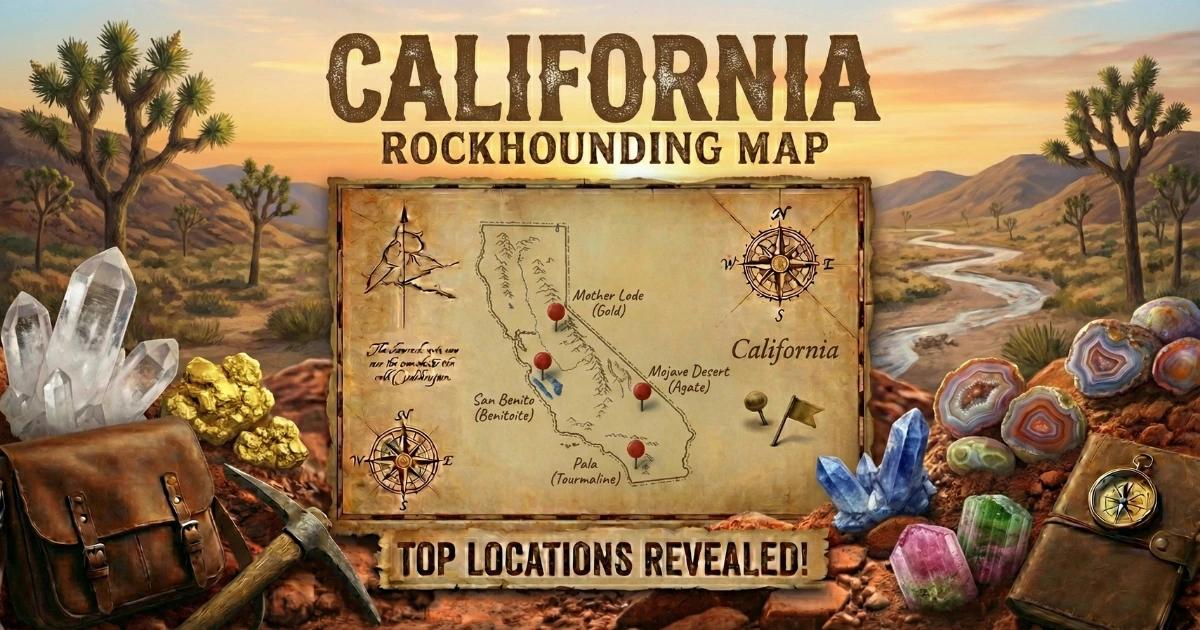
California Rockhounding Map
Use our interactive map to find collecting locations across California, including the sites described in this guide and dozens more. Each pin includes GPS coordinates, land status, target minerals, and access notes.
View the full California rockhounding map here.

California will not run out of ground to cover. The geology is too varied, the state is too large, and the mineral list is too long. Pick a region, check the land status, load your truck, and go find something. The rocks are not going anywhere — but the daylight is, so get moving.