

conglomerate
Mohs 4–7
rock · common
Field note. Rounded pebbles cemented in a matrix — nature's concrete (concrete fizzes, this may not).
Also called puddingstone, pudding stone, gravel rock.
Conglomerate and breccia: what rounded and angular pebbles mean
Rounded pebbles were worn by water or surf, and how far that takes depends on the rock: limestone rounds within a few kilometers, hard rock over tens of kilometers. Angular breccia barely moved, because it was broken by collapse, faulting or a rockfall.
Tap a rock to compare its pieces. Tap a number to name them.
- Breaks offA sharp chip of rock
- RollsWater wears its corners away
- BuriedSand glues the pebbles


Which rock’s pieces were rolled along by moving water?
Conglomerate: pebbles rounded by water
These pebbles are round because moving water rolled and bumped them until their corners wore away. Then sand filled the gaps and glued them into rock.
- Pieces
- Rounded pebbles
- Rounded by
- Rolling in a river or in the surf
- This rock
- Sharon Formation, Virginia Kendall Ledges, Ohio
How we know
Johnson, Affolter, Inkenbrandt and Mosher’s open textbook An Introduction to Geology defines conglomerate as rock of coarse, rounded pieces and breccia as rock of angular pieces. Rounding happens when abrasion during transport wears the corners off. More rounding means a longer time or distance of travel, or a more energetic process, and harder minerals round more slowly.
So there is no single distance. Szabó, Domokos, Grotzinger and Jerolmack (2015) found that taking an angular chip to a rounded pebble costs it roughly 10 to 20 percent of its mass. Limestone pebbles on the Dog Canyon alluvial fan lost about 15 percent over 2 km, while experiments show volcanic rock wearing about ten times slower. Using the same method, they estimated that rounded pebbles found on Mars by the Curiosity rover had traveled tens of kilometers.
The photographer, geologist James St. John, summarizes field-trip notes that the Sharon Formation is a 10 to 15 meter thick river deposit laid down by currents flowing from north to south, and that its gravel clasts are mostly spheroidal.
Sources, checked November 2026: Johnson et al., An Introduction to Geology, 5.3 Sedimentary rocks; Szabó et al. 2015, Reconstructing the transport history of pebbles on Mars, Nature Communications 6:8366; James St. John, photo notes on Wikimedia Commons.Collapse breccia: rock that caved in
These sharp-cornered blocks never traveled far. Salt dissolved deep underground, the rock above caved in, and the broken blocks were cemented back together.
- Pieces
- Sharp-cornered blocks
- Broken by
- Collapse into caverns where salt dissolved
- This rock
- Mackinac Breccia, near St. Ignace, Michigan
How we know
James St. John’s notes, citing Landes (1959), describe the Mackinac Breccia of Michigan’s Straits of Mackinac area as mostly a jumble of broken blocks of the St. Ignace Dolomite. It records many collapse events into old caverns left where salt and other evaporite layers of the Salina Group dissolved. He adds that this kind of collapse was widespread across Michigan and Ohio after the Silurian.
Johnson and co-authors note that both breccia and conglomerate are usually poorly sorted, with big and small pieces mixed together.
Sources, checked November 2026: James St. John, photo notes on Wikimedia Commons; Johnson et al., 5.3 Sedimentary rocks.Fault breccia: rock crushed by a fault
Here the rock broke along a fault, and one side slid past the other. The grinding smashed the rock in between into sharp pieces.
- Pieces
- Crushed, sharp fragments
- Broken by
- Rock sliding along a fault
- This rock
- Lake Vermilion Formation, near Peyla, Minnesota
How we know
James St. John notes that the fault in the middle of this outcrop has visibly offset the layers, and that it holds broken, pulverized and sheared pieces of the rock around it: a thin zone of fault breccia. Here the pieces were broken in place, not carried anywhere.
The layers are turbidites, alternating graywacke and shale laid down by underwater flows, later metamorphosed to metagraywacke and slate. St. John gives their age as 2.695 to 2.722 billion years.
Sources, checked November 2026: James St. John, photo notes on Wikimedia Commons.You find a rock full of sharp-cornered pieces. What does that tell you?
How to identify conglomerate
Drag it across the back of a ceramic tile. Conglomerate leaves a white or no streak.
A copper coin (3.5) does not mark it. A steel blade (5.5) marks it with effort, and it will not scratch glass.
Vinegar does nothing. Conglomerate is not a carbonate.
Conglomerate does not fluoresce under UV.
A drawing made from its color and luster.
Send photos so we can scan one →How hard is conglomerate?
Conglomerate is 4 to 7 on the Mohs scale. A copper coin (3.5) does not mark it. A steel blade (5.5) marks it with effort, and it will not scratch glass.
Mohs scale from 1, talc, to 10, diamond. A fingernail is 2.5, a copper coin 3.5, a steel knife 5.5 and a steel file 6.5.
- Mohs hardness
- 4–7A copper coin does not mark it; a steel blade marks it with effort.
- Streak
- white
- Color
- graybrowntanred
- Luster
- glassy
- Light
- opaque
- Fracture
- uneven
- In vinegar
- No reaction
- Magnetic
- No
Stones mistaken for conglomerate
fieldstoneGray or brown, hardness 3–7.Conglomerate is glassy; fieldstone is dull.river rockGray or brown, hardness 3–7.Conglomerate is glassy; river rock is dull.pea gravelGray or brown, hardness 3–7.Conglomerate is glassy; pea gravel is dull.beach pebbleGray or brown, hardness 3–7.Conglomerate is glassy; beach pebble is dull.How hard is conglomerate?
Conglomerate has a Mohs hardness of 4–7. A copper coin (3.5) does not mark it. A steel blade (5.5) marks it with effort, and it will not scratch glass.
What color is the streak of conglomerate?
Conglomerate leaves a white streak on an unglazed ceramic tile. The streak is the color of the powder and is more reliable than the color of the surface.
Does conglomerate react with vinegar?
Vinegar does nothing. Conglomerate is not a carbonate.
What is conglomerate confused with?
Fieldstone, river rock, pea gravel and beach pebble. Conglomerate is glassy; fieldstone is dull.
Conglomerate: the coarse-grained sedimentary rock

Composition: Variable; mainly quartz, feldspar and rock fragments held in a cemented matrix
Color: Various (Brown, Grey, Red, Green, Yellow)
Hardness: Strength depends on the cement; its quartz and chert clasts are 7 on the Mohs scale
Rock Type: Clastic sedimentary rock
Localities: United States, Canada, India, South Africa, Australia
Common Uses: Construction aggregate, decorative stone, fill material
Conglomerate is a clastic sedimentary rock composed of rounded clasts or fragments that are larger than 2 millimeters in diameter. These clasts, often made of quartz, chert, or other durable rocks, are cemented together by finer-grained sediment and natural mineral cement such as silica, calcite, or iron oxides. Conglomerate forms through the lithification of sediments that accumulate in environments with strong water currents, such as rivers, beaches, or alluvial fans.
Known for its varied appearance, conglomerate can be a mix of many different types of rock and mineral fragments, giving it a distinct texture and color. While it is not as commonly used in jewelry or fine decoration, conglomerate is often employed in construction due to its durability and availability.
Formation and Types of Conglomerate
Conglomerate forms in high-energy environments where rivers, waves, glaciers or debris flows move gravel and deposit large clasts. Wind cannot carry anything coarser than sand. Over time, these clasts become compacted and cemented together, creating the rock's characteristic structure. The size, composition, and source of the clasts can vary widely, leading to different types of conglomerate.
Key Types of Conglomerate:
1. Orthoconglomerate

This type of conglomerate has a well-cemented matrix, with a high proportion of clasts and minimal finer sediment between them. Orthoconglomerates are typically formed in high-energy environments such as rivers or beaches.
2. Paraconglomerate

Paraconglomerate contains more fine-grained matrix material than orthoconglomerate, meaning the clasts are not as densely packed. Most paraconglomerates are glacial tills (tillites) or the deposits of debris flows and mudflows, which dump gravel and mud together.
3. Polymict Conglomerate
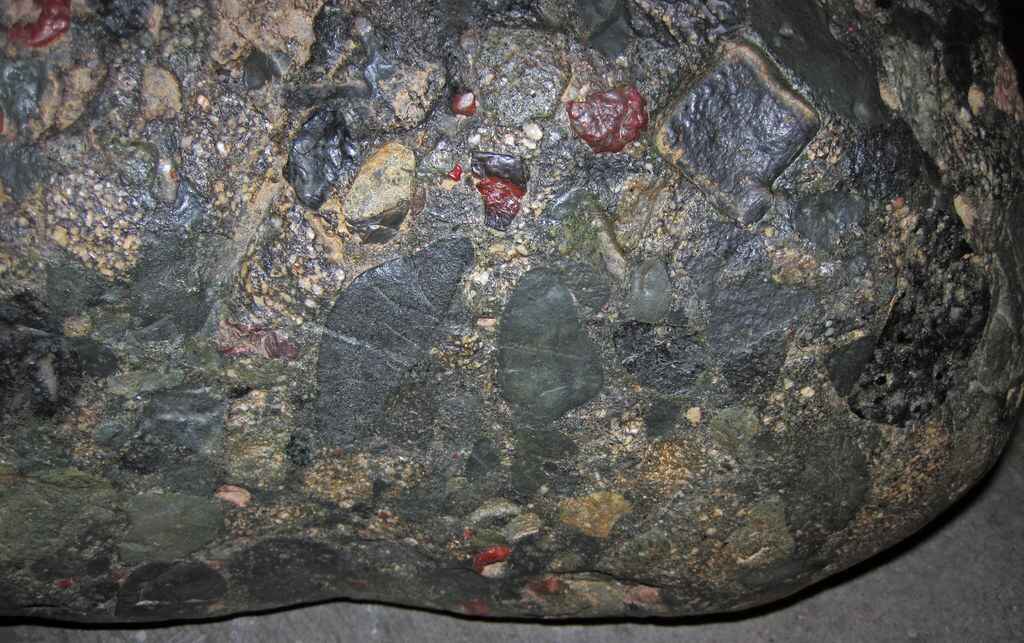
Polymict conglomerate consists of clasts from a variety of different rock types. This mainly shows that the source area held many rock types. Polymict conglomerates are often deposited near their source, before the weaker clasts break down.
4. Oligomict Conglomerate

Oligomict conglomerate is dominated by one or a few clast types, usually resistant materials such as quartz or chert that survive long transport and weathering. A conglomerate made of a single clast type is called monomict.
5. Intraformational Conglomerate

Intraformational conglomerate forms within a single depositional environment, typically from the reworking of sedimentary material within a basin. This type is common in shallow marine settings.
Structure and Properties of Conglomerate
Conglomerate's structure is defined by its clasts, which are bound together by a finer-grained matrix or cement. The large clasts are typically rounded by abrasion and collision as rivers or surf move them. The properties of conglomerate depend on the types of clasts and the nature of the matrix or cement holding the rock together.
- Hardness: Mohs hardness applies to minerals, not rocks. How tough conglomerate is depends mostly on its cement, while its quartz and chert clasts are 7 on the Mohs scale.
- Color: Conglomerate can appear in a wide range of colors, including brown, grey, red, green, and yellow. The color is influenced by the clasts and the cementing minerals, such as iron oxides, which give a reddish hue.
- Porosity: Conglomerate can have varying degrees of porosity, depending on how tightly packed the clasts are and the amount of matrix between them.
- Clast Size and Shape: Clasts in conglomerate are typically larger than 2 millimeters and are rounded, showing that rivers or waves wore them down during transport.
- Cementation: The matrix of a conglomerate can consist of finer sediments like sand or silt, and it is often cemented by minerals such as silica, calcite, or iron oxide.
Uses of Conglomerate

While conglomerate is not commonly used in fine construction or decoration, it serves important functions in more practical applications. Its durability and abundance make it suitable for several industrial and architectural purposes.
1. Construction Material
Conglomerate is used as a construction aggregate in the production of concrete and other building materials. Its large clasts and overall strength make it useful for foundational work.
- Aggregate and Fill Material: Conglomerate is crushed and used as aggregate for roads, railways, and construction foundations. Its natural strength and hardness contribute to the durability of structures.
- Riprap: In areas prone to erosion, conglomerate can be used as riprap, a layer of large stones placed along shorelines or riverbanks to protect against water erosion.
2. Decorative and Architectural Stone
Due to its unique appearance, conglomerate can sometimes be used decoratively in architecture and landscaping.
- Interior Design and Landscaping: Conglomerate slabs can be used in flooring or wall cladding, providing a rustic and natural aesthetic. Its mix of colors and textures makes it an attractive option for outdoor landscapes, such as garden paths and retaining walls.
- Monuments and Sculptures: In rare cases, conglomerate has been used in sculptures or monuments, particularly when the stone's variety of clasts and colors can enhance the artistic value of the piece.
3. Aquifers
Conglomerate, depending on its porosity, can act as an aquifer, storing groundwater in the spaces between clasts. This property makes it an important resource in regions where groundwater extraction is essential for agriculture and human consumption.
- Groundwater Storage: In areas with porous conglomerate, water can flow through the rock's matrix, making it a natural reservoir for groundwater, similar to sandstone.
Unusual Varieties of Conglomerate
Certain varieties of conglomerate are notable for their unique clasts or the environments in which they form, leading to special uses or geological interest.
1. Diamictite

Diamictite is any poorly sorted, matrix-supported rock with scattered clasts of many sizes, from fine sediment to large boulders. Many diamictites are lithified glacial till (tillite) and record past ice ages, but debris flows and submarine slumps form them too.
2. Puddingstone

Puddingstone is a type of conglomerate known for its smooth, rounded clasts embedded in a fine-grained matrix. It often has aesthetic appeal due to its contrasting colors and has been used decoratively and in jewelry.
3. Volcanic Conglomerate

Volcanic conglomerate forms near active volcanoes, where volcanic debris is mixed with clasts from other rock types. It provides clues to volcanic activity and the nature of the surrounding landscape.
Sourcing Locations of Conglomerate
Conglomerate deposits are found worldwide, particularly in regions where ancient rivers, glaciers, or coastal processes left behind thick layers of sediment. Some of the most famous conglomerate formations provide insights into past environments and climates.
- United States: The Fountain Formation, which forms the Flatirons at Boulder, Colorado, is a well-known sandstone and conglomerate shed from the Ancestral Rocky Mountains. The Piedmont region in the eastern United States also contains numerous conglomerate deposits.
- Canada: In British Columbia, conglomerate formations are widespread and are often mined for construction aggregate and decorative stone.
- India: Himalayan conglomerates are rich in quartzite and are often used in construction and as aggregate for roads and buildings.
- South Africa: Witwatersrand Conglomerates are famous for containing gold deposits and have been mined for over a century, providing significant economic value.
- Australia: The Bungle Bungle Range in Western Australia contains spectacular conglomerate formations that draw both geological interest and tourism.
Before you collect. Who owns the land decides whether you may take anything. BLM land and national forests allow small amounts for personal use, collected by hand. National parks and monuments allow none, most state parks allow none, and private land needs the owner’s permission. Active mining claims are off limits even on public land. The full rules.
Exploration and Mining of Conglomerate
The exploration and mining of conglomerate focus on regions where this rock is exposed or near the surface, often in river valleys, coastal areas, or mountainous regions. These rocks are commonly extracted for use in construction and other industries.
Exploration
Geologists identify conglomerate deposits through field mapping and subsurface geological surveys. Sedimentary basins, ancient riverbeds, and alluvial fans are typical locations where conglomerate is likely to be found. In some cases, conglomerate deposits can indicate the presence of valuable minerals, such as gold.
Mining Methods
Conglomerate is typically extracted through open-pit mining or quarrying, depending on the size and location of the deposit. The rock is then crushed or cut into the appropriate size for its intended use.
- Processing for Aggregate: Once extracted, conglomerate is crushed and sorted for use as aggregate in construction. Larger clasts are often used in foundation work, while smaller fragments are suitable for road building and other applications.
Processing
Conglomerate used for decorative purposes is often cut into slabs and polished, bringing out the texture and color contrasts in the rock. If conglomerate is used in construction, it is typically broken down into smaller fragments or used in its natural rough form.
In folklore
Some people see conglomerate, many rocks cemented into one, as a symbol of unity and strength, and believe it has a grounding effect. These are beliefs with no scientific basis.
Famous Finds and Conglomerate
Conglomerate formations can be found in many famous geologic landmarks and have played a significant role in our understanding of past environments and climate changes.
1. The Old Red Sandstone (United Kingdom)
The conglomerate layers within the Old Red Sandstone of Scotland and Wales provide evidence of ancient river systems that once flowed across the region during the Devonian period.
2. Witwatersrand Basin (South Africa)
The Witwatersrand conglomerates are famous for their rich gold deposits, which have made South Africa one of the world's leading gold producers. These conglomerates formed in ancient river systems over 2.7 billion years ago.
3. Fountain Formation (Colorado, USA)
The Pennsylvanian Fountain Formation, which forms the Flatirons above Boulder, Colorado, is an arkosic sandstone and conglomerate full of pink feldspar and granite debris eroded from the Ancestral Rocky Mountains.
Caring for Conglomerate
While durable, conglomerate requires proper care when used in decorative applications, particularly if it contains a matrix or cement that is prone to weathering.
- Cleaning: Use a mild detergent and water to clean conglomerate surfaces. Avoid abrasive cleaners that could damage the cementing material between clasts.
- Sealing: If used outdoors or in wet environments, conglomerate may benefit from a protective sealant to prevent water infiltration, which could weaken the matrix over time.
- Handling: When using conglomerate for decorative or architectural purposes, care should be taken to handle the rock gently, especially if the clasts are loosely cemented.
Conclusion
Conglomerate is a versatile and fascinating sedimentary rock, valued for its durability and unique appearance. Formed in high-energy environments like rivers and beaches, this rock offers valuable insight into ancient landscapes while also serving practical purposes in construction and architecture. Whether used as aggregate in concrete or as a decorative stone, conglomerate continues to be an important resource in both geology and industry.
Photographs of conglomerate
We have no 3D scan of conglomerate yet. If you own a good piece, send phone photos and we will build one, credited to you.